Category: Accounting
Strong sales and an empty bank balance usually mean one thing. Your business isn't controlling timing.
In Dubai, Abu Dhabi, Riyadh, and across the GCC, I see the same pattern again and again. The owner says revenue is fine. The projects are moving. The customers are active. But salaries, supplier payments, VAT obligations, and day-to-day commitments keep putting pressure on cash. The problem usually isn't revenue alone. The problem is weak control over payables and receivables.
If customers pay late, your receivables trap cash. If suppliers are paid with no discipline, your payables drain cash too early. If invoices are delayed, posted incorrectly, or disconnected from approvals, your reports lie to you. That's where businesses get into trouble. They make decisions using numbers that don't reflect operational reality.
This is why I treat accounts payable and accounts receivable as management disciplines, not bookkeeping tasks. They are the two engines that move cash through the business. One pulls money in. One pushes money out. If either side is unmanaged, your working capital suffers, your compliance risk rises, and your ERP becomes nothing more than an expensive data archive.
Modern systems matter here. A properly implemented ERP such as Hinawi ERP gives management one place to control invoicing, approvals, due dates, tax treatment, collections, and supplier obligations. That visibility changes how you run the business. It stops cash flow from being a surprise.
If you want better liquidity, stop treating payables and receivables as accounting terminology. Treat them as operating controls.
If you want to modernise how your business controls receivables, payables, approvals, and compliance across the UAE and GCC, speak with the Hinawi ERP team or visit Hinawi ERP for a personalised consultation.
Chat on WhatsApp +971506228024 Quotation – Demo RequestIntroduction The Twin Engines of Your Business Cash Flow
It is the 25th of the month. Payroll is close. A major customer still has not paid. Three supplier invoices are due. Your finance manager is checking spreadsheets from two branches, one set of invoices is in AED, another is in USD, and a VAT error on a customer invoice is holding up collection. That is how cash pressure starts in many UAE and GCC businesses. Not with a lack of sales, but with weak control over payables and receivables.
Payables and receivables sit at the center of that control. Receivables decide how fast cash comes in. Payables decide how carefully cash goes out. If either side is poorly managed, profit on paper will not protect your working capital.
The GCC adds another layer of difficulty. Finance teams here must handle VAT treatment, bilingual invoice requirements, growing e-invoicing expectations, multi-entity operations, and routine multi-currency transactions across suppliers and customers. A late invoice, a missing tax field, or an unapproved supplier bill quickly turns into a collection delay, a compliance risk, or both. If your business issues adjustments regularly, your team also needs clear rules for documents such as debit notes and credit notes in UAE accounting.
The test is simple.
Practical rule: If your finance team cannot tell you today which customers are overdue, which supplier invoices fall due this week, and which transactions still need VAT review, you do not have cash control. You have accounting records.
Disciplined businesses treat AP and AR as daily operating controls, not month-end reporting tasks. They invoice immediately after delivery. They enforce approval limits before any supplier payment is released. They monitor due dates by branch, entity, and currency. They reconcile cash activity fast enough to spot delays before they become problems.
In practical terms, an integrated ERP is highly significant. Hinawi ERP gives GCC businesses one system for invoicing, collections, supplier obligations, tax treatment, approvals, and entity-level visibility. That is the standard to aim for if you want tighter liquidity, fewer surprises, and finance operations that hold up under VAT and e-invoicing pressure.
Defining Accounts Payable and Accounts Receivable

Most businesses overcomplicate this. The definitions are simple.
Accounts receivable is the money your customers owe you after you've delivered goods or services and issued an invoice. It sits on the balance sheet as a current asset because it should turn into cash. Accounts payable is the money you owe suppliers after they've delivered goods or services to you. It sits on the balance sheet as a current liability because your business must settle it.
Think of cash flow as a tank
Receivables are the inflow side. Payables are the outflow side.
If receivables are slow, the tank doesn't refill fast enough. If payables are uncontrolled, the tank empties too quickly. If both are weak, the business looks profitable on paper and stressed in reality. That's a dangerous position, especially for contracting companies, traders, manufacturers, and property-related businesses with uneven collections and regular supplier commitments.
Here's the balance in plain terms:
| Function | What it represents | Balance sheet treatment | Cash flow effect |
|---|---|---|---|
| Accounts Receivable | Customer amounts owed to you | Current asset | Future cash inflow |
| Accounts Payable | Supplier amounts you owe | Current liability | Future cash outflow |
Why owners should care about both
Many owners focus only on collections. That's a mistake. Strong receivables with weak payables discipline still create cash strain. I've seen businesses chase customers aggressively while paying vendors early without checking receipt, pricing, or approval status. That destroys working capital.
You also need clean document handling. Debit notes, credit notes, and invoice adjustments must be controlled properly because they affect both customer balances and supplier balances. If your team still handles these inconsistently, review a practical explanation of debit notes and credit notes in ERP workflows.
Receivables tell you how much cash should come in. Payables tell you how much cash must go out. Management's job is to control the timing gap between the two.
The accounting point most businesses miss
Receivables are not “money received later”. They are recognised when earned. Payables are not “expenses paid later”. They are recognised when the obligation exists. That distinction matters because it affects reporting, forecasting, tax, and audit readiness.
If your business still relies on memory, Excel sheets, and WhatsApp approvals to track these balances, you're inviting disputes and reporting errors.
If your business is still relying on spreadsheets for invoice tracking, collections, or vendor payment approvals, visit Hinawi ERP or request a custom demo to see how integrated controls work in practice.
Chat on WhatsApp +971506228024 Quotation – Demo RequestMastering AP and AR Workflows and Internal Controls
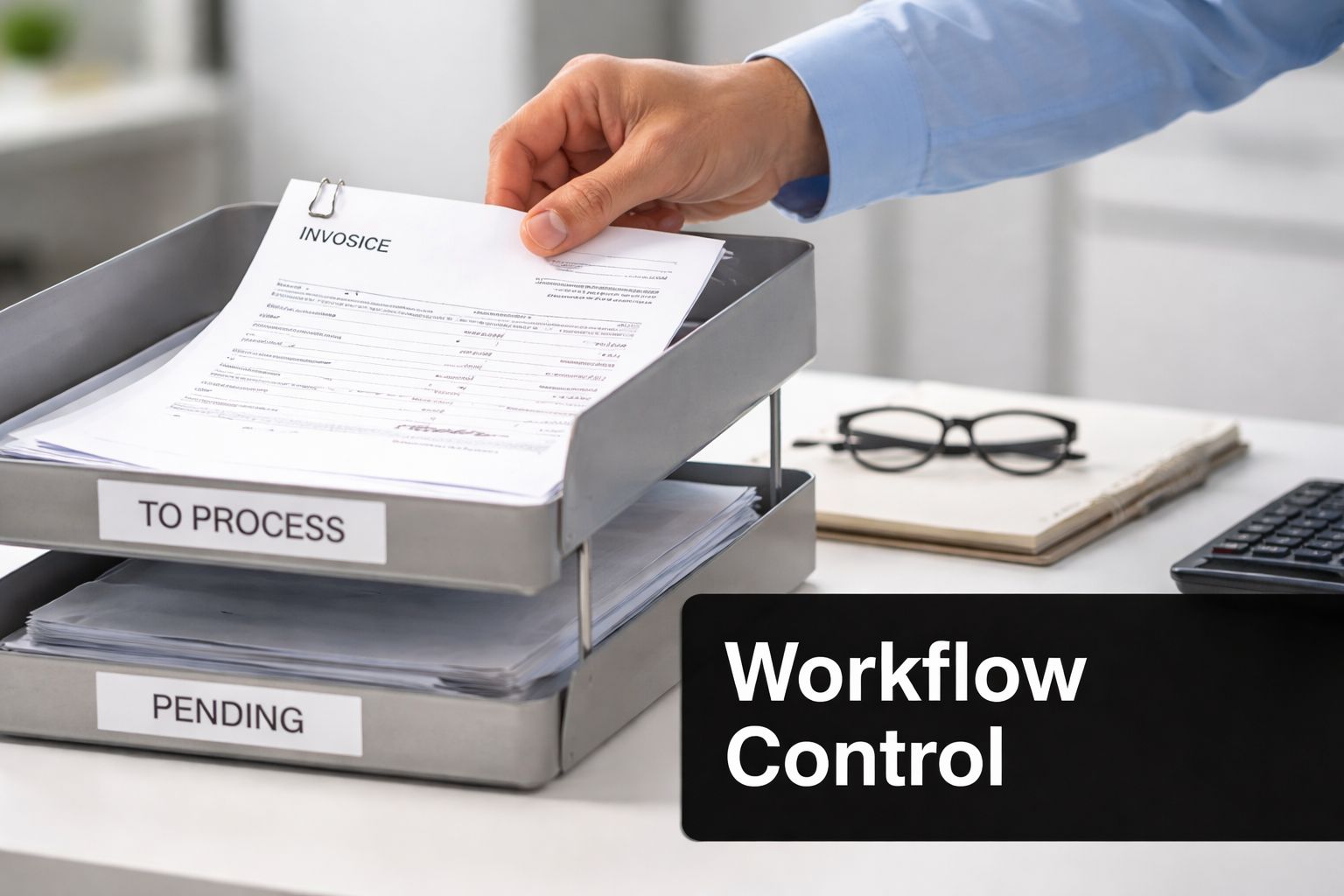
Processes matter more than intentions. A finance team can have experienced people and still lose control if the workflow is weak.
Payables need discipline before payment
On the AP side, the biggest control is three-way matching. That means the team matches the purchase order, the goods or service receipt, and the supplier invoice before recognising the liability and approving payment. This is the technical control point in AP automation, as explained in this overview of AP and AR controls.
That's not bureaucracy. That's protection.
A contracting company in Saudi Arabia might receive a supplier invoice for materials, but unless procurement raised the PO and the site confirmed receipt, finance shouldn't pay. If you skip that discipline, duplicate payments, overbilling, and disputes become normal.
What a sound AP workflow should include
Use this as a minimum standard:
- Purchase order approval before the supplier commits supply.
- Receipt confirmation by warehouse, site, or department.
- Invoice capture into the system with tax details.
- Three-way match before liability recognition.
- Approval routing based on amount, branch, or category.
- Scheduled payment run based on due date and cash position.
A business that pays from email attachments and verbal confirmations doesn't have AP control. It has risk.
For teams reviewing tools to tighten this process, a structured vendor invoice management workflow is usually the right starting point.
If the same employee can create a supplier, enter the invoice, and approve the payment, your control environment is weak.
Receivables need speed and follow-through
AR is not just sending invoices. It starts much earlier.
A proper order-to-cash cycle includes customer onboarding, credit review, invoice generation, due date tracking, collection follow-up, dispute handling, and receipt allocation. The businesses that collect well don't wait until invoices become old. They prevent delay before it starts.
Here are the controls I recommend:
- Credit review before supply: Don't let sales override finance on risky accounts.
- Invoice issue on time: Delayed invoicing delays collection.
- Clear payment terms: Ambiguous terms create predictable disputes.
- Collection ownership: Someone must own overdue follow-up by account.
- Dispute logging: If a customer challenges quantity, price, or tax, log it immediately and assign responsibility.
Manual gaps always become cash gaps
I've seen UAE traders ship goods, delay invoicing, then chase payment using incomplete statements. I've seen service firms approve supplier bills before confirming service delivery. Both are process failures, not accounting problems.
That's why integrated ERP controls matter. The system should link purchasing, inventory, projects, sales, and accounting. Otherwise, finance keeps reconciling issues that operations created.
Key Performance Indicators for Payables and Receivables

Cash flow problems usually show up in the numbers before they hit the bank account. If you are not tracking the right AP and AR indicators, your team will pay and collect based on noise, pressure, and habit instead of control.
Start with DSO and DPO.
Days Sales Outstanding shows how long customer cash stays tied up after a sale. Days Payable Outstanding shows how long you hold cash before paying suppliers. In a UAE or GCC business, both matter more than generic profitability metrics because VAT timing, invoice approval delays, and multi-currency balances can distort your real cash position if you only look at the P&L.
Use them with discipline:
- Rising DSO means collections are slowing, invoicing is delayed, or disputes are sitting unresolved.
- Rising DPO can support cash preservation, but it can also signal approval bottlenecks or supplier stress.
- Invoice processing time shows whether AP is operating with control or building a backlog.
- Collection effectiveness by customer tells you which accounts need credit tightening, not just reminder emails.
Ageing reports are the next control point. Many finance teams run them every month. Too few use them to drive action.
Your AR ageing should separate overdue invoices by customer, branch, salesperson, and dispute status. Your AP ageing should show due invoices, blocked invoices, and invoices pending approval or document matching. If you cannot drill down to the invoice level, the report is too weak to manage with. A clear financial report example for ERP reporting shows the level of visibility a finance team should expect.
Ask better questions. Which invoices are overdue, what is blocking payment or collection, and who is accountable for the next action?
One warning. A high DPO is not automatically a sign of strength.
A company can appear more cash-efficient because it is stretching suppliers beyond normal terms. That improves short-term liquidity on paper, but it can hide pressure in operations, damaged vendor relationships, and financing-like obligations sitting inside trade payables. This is especially relevant in the GCC, where extended supplier credit is common and group companies often trade across entities and currencies.
That is why KPI review should go beyond ratios. Review overdue buckets, disputed invoices, unapplied receipts, supplier concentration, foreign currency exposure, and payment terms by vendor class. If your ERP cannot show that clearly across UAE branches, GCC entities, VAT treatments, and invoice statuses, finance will spend month-end explaining balances instead of controlling them.
Hinawi ERP helps businesses in the region monitor these indicators inside one system, with AP ageing, AR ageing, approval status, tax impact, and branch-level visibility tied back to the underlying transaction. That is the standard you want.
Navigating GCC Compliance VAT E-Invoicing and Multi-Currency
Many generic articles on payables and receivables ignore the regional reality. That's a mistake. In the GCC, compliance is part of cash management.
Invoice timing is a legal and operational issue
In UAE accounting, AR should be managed on an accrual basis, where revenue is recognised when earned, not when cash is collected. In a UAE and GCC environment with VAT and e-invoicing requirements, the invoice is the legal trigger for revenue recognition and downstream collection control, so delays in posting invoices distort working capital, as explained in this AR and AP accounting guidance.
That means your team can't treat invoice posting as an admin task to finish later. The invoice date drives accounting, collections, and compliance.
VAT discipline must sit inside the workflow
A proper process should enforce:
- Correct tax coding: Every taxable sale and purchase must flow through the right VAT treatment.
- Timely invoice posting: Because delays distort both tax and cash forecasting.
- Document traceability: You need an audit trail for what was billed, approved, adjusted, and settled.
- Linked credit and debit adjustments: Tax impact must follow the original transaction cleanly.
This becomes even more important when the business has several entities, branches, or project locations. Manual workarounds create mismatches quickly.
For companies preparing for digital compliance changes, this practical overview of e-invoicing in the UAE is worth reviewing.
Late invoicing doesn't just delay collection. It can also distort tax reporting and management reporting at the same time.
Multi-currency adds pressure to both AP and AR
A trading company in the UAE may buy in one currency, sell in another, and settle through several banks. If the ERP doesn't handle open invoices cleanly by currency and entity, finance ends up reconciling manually. That introduces timing issues, settlement confusion, and reporting noise.
I'm not talking about theory. In practice, many finance teams lose hours every month. Supplier statements don't match. Customer allocations are unclear. Management gets a cash forecast that looks precise but isn't reliable.
A GCC business with foreign suppliers or export customers needs clear controls for:
| Area | Risk if unmanaged | Required control |
|---|---|---|
| Supplier invoices | Wrong liability values | Accurate invoice capture and review |
| Customer invoices | Distorted receivable values | Timely posting and clean allocation |
| Bank settlements | Unclear realised differences | Prompt reconciliation |
| Entity reporting | Group-level confusion | Standardised accounting policies |
This is why a localised ERP is no longer optional for serious operators in the region.
How ERP Automation Transforms AP and AR Management
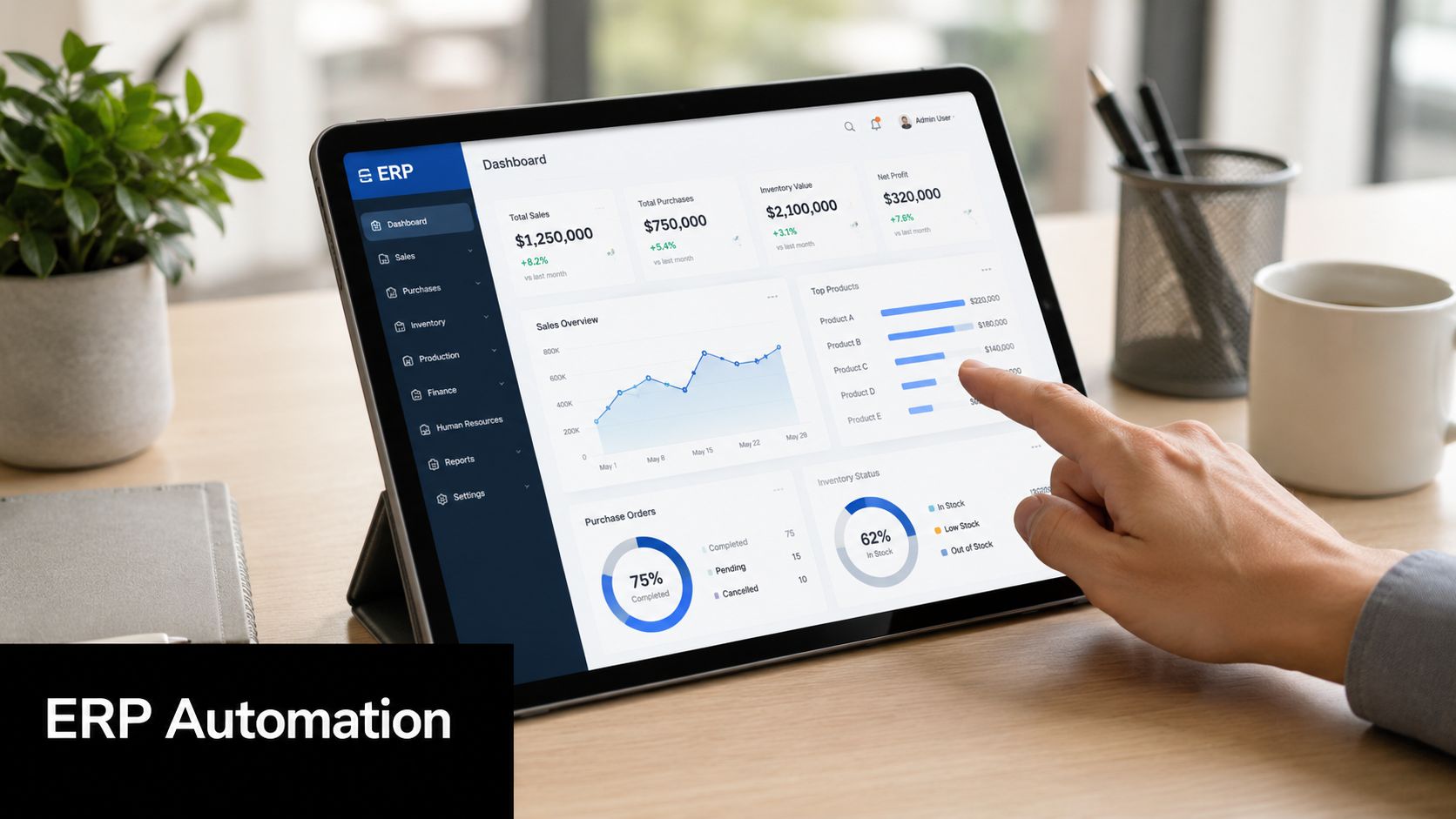
Manual finance teams spend too much time moving information and not enough time controlling it. That's why ERP automation changes the game.
Industry coverage notes that AP and AR are becoming strategic functions because technology affects approval speed, payment visibility, and collection efficiency. This is especially relevant for SMEs in the UAE and GCC, where recurring payment delays and multi-entity reconciliation challenges turn automation into a response to structural liquidity pressure, not just admin inefficiency. The wider late-payment issue is significant enough that SMEs face up to a $3 trillion late-payment drag globally, according to The Payments Association's analysis of SME payment pressure.
What automation should do in real operations
A decent ERP should automate the dull but critical parts of finance:
- Generate customer invoices from sales activity
- Route supplier invoices for approval
- Apply three-way matching before payment
- Send reminders for due and overdue receivables
- Track open balances by customer, vendor, branch, and entity
- Post accounting entries in real time across operations
That's what turns AP and AR into management tools.
One system is better than five disconnected tools
A UAE manufacturer, contractor, or trading business doesn't need more isolated apps. It needs one integrated flow from operational event to accounting result. Sales should create receivables. Purchasing should create payables. Inventory movements, service delivery, project billing, and payment allocation should all hit finance correctly and immediately.
That's where a system such as Hinawi ERP fits naturally. It handles accounting, receivables cycle management, payment cycle management, and real-time integration across broader business operations. For GCC firms dealing with VAT, bilingual workflows, and mixed business models, that integration matters far more than flashy dashboards.
Automation isn't about replacing people. It's about stopping skilled finance staff from wasting time on preventable errors.
My recommendation to business owners
If your team still relies on spreadsheets for AR follow-up, emails for AP approvals, and month-end reconciliation to discover mistakes, fix the operating model now. Don't wait for a VAT review, supplier dispute, or payroll pressure to expose the weakness.
Choose an ERP that supports how GCC businesses operate. That means bilingual use, VAT compliance, e-invoicing readiness, configurable approvals, and real accounting integration across departments.
If you want to see how an integrated ERP can automate supplier approvals, customer invoicing, VAT compliance, and real-time accounting for your UAE or GCC business, visit Hinawi ERP or request a personalised demo.
Chat on WhatsApp +971506228024 Quotation – Demo RequestTake the Next Step with Hinawi ERP
If your business operates in the UAE or GCC, manual finance control is holding you back. The answer isn't another spreadsheet, another reminder from finance, or another disconnected approval process. The answer is an integrated system that connects operations, accounting, compliance, and management visibility.
Hinawi ERP UAE is a fully integrated ERP software platform developed in Abu Dhabi since 1998. It supports Accounting, HR & Payroll, Real Estate Management, Fixed Assets, Manufacturing, Garage & Maintenance, School Management, CRM, and full business automation in one environment.
For companies in the UAE and GCC, that matters because the system is built around real operating needs in the region:
- VAT and e-Invoicing compliance
- UAE WPS payroll support
- Arabic and English bilingual operation
- Flexible company policy settings
- Real-time accounting integration across all modules
- Practical fit for factories, contractors, schools, real estate companies, garages, traders, and manufacturers
If you want tighter control over payables and receivables, cleaner financial reporting, less manual work, and stronger management visibility, this is the right time to modernise. Visit www.hinawierp.com or request a personalised demo and speak with the Hinawi ERP team about your business requirements in the UAE or GCC.
Explorer Computer LLC offers Hinawi Software ERP for companies that need integrated control over accounting, HR, payroll, real estate, manufacturing, maintenance, school operations, CRM, and business automation across the UAE and GCC.