
Category: Accounting
A supplier has already delivered the materials. Your team has already booked the invoice. Then someone spots the problem. The quantity was wrong, the rate was wrong, the goods were damaged, or a discount agreed over WhatsApp never made it into the final bill. That’s where many UAE businesses create bigger problems than the original mistake.
They issue an informal adjustment, edit the invoice outside process, or record a manual journal entry with no proper document trail. That approach is sloppy. It creates VAT risk, weakens your audit file, and confuses both receivables and payables. If you run a trading company, contracting business, manufacturing operation, or multi-branch group, you need a clean adjustment process. That means using the right document at the right time: debit note or credit note.
This matters more than many owners realise. In practice, post-invoice corrections are routine, not rare. In India’s GST framework during 2024-25, over 70% of return cases involve credit notes, which shows how common these adjustment documents are in day-to-day operations, as noted in this GST credit note reference. The GCC tax environment has its own rules, but the operational lesson is universal. Businesses need disciplined control over transaction adjustments.
I’ve seen the same pattern across Abu Dhabi, Dubai, Riyadh, and other GCC markets. The companies with clean debit note credit note workflows close faster, argue less with customers and suppliers, and survive VAT reviews with far fewer surprises. The companies that still manage adjustments through email chains and spreadsheets usually discover the damage at month-end.
If your invoicing process starts with estimates or advance billing, your adjustment workflow also needs to stay linked to source documents such as a pro forma invoice sample used in ERP-led billing controls.
Chat on WhatsApp +971506228024 Quotation – Demo RequestIntroduction The Need for Transaction Adjustments
A contracting company in Abu Dhabi orders specialised fittings for a project. The goods arrive, but a portion doesn’t match the approved specification. The supplier has already issued the invoice. The site team wants a replacement, the accounts team wants to hold payment, and the VAT treatment now needs to stay aligned with whatever commercial correction is made.
A Dubai trading business faces a different problem. It invoices a customer on bulk pricing, then discovers a rate mismatch after dispatch. The original invoice exists, stock has moved, and the customer ledger is already open. If someone edits numbers in Excel, the business loses control over the transaction history.
That’s why debit notes and credit notes exist. They are not admin paperwork. They are controlled adjustment documents used after an invoice has already been raised. They preserve the original invoice and record the correction properly.
Why owners should care
Business owners often leave this to accountants. That’s a mistake. If your team uses the wrong note, three things go wrong quickly:
- Cash flow gets distorted because collections and payments no longer match the customer or supplier statement.
- VAT reporting becomes exposed because the adjustment may not be linked clearly to the original taxable supply.
- Operational disputes drag on because neither side has one accepted document trail.
Practical rule: Never correct a posted invoice by “just changing the amount” outside your accounting process. Issue the proper adjustment note and keep the original record intact.
Manual handling is where the real trouble starts
Most debit note credit note problems are not conceptual. They’re procedural. Teams know a correction is needed, but they don’t know who should issue it, which ledger should move, or what tax information has to follow the adjustment.
That’s exactly where ERP discipline matters. A proper system doesn’t just print a note. It links the note to the original invoice, updates receivables or payables, posts the accounting entry, and keeps the tax trail organised. Hinawi ERP is often used in this context because the adjustment sits inside the same financial workflow as invoicing, inventory, and VAT reporting, instead of floating around in disconnected files.
Debit Note vs Credit Note The Core Differences
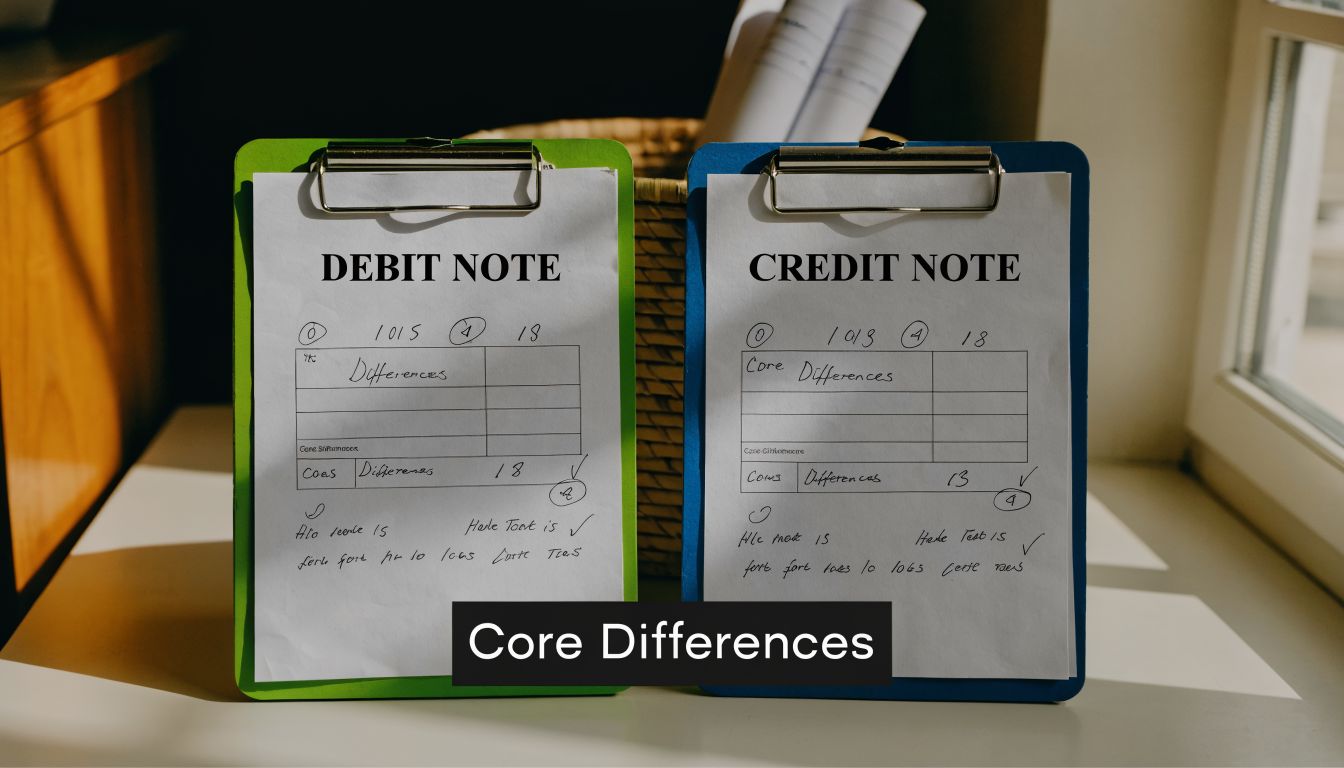
A debit note and a credit note do opposite jobs. If your staff treats them as interchangeable, receivables, payables, and VAT adjustments stop matching the commercial reality of the transaction.
A credit note reduces the value of an invoice that has already been issued. The seller uses it when the customer was overbilled, goods were returned, quantities were short, prices were wrong, or a discount was approved after invoicing. In accounting terms, the seller reduces the customer balance and the related revenue or tax amount. The buyer records the matching reduction in payable or purchase value.
A debit note increases the amount to be settled, or serves as a formal claim for adjustment depending on the transaction flow. In supplier and customer operations, this usually appears in two forms. The seller issues a debit note to recover an undercharge after invoicing, or the buyer sends a debit note to notify the supplier of a return, shortage, or claim that requires the supplier to respond. Your process must define which model your business follows. Do not leave this to staff interpretation.
The cleanest way to separate the two is to look at the invoice value after adjustment.
- Credit note: the approved amount goes down.
- Debit note: the approved amount goes up, or the buyer formally raises an adjustment claim.
That distinction matters because tax authorities do not care about your internal shorthand. They care whether the adjustment document clearly supports the change to the original taxable supply. In the UAE, a tax credit note and tax debit note are not casual memos. They are part of the VAT record trail and must tie back to the original invoice correctly. The same discipline matters across GCC businesses handling e-invoicing and structured audit requirements.
One more point. A debit note is usually the document teams get wrong because they treat every correction as a reduction. That creates avoidable errors in margin analysis and supplier reconciliation. If the original invoice was too low, issue an upward adjustment through the proper debit note workflow instead of editing the posted invoice or adding an unrelated line later.
If your finance team imports sales and purchase transactions from multiple channels, keep the adjustment linked to the source document from the start. Hinawi ERP handles this far better when the note is created inside the same transaction chain used for cash and credit invoice imports into accounting workflows, rather than being entered as a disconnected manual correction.
Chat on WhatsApp +971506228024 Quotation – Demo RequestCredit notes reduce a posted invoice. Debit notes increase it, or document a formal claim that requires that increase or correction to be processed.
When to Issue Each Note Practical Business Scenarios
A common UAE finance problem looks like this. The invoice is already posted, the customer disputes part of it, operations confirms a delivery issue, and someone in accounts asks whether to edit the invoice, issue a credit note, or raise a debit note. Make that decision by asking what changed in the transaction after the original invoice, and whether the amount must go down or up in a way that can be defended commercially and for VAT.
Use a credit note when you need to reduce a posted sale or purchase. Use a debit note when you need to document an upward adjustment or a formal claim, based on how your business and supplier process these cases. In Hinawi ERP, that decision should be tied to the original invoice and approval trail, not handled as a disconnected manual correction.
Issue a credit note in these cases
- Returned damaged goods. The customer returns part of the shipment because the goods arrived damaged, expired, or unusable. Issue a credit note against the original invoice for the accepted return quantity.
- Post-invoice discount approval. Sales approves a discount after the invoice was sent and posted. Issue a credit note for the approved reduction instead of changing the original invoice.
- Overcharge correction. The invoice includes the wrong price, duplicate lines, or higher quantities than were delivered. Fix it with a credit note.
- Partial service failure. You billed for a service that was only partly delivered, such as maintenance visits not completed or facilities charges applied in error. Issue a credit note for the unsupported portion.
Issue a debit note in these cases
- Underbilling after invoice. Freight, handling, variation work, or approved extras were missed from the original invoice. Raise a debit note if your contract terms and tax treatment allow that method.
- Buyer’s formal claim to supplier. The buyer sends a document to the supplier requesting compensation or adjustment for unsuitable goods, shortages, or quality issues. In many B2B workflows, the buyer issues a debit note first, and the supplier then responds with a corresponding credit note if accepted.
- Approved scope increase. A contractor or service provider completes additional approved work after the first invoice. If you need to increase the amount without cancelling and reissuing the original invoice, a debit note is often the cleanest document.
Scenarios that need caution
Commercial agreement alone is not enough. Tax treatment must match the underlying event, the supporting documents, and the timing of the adjustment. If goods were not returned, services were only renegotiated, or the dispute is still unresolved, your finance team should check the VAT effect before posting the note as a tax adjustment.
This matters in property, contracting, wholesale, and cross-border GCC trade. UAE businesses must align the note with FTA documentation rules, and Saudi-linked flows must also consider ZATCA e-invoicing requirements where applicable. The document type, reference to the original invoice, and reason code all need to be controlled inside the ERP, not left to email approvals and spreadsheet trackers.
Manual handling causes the most significant trouble. Teams issue the right commercial document but fail to attach the return record, discount approval, supplier claim, or customer correspondence. Hinawi ERP should be configured so users select a reason, link the source invoice, attach evidence, and route the note for approval before posting.
Review note activity every month. If repeated debit and credit notes are hitting the same customer, warehouse, branch, or sales team, the issue is operational. Track that pattern against your profit and loss statement and management reporting so finance can identify whether the problem starts in pricing, dispatch, contract scope control, or billing discipline.
Ask one question first. Did the original invoice need to be reduced, or did a valid later event increase the amount due?
The Accounting Impact Journal Entries Explained
Debit notes and credit notes post directly into the ledger. If your team treats them as paperwork instead of accounting events, receivables, payables, revenue, expenses, inventory, and VAT will drift out of line.
The correct entry depends on one point. Are you reversing part of the original transaction, or are you adding a valid extra charge after the original invoice?
Seller’s credit note for goods return
A seller’s credit note usually reduces the customer balance and reverses the income already recorded. In a goods return case, finance should also confirm whether inventory is coming back into stock and whether the VAT amount must be reversed based on the original invoice treatment and supporting return documentation.
Journal Entries for a Seller's Credit Note (Goods Return)
| Account | Debit | Credit |
|---|---|---|
| Sales Returns | Amount of goods returned excluding VAT | |
| VAT Payable | VAT portion being reversed | |
| Accounts Receivable | Total credit note amount |
This structure keeps the audit trail clear. You can see the commercial reversal, the VAT effect, and the exact reduction in the customer’s outstanding balance.
If stock is physically returned, add the inventory-side entry based on your costing method. If stock is not returned and the note relates only to a price reduction or service adjustment, do not force an inventory movement into the journal.
Buyer’s side of the same transaction
The buyer records the opposite accounting effect. Accounts payable comes down, and the offset goes to purchase returns, inventory, or the original expense account depending on how the supplier invoice was posted.
Typical buyer-side treatment includes:
- Reducing Accounts Payable
- Crediting purchase return, inventory, or expense reversal accounts
- Adjusting input VAT if the tax treatment requires it
Keep this controlled inside the ERP. Freehand journals create avoidable errors, especially where one team posts the supplier note and another team updates stock or tax separately.
Debit note accounting needs tighter control
A debit note increases the value of the transaction. That may happen because of an underbilled quantity, a contractually valid extra charge, a pricing correction, or a supplier claim accepted after the invoice date.
On the seller’s books, the entry usually increases Accounts Receivable and increases revenue or a designated charge account. On the buyer’s books, it increases Accounts Payable and increases the related expense, asset, or inventory value. The exact account matters. Posting every debit note into revenue or overheads is lazy accounting and produces weak margin analysis.
In Hinawi ERP, set debit and credit notes to inherit the source invoice, item lines, tax code, branch, cost center, and approval route. That gives you ledger accuracy and a defensible audit trail from document to posting. If your team still relies on manual journals, review the posting logic against this UAE journal entries reference and posting control guide.
Chat on WhatsApp +971506228024 Quotation – Demo RequestVAT and E-invoicing Compliance in UAE & GCC

Your sales team grants a post-sale discount. Finance issues a credit note. The customer accepts it. Then the FTA or ZATCA asks a simple question: where is the link to the original tax invoice, and does the VAT adjustment match it? If your answer depends on email trails or Excel files, your control has already failed.
Debit and credit notes are tax documents, not just accounting corrections. In the UAE and Saudi Arabia, they must be structured so the authority can trace the adjustment back to the original transaction, the tax treatment, and the commercial reason.
What a compliant note must show
For VAT purposes, every debit note or credit note should include:
- A clear reference to the original invoice
- The date of the adjustment
- The reason for the adjustment
- The adjusted taxable amount
- The VAT amount and tax treatment for that adjustment
- The legal identity of both parties
- A document number that fits your sequence and audit trail
Miss one of these, and you create avoidable audit risk.
Saudi Arabia demands stricter document discipline
Saudi businesses operating under ZATCA rules need tighter formatting and stronger traceability, especially where e-invoicing controls apply. A credit note that reduces consideration and a debit note that increases it cannot be treated as interchangeable internal forms. The tax effect must follow the document type, the original invoice reference, and the reason for issue.
That matters to UAE groups with KSA branches, subsidiaries, or shared-service finance teams. Do not run one generic GCC template and hope finance will “adjust it later.” Set separate document rules by country inside the ERP.
UAE businesses should focus on linkage, timing, and tax logic
In the UAE, the core discipline is straightforward. Link every note to the original invoice, carry the correct VAT code, and post it in the right tax period. If your team creates free-text notes outside the system, you increase the chance of mismatched VAT reporting, duplicate adjustments, and unsupported recoveries.
Reverse charge scenarios, branch transactions, and intra-GCC flows need extra care because the VAT treatment depends on the nature of the supply and the legal setup, not just the commercial intent. Do not rely on informal summaries or copied templates for this. Base your configuration on the actual UAE tax rules and keep your ERP aligned with your wider UAE tax setup and compliance configuration.
Timing matters too. A commercial concession does not automatically mean the VAT position changes in the same way or in the same period. Real estate, contract billing, and cross-border trading businesses should review note dates, supply dates, and supporting approvals before posting the adjustment.
My recommendation is simple. Make debit and credit notes system-controlled documents inside Hinawi ERP, with mandatory invoice linkage, locked tax codes, approval by value, and country-specific formats for UAE and KSA. That is how you protect both VAT compliance and financial accuracy.
Managing Notes in Hinawi ERP A Practical Workflow

A system should remove ambiguity. If your staff still create notes in Word or Excel and then ask finance to “adjust it in the books”, your process is broken. Debit note credit note control belongs inside the ERP.
A practical workflow that works
In Hinawi ERP, the disciplined approach is simple and should be enforced as policy:
- Open the original invoice first. The adjustment should begin from the existing sales or purchase transaction, not from a blank note screen.
- Select the correct adjustment type. Choose credit note when reducing the amount. Choose debit note when increasing the amount or following the approved buyer-side claim flow.
- Enter the reason clearly. Damaged goods, pricing correction, discount, short supply, freight correction, branch transfer adjustment. Be specific.
- Review item lines and VAT treatment. Don’t let staff issue a lump-sum adjustment unless policy explicitly allows it.
- Submit for approval. Commercial teams can initiate. Finance must validate. Larger values should require higher approval.
- Post the note. The system should update receivables or payables, post the journal entry, and feed the tax report.
- Keep the audit trail intact. Attach supporting documents, correspondence, and return acknowledgements where relevant.
Why ERP linkage is no longer optional
The verified brief states that a 2025 UAE MoF survey found 42% of trading SMEs misreport payables through unlinked credit and debit notes, which is exactly the kind of failure an integrated ERP is supposed to prevent. The answer is not more manual checking. The answer is system-enforced linkage between the note and the original invoice.
That’s where one practical option in the market, Explorer Computer LLC – Hinawi Software ERP, fits well for UAE and GCC businesses. It keeps accounting, VAT handling, inventory, real estate billing, and operational modules connected in real time, so a posted adjustment doesn’t sit outside the ledger or branch reporting process.
My implementation advice
If you own the business, set these rules:
- Ban standalone notes unless finance creates them through approved ERP controls.
- Require invoice reference on every note. No exceptions.
- Make VAT fields mandatory wherever tax applies.
- Separate initiation from approval so sales, procurement, and finance don’t override each other.
- Review note trends monthly. A high volume of pricing corrections usually means a process problem upstream.
Good ERP workflow doesn’t just speed up note creation. It stops weak documentation, broken tax treatment, and ledger mismatches before they happen.
Take the Next Step with Hinawi ERP
Debit notes and credit notes look small on paper. They are not small in business impact. They affect customer balances, supplier statements, revenue, expenses, VAT, and audit readiness. If your team handles them casually, your financial reporting will never be as reliable as you think it is.
Most UAE and GCC businesses don’t need more accounting effort. They need better process control. That means one system where invoice creation, approval, adjustment, tax treatment, and reporting all stay connected. It also means your finance team should stop relying on disconnected spreadsheets, informal email approvals, and manual journal corrections.
Hinawi ERP gives businesses that control in a practical, operational way. Developed since 1998 in Abu Dhabi, it is a fully integrated ERP software platform supporting Accounting, HR & Payroll, Real Estate Management, Fixed Assets, Manufacturing, Garage & Maintenance, School Management, CRM, and complete business automation. For companies managing debit note credit note workflows, that integration matters because the correction doesn’t remain isolated inside accounts. It flows through the wider business record.
Why this matters for UAE and GCC companies
- VAT and e-Invoicing compliance helps businesses maintain proper adjustment records for tax reporting.
- UAE WPS payroll support means HR and payroll operations can run within the same business platform.
- Arabic and English bilingual operation supports regional teams without forcing parallel systems.
- Flexible company policy settings allow each business to configure approvals, document flows, and financial controls according to internal rules.
- Real-time accounting integration across all modules reduces manual posting and improves financial accuracy.
- Industry suitability makes it practical for factories, contracting companies, real estate businesses, schools, garages, trading companies, and manufacturers.
My recommendation
If your company still treats debit notes and credit notes as back-office paperwork, change that now. Put them under controlled ERP workflow. Make invoice linkage mandatory. Make VAT review mandatory. Make approval routing mandatory.
That’s how you reduce manual work, improve financial accuracy, and get real management control instead of reactive correction after month-end.
Before you close this topic, speak to a team that understands GCC operations, not just generic software setup.
Chat on WhatsApp +971506228024 Quotation – Demo RequestVisit Hinawi ERP official website or request a personalised demo to see how your business can manage accounting, VAT, payroll, property, fixed assets, manufacturing, maintenance, and operational automation in one system.
Explorer Computer LLC – Hinawi Software ERP supports businesses across the UAE and GCC with integrated ERP solutions built for financial control, VAT compliance, payroll, property management, manufacturing, and automation. If you want to modernise your operations and see how debit note credit note workflows can be managed correctly inside a real system, speak with the team through Explorer Computer LLC – Hinawi Software ERP.