
Effective Inventory Management in UAE is essential for businesses aiming to thrive. With proper Inventory Management in UAE, companies can significantly reduce waste and improve overall efficiency.
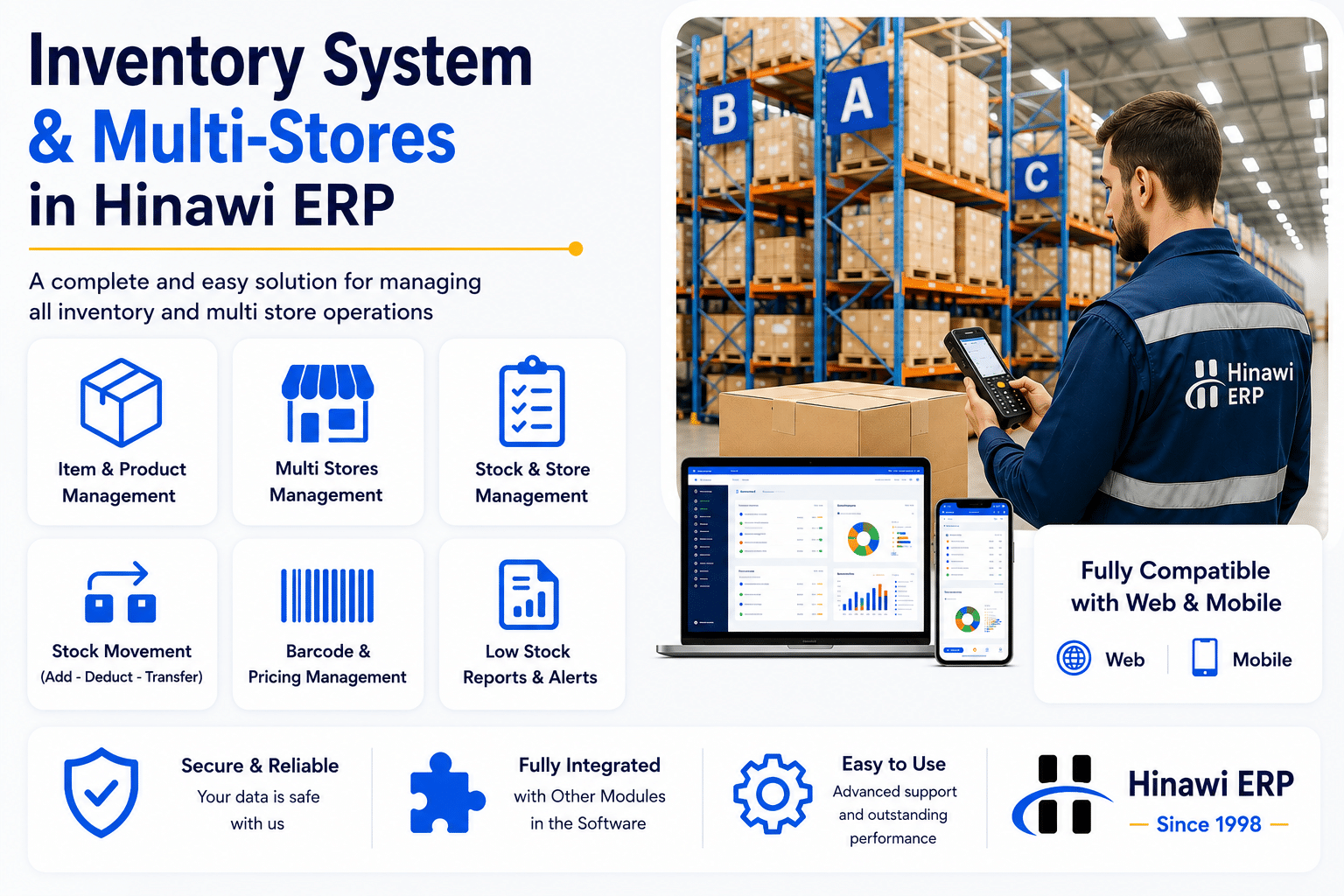

Hinawi ERP offers a powerful, scalable inventory management solution that enables businesses to manage an unlimited number of warehouses (multi-stores), each with specific settings such as warehouse name, physical location, storage conditions, and item capacity. This flexibility allows users to assign products to one or multiple stores for streamlined distribution and location-based tracking.
Designed for efficiency, Hinawi ERP supports real-time tracking of item movements between stores, ensuring accurate and seamless stock transfers across locations. The system enables businesses to set reorder points for each item to prevent stockouts or excess inventory, helping maintain consistent inventory availability across departments.
With built-in for production, companies can track raw materials, semi-finished products, and finished goods across the supply chain, making the solution essential for manufacturing, maintenance, and real estate operations. Hinawi ERP supports intelligent inventory management by automatically adjusting inventory levels based on demand, consumption, and lead times.
The system also calculates and records all shipping and freight costs directly within inventory costs, giving businesses full visibility into the true product valuation. It supports quality management, cost tracking, and audit-friendly reporting with complete transparency.
Implementing robust Inventory Management in UAE strategies helps businesses to adapt swiftly to market demands and ensures that products are always available.
Effective Inventory Management in UAE systems can enhance customer satisfaction by ensuring faster order fulfillment and reducing backorders.
Importance of Effective Inventory Management in UAE
By focusing on Inventory Management in UAE, businesses can gain a competitive edge in their industries.
Real-Time Reporting & Multi-Store Dashboards
Hinawi ERP offers a wide range of dynamic inventory reports and multi-store dashboards that provide real-time visibility into inventory status across all locations. These include:
- Stock Level Reports – Track stock quantities by item, warehouse, or category.
- Replenishment Reports – Identify low-stock items and automatically flag them for reordering.
- Financial Analysis Reports – Monitor inventory costs and assess profitability.
- Obsolete Inventory Reports – Identify slow-moving or outdated stock.
Advanced Controls & Role-Based Access
Hinawi ERP includes a robust user permission management system that allows administrators to control access to inventory data based on user roles. This ensures the secure handling of sensitive inventory information while reducing the risk of unauthorized changes. The system also sends automatic alerts for low stock levels or significant variances, helping prevent errors before they affect operations.
Seamless Integration with Other Hinawi ERP Modules
Inventory in Hinawi ERP is fully integrated with other modules, including sales, purchasing, manufacturing, fixed assets, and accounting, enabling end-to-end automation and data consistency across the business. For example:
- Inventory is deducted automatically during sales or production.
- Purchase orders update warehouse stock and trigger alerts for received quantities.
- Freight and landed costs are reflected in the balance sheet and item valuation.
Label Generator & Barcode Support
Hinawi ERP includes a built-in label generator that allows businesses to print product labels and barcodes directly from the system. This feature enhances warehouse operations, simplifies tracking, and improves inventory accuracy through scannable codes.
Key Benefits of Using Hinawi ERP for Inventory
- Real-time inventory Sync across multi-store locations.
- Cost Efficiency through reduced wastage and automated restocking.
- Improved Accuracy in stock tracking and financial reporting.
- Better Purchasing Decisions with detailed inventory analytics.
- Streamlined Inventory Control for production, maintenance, and daily operations.
Utilizing technology in Inventory Management in UAE allows for better tracking and reporting capabilities.
Accounting Integration
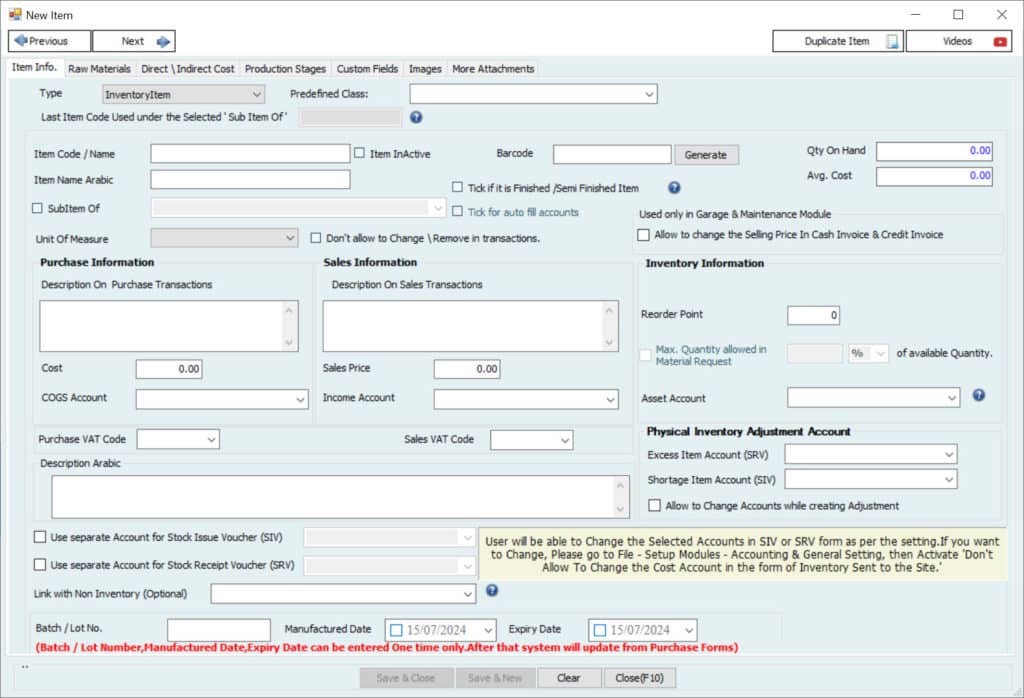
When creating a new item, the system requires linking it to three essential accounts:
Cost Account: Tracks the cost of goods sold (COGS) when items are sold, used in projects, or consumed in manufacturing.
Sales Account: Monitors revenue generated from item sales, reflecting business profitability.
Assets Account: Records the value of available stock, ensuring accurate financial representation in the balance sheet.
Real-Time Update
It ensures that all stock data is instantly updated with every transaction. This enables businesses to make timely, accurate decisions while maintaining adequate stock levels to meet customer demand.
Investing in proper Inventory Management in UAE systems can yield significant returns through increased productivity.
Seamless Integration with Other ERP Modules
Enhanced Inventory Management in UAE leads to clearer insights into stock levels and inventory turnover rates.
Hinawi ERP integrates seamlessly with other modules, enhancing flexibility and operational efficiency. Some key integrations include:
Manufacturing Module: Automatically tracks raw material consumption and production output.
Maintenance Module: Monitors spare parts and consumables used in maintenance activities.
Purchasing and Sales: Links stock availability to sales and purchase invoices.
Fixed Assets: Tracks asset usage and transfers between locations.
Industry Applications of Inventory Management Software & Multi-Warehouse
The Procedure is highly adaptable and serves a wide range of industries:
Manufacturing: Tracks raw materials, semi-finished products, and finished goods, optimizing production workflows.
Real Estate: Monitors equipment and tools used for maintenance operations.
Maintenance Management: Efficiently manages spare parts and maintenance supplies.
Fixed Asset Management: Tracks asset movement and valuation across multiple sites.
Effective Inventory Management in UAE is vital in minimizing stock discrepancies and ensuring data integrity.
Companies will benefit from reviewing their Inventory Management in UAE processes regularly to enhance performance.
Screenshots and videos link
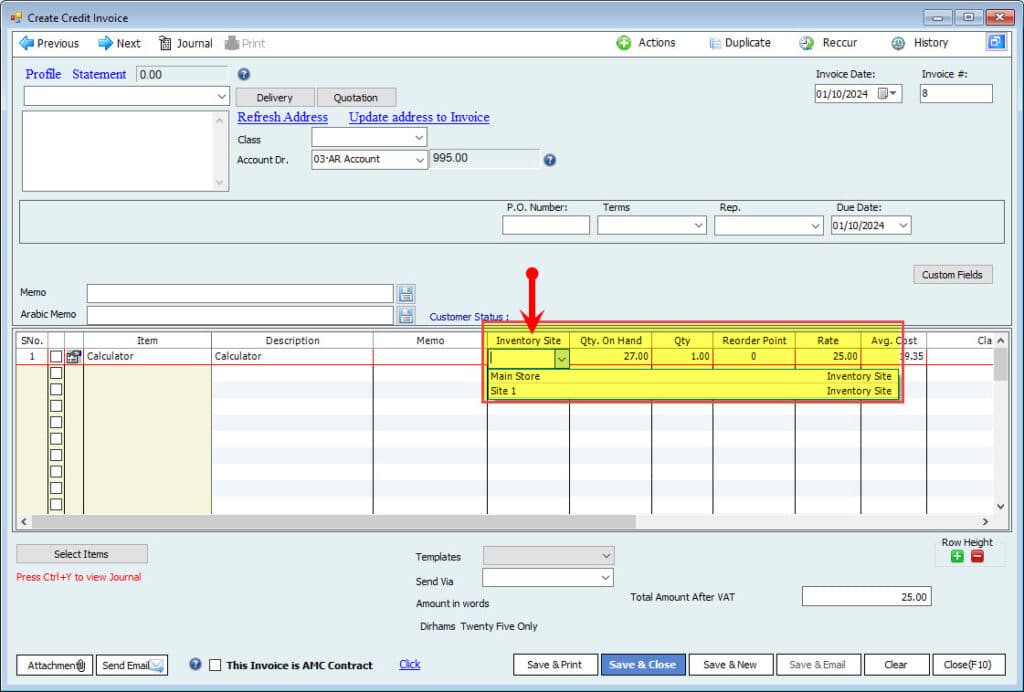
In the competitive landscape of software solutions, the key features what users demand are simplicity and seamless integration. While many platforms are saying key features are the main differentiator, our experience shows that satisfied users across platforms are more concerned with reliable performance and efficient support. Ultimately, the robust features what users across platforms need are those that solve complex business challenges through a unified, intuitive interface.”
Frequently Asked Questions about the Inventory
Frequently asked questions often revolve around best practices for effective Inventory Management in UAE.
Hinawi ERP allows users to create and manage unlimited warehouses, each with custom settings like name and location. Items can be assigned to one or multiple warehouses for efficient stock distribution.
Yes, Hinawi ERP provides real-time tracking of item movements between warehouses, ensuring accurate and timely inventory transfers.
Reorder points can be set for each item. The system notifies users when stock levels drop below the defined threshold, helping maintain optimal inventory levels.
Hinawi ERP offers detailed reports such as:
Stock Level Reports
Financial Analysis Reports
Replenishment Reports
Obsolete Item Reports
These help businesses monitor stock status and make data-driven decisions.
Yes, the system has advanced user permission settings that allow admins to control access based on user roles, improving data security and reducing unauthorized changes.
Inventory integrates seamlessly with modules such as:
Manufacturing: Tracks material consumption and production.
Maintenance: Monitors spare parts and consumables.
Purchasing & Sales: Connects stock availability to invoices.
Fixed Assets: Tracks equipment and asset transfers.
Each item must be linked to three key accounts:
Cost Account (COGS)
Sales Account (Revenue tracking)
Inventory Account (Stock value on the balance sheet)
Yes, the system updates all stock data instantly with each transaction, ensuring accurate and timely inventory decisions.
Increased Efficiency – Automated processes and real-time tracking
Cost Reduction – Minimized waste and overstocking
Improved Accuracy – Reliable stock monitoring and control
The four primary categories are Raw Materials (basic inputs for production), Work-in-Progress (WIP) (items currently being manufactured), Finished Goods (completed products ready for sale), and MRO Supplies (items used for maintenance, repair, and operations that keep the business running).
Also known as the Pareto Principle, this rule states that 80% of your inventory value typically comes from just 20% of your items. By identifying this “critical 20%” (often called “A-items”), inventory controllers can focus their management efforts and capital on the items that have the biggest impact on the business’s bottom line.
While FIFO and LIFO depend on the order in which items are purchased, the Weighted Average Cost method calculates the average cost of all units available for sale during a period. This approach is superior for many businesses because it “smooths out” price volatility, reduces the administrative burden of tracking individual unit costs, and provides a more stable and consistent reflection of inventory value and Cost of Goods Sold (COGS).
The salary for an Inventory Controller in the UAE varies significantly based on experience, industry, and company size. On average, you can expect a range starting from AED 6,000 to AED 12,000 per month. Positions involving advanced ERP proficiency (like Hinawi ERP), strategic planning, and supply chain oversight can command salaries at the higher end of this range or beyond.