
Category: Accounting
A finance manager in Dubai closes one branch on time, waits for another branch to email spreadsheets, calls HR for payroll totals, then asks the accountant to recheck VAT because one invoice was posted twice. By the time management gets the report, the numbers are already old. That's how many UAE businesses still operate, even when they believe they have “software”.
The problem usually isn't lack of effort. It's a disconnected finance setup. One tool for invoices, another for payroll, Excel for branch consolidation, and manual adjustments at month-end. That model breaks under VAT, multi-branch operations, and audit pressure.
Most articles about online accounting systems stay too generic. They talk about invoicing and bookkeeping but skip what matters in the UAE and GCC: audit trails, localisation depth, VAT handling, WPS payroll, and bilingual operation in one connected platform, which is exactly the gap noted in this software selection guide discussing overlooked operational requirements.
If you're a business owner, finance head, or operations manager in the UAE, you don't need another generic feature list. You need a practical decision framework for a regulated market. That means choosing online accounting systems that can support the way businesses here operate.
Hinawi ERP is a relevant example because it was developed in Abu Dhabi for this market and connects accounting with payroll, assets, operations, and reporting instead of forcing teams to patch systems together.
If your finance team is still chasing files, correcting duplicate entries, and rebuilding reports every month, it's time to change the architecture, not just the routine.
Chat on WhatsApp +971506228024
Introduction The End of Disconnected Financials
A trading company in Abu Dhabi with multiple branches doesn't usually fail because sales are weak. It struggles because management can't see clean numbers fast enough. One branch posts revenue late, another branch records supplier bills differently, payroll sits outside accounting, and VAT reconciliation becomes a monthly fire drill.
That old approach was already inefficient. In the UAE, it's now risky.
Online accounting systems solve a specific business problem. They create one live financial environment where invoices, receipts, purchases, payroll, and branch transactions feed into the same accounting structure. Instead of collecting data after the fact, your team records activity once and reports from it immediately.
Why this matters in the GCC
In the GCC, finance systems must do more than basic bookkeeping. They must support bilingual teams, remote approvals, operational controls, and compliance-heavy workflows. A business with construction projects, rental contracts, field technicians, or warehouse transfers can't rely on a finance system that only handles journals and printed reports.
Practical rule: If your accountant still needs to ask three departments for month-end numbers, you don't have a system. You have fragments.
A proper online accounting environment also changes management behaviour. Owners stop waiting for monthly surprises. Finance managers stop rebuilding reports manually. Department heads start seeing the cost impact of their own transactions.
What has to change
You don't need more data entry discipline. You need a system design that removes duplicate work.
That means:
- One financial core: Every operational transaction should land in accounting without retyping.
- Clear traceability: Users should be able to follow balances back to source documents.
- Regional fit: The system must support UAE tax and payroll realities, not just generic accounting theory.
Businesses that modernise early usually gain control first, then efficiency. That sequence matters. Control is what keeps you compliant and audit-ready.
What Are Online Accounting Systems
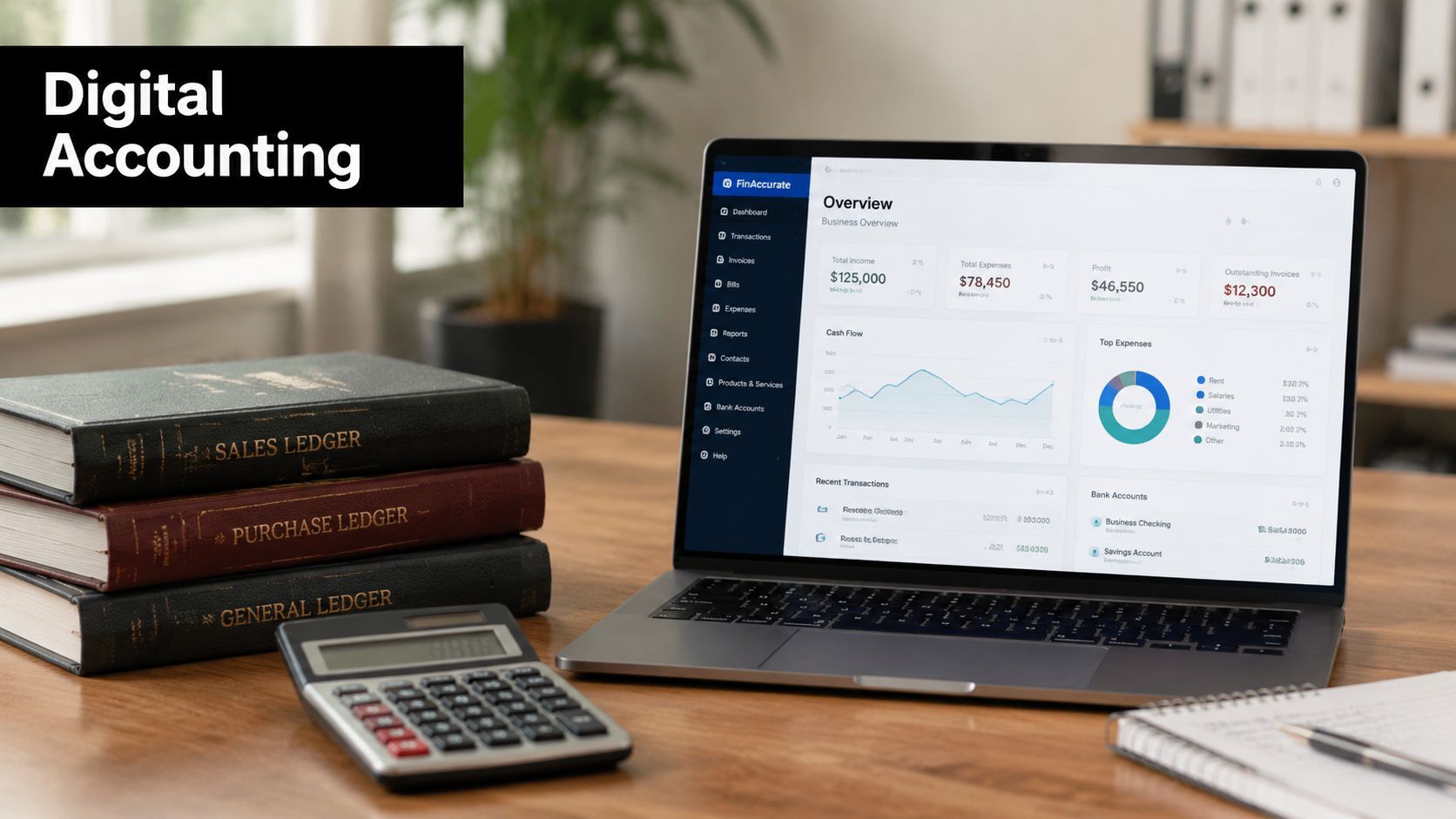
Online accounting systems are accounting platforms accessed through a connected environment rather than isolated desktop files and scattered spreadsheets. The practical difference is simple. Your finance data is available to authorised users in real time, across branches and departments, without waiting for someone to email the latest version.
Think of it as the difference between a paper road map and live navigation. Both can show direction. Only one reflects what's happening now.
What they replace
Most UAE businesses don't move to online accounting systems from a perfect legacy setup. They move from a patchwork like this:
- Desktop accounting: Data is tied to specific machines or local networks.
- Spreadsheet reporting: Teams export, merge, and correct data manually.
- Separate payroll and operations: Finance receives totals, not transaction detail.
- Delayed decision-making: Management sees reports after the problem has already grown.
This is why many firms outgrow basic tools. If your company has branches, inventory, projects, rental contracts, staff across departments, or approval chains, the accounting function can't stay isolated.
What a modern system should actually do
Online accounting systems should give you:
- Live access to ledgers and balances
- Role-based access for owners, finance staff, and operations users
- Immediate visibility across branches or entities
- Built-in support for connected processes such as invoicing, payables, and payroll
- A reporting structure that doesn't depend on Excel reconstruction
The market direction is already clear. The global online accounting systems market is projected at USD 16.2 billion in 2026, and cloud deployments accounted for 68.08% of revenue in 2025, while payroll management represented 29.10% of market activity, according to this global market analysis of online bookkeeping and accounting software. That matters because it shows online accounting isn't a niche upgrade anymore. It's the operating standard.
For UAE companies comparing options, start with systems built for real business operations, not just entry-level bookkeeping. A useful benchmark is to review how business accounting programs for UAE companies handle integrated finance requirements.
Online accounting systems aren't just about where the software runs. They're about whether your financial data moves once through the business, or gets rebuilt by people every month.
Chat on WhatsApp +971506228024
Core Features and Modules Every UAE Business Needs
A serious finance system starts with structure. If the core modules are weak or disconnected, everything above them becomes manual, slow, and unreliable.
The financial core
The minimum modules you need are not complicated, but they must work together:
- General Ledger: This is the accounting backbone. Every financial event should end here in a controlled, traceable format.
- Accounts Payable: Supplier invoices, due dates, payment processing, and liability tracking belong here.
- Accounts Receivable: Customer invoicing, collections, ageing, and credit control need to sit in one place.
- Cash and Bank Management: Reconciliation must tie receipts and payments back to actual ledger postings.
A weak system treats these as separate screens. A proper one treats them as one transaction flow.
Why integration between modules matters
If sales issues an invoice, accounts receivable should update immediately. The ledger should reflect the posting without waiting for finance to re-enter it. When a payment arrives, the bank transaction, customer balance, and ledger position should all move together.
That's the true value. Not prettier dashboards. Cleaner transaction flow.
The strongest technical advantage in this category is integration across accounting, payroll, inventory, invoices, and operational subledgers within one accounting information system, as described in this overview of accounting software and information systems. In practical terms, one shared data model reduces human error and improves control over receivables, payables, and month-end closing.
Modules UAE businesses should treat as non-negotiable
Core accounting alone isn't enough for many GCC companies. Look for these adjacent modules or native connections:
- VAT handling: Tax posting must sit inside the transaction flow, not as a manual afterthought. Review how VAT accounting in UAE ERP systems is managed before committing to any product.
- Payroll linkage: Payroll expenses and liabilities should post directly to accounts.
- Inventory connection: Stock movement must affect costing and financial reporting.
- Fixed assets: Depreciation should post automatically and stay auditable.
- Multi-branch reporting: Branch-wise and consolidated views must come from the same dataset.
If your staff enter the same transaction in two systems, you are paying twice for weaker control.
Many businesses make a costly mistake. They buy a simple accounting package, then add payroll, inventory, assets, and reporting tools around it. That approach usually creates more reconciliation work, not less.
Key Benefits for UAE and GCC Operations
In the UAE and GCC, the main benefit of online accounting systems isn't convenience. It's operational control under real regulatory pressure.

VAT and e-invoicing are no longer side tasks
The UAE introduced VAT on 1 January 2018 at a standard rate of 5%, and phased mandatory e-invoicing for business-to-business and business-to-government transactions has been announced from 2026 onward, according to this market report covering the UAE's digital finance shift. That changed the accounting role permanently.
You can't handle that environment with loose invoicing controls and spreadsheet tax summaries. Your system must produce structured, auditable financial data every day.
What that means in practice:
- Transaction-level VAT recording
- Consistent reconciliation across sales, purchases, and imports
- Reliable audit trails
- Tax-ready invoice generation
- Reporting that can support filing and review
Multi-branch visibility without month-end chaos
A company with branches in Dubai, Abu Dhabi, Al Ain, or across the GCC shouldn't wait until month-end to understand cash position, receivables exposure, or branch profitability.
Online accounting systems give management live visibility. That matters for:
- Branch managers who need budget and expense control
- Owners who want one consolidated financial view
- Finance teams who must close faster without collecting offline files
For management teams that rely heavily on operational and financial analysis, a connected MIS and reporting approach inside ERP is far more useful than exporting balances into separate reporting sheets.
WPS and bilingual operations need native support
Generic global software often looks good in demos and falls apart during implementation because local payroll and language requirements were never designed into the product.
In the UAE, your system should support:
- WPS payroll workflows
- Arabic and English output
- Multi-entity reporting
- Approval paths that match local company practice
A construction company, real estate group, school operator, or trading business doesn't need “basic accounting with some add-ons”. It needs finance operations that align with how payroll, contracts, billing, and compliance work in this region.
Chat on WhatsApp +971506228024
Integrating Accounting with Your Complete ERP Workflow
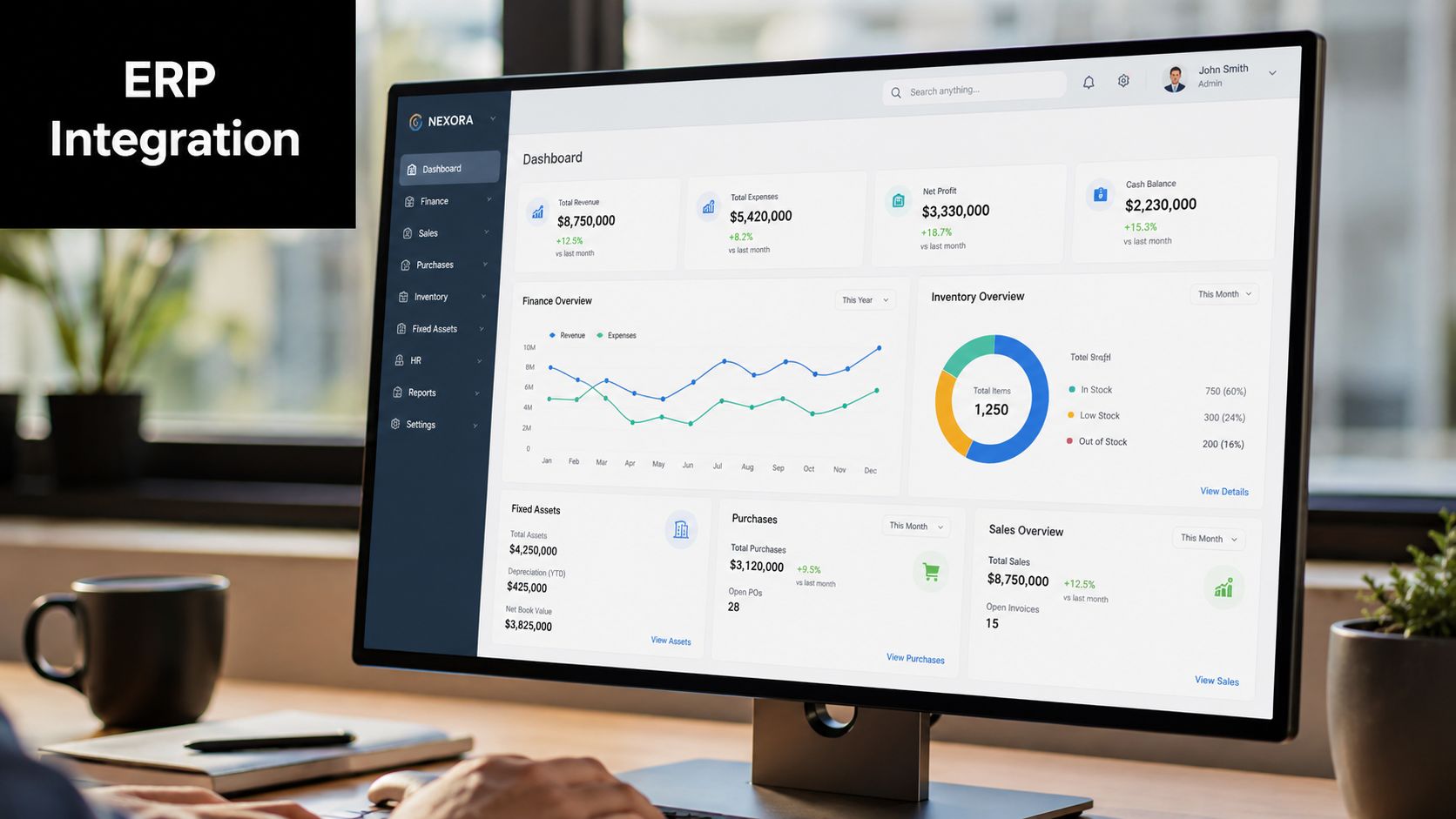
Standalone accounting can record the past. Integrated ERP can control the business while it's happening.
That distinction matters most in companies with projects, assets, stock, payroll, property contracts, or service operations. Once those activities happen outside accounting, finance loses timing, detail, and traceability.
A practical UAE contracting scenario
Take a contracting company in Abu Dhabi.
The procurement team buys site materials. Inventory receives the goods. Accounts payable recognises the supplier obligation. Later, project operations consume those materials on a job. Payroll processes staff cost through WPS. Management wants to see project cost, outstanding supplier balances, branch profitability, and cash pressure without waiting for finance to rebuild the picture.
That only works when the system is integrated.
A connected ERP flow should look like this:
- Purchase entry: The supplier invoice updates inventory and creates a payable.
- Material issue to project: Stock reduces and the relevant cost moves to the project or cost centre.
- Payroll run: Salary expense and liabilities post to accounting automatically.
- Asset purchase if applicable: Capital items move into fixed assets and depreciation follows the defined rules.
- Management reporting: P&L, balance sheet, project cost, and branch analysis all pull from the same transaction base.
Why auditability depends on integration
For real-time compliance in the UAE, a system must preserve invoice-level tax detail and posting traces so VAT return figures can be reconciled directly to source transactions, as explained in this technical note on accounting software requirements for UAE compliance. That's exactly why integrated systems reduce manual errors. Every taxable supply, adjustment, or input tax claim stays tied to a ledger event.
A VAT return is only as reliable as the transaction path behind it.
This is also where an ERP platform such as accounting ERP software for UAE operations becomes more useful than a standalone bookkeeping tool. It keeps accounting as the financial result of operational activity, not a separate clerical layer.
Where one integrated platform helps most
Hinawi ERP fits this model because it connects accounting with HR and payroll, fixed assets, real estate, manufacturing, CRM, and operational workflows in one environment. For businesses in the UAE, that matters less as a product feature and more as a control model.
The biggest gains usually appear in:
- Contracting and project businesses
- Real estate and property management
- Trading and distribution
- Factories and manufacturers
- Schools and service operations with payroll-heavy structures
When data enters once and posts correctly across modules, finance stops chasing transactions and starts analysing them.
How to Select the Right System in the GCC
Most software buying mistakes happen before implementation starts. The buyer focuses on screens and ignores operational fit.
In the GCC, that's expensive. A polished demo won't save you if the system can't support local compliance, branch structure, payroll requirements, or reporting logic.
Start with the right questions
Use this checklist when evaluating vendors.
| Criterion | Key Questions to Ask | Why It Matters for GCC |
|---|---|---|
| Local Compliance Depth | Does the system support VAT handling, audit trails, e-invoicing readiness, and WPS-related workflows? | GCC businesses operate in regulated environments where finance and payroll controls must be built in. |
| Integration and Scalability | Can accounting connect natively with payroll, inventory, assets, projects, or real estate operations? | Disconnected systems create reconciliation problems as the business grows. |
| Local Support | Is support available in the UAE or GCC, with consultants who understand local business processes? | Regional implementation issues are rarely solved well by generic remote support alone. |
| Data Residency and Security | Where is data stored, who controls access, and what happens if your internet connection is disrupted? | Many companies need clarity on access control, continuity, and internal policy requirements. |
| Total Cost of Ownership | What will the system cost over the medium term, including licences, support, implementation, customisation, and change requests? | The cheapest subscription can become the most expensive setup once local adaptations begin. |
Cloud versus self-hosted is a business decision
This debate is often handled badly. People reduce it to “modern versus old”. That's lazy thinking.
GCC businesses should weigh the trade-offs between subscription cloud models and self-hosted alternatives based on total cost over 3 to 5 years, data residency needs, internet dependency, and the desire for permanent offline access, as discussed in this guide to no-subscription desktop accounting software and deployment trade-offs.
That doesn't mean self-hosted is automatically better. It means deployment choice should follow business reality.
My recommendation for decision-makers
Use this decision logic:
- Choose cloud-first if your teams work across branches, approvals happen remotely, and you want lower infrastructure management.
- Consider self-hosted or flexible deployment if internal policy, continuity planning, or data control requirements are strict.
- Reject any system that needs bolt-ons for core GCC needs such as payroll linkage, localisation, or auditable VAT handling.
- Insist on process-based demos using your own workflows, not generic sales demonstrations.
Buy for the next operating model, not the current workaround.
Chat on WhatsApp +971506228024
Take the Next Step with Hinawi ERP
If your business still depends on disconnected spreadsheets, delayed branch reporting, manual payroll postings, or patchwork VAT reconciliation, the issue isn't your team. It's the system design.
Online accounting systems have become the practical foundation for companies that want tighter control, cleaner reporting, and less operational friction. In the UAE and GCC, the right system also needs to support compliance realities that generic accounting tools often miss. That includes VAT-ready transaction handling, e-invoicing readiness, WPS payroll support, bilingual operation, and integrated reporting across branches and entities.
Hinawi ERP is built for that environment. Developed in Abu Dhabi since 1998, it provides a fully integrated ERP platform covering Accounting, HR and Payroll, Real Estate Management, Fixed Assets, Manufacturing, Garage and Maintenance, School Management, CRM, and broader business automation. For companies operating in the UAE and GCC, that means finance doesn't sit in isolation. It connects directly with daily business activity.
Why this is relevant for GCC businesses
Hinawi ERP supports:
- VAT and e-invoicing compliance
- UAE WPS payroll support
- Arabic and English bilingual operation
- Flexible company policy settings
- Real-time accounting integration across all modules
It also fits the operating needs of:
- Factories and manufacturers
- Contracting companies
- Real estate businesses
- Schools
- Garages and maintenance operations
- Trading companies
If you want one platform that can support finance, operations, payroll, assets, and reporting together, review the capabilities of Hinawi ERP for UAE businesses.
Modernising your financial systems isn't just about replacing old software. It's about reducing manual work, improving financial accuracy, strengthening audit readiness, and giving management direct control over the business.
Speak with the Hinawi ERP team if you want a practical review of your current setup, a personalised demo, or guidance on how to move from disconnected accounting to an integrated ERP model.
A CTA for Explorer Computer LLC – Hinawi Software ERP. Businesses in the UAE and GCC don't need more disconnected tools. They need one reliable ERP platform that handles accounting, HR and Payroll, real estate, fixed assets, manufacturing, garage and maintenance, school management, CRM, and full business automation in a way that fits regional operations. Hinawi ERP, developed in Abu Dhabi since 1998, is built for exactly that. It supports VAT and e-Invoicing compliance, UAE WPS payroll, Arabic and English bilingual workflows, flexible company policy settings, and real-time accounting integration across all modules. Whether you run a factory, contracting company, real estate business, school, garage, trading company, or manufacturing operation, Hinawi ERP helps reduce manual work, improve financial accuracy, and give management stronger control. Visit www.hinawierp.com to learn more or request a personalised demo from the Hinawi ERP team.