
Category: Accounting
A finance manager in Dubai closes the month with three spreadsheets open, one accounting file half-reconciled, and a pile of supplier invoices waiting for VAT review. Sales has issued invoices in one format, procurement has booked purchases in another, and inventory movements haven’t been mapped properly to tax treatment. The VAT return is due, and nobody is fully confident that the numbers will survive an FTA review.
That situation is still common. It’s also avoidable.
In the UAE, VAT accounting isn’t just an accounting task anymore. It’s an operational discipline that touches sales, purchasing, inventory, fixed assets, contracting, payroll allocations, and document control. If your VAT process still depends on manual checks after transactions are posted, your system is too weak for the job. The right approach is to build VAT into the transaction itself, inside the ERP, at the moment the business event happens.
That’s why serious UAE businesses have moved away from fragmented tools and towards integrated systems. A localised ERP can apply the correct tax logic to invoices, credit notes, stock movements, asset purchases, and project billing before errors spread into the ledger. Hinawi ERP is a practical example of that approach because it was developed in Abu Dhabi for businesses that operate under local compliance, bilingual documentation, and multi-module workflows.
If you’re evaluating VAT accounting UAE ERP options, focus less on glossy dashboards and more on operational control. Can the system classify supplies correctly? Can it produce compliant invoices? Can it reconcile VAT across modules without manual patchwork? Can it support e-invoicing readiness? Those are the questions that matter.
Chat on WhatsApp +971506228024 Quotation – Demo RequestIntroduction Navigating the Complexities of UAE VAT Compliance
The UAE altered the compliance environment when it introduced VAT on January 1, 2018 at a standard rate of 5%, with quarterly VAT returns, mandatory record retention for five years, and penalties ranging from AED 5,000 to AED 50,000 per offence, according to this UAE VAT compliance overview. That wasn’t just a tax change. It forced businesses to rework how they issue invoices, classify transactions, and store audit evidence.
For many owners, the first response was tactical. Add VAT codes. Update invoice templates. Ask accounts staff to review reports manually before filing. That may work for a very small company with simple transactions. It fails quickly once you add branches, warehouses, projects, service contracts, fixed assets, or multiple entities.
Why spreadsheets fail first
Manual VAT control usually breaks in the same places:
- Sales documents drift: Teams issue invoices with inconsistent wording, missing TRN details, or incorrect tax treatment.
- Purchase recovery gets messy: Input VAT claims depend on correct classification and document support, not just invoice totals.
- Operations sit outside finance: Inventory transfers, service jobs, lease billing, and asset transactions affect VAT even when the finance team sees them late.
- Quarter-end turns reactive: Staff start reconciling tax data after the business has already posted the wrong transactions.
Practical rule: If your VAT accuracy depends on month-end corrections, your ERP design is the problem.
The smarter model is simple. Let the ERP control VAT at source. Product masters carry tax attributes. Customers and suppliers carry TRN data. Invoice formats are compliant by default. Reports draw from posted transactions, not spreadsheets rebuilt by hand.
That’s the standard business owners in Abu Dhabi and across the UAE should expect now.
Understanding UAE VAT and E-Invoicing Regulations for ERP Systems
A contractor in Abu Dhabi buys machinery for a project, transfers stock between branches, bills a progress certificate, and disposes of an old asset in the same quarter. If the ERP treats VAT as a sales invoice setting instead of a system-wide control, the return will be wrong before finance starts reviewing it.
What the ERP must recognise
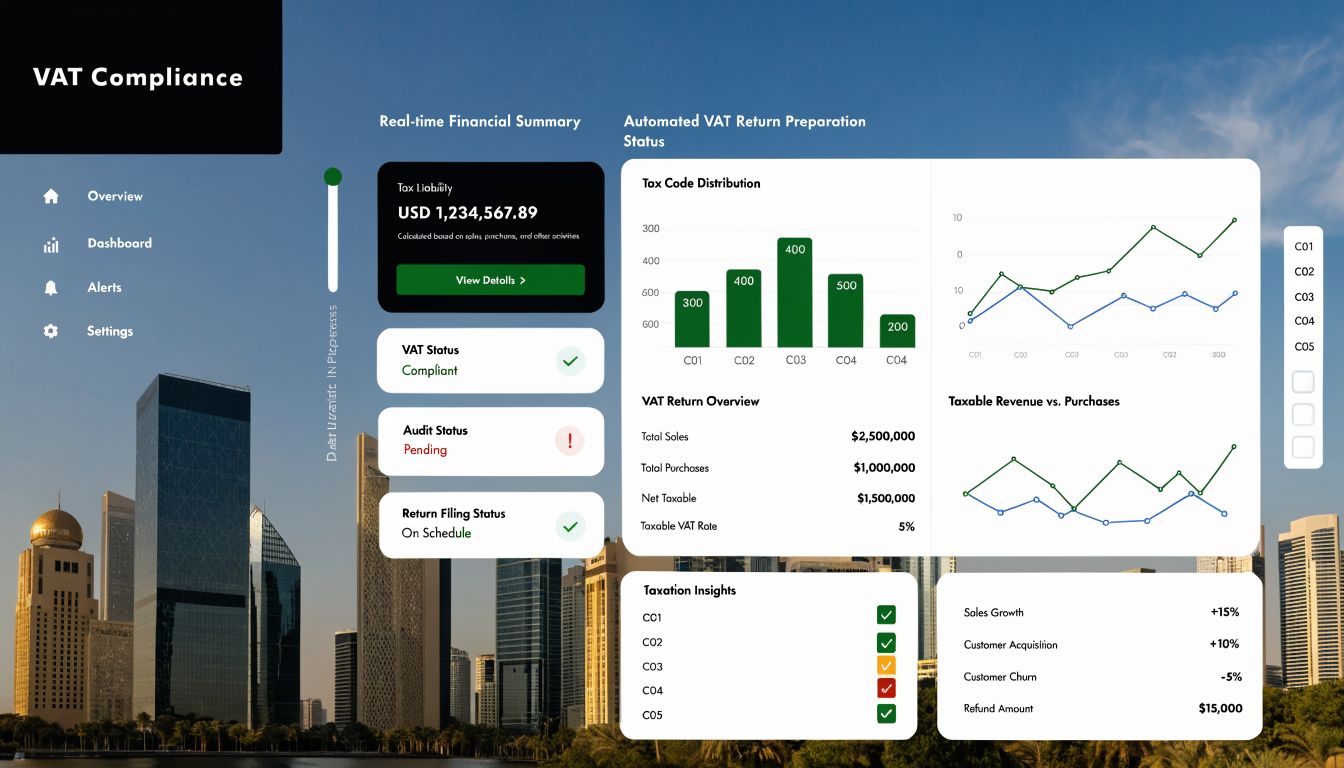
Your ERP must classify UAE transactions correctly at source. That means standard-rated, zero-rated, exempt, and out-of-scope treatment must sit inside item masters, service codes, customer and supplier records, branch setups, and document types. If tax logic only appears at invoice print stage or in a month-end spreadsheet, you have a control failure.
This matters most in businesses with operational complexity. Fixed asset purchases affect recoverability and audit support. Multi-branch inventory movements can create confusion if transfer and landed cost processes are poorly configured. Contracting businesses need tax treatment tied to project billing events, retention, variation orders, and credit notes. These are not edge cases. They are routine UAE transactions.
Review whether your system can control:
- Tax treatment by transaction type: sales, purchases, asset acquisition, asset disposal, project billing, credit notes, and inter-branch activity
- Master data accuracy: TRN fields, place-of-supply indicators, item and service tax categories, and exemption or zero-rating reasons where needed
- Document-level compliance: tax invoices and credit notes with the required information and a clear audit trail to the ledger
- Return mapping: posted data flows into VAT reporting without manual reclassification outside the ERP
If you are comparing systems, examine how Hinawi applies VAT logic across day-to-day accounting workflows. The right test is simple. Can the software handle UAE VAT inside operations, or does your team need workarounds after posting?
Record keeping must support an audit
UAE VAT compliance is not limited to calculating output and input tax. The Federal Tax Authority expects businesses to retain records that support each tax position, including invoices, credit notes, imports, exports, adjustments, and underlying accounting entries. The UAE government's VAT record keeping guidance makes the point clearly. Records must be maintained and retrievable.
That requirement affects ERP design directly. You need posted transactions linked to source documents, user activity, tax codes, and amendments. You also need records structured in a way your team can retrieve quickly during an FTA review. A VAT summary without drill-down is not a control. It is a reporting shortcut.
Audits test traceability. If your team cannot move from VAT return box totals to the original transaction and document in minutes, your ERP setup is weak.
E-invoicing readiness starts long before mandate dates
E-invoicing will expose poor ERP discipline fast. Businesses that still rely on PDF invoices, inconsistent customer masters, and manual tax edits will struggle the moment structured invoice data becomes mandatory.
Treat e-invoicing as an operational and finance control issue. Customer records must be clean. Tax classifications must be consistent across branches and business units. Invoice numbering, amendment handling, and approval workflows must be system controlled. If your contracting module, inventory module, and fixed asset register do not feed clean tax data into finance, e-invoicing readiness will remain superficial.
Hinawi ERP is useful here because the compliance question is broader than sales and purchase ledgers. UAE businesses need one system that carries VAT logic through projects, inventory, assets, service billing, and financial posting without breaking the audit trail.
Chat on WhatsApp +971506228024 Quotation – Demo RequestMapping VAT Accounting Processes to Core ERP Modules
Many businesses still speak about VAT as if it belongs only to the accounting department. That’s wrong. VAT sits inside operations. Your ERP either reflects that reality or creates risk.
Where VAT actually happens
VAT is triggered across the business:
- A sales team issues a tax invoice.
- Procurement books a supplier bill.
- Stores transfer stock between locations.
- Projects raise progress billing.
- Fixed assets are acquired or disposed.
- Finance reconciles control accounts in the general ledger.
If these activities run in disconnected modules, your VAT return becomes a reconstruction exercise. If they run in one integrated ERP, tax treatment follows the transaction from source to ledger.
Use the general ledger as the final checkpoint, not the first place problems are discovered. Businesses that want tighter control should review how an integrated ledger structure supports accounting visibility.
VAT process mapping within an integrated ERP system
| VAT Process | Responsible ERP Module | Key Functionality |
|---|---|---|
| Customer tax invoice creation | Sales and Accounts Receivable | Applies tax code at document level, includes required invoice data, posts output VAT automatically |
| Sales credit note handling | Sales and Accounts Receivable | Reverses taxable value and linked VAT consistently against the original transaction |
| Supplier invoice booking | Purchases and Accounts Payable | Captures input VAT, validates supplier data, supports recoverability review |
| Purchase returns and debit adjustments | Purchases and Accounts Payable | Corrects input VAT treatment through controlled reversal entries |
| Stock issue and item sale | Inventory and Sales | Uses item tax attributes to carry VAT logic into outgoing transactions |
| Inter-branch and warehouse movement review | Inventory | Preserves movement history and supports correct treatment where location and transaction context matter |
| Asset acquisition | Fixed Assets | Records VAT as part of acquisition workflow and links accounting impact to asset records |
| Asset disposal | Fixed Assets and General Ledger | Ensures disposal entries reflect tax treatment and supporting records |
| Project billing and service contracts | Project or Contracting module | Applies VAT to milestones, progress claims, retention-related billing, and service invoices |
| VAT reconciliation and return review | General Ledger and Tax reporting | Reconciles output VAT, input VAT, and control balances before return submission |
What owners should test
Don’t ask your ERP vendor whether the system “supports VAT”. That question is too vague to be useful. Ask them to show actual transaction flows.
For example:
- Create a sales invoice for a taxable item.
- Book a purchase invoice for recoverable input VAT.
- Transfer stock through the inventory flow.
- Acquire an asset and confirm how VAT is recorded.
- Run the tax reports and trace all figures back to posted entries.
If the demo relies on manual journals to fix tax outcomes, the VAT design is weak.
Many generic systems often fall short. They may post sales and purchases well enough, but they often struggle when VAT has to stay aligned across contracting, asset management, inventory movement, and service modules.
Essential ERP Features and Configuration for FTA Compliance
A compliant system isn’t defined by reports alone. It’s defined by configuration discipline. Poor setup creates tax errors even in good software.
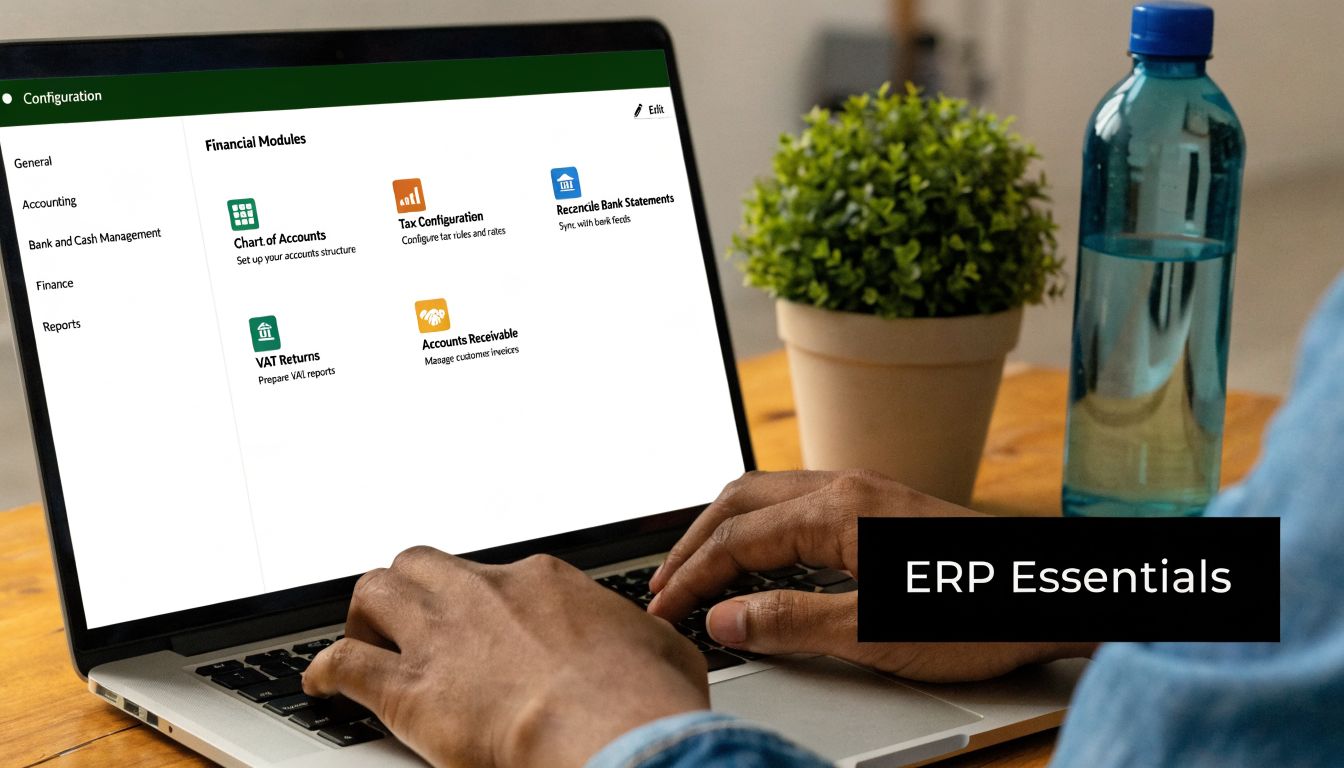
According to this UAE ERP VAT reference, compliant ERP systems automate FTA-compliant tax invoice generation and VAT 201 return preparation, including emirate-specific selections, item classifications such as “Is Zero Rated” or “Is Exempt”, and real-time tracking. The same source notes this is especially relevant for VAT-registered businesses with turnover exceeding AED 375,000, and for the over 350,000 VAT-registered businesses in the UAE.
The tax engine must be configurable
The first thing I check in any VAT accounting UAE ERP review is the tax engine. If tax codes are hard to manage or inconsistently linked, users will bypass the system.
Your ERP should allow you to define tax logic at multiple levels:
- Item and service level: Products and services must carry the right VAT classification.
- Customer and supplier master level: TRN details and tax behaviour must be stored centrally.
- Document level: Sales invoices, purchase invoices, credit notes, and adjustments should inherit tax settings correctly.
- Account level: Input VAT, output VAT, and control accounts must be segregated for clean reconciliation.
A proper file structure matters just as much as the tax settings. Businesses reworking VAT controls should review general file setup discipline in ERP configuration.
Invoice design is a compliance control
Many teams treat invoice templates as a cosmetic issue. They’re not. They’re a compliance control.
A UAE-ready ERP should generate tax invoices in the format your business uses, while preserving required information and bilingual capability. It should also support simplified and detailed tax invoice formats where needed. If staff have to edit Word templates outside the system, the control environment is already broken.
Key invoice expectations include:
- Bilingual support: Arabic and English output should be available for practical operations.
- TRN handling: Company and counterparty tax details should be maintained properly in master data.
- Tax amount accuracy: VAT should calculate from line-level logic, not from manual calculator checks.
- Document traceability: Users should be able to retrieve the posted invoice and related accounting entry quickly.
VAT return automation must come from live transactions
The VAT 201 return should be the output of posted business activity, not a separate spreadsheet project.
That means your ERP needs:
- Box-level population logic based on transaction classification.
- Real-time accounting integration so sales, purchases, inventory, and asset entries update the tax position as they happen.
- Reconciliation support between tax reports and general ledger balances.
- Central record retention so supporting documents remain available for audit review.
One practical example is the use of item master flags such as “Is Zero Rated” or “Is Exempt”. When these are configured correctly, the transaction flows into reporting with far less manual intervention. That’s the difference between system-led control and staff-led patchwork.
Consultant’s advice: Don’t accept a VAT report that can’t be drilled down to invoice, item, customer, and ledger posting.
What to check during a system audit
If you already have an ERP, run a blunt internal audit against these questions:
- Are tax codes used consistently across all modules?
- Can the system produce bilingual tax invoices directly?
- Are TRN fields controlled in master data?
- Do inventory, fixed assets, and project modules feed accounting in real time?
- Can the finance team prepare VAT 201 from system reports without rebuilding data externally?
If the answer to any of those is no, your VAT exposure is operational, not just accounting-related.
Advanced VAT Scenarios and Future-Proofing Your ERP
Basic VAT setup isn’t enough for a serious business. The key test comes when transactions stop being simple.

Complex tax treatment needs system logic
Imported services, imported goods, mixed-use activity, margin-based transactions, and correction entries all create opportunities for manual error. Finance teams often understand the tax rule in principle, but the ERP hasn’t been configured to process it consistently. That’s when staff start posting manual journals, keeping side schedules, and relying on memory.
Reverse charge treatment is a common pressure point. If the ERP doesn’t support the accounting logic cleanly, users end up splitting entries manually and then struggling to reconcile tax impact later. The same problem appears in special transaction types where the tax treatment differs from an ordinary local sale or purchase.
A structured ERP offers distinct advantages over a simple accounting package. It can apply tax logic at source, preserve the audit trail, and stop non-standard entries from bypassing control.
E-invoicing readiness is now a selection criterion
According to this guide on VAT-enabled ERP readiness, the UAE’s move towards mandatory e-invoicing requires ERP systems to support structured data formats for FTA submission, encrypted audit trails, and API-level connectivity. The same source states that proactive adoption of e-invoicing-ready ERPs eliminates transaction submission delays and reduces document rejection rates from tax authorities.
That requirement should change how you buy software. Don’t buy for today’s invoice printout only. Buy for tomorrow’s data exchange environment.
A future-ready ERP should support:
- Structured invoice data: Information must be stored in a format suitable for digital submission, not only visual printing.
- Encrypted or protected audit history: Transaction changes must remain traceable.
- API capability: The system should be able to connect to future authority or third-party compliance gateways.
- Template flexibility: Tax invoice formats must adapt without breaking core tax logic.
E-invoicing won’t punish businesses because they lack PDFs. It will punish businesses because their underlying data is inconsistent.
The strategic decision owners should make
If you’re planning an ERP upgrade, don’t separate VAT, e-invoicing, and operational integration into different projects. That’s how businesses create duplicate work and incompatible systems.
Choose one platform architecture that can handle current VAT control and future digital compliance together. It will cost less disruption than retrofitting disconnected tools later.
Sector-Specific VAT Challenges and ERP Solutions
Generic VAT advice is easy. Sector-specific control is harder. That’s where many UAE businesses get caught.
According to this analysis of VAT and ERP transparency issues, a major challenge for asset-intensive UAE companies is integrating VAT accounting with fixed assets and multi-warehouse inventory, and over 75% of GCC tax professionals report transparency issues in their ERPs for these complex transactions.
Real estate and mixed tax treatment
Real estate businesses often deal with taxable and exempt activity in the same operating structure. Lease billing, service charges, unit classification, and tenant-related accounting can’t be handled reliably if the ERP treats every property transaction the same way.
The practical solution is module-level classification. Property units, contracts, and charge types should carry tax treatment integrated into the estate workflow, not as finance notes added later.
Contracting and project billing
Contracting businesses face a different problem. VAT doesn’t just attach to final invoices. It intersects with progress billing, retention structures, subcontractor invoices, variation orders, and project-based procurement.
A weak ERP forces the accounts team to interpret project data manually before filing tax. A stronger setup pushes tax rules into project billing and purchasing transactions so that finance reviews exceptions rather than rebuilding the entire picture.
Manufacturing and multi-warehouse operations
Manufacturers and distributors often underestimate VAT risk in inventory flows. Raw material purchases are one part of the story. Inter-warehouse movement, inter-branch operations, finished goods sales, scrap handling, and landed cost treatment all affect reporting discipline.
If warehouse transactions sit outside the accounting core, stock and tax data diverge. Once that happens, the VAT return becomes a reconciliation exercise between systems that don’t agree.
Chat on WhatsApp +971506228024 Quotation – Demo RequestAsset-heavy companies need the strictest control. Fixed asset acquisition, depreciation context, disposal entries, and location-based records must stay connected to the general ledger. That’s one area where a locally developed integrated platform such as Explorer Computer LLC – Hinawi Software ERP can be useful in practice because it combines accounting, fixed assets, inventory, real estate, manufacturing, and service operations in one environment rather than forcing VAT review across disconnected applications.
Implementation Migration and Avoiding Common Pitfalls
Most VAT problems aren’t caused by the law. They’re caused by rushed implementation.
A business can buy the right software and still fail if the setup is careless. I see the same mistakes repeatedly in UAE projects, especially when companies migrate from basic accounting software or heavily customised spreadsheets.
The mistakes that cause trouble later
- Wrong tax structure at the start: If tax codes, item masters, and chart of accounts are set up badly, every transaction after go-live carries the error forward.
- Dirty master data: Invalid customer records, weak supplier files, and inconsistent item classification will contaminate reporting.
- Poor training: Staff need to understand where VAT is triggered in their daily work, not just how to print a return.
- Generic implementation support: A team with weak UAE operational knowledge will miss local requirements that matter in practice.
If you’re moving from a lighter system, review what a structured migration from QuickBooks to Hinawi ERP should involve. The important point is the migration method, not just the software switch.
A better implementation sequence
I advise businesses to follow a disciplined order:
- Clean customer, supplier, item, and asset master data.
- Define tax codes and reporting logic before migration.
- Test full transaction cycles across modules.
- Train users by role, not in one generic session.
- Run parallel checks before trusting the first live VAT period.
Software doesn’t create compliance by itself. The combination of setup, user behaviour, and local support does.
For UAE businesses, local implementation support matters. VAT, payroll, bilingual documents, property billing, contracting workflows, and inventory structures often intersect. Your implementation partner should understand those intersections from real projects, not from a software manual.
Take the Next Step with Hinawi ERP
If your team is still fixing VAT at quarter-end, your system is costing you time and creating audit risk. If your invoices depend on manual edits, your inventory doesn’t reconcile cleanly to accounting, or your fixed assets sit outside the tax control process, you don’t have a VAT-ready operation. You have a temporary workaround.
Hinawi ERP gives UAE and GCC businesses a practical path forward. Developed in Abu Dhabi since 1998, it’s a fully integrated ERP platform covering Accounting, HR & Payroll, Real Estate Management, Fixed Assets, Manufacturing, Garage & Maintenance, School Management, CRM, and broader business automation. It supports VAT and e-invoicing compliance, UAE WPS payroll, Arabic and English bilingual operation, flexible company policy settings, and real-time accounting integration across all modules.
That matters for factories, contracting companies, property businesses, schools, garages, trading companies, and manufacturers because VAT doesn’t sit in one department. It cuts across the whole business. A fully integrated ERP helps you reduce manual work, improve financial accuracy, and gain tighter management control.
If you want a system that reflects how UAE businesses operate, visit Hinawi ERP’s official website or request a personalised demo. If you want to explore the platform directly, you can also review the Hinawi ERP demo page.
Don’t wait for the next filing cycle to expose process weaknesses. Fix the workflow, not just the report.
A CTA for Explorer Computer LLC – Hinawi Software ERP.