
Category: Accounting
If you're still running management reports from spreadsheets, emailed exports, and last-minute reconciliations, your business already has a reporting problem.
You see it at month-end and quarter-end. Finance has one number. Operations has another. HR sends payroll totals that don't fully match the ledger. Inventory values are delayed. VAT checks become a scramble. Then management asks for profit by branch, receivables ageing, payroll variance, and asset depreciation, and your team spends hours proving which spreadsheet is “correct”. That isn’t control. That’s exposure.
For many UAE and GCC companies, mis and reporting isn't a software issue first. It's a discipline issue built on weak systems. A structured MIS framework, supported by an integrated ERP such as Hinawi ERP, gives management one version of the truth. That matters when you're dealing with VAT, e-invoicing, WPS payroll, fixed assets, multi-branch trading, real estate contracts, or manufacturing costs across more than one location.
The businesses that perform well don't just collect data. They organise it, validate it, and turn it into reports management can trust.
Chat on WhatsApp +971506228024Quotation – Demo RequestChat with Hinawi AI
The Reporting Chaos That Costs Your Business
A familiar scene plays out in many UAE businesses. The board meeting is tomorrow. Your Dubai office sends sales figures. Abu Dhabi operations sends stock movement and project costs. Finance sends the quarterly numbers. Nothing aligns cleanly.
One sheet includes invoices not yet posted. Another excludes returns. HR has payroll accruals in a separate file. Fixed asset depreciation was updated in one system but not reflected in management reports. Someone then says the final version will be ready “after one last adjustment”. That statement should worry every business owner.
Manual reporting creates fake confidence
Manual reporting doesn't only waste time. It gives management a dangerous sense of certainty. People assume the report is right because it looks polished. The formatting is neat, the charts are coloured, and the totals appear balanced. But if the source data is fragmented, the report is still unreliable.
Inaccurate reporting leads to reduced profitability. Managers delay purchasing decisions because stock data is old. Payroll variances surface too late. VAT reconciliations become stressful. Real estate revenue recognition gets reviewed manually. Manufacturing cost reports come after the production decision was already made.
Good reporting isn't about attractive dashboards. It's about whether a manager can act on the number without doubting it.
A lot of this starts with incomplete data capture. If your sales invoice, maintenance ticket, payroll posting, and depreciation entry sit in different systems or manual files, reporting quality will always be unstable. That's why companies struggling with fragmented reporting should first address missing and incomplete data in business systems.
In the GCC, compliance raises the stakes
This problem is more serious in the UAE and GCC because reporting isn't just internal. It affects VAT treatment, payroll compliance, branch accountability, and audit readiness. If management gets the wrong figures, the business makes poor decisions. If authorities receive the wrong figures, the business faces corrective pressure and penalties.
For a trading company, one weak report can distort margin by warehouse. For a contractor, it can hide project overruns. For a real estate business, it can misstate receivables, deposits, or lease income. For an HR-heavy operation, it can trigger payroll disputes and WPS problems.
The fix isn't to hire more people to maintain spreadsheets. The fix is to stop building critical reports on disconnected data.
What Are MIS and Reporting in Business
Business owners often use MIS and reporting as if they mean the same thing. They don't.
MIS means Management Information System. It's the full framework your business uses to collect, process, validate, organise, and present data from across departments. Reporting is the output. MIS is the structure behind it.

Think of MIS as the operating system for management decisions
If reporting is the dashboard on your car, MIS is the engine, wiring, sensors, and control system behind it. The dashboard only works if the underlying system is accurate and connected.
In business terms, MIS brings together data from:
- Accounting
- HR and payroll
- Inventory and warehousing
- Sales and receivables
- Fixed assets
- Real estate or project operations
- Manufacturing or maintenance workflows
When these functions sit inside a connected ERP, management gets reports built from posted transactions, not assumptions. If they don't, people start exporting data into Excel, adjusting it manually, and circulating multiple versions of the truth.
A proper MIS also depends on accounting discipline. If your chart of accounts, cost centres, branch coding, and posting logic are weak, reporting will remain weak. That's why management teams reviewing reporting quality should also understand the role of the ledger in accounting and financial control.
Reporting is the decision tool, not the system
A report is only useful when it answers a management question clearly. What is our gross profit by branch? Which tenants are overdue? How much overtime exceeded budget? Which production jobs are consuming more material than planned? What assets are depreciating and what does that do to month-end profitability?
Without MIS, reports become manual summaries. With MIS, reports become controlled outputs from an integrated database.
The risk of getting this wrong is already visible in the region. In the UAE's MIS reporting environment, a 2023 PwC Middle East survey of 150 GCC-based SMEs revealed that 68% of organisations experienced misreporting errors exceeding 10% in quarterly financial KPIs, primarily due to manual data consolidation from ERP systems (PwC Middle East survey summary).
That statistic should end the debate. Manual consolidation is not a temporary inconvenience. It's a known source of material reporting error.
Chat on WhatsApp +971506228024Quotation – Demo RequestChat with Hinawi AI
Why Real-Time MIS is a Competitive Edge in the GCC
A month-old report has very little strategic value in the GCC. Markets move fast, labour costs shift, procurement changes, tenants delay payments, and branch-level performance can change before management notices. If your MIS only tells you what happened after the fact, it isn't helping you manage. It's documenting delay.
Real-time MIS changes the role of reporting. Instead of producing historical summaries, it gives management a live operating view. That matters when you're running multi-branch trading, payroll-heavy operations, factories, schools, garages, or leased property portfolios.
Accuracy first, then speed
Some owners chase live dashboards before fixing data quality. That's backwards. Fast wrong numbers are worse than slow numbers.
The payroll side of this issue is especially important in the UAE. A 2024 Dubai Statistics Center report on MIS reporting accuracy in the UAE documented that only 72% of data elements in HR and payroll MIS reports for SMEs were reported without errors, with 28% discrepancies in metrics like employee lifecycle data and WPS-compliant wage filings (Dubai Statistics Center report summary).
That tells you something simple. If HR, payroll, and finance are not integrated, management cannot trust labour cost reporting, compliance reporting, or workforce analysis.
Practical rule: If one department edits numbers before management sees them, your MIS is still immature.
A strong real-time MIS depends on structured budgeting, cost coding, and ongoing comparison between plan and actual. Businesses trying to strengthen that discipline should treat budgeting and forecasting in ERP environments as part of reporting design, not as a separate finance exercise.
The KPIs that actually matter
Different sectors need different MIS views. The mistake is forcing every department to look at the same dashboard.
| Industry | Key MIS KPIs | Business Value |
|---|---|---|
| Trading and distribution | Sales by branch, gross margin by item group, inventory ageing, receivables ageing, VAT reconciliation status | Helps owners protect margin, reduce dead stock, and catch collection issues early |
| Real estate | Occupancy status, lease renewals, overdue rents, maintenance ticket status, property-wise income and expense | Improves rental visibility, tenant follow-up, and property-level profitability |
| Manufacturing | Job costing, material consumption variances, production completion status, scrap trends, work order progress | Gives factory managers cost control and earlier intervention on overruns |
| HR-intensive businesses | Payroll variance, overtime exceptions, employee lifecycle changes, leave balances, WPS-related reporting status | Reduces payroll disputes and strengthens compliance control |
| Garage and maintenance | Open job cards, parts usage, technician productivity, pending delivery, customer receivables | Improves workshop flow, billing control, and after-service follow-up |
| Schools and service organisations | Fee collection status, payroll commitments, departmental cost allocation, contract billing | Supports predictable cash flow and cleaner management oversight |
A trading business in Sharjah doesn't need the same dashboard as a real estate group in Abu Dhabi. A factory in Saudi Arabia needs live production and cost visibility, while a school group may care more about fee collection, staffing cost, and budget adherence.
Real-time visibility changes behaviour
When managers can see current exceptions, they act earlier. Branch supervisors stop waiting for month-end. Finance stops chasing missing documents after the close. HR sees payroll anomalies before salaries are pushed. Operations sees cost leakage while the issue is still manageable.
Mis and reporting becomes a profit tool instead of an administrative burden. Real-time information improves speed, but it also significantly enhances accountability. Everyone sees the same operational reality, and excuses disappear.
Chat on WhatsApp +971506228024Quotation – Demo RequestChat with Hinawi AI
How Hinawi ERP Modules Power Your Reporting Engine
The only reliable way to improve reporting is to improve the system feeding it. That means one integrated ERP database, consistent posting rules, and modules that share data in real time. Without that, MIS stays dependent on rework.
Hinawi ERP has been developed in Abu Dhabi since 1998 and is structured around this principle. The important point isn't branding. It's architecture. When accounting, HR, real estate, fixed assets, manufacturing, CRM, garage, and other operational modules update the same financial core, reporting becomes immediate and traceable.

What integration fixes in real operations
Take a common UAE business setup. A company has multiple branches, runs payroll monthly, tracks fixed assets, issues VAT invoices, and manages customer service or maintenance jobs. In a disconnected environment, each department maintains its own records and finance manually consolidates them. In an integrated ERP, those transactions post once and flow through the reporting structure automatically.
That creates immediate reporting value:
- Accounting entries update from operational activity without rekeying
- Payroll figures move into financial reports without manual journals
- Asset depreciation links to the ledger consistently
- Sales and tax data remain aligned for VAT and invoicing reviews
- Branch-level reporting becomes easier because source transactions are already coded correctly
For companies assessing module-level requirements, the practical starting point is to review the software modules available in Hinawi Software.
The modules that matter most for MIS and reporting
Financial accounting sits at the centre. If this module is strong, management gets current P&L, balance sheet, cash movement, receivables, payables, branch performance, and cost centre reporting from posted activity rather than spreadsheet summaries.
HR and payroll with WPS support is another critical reporting engine in the GCC. In the UAE, ERP systems like Hinawi ERP that integrate WPS compliance for HR and Payroll modules can generate real-time payroll variance analysis, leading to a 15-20% reduction in compliance penalties for SMEs, according to 2024 UAE Ministry of Human Resources data (UAE Ministry of Human Resources data summary). That matters because payroll reporting isn't just internal. It's tied to legal and banking workflows.
Fixed assets should never be treated as an afterthought. Asset-heavy businesses need depreciation, asset movement, maintenance cost history, and disposal records reflected accurately in both management and statutory reporting. If assets are tracked manually outside the ERP, month-end accuracy suffers immediately.
Manufacturing and job costing modules turn raw production activity into management information. Material use, labour allocation, work order status, and finished goods movement all become reportable without manual cost reconstruction.
Real estate and contract-based operations also benefit from integrated reporting. Lease billing, tenant statements, service charges, deposits, maintenance records, and property-level income all connect back to financial reporting.
If your staff enters the same transaction twice in two systems, your reporting engine is already compromised.
This is where many businesses get stuck
Some companies buy software and still keep the old reporting habits. They continue exporting to Excel because managers are used to “adjusting” reports before circulation. That destroys the point of ERP integration.
The right approach is stricter. Post transactions correctly. Define approval rules. Map branches, departments, cost centres, and tax treatment properly. Then let the ERP produce the report. Adjust source data if needed, not the final report.
That is how MIS becomes dependable.
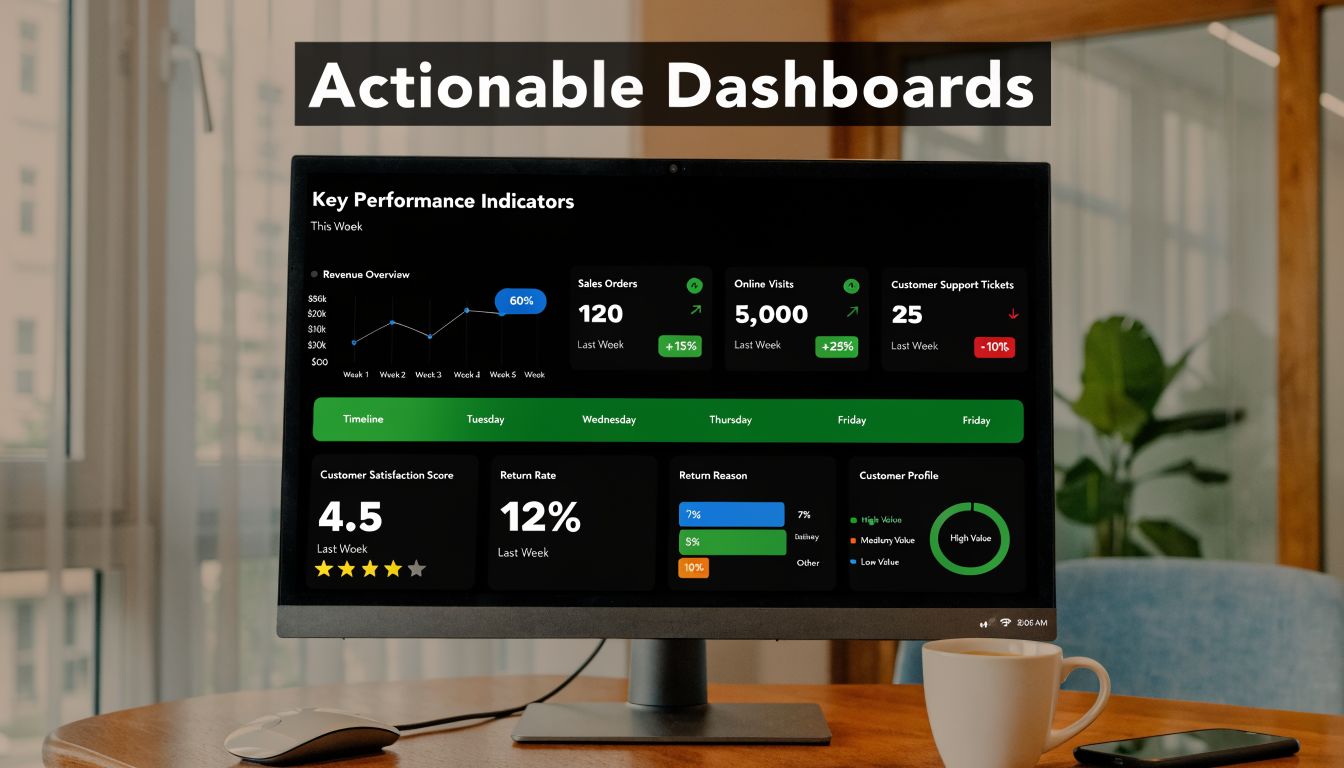
Best Practices for Designing Actionable Dashboards
A dashboard should help someone make a decision quickly. If it needs a meeting to explain what every chart means, the design failed.
Most reporting dashboards are overloaded. They show too many KPIs, too much colour, and not enough accountability. Good dashboard design is simpler and tougher. It shows what matters, what changed, and what needs action now.
Design around the user, not the data dump
A CEO needs a short strategic view. Cash position, profitability direction, receivables pressure, key compliance alerts, and branch comparison are usually enough. An operations manager needs exceptions, delays, and unresolved transactions. An HR manager needs salary-related controls, leave liability, employee movement, and payroll exceptions.
Don't give all three the same dashboard.
The best dashboards answer three questions:
- What is happening now
- Where are we off target
- Who needs to act
A report that only repeats totals is passive. A dashboard that highlights variance is useful.
Use visuals with discipline
Visual choice matters because it changes how quickly management understands the issue. Keep it practical.
- Line charts work for trends such as monthly sales, payroll cost movement, or receivable collection patterns.
- Bar charts are better for branch comparisons, department spending, or top overdue customers.
- Number cards are ideal for urgent KPIs such as bank balance, overdue rent, or open work orders.
- Tables with filters are still essential when managers need drill-down detail rather than a graphic summary.
Show variance and exceptions first
A dashboard should never force management to calculate what went wrong. Build the logic into the view.
For example:
- Budget against actual should be visible at the top for revenue, payroll, and major cost heads.
- Overdue items should be grouped clearly, whether they are invoices, maintenance jobs, lease renewals, or approvals.
- Threshold alerts should be obvious so managers can investigate fast.
For UAE and GCC companies, bilingual presentation also matters. If branch managers, finance staff, owners, and operational teams work in both Arabic and English, the reporting layer must support both without creating duplicate versions. Hinawi ERP handles this naturally because bilingual operation is built into the working environment rather than patched in later.
Protect one source of truth
This is the rule that separates serious MIS from cosmetic reporting. Every dashboard must pull from the same controlled ERP database. Not from a copied Excel file. Not from someone’s desktop report. Not from a manually edited export.
If you break that rule, managers start arguing about whose report is right. Once that happens, the dashboard stops being a management tool and becomes a political document.
Chat on WhatsApp +971506228024Quotation – Demo RequestChat with Hinawi AI
Your Roadmap for Implementing a New MIS
A new MIS doesn't fail because of software alone. It fails because the business doesn't define reporting priorities, clean its data, or enforce process discipline after go-live.
A proper rollout is operational change. Treat it that way.
Start with management questions
Before choosing report formats, define what management needs to know regularly. Not every possible KPI. Only the ones that drive decisions.
Examples include:
- Profitability visibility by branch, department, project, or property
- Cash discipline through receivables, payables, and collection ageing
- Payroll control through variance and exception reviews
- Inventory reliability through movement, valuation, and ageing visibility
- Compliance readiness through VAT, invoicing, and payroll reporting checks
If you don't define these questions first, you'll end up with many reports and very little control.
A useful implementation checklist should also include process ownership and rollout sequencing. Businesses moving from manual work can use a structured work plan for starting software implementation as a practical reference point.
Clean data before you migrate it
Messy customer masters, duplicate suppliers, inconsistent item codes, and weak chart-of-account structures will poison the new MIS on day one. Data cleansing isn't optional. It's one of the main jobs.
The business should agree on:
- Master data standards for customers, suppliers, employees, assets, and items
- Branch and cost centre rules so reporting remains consistent
- Approval flows for transactions that affect compliance or cash
- Document discipline so source transactions are complete before posting
Build reports after processes are stable
Many companies rush into dashboard design too early. First stabilise posting, approvals, masters, and workflows. Then build dashboards that reflect how the business operates.
That sequence matters. Otherwise, management sees reports that look modern but still depend on bad operational habits.
The best MIS implementation is boring in one sense. People stop arguing about data and start discussing decisions.
Train users on responsibility, not only screens
User training should cover more than button clicks. Staff need to understand why timely data entry, correct coding, and complete documents affect management reporting and compliance. When users understand downstream impact, report quality improves quickly.
Local implementation support matters here. GCC businesses often need policy-specific configuration around payroll, VAT, branch structures, Arabic-English reporting, and industry workflows. A generic setup rarely survives real operational pressure.
Take the Next Step with Hinawi ERP
If your current reporting depends on spreadsheet consolidation, informal adjustments, and manual follow-up across departments, you're not running a controlled MIS. You're running a reporting workaround.
Hinawi ERP is a fully integrated ERP software developed since 1998 in Abu Dhabi for businesses in the UAE and GCC. It supports Accounting, HR & Payroll, Real Estate Management, Fixed Assets, Manufacturing, Garage & Maintenance, School Management, CRM, and complete business automation. That breadth matters because management reporting only becomes reliable when operational and financial data flow through one system.
For GCC business owners, the practical benefits are clear:
- VAT and e-Invoicing compliance built into daily operations
- UAE WPS payroll support for cleaner payroll processing and reporting
- Arabic and English bilingual operation across departments
- Flexible company policy settings that reflect how your business works
- Real-time accounting integration across all modules so management doesn't wait for manual consolidation
- Industry fit for factories, contracting companies, real estate businesses, schools, garages, trading companies, and manufacturers
If you want stronger control over profit, payroll, stock, leases, assets, and compliance, modernising your MIS is the right move. Visit Hinawi ERP's official website or request a personalised demo to see how an integrated reporting structure can reduce manual work and improve financial accuracy across your business.
Chat on WhatsApp +971506228024Quotation – Demo RequestChat with Hinawi AI
For UAE and GCC companies that want better reporting, tighter compliance, and real operational control, speak with Explorer Computer LLC – Hinawi Software ERP for consultation or a personalised demo.