
Category: Accounting
A branch in Dubai receives goods against a purchase order entered in Arabic. The warehouse clerk books the receipt in English with a shortened item name. Sales sees stock in one file, finance values it in another, and the VAT trail no longer lines up cleanly. By the time a customer order is due, your team is arguing over spreadsheets instead of shipping goods.
That is how inventory control fails in UAE businesses. Not through one dramatic mistake, but through small data mismatches across branches, warehouses, currencies, and departments. Excel sheets, handwritten bin cards, disconnected POS records, and delayed month-end updates cannot hold together a business that buys in USD, sells in AED, manages bilingual users, and still needs accurate stock valuation and tax records.
The cost goes far beyond a stock count problem. Bad inventory data leads to duplicate purchasing, missed deliveries, pricing errors, margin distortion, and weak management reporting. It also creates compliance exposure. If your item history, landed cost, and movement records are inconsistent, defending VAT treatment during a review becomes harder than it should be.
A modern inventory tracking program fixes the source of the problem. It records stock through actual transactions, receipt, transfer, sale, return, production use, adjustment, and valuation, then pushes the same data into purchasing, sales, and accounts. That matters in the GCC because inventory control is not just a warehouse issue. It has to support bilingual item data, multi-currency purchasing, VAT-ready documentation, and integration with the local systems your business already depends on.
Feature lists alone are not enough. In the UAE, success depends on whether the software vendor can configure the system around your daily operation, train Arabic and English users properly, and connect inventory with accounting, payroll, and local workflows such as WPS. Businesses reviewing warehouse management and stock control processes in the UAE usually reach the same conclusion. Manual tracking creates avoidable risk, and disconnected systems make it worse.
If you want accurate stock, cleaner valuation, faster decisions, and fewer compliance headaches, move inventory control into an integrated ERP and stop running the business on conflicting files.
Chat on WhatsApp +971506228024 Quotation – Demo RequestIntroduction Why Manual Inventory Control Fails in the Modern UAE Market
A trading company in Abu Dhabi doesn't lose control of stock in one dramatic moment. It happens slowly. One transfer between branches isn't recorded properly. One receiving clerk uses a temporary item description in English while purchasing entered the original line in Arabic. One sales return is kept in the warehouse but not posted back into stock. Then month-end arrives, and finance has to reconcile inventory balances that no longer match physical reality.
That's why manual inventory control fails. It depends on people remembering to update files, matching product names consistently, and sharing the same version of the truth across warehouse, sales, purchasing, and accounts. In a UAE business with multiple locations, mixed-language users, imported goods, and VAT-sensitive records, that model breaks down fast.
The real cost is wider than stock variance
When owners think about inventory errors, they usually think about missing stock. That's too narrow. The damage spreads into several areas at once:
- Sales risk: A promised item isn't available when the customer order is due.
- Cash flow pressure: Buyers reorder goods that are already sitting in another branch or warehouse.
- Accounting distortion: Inventory valuation no longer matches what the company physically holds.
- VAT exposure: Transaction trails become difficult to defend during review or audit.
- Management delay: Teams spend time arguing over numbers instead of acting on them.
Manual inventory doesn't fail because staff are careless. It fails because the process asks people to maintain perfect timing and perfect data discipline without system control.
An inventory tracking program solves this by forcing stock movement into a transactional workflow. Receiving updates stock. Transfers update location balances. Dispatch reduces availability. Returns change status. The system becomes the operational record, not a spreadsheet that gets corrected after the fact.
For companies that want predictable control, that shift is no longer optional.
Defining the Modern Inventory Tracking Program
At 4:30 pm, sales promises delivery tomorrow, the warehouse says stock is available, accounts shows a different value, and the owner is left asking a basic question no one can answer with confidence. How many units do we have, where are they, and what is their true cost in AED right now? That is the point of an inventory tracking program. It records stock as a controlled business transaction, not as a spreadsheet correction made after the fact.

One operational record across stock, cost, and compliance
A modern inventory tracking program creates one operational record for every item movement. Purchase receipt, warehouse transfer, sales dispatch, return, adjustment, and write-off all post against the same item ledger. Quantity, location, batch or serial reference, status, valuation, and user history stay connected.
That matters more in the UAE than many software vendors admit. Your team may enter item names in Arabic and English. Suppliers may bill in USD, EUR, or RMB while management wants stock valuation in AED. Finance needs VAT-ready documentation. Payroll, purchasing, and accounting often sit in separate systems. If the inventory program cannot handle bilingual item data, multi-currency costing, and clean integration with local workflows, including inventory accounting software in the UAE, you will still be fixing errors manually. You will just be fixing them inside a prettier screen.
Real-time control changes how decisions get made
Periodic stock counts have a place. They do not run the business day to day.
A proper system updates stock when the transaction happens. Receiving increases available quantity. A transfer reduces one location and increases another. Picking reserves stock. Dispatch relieves inventory and pushes the accounting entry through the ERP. That is how you stop sales, warehouse, and finance from working off different numbers.
The practical difference is easy to see:
| Question | Manual method | Modern inventory program |
|---|---|---|
| What is on hand right now | Usually estimated | Posted from live transactions |
| Which branch has saleable stock | Checked by calls, messages, or sheets | Visible by warehouse and status |
| Why did quantity change | Often unclear | Traced by user, date, and document |
| Does stock value match finance | Often delayed or adjusted later | Synced through ERP posting logic |
Success depends on fit, support, and local integration
Software features alone do not solve inventory problems. Implementation discipline does.
Choose a program that fits how your business operates in the GCC. It should support bilingual master data without duplicate item creation. It should handle landed cost and foreign currency purchases cleanly. It should produce transaction records that finance can defend during VAT review. It should connect properly to the rest of your operation, including accounting, purchasing, sales, and any local processes that affect payroll and administration, such as WPS-linked workflows.
Vendor support matters just as much. If your team cannot get fast answers during setup, stock migration, barcode rollout, or month-end reconciliation, the project slows down and users return to Excel. A serious inventory program gives you control. A serious vendor makes sure that control survives after go-live.
Core Features That Drive Operational Excellence
Most buyers make the same mistake. They ask for a feature list, compare brochures, and assume the system with the longest list is the safest choice. That's not how inventory selection works. What matters is whether each function solves a real operational problem inside your business.
Barcode and RFID event capture
In the UAE, real-time inventory tracking is most valuable when tied to barcode or RFID event capture and multi-location stock ledgers. Each scan updates on-hand quantity, item status, and warehouse location immediately, creating tighter control between receiving, put-away, picking, and dispatch, as explained in this review of inventory software features.
That matters because manual entry creates delay and inconsistency. A paper receiving note can sit for hours before someone posts it. A scanned receipt updates stock immediately. A transfer executed without scan confirmation leaves stock in the wrong place on the system. A scan-based workflow stops that drift.
Multi-location stock control
If your company has a warehouse in Dubai, a branch in Abu Dhabi, and a smaller stock point in Sharjah, one total quantity is useless. You need to know where the item is, what status it's in, and whether it is saleable, reserved, damaged, in transit, or awaiting inspection.
A proper inventory program should support:
- Warehouse-level balances: Stock by location, not just company total.
- Transfer control: Movement between stores, vans, sites, and branches.
- Status visibility: Available, committed, returned, blocked, or damaged stock.
- Branch accountability: Clear ownership of discrepancies and operational delays.
Reorder logic and stock discipline
Stock control isn't just about counting what you have. It's about deciding what to buy next, when to buy it, and how much to hold. Reorder thresholds, item movement history, and branch-level visibility help purchasing teams avoid panic buying and unnecessary overstock.
If you're already working on safety stock calculation for business continuity, your inventory tracking program should support that discipline inside daily operations instead of leaving planners to maintain separate spreadsheets.
Practical rule: If your replenishment process sits outside the inventory system, your purchasing team is still guessing.
Traceability and exception handling
Lot tracking, serial control, and transaction history matter more than many SMEs realise. They aren't just for pharmaceuticals or high-end electronics. They matter anywhere the business needs to trace what was received, issued, returned, or replaced.
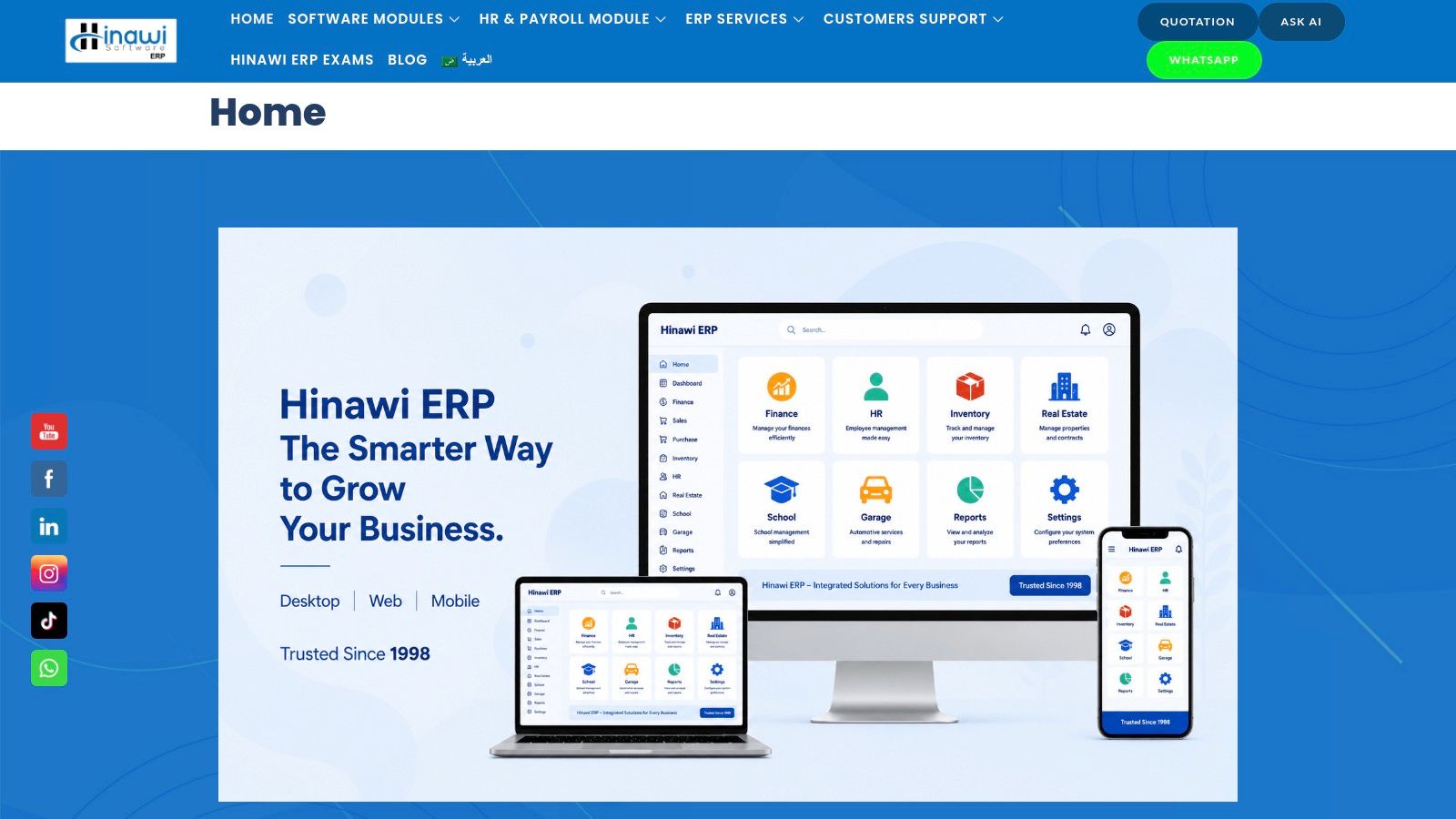
Integrated ERP tools demonstrate their usefulness. One example is Hinawi ERP, which includes inventory inside a broader system that connects accounting, purchasing, HR, payroll, fixed assets, and business operations. That matters because inventory accuracy becomes stronger when warehouse movements don't sit in a disconnected application.
Translating Features into Tangible Business Benefits
A Dubai trading company closes the month believing it has profitable stock on hand. Then finance finds valuation errors, sales discovers promised items are not available, and the VAT trail does not fully match the physical movement of goods. That is what manual inventory control does. It gives management false confidence until the numbers are tested.
Better stock accuracy means stronger financial control
Inventory accuracy is not a warehouse KPI in isolation. It shapes cash flow, purchasing decisions, margin reporting, and tax records.
If your item quantities are wrong, your replenishment decisions are wrong. If your item costs are wrong, your profitability reports are wrong. In a UAE business importing goods in multiple currencies, one bad receipt or manual adjustment can distort landed cost, stock valuation, and selling decisions across several branches.
This is why inventory turnover ratio analysis for stock efficiency matters. The ratio only helps if the underlying quantities and values are reliable. A modern inventory tracking program gives management numbers they can act on, not numbers they have to question.
The return shows up in operations, finance, and compliance
A good system pays for itself through fewer errors and faster decisions.
- Less cash trapped in slow-moving stock: Buyers stop ordering based on guesswork or outdated branch reports.
- Fewer avoidable stockouts: Sales teams promise based on live availability, not yesterday's spreadsheet.
- Lower month-end cleanup: Finance spends less time fixing quantity mismatches, valuation issues, and posting corrections.
- Better VAT support: Inventory transactions are recorded with a clear audit trail, which makes reviews and reconciliations far easier.
- Stronger branch control: Head office can see which branch is overstocked, understocked, or creating repeated adjustment issues.
That is real ROI. It reduces waste, protects margin, and cuts administrative effort.
Accuracy has higher stakes in the UAE and GCC
GCC businesses deal with operating friction that many generic software vendors ignore. Item masters often need Arabic and English descriptions. Purchases may be raised in one currency and valued in another. VAT treatment must stay consistent across purchasing, inventory, and invoicing. If the inventory program does not integrate properly with accounting, payroll, and local operating systems such as WPS-linked processes, errors move from one department to the next instead of being fixed at source.
Vendor support matters as much as the feature list. If your team cannot get fast help with bilingual setup, local tax workflows, user permissions, or integrations, the software will decay into workarounds. Then you are back to spreadsheets, manual checks, and delayed reporting.
The cheapest inventory process usually creates the most expensive corrections later.
Chat on WhatsApp +971506228024 Quotation – Demo RequestYour Checklist for Selecting a Program in the UAE and GCC
A feature-rich system can still fail in the first six months if it doesn't fit GCC operating reality. Many businesses make an expensive mistake by choosing software based on generic demos, only to discover later that the core problem wasn't missing screens. It was weak fit.

Decision-makers often ask, “Will it stay accurate after implementation?” That's the right question. The biggest risk isn't a lack of features. It's poor data quality at the point of capture, especially when warehouses, branches, exceptions, and bilingual workflows are involved, as noted in this discussion of inventory accuracy risk and loss prevention.
What to check before you sign
Use this checklist during evaluation:
- Bilingual operation: Arabic and English item names, user screens, and documents must work properly. If warehouse users and accounts staff enter data differently, your stock master will become messy fast.
- Multi-currency and landed cost support: If you import goods, the system must handle valuation logic properly. Otherwise, your stock value and profitability reports will be misleading.
- VAT and e-invoicing readiness: Inventory has to support the accounting side, not live in isolation.
- Multi-branch structure: The system must handle branch transfers, separate balances, and central visibility without manual consolidation.
- Exception tolerance: Returns, partial receipts, damaged items, wrong scans, and stock adjustments must be handled cleanly.
- Local support capability: When a live issue affects dispatch or month-end closing, you need fast support from people who understand UAE workflows.
Vendor fit matters more than brochure quality
A poor support model can destroy a good software product. If your business operates in Abu Dhabi, Dubai, Al Ain, or across GCC branches, you need implementation support that understands local accounting expectations, warehouse discipline, bilingual documentation, and payroll links such as WPS in the wider ERP environment.
Here's the practical test. Ask the vendor how they handle mis-scans, duplicate items, branch transfers under pressure, Arabic item search, and stock valuation issues after returns. Their answer will tell you more than the demo ever will.
Software doesn't create control by itself. The vendor's implementation method, support quality, and willingness to deal with messy real-world behaviour decide whether the system stays accurate.
Implementation Roadmap and Best Practices
Go live with dirty item data, weak warehouse discipline, and vague ownership, and your new inventory system will fail in the first month. The software will process transactions. Your team will still create errors faster than finance can clean them up.

For UAE and GCC businesses, implementation has to deal with local operating reality from day one. That includes Arabic and English item descriptions, branch-specific stock rules, supplier purchases in different currencies, and VAT treatment that matches the accounting entries. Analysts at NetSuite explain that inventory systems are stronger when traceability and cycle counting connect directly with ERP records, which improves discrepancy control and financial reconciliation in regulated environments, according to this overview of inventory management system features.
Start with control, not configuration
Do not begin with screen setup. Begin with operating rules.
Decide who can create item codes, who can approve adjustments, how returns are classified, when branch transfers become in-transit stock, and how damaged goods are separated from saleable stock. If these decisions stay informal, the system will mirror the same confusion you had in spreadsheets.
Master data comes next. Clean duplicate SKUs. Standardise units of measure. Fix Arabic and English naming so search works properly for both warehouse and front-office users. Mark which items need serial numbers, batch tracking, expiry dates, or restricted movement between branches.
Build integrations before users invent workarounds
An inventory program must post cleanly into purchasing, sales, finance, and the wider ERP environment. If payroll, HR, or branch operations already rely on tools such as WPS-linked processes, your implementation team needs to understand those dependencies before go-live. Otherwise, staff will start exporting data, correcting journals manually, and bypassing controls the moment pressure hits.
Use this rollout sequence:
- Clean and govern item, supplier, and location data
- Map real transaction flows, including returns, partial receipts, and damaged stock
- Set valuation, tax, and approval rules
- Test accounting entries for receipts, issues, transfers, and adjustments
- Confirm integrations with the wider ERP stack
- Train users by role using live business scenarios
- Go live with daily monitoring and weekly exception review
Train for exceptions
Basic training is not enough. Staff already know how to click through screens. What they need is instruction on what to do when the shipment is short, the barcode is wrong, the supplier invoice is in another currency, the branch sends back damaged stock, or the physical count does not match the system.
That is where projects either stabilise or break.
Run training by role. Warehouse teams should practise receiving, picking, transfers, and adjustments on actual items. Finance should verify how each transaction affects stock value, cost of sales, and VAT reporting. Branch staff should learn strict transfer and return procedures, not informal phone approvals.
| Implementation area | Common mistake | Better approach |
|---|---|---|
| Master data | Duplicate codes, weak bilingual naming | Central item governance with Arabic and English standards |
| Receiving | Posting from paper later | Record receipts at the point of receipt |
| Multi-currency purchasing | Manual value corrections after posting | Test currency, landed cost, and valuation rules before go-live |
| Branch transfers | Untracked movement between locations | Use transfer requests, dispatch, receipt, and in-transit status |
| Stock counts | Infrequent full counts only | Set cycle counts by item class and variance risk |
| User adoption | Generic training session for everyone | Role-based training with real exceptions and supervisor sign-off |
| Support after go-live | Vendor disappears after setup | Weekly review of issues, fixes, and user compliance |
The best implementation partner is not the one with the cleanest demo. It is the one that stays involved after go-live, fixes transaction logic under pressure, and understands how UAE businesses operate across warehouse, finance, payroll, and compliance.
Chat on WhatsApp +971506228024 Quotation – Demo RequestExample A Dubai Trading Company's Transformation
Consider a realistic Dubai trading business operating from Jebel Ali with two branch outlets and a central warehouse. Before system change, the company runs inventory through spreadsheets, emailed transfer requests, and periodic manual counts. Sales staff often call the warehouse directly to “confirm” availability because nobody trusts the reported balance. Purchasing keeps extra stock as a safety measure because they don't trust it either.
The result is predictable. Fast-moving items run out unexpectedly. Slow-moving items pile up. Returned goods sit in a corner waiting for someone to update the spreadsheet. Finance spends days trying to explain why stock valuation doesn't align with the physical count. Management meetings revolve around data disputes instead of action.
What changed after implementation
The company moves to an integrated inventory tracking program with barcode-driven receiving, transfer control, branch-level visibility, and accounting integration. The first big improvement isn't reporting. It's trust. Staff stop relying on side conversations and start relying on transactions.
Receiving updates stock immediately. Dispatch reduces stock at the moment of issue. Transfers between warehouse and branches follow a controlled workflow. Returns go into defined statuses instead of disappearing into operational grey areas.
The practical outcome
The business becomes easier to run.
- Sales gains confidence because available stock is visible by location.
- Purchasing buys more rationally because reorder decisions are based on current balances, not assumptions.
- Finance closes faster because inventory postings and valuation are no longer managed separately.
- Management sees exceptions sooner because discrepancies appear as process issues, not month-end surprises.
This kind of transformation is common when the company stops treating inventory as a warehouse-only matter and starts treating it as a core financial control process.
Take the Next Step with Hinawi ERP
A warehouse clerk posts receipts in English. Finance reviews item names in Arabic. Purchasing buys in USD. Sales invoices in AED. Payroll runs through WPS. Then month-end arrives and your stock value, VAT trail, and actual quantities do not match. That is what manual inventory control does to a UAE business. It creates avoidable errors across operations and finance, then forces management to spend time cleaning them up.
You need an inventory system that fits how companies in the UAE and GCC operate. That means real-time stock control tied to accounting, bilingual Arabic and English use, multi-currency handling, VAT and e-invoicing support, and integration with the rest of the business. Features on a brochure are not enough. If vendor support is weak or local workflow setup is poor, the project fails after go-live.
Hinawi ERP was developed in Abu Dhabi and built for businesses that run under real operational pressure, including trading, contracting, manufacturing, real estate, schools, garages, and service-heavy environments. If you are evaluating a UAE ERP system for inventory and operations control, judge it on the issues that affect profit and compliance every day. Can it keep stock, purchasing, sales, finance, VAT, and payroll aligned without duplicate entry? Can the vendor configure it for your process and support your team after implementation?
Choose a system that reduces correction work, closes books faster, and gives management figures they can trust. Then act on it.
Chat on WhatsApp +971506228024 Quotation – Demo RequestA CTA for Explorer Computer LLC – Hinawi Software ERP.