
Category: Accounting
If you're still closing inventory with spreadsheets, WhatsApp confirmations from the warehouse, and last-minute accountant adjustments before VAT filing, you're taking unnecessary risk. I see this pattern across trading companies, distributors, factories, and contracting businesses in the UAE and wider GCC. Stock exists physically, but the financial records don't match. Purchase costs sit in one file, warehouse transfers in another, and the final numbers are patched together at month end.
That isn't inventory control. It's delayed damage control.
Inventory accounting software matters because inventory isn't just an operations issue. It's a balance sheet issue, a tax issue, a pricing issue, and often a cash flow issue. In the GCC, those problems get sharper when you add VAT treatment, landed costs, multiple warehouses, bilingual teams, and management pressure for fast reporting. A system built for this environment needs to connect stock movement directly to accounting, not leave your finance team to reconcile the mess afterwards.
Many business owners also make the wrong comparison. They compare software licence cost against their current manual process. They should compare it against inventory errors, audit exposure, delayed reporting, excess stock, stockouts, and staff time spent fixing journals. That changes the conversation quickly.
The True Cost of Inaccurate Inventory in the GCC
A Dubai trading company reaches quarter end. The warehouse team is counting cartons manually. The accounts department is waiting for final stock valuation. Sales has already issued urgent deliveries from another location. Purchasing has booked incoming goods, but freight and customs charges are still outside the inventory value. The VAT filing deadline is close, and nobody is fully confident that the inventory figure on the balance sheet reflects reality.
That scenario is common because many SMEs still haven't properly systemised inventory. Among SMEs in the UAE and GCC, only 18% use dedicated inventory management solutions, while 43% either don't track inventory or still rely on manual methods, according to inventory management statistics for SMEs. The same source notes that inventory distortion contributes to $1.1 trillion in global losses annually. In the GCC, the consequences are worse because stock errors spill directly into VAT treatment, purchasing decisions, and customer fulfilment.

What inventory accounting software actually does
A lot of owners think inventory accounting software is just a stock list with quantities in and out. That's too narrow.
Proper inventory accounting software connects five things in one controlled process:
- Physical movement of goods through receipt, issue, return, and transfer
- Cost valuation using a consistent accounting method
- Financial posting into the general ledger
- Tax treatment for purchases, sales, write-offs, and adjustments
- Management reporting for margin, ageing, and stock availability
If one of those sits outside the system, accuracy falls apart.
Why GCC businesses feel the pain faster
A UAE or Saudi business rarely operates in a simple, single-location model. You may have a warehouse in Abu Dhabi, a branch in Dubai, customers in Al Ain, imports arriving through Jebel Ali, and management asking for profitability by item, branch, and customer. If your inventory data is late or incomplete, your margin analysis becomes unreliable. You can review gross margin basics in practical terms all day long, but if inventory cost is wrong, gross margin is wrong.
Practical rule: If your stock quantity is updated today but your accounting impact is posted next week, you don't have control. You have lag.
Regional ERP design is essential in this context. A GCC business needs inventory accounting software that can handle Arabic and English operations, warehouse transfers, VAT-aware transactions, and the accounting consequences of every stock movement without relying on spreadsheets after the fact.
Chat on WhatsApp +971506228024 Quotation – Demo Request
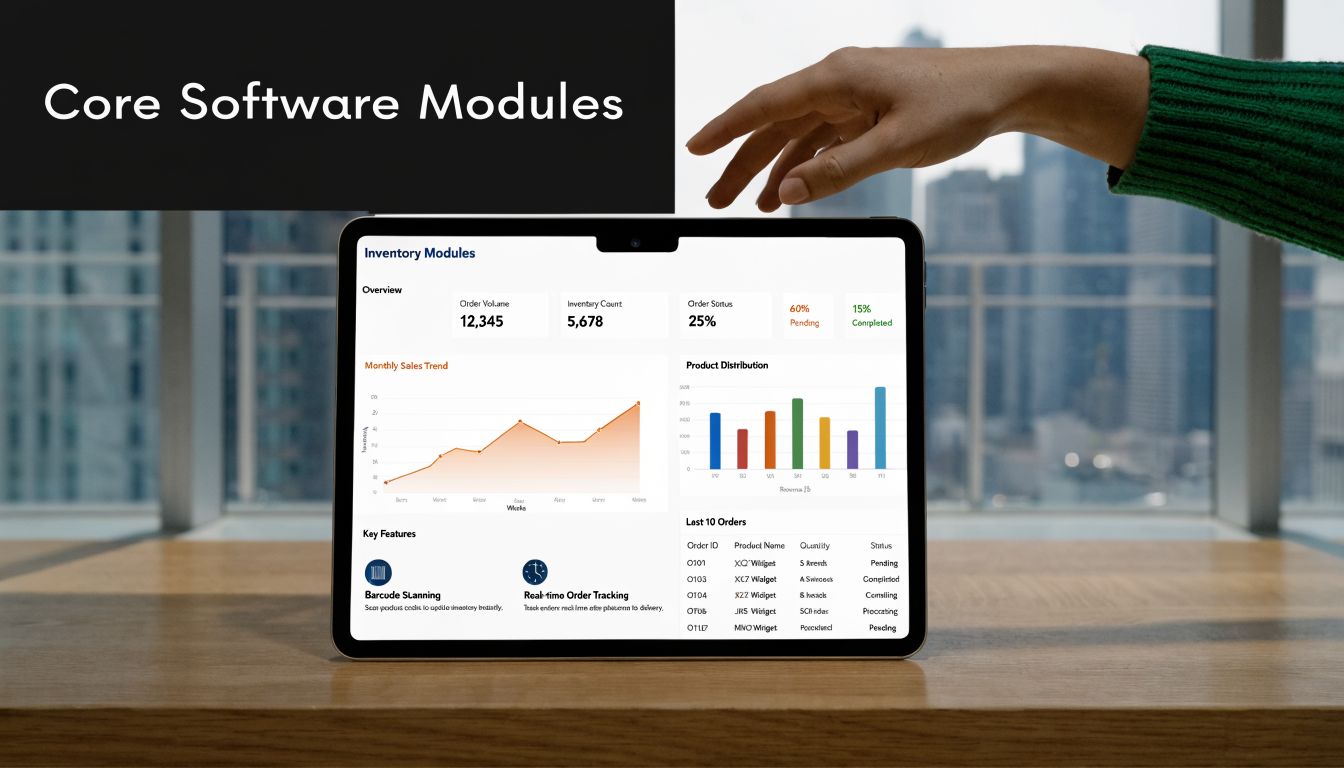
Core Modules Your Inventory Accounting Software Must Have
If a vendor shows you a clean dashboard and a stock summary report, don't be impressed yet. Ask how the system values stock, handles branch transfers, allocates landed cost, and posts adjustments to accounts. That's where weak systems fail.
Valuation methods that finance can defend
Inventory valuation isn't an accounting side note. It determines cost of goods sold, gross profit, and closing stock.
Two methods matter in day-to-day GCC operations:
- FIFO works like a grocery shelf. The oldest stock goes out first for costing purposes. This usually makes sense when purchase prices move regularly and stock rotation matters.
- Weighted average blends purchase cost across available quantity. This often suits import-heavy businesses buying the same item repeatedly at varying landed prices.
A serious system must let your finance team choose the appropriate method and keep it consistent. It should also stop users from making operational transactions that bypass valuation logic.
Multi-warehouse control is not optional
If you store goods in more than one location, you need stock visibility by warehouse, not just by item code. That includes goods in transit, branch transfers, reserved stock, and available quantity for sale. Businesses with multiple stores can review how multi-warehouse inventory handling works in practice when assessing whether a system fits regional branch operations.
Without proper warehouse structure, two bad habits appear fast. Sales promises stock that doesn't exist in that location. Finance values stock globally even though branch-level shortages and overstocking are hidden.
Lot and serial tracking for audit and service control
This matters more than many owners realise.
You need lot or batch tracking if you deal in expiry-sensitive or traceable products such as food ingredients, chemicals, pharmaceuticals, or regulated consumables. You need serial number tracking if you sell electronics, equipment, machinery parts, or assets that may come back for warranty or maintenance.
If you can't trace what batch was received, where it moved, and which invoice it was sold on, your audit trail is weak before the auditor even starts asking questions.
Landed cost allocation for imported goods
A surprising number of companies still value imported items at supplier invoice price and leave freight, duty, handling, and clearing charges outside stock cost. That distorts margin and gives management the wrong profitability picture.
Your system should allocate landed cost into inventory before sale, not leave accountants to post manual adjustments later. This is particularly important for importers and distributors whose real cost sits across several documents and several service providers.
Automated reconciliation and cycle counts
Manual stock count sheets are still necessary in some environments, but the posting process should be system-driven. Good software supports cycle counting, physical adjustments, approval controls, and audit logs.
Use this quick checklist when reviewing a system:
| Module | What to verify |
|---|---|
| Valuation | FIFO or weighted average is built into the accounting logic |
| Warehouses | Transfers, reservations, and branch-level quantities are visible |
| Tracking | Batch, lot, serial, and expiry fields are available where needed |
| Landed cost | Freight, duty, and related import charges can be allocated to items |
| Reconciliation | Count variances post through controlled inventory journals |
Chat on WhatsApp +971506228024 Quotation – Demo Request
Unlocking Business Benefits and Financial ROI
Software decisions should be justified in financial terms. Inventory accounting software earns its place when it improves cash discipline, reduces reporting errors, and gives management cleaner control over margin.
The strongest business case starts with stock-holding cost. GCC-focused ERP adoption benchmarks show that integrating real-time stock tracking with financial modules can reduce stock-holding costs by 7–12%, according to GCC ERP and inventory accounting benchmarks. The same source notes that UAE firms using these systems report 15–20% fewer journal errors because inventory valuation entries are automated.
Where the return actually comes from
The return doesn't come from “having software”. It comes from replacing broken habits.
- Excess stock falls because reorder decisions are based on system quantities, not guesswork.
- Month-end closes become cleaner because inventory journals are created through transactions, not manual rework.
- Profitability analysis improves because item cost includes the right valuation logic.
- Finance and operations stop arguing about whose numbers are correct.
That has a direct effect on working capital. Slow-moving stock ties up cash. Wrong valuation hides margin problems. Delayed postings weaken management reports.
Better numbers lead to better decisions
A business owner doesn't need more reports. They need reliable reports. If stock values are wrong, gross profit by item, category, or branch becomes misleading. That's why inventory accounting software should be part of financial control, not treated as a warehouse tool.
If you're reviewing item profitability, gross profit calculation in an ERP context matters because sales margin only becomes useful when the underlying stock cost is trustworthy.
Advisor's view: The cost of weak inventory accounting rarely appears as one big disaster. It leaks out through pricing mistakes, duplicated purchases, stock shortages, and accountant time spent fixing avoidable entries.
There's another ROI angle many firms ignore. Banks, auditors, and investors trust businesses that can produce consistent stock valuation and clear supporting records. A company with organised inventory accounting presents lower operational risk than a company that needs three departments to explain one closing stock figure.
The Power of an Integrated Business Ecosystem
Standalone inventory tools create another silo. They may track quantity well enough, but they often leave accounting, tax, payroll-related workflows, and reporting disconnected. That's a poor fit for GCC businesses where compliance and branch operations sit close together.

What integration should look like in real life
A sales invoice should do more than generate revenue. It should reduce available stock, create the correct cost entry, calculate VAT correctly, and update receivables. A purchase receipt should do more than increase quantity. It should update stock value, recognise supplier liability, and preserve the audit trail for landed costs and later adjustments.
That only happens when inventory sits inside an integrated ERP framework.
One practical example is Hinawi ERP, developed by Explorer Computer LLC in Abu Dhabi since 1998, which integrates accounting, inventory, VAT support, HR and payroll, manufacturing, fixed assets, CRM, and other business modules in one structure. For businesses comparing architecture rather than marketing claims, it helps to review how integrated supply chain and stock processes connect across ERP functions.
Chat on WhatsApp +971506228024 Quotation – Demo Request
Why VAT and e-invoicing depend on inventory structure
For VAT-compliant companies in the UAE and KSA, software with batch or lot tracking and landed-cost allocation can reduce VAT-related valuation corrections by 20–35% during audits, because the system can reproduce an auditable trail for each item's movement and cost, according to regional guidance on inventory software audit controls.
That matters because audit defence isn't just about tax codes. It's about proving how a stock item moved, how it was costed, and why its write-down or adjustment was recorded the way it was.
WPS and payroll still belong in the conversation
Many owners ask why payroll matters in an article about inventory accounting software. It matters because GCC businesses don't run in isolated modules.
Consider these common links:
- Sales commissions may depend on invoiced and delivered stock
- Production incentives may relate to completed output and material usage
- Warehouse overtime affects fulfilment periods and cut-off discipline
- WPS-compliant payroll requires clean employee and cost-centre structure
If inventory, accounting, and payroll are disconnected, management loses the full operational picture. An integrated ERP helps finance trace the commercial transaction all the way from stock movement to ledger impact to payroll-linked cost centre reporting.
Strong ERP design removes repeat data entry. It also removes excuses when figures don't match.
How to Select the Right Software for Your GCC Business
Most software shortlists are built the wrong way. Owners compare screens, prices, and generic feature lists. They should compare regional fit, accounting depth, and implementation capability.

A major gap in global software reviews is that they miss multi-jurisdiction GCC compliance, especially where different VAT rates, e-invoicing mandates, and multiple currencies have to be handled together, as explained in this analysis of inventory accounting software gaps for GCC businesses.
The shortlist criteria I would insist on
If you're operating in the UAE, Saudi Arabia, Qatar, or across multiple GCC markets, don't compromise on these points:
Local compliance fit
The system must support VAT workflows, e-invoicing realities, and auditable inventory valuation. If this is weak, the rest of the features don't matter.Bilingual usability
Arabic and English operation isn't a cosmetic preference. It's often necessary across finance, stores, HR, and management.Multi-currency and branch capability
Your inventory accounting software should handle transactions in the currencies you operate with while preserving cost logic and financial reporting discipline.Real implementation support in the region
Remote support from another time zone sounds fine during sales calls. It becomes a problem during go-live, quarter-end, or audit prep.
Questions to ask every vendor
Ask these directly and don't accept vague answers:
| Question | Why it matters |
|---|---|
| How are landed costs allocated into inventory? | This affects item profitability and stock valuation |
| What happens to the ledger when stock is transferred, adjusted, or returned? | You need accounting integrity, not just quantity updates |
| Can the system support multiple warehouses and branch controls? | GCC operations often span several locations |
| How are VAT and e-invoicing requirements reflected in stock transactions? | Compliance depends on transaction structure |
| How is payroll or WPS-related reporting linked to cost centres or departments? | Integration matters for management reporting |
Don't buy a foreign workflow and force your team into it
Generic international software often looks polished but assumes a simpler operating model. A GCC business may need bilingual printouts, VAT-specific handling, local payroll support, branch-driven stock transfers, BOQ-related material flows, or contractor-style approval chains. If the software doesn't fit those realities, your team will build workarounds outside the system.
That's when software becomes expensive without becoming useful.
Your Implementation and Data Migration Checklist
A weak implementation can ruin a good software choice. Most inventory accounting failures aren't caused by the system itself. They're caused by dirty item masters, unclear warehouse rules, and users who were never trained on the accounting impact of their actions.
Clean data before you migrate
Do not migrate bad data and expect clean reporting.
Start with your item master. Remove duplicates. Standardise units of measure. confirm which items require serial numbers, batches, expiry dates, or variants. Decide which warehouses are active and which are legacy. If you need to move structured opening data into a new ERP, study the discipline behind importing lists and opening balances into business software.
Map the real process, not the ideal one
Many companies describe the process they wish they had, not the process staff follow. That's a mistake.
You need to document:
- How purchasing is approved
- How goods are received
- How landed cost is captured
- How stock is issued, transferred, or returned
- How finance reviews and closes inventory journals
Then redesign only what needs fixing. Don't automate chaos.
Implementation rule: If your warehouse team, purchasing team, and finance team define the same transaction differently, resolve that before go-live.
Train by role, not by module
A storekeeper doesn't need a finance lecture. A chief accountant doesn't need a bin-location tutorial. Train users based on what they do and what errors they can create.
Focus on these areas:
- Warehouse users should learn receiving, transfers, counts, and item identification rules
- Purchasing users should learn how cost and landed charges flow into stock
- Finance users should understand valuation, journals, cut-off, and reporting checks
- Managers should learn approval controls and exception reporting
Protect the go-live period
Go-live needs controls. Freeze unnecessary master changes. Define opening balances clearly. Keep experienced support available. Run parallel checks for critical reports until the team is confident.
The first goal isn't fancy analytics. It's transaction discipline.
Chat on WhatsApp +971506228024 Quotation – Demo Request
Take the Next Step with Hinawi ERP
If your business still treats inventory as a separate warehouse problem, you're leaving finance, compliance, and management reporting exposed. GCC businesses need more than barcode scanning or a basic stock ledger. They need inventory accounting software that reflects how the region operates. That means VAT-aware transactions, e-invoicing readiness, landed cost handling, multi-warehouse control, bilingual use, and integration with payroll and financial reporting.
Hinawi ERP fits that requirement because it was developed in Abu Dhabi since 1998 for businesses operating in the UAE and GCC. It isn't limited to inventory. It supports Accounting, HR & Payroll, Real Estate Management, Fixed Assets, Manufacturing, Garage & Maintenance, School Management, CRM, and broader business automation in one integrated environment. That matters because businesses don't run in isolated departments. Stock affects accounting. Payroll affects cost centres. Real estate billing affects receivables. Fixed assets affect depreciation and financial statements.
For decision-makers, the practical benefits are clear:
- VAT and e-Invoicing compliance built into operational workflows
- UAE WPS payroll support for HR and salary processing discipline
- Arabic and English bilingual operation for mixed teams and management
- Flexible company policy settings to match your internal controls
- Real-time accounting integration across all modules so transactions don't wait for manual posting
- Suitability across sectors including factories, trading companies, manufacturers, contractors, real estate businesses, schools, and garages
If you're running a factory, a distribution company, a contracting business, or a multi-branch trading operation, manual fixes won't solve a structural problem. You need a system that reduces repeated data entry, improves financial accuracy, and gives management direct visibility into what is happening across the business.
Chat on WhatsApp +971506228024 Quotation – Demo Request
Visit Hinawi ERP's official website or request a personalised demo if you want to assess your inventory accounting process properly and modernise it with a system built for UAE and GCC operating realities.
Speak with the team at Explorer Computer LLC – Hinawi Software ERP if you want a practical discussion about replacing manual inventory control, improving VAT and e-invoicing compliance, integrating WPS payroll, and bringing accounting, stock, HR, real estate, manufacturing, and operational reporting into one ERP environment.