Category: Accounting
A Dubai contracting company wins work, signs subcontracts, approves variations, and issues invoices. On paper, the business looks organised. In practice, the contracts sit in email threads, approval evidence is split across WhatsApp and inboxes, and finance only sees the final signed PDF after key terms have already been agreed. Then significant problems arise. A milestone invoice goes out late. A retention clause is missed. A renewal date passes without review. VAT treatment has to be checked manually because nobody trusts the contract summary.
That's where most UAE and GCC businesses still are. Not because they lack software, but because they treat contracts as legal files instead of operational records. That approach no longer works. Contracts now affect billing, procurement, project control, fixed asset commitments, vendor obligations, and audit readiness.
A proper contract lifecycle management process fixes that. It gives the business one controlled path from request to drafting, approval, execution, obligation tracking, amendment, renewal, and reporting. For companies already running finance, projects, HR, or real estate operations inside an ERP, this matters even more. If contract terms don't connect to the rest of the system, the business is still exposed.
For UAE businesses dealing with VAT controls and digital audit expectations, disconnected contract handling is a weak point. That's why many firms reviewing their VAT-compliant ERP approach in the UAE are also being forced to rethink how contracts move through the business.
Chat on WhatsApp +971506228024 Quotation – Demo Request
The Modern Imperative for Contract Management in the GCC
Contracts now drive operations, not just legal review
A branch manager in Abu Dhabi approves a supplier agreement by email. Procurement uploads one version to a shared folder. Finance in Dubai invoices from a different commercial assumption. At quarter end, nobody can prove which payment terms, approval path, or renewal dates were authorised.
That is the fundamental contract problem in the GCC. It is not a document storage issue. It is an operating model issue.
Historically, contract handling in the GCC was treated as a back-office, manual process. That worked when businesses were smaller, approvals were local, and tax and audit requirements were less demanding. It fails in multi-branch groups, project-based contracting companies, property portfolios, and procurement-heavy operations where contract terms directly affect billing, retention, notices, penalties, and vendor commitments.
The pressure is now coming from finance and compliance as much as legal. In the UAE, structured digital records, VAT controls, and e-invoicing preparation are forcing companies to connect contract terms to the systems that generate purchase orders, invoices, approvals, and audit trails. Businesses already reviewing a VAT-compliant ERP system for UAE operations should treat contract management as part of the same control framework, not as a separate admin task.
Practical rule: If finance has to re-read a signed PDF to understand billing terms, your contract process is broken.
Why GCC companies feel the pain first
GCC businesses often carry more operational complexity inside each contract than companies realise. A trading company may buy centrally and receive goods across several branches. A real estate firm may track lease escalations, fit-out periods, notice dates, service obligations, and tenant renewals. A contracting company may depend on milestone billing, variation orders, subcontract back-to-back terms, retention release, and performance guarantees.
In each case, the contract controls cash flow, timing, and compliance.
The warning signs are easy to spot:
- Missed renewals: Teams rely on Outlook reminders or personal memory.
- Approval gaps: Decisions happen in email or WhatsApp, but the final authorised chain is unclear.
- Billing errors: Finance invoices based on operational assumptions instead of signed terms.
- Version confusion: The executed copy does not match the negotiated commercial position.
- Audit exposure: Supporting evidence exists, but it sits across folders, inboxes, and disconnected systems.
A disciplined contract lifecycle management process fixes this by putting requests, approvals, executed terms, obligations, and renewals into one controlled record. For GCC companies using ERP to run finance, procurement, projects, assets, or property operations, the standard should be higher. CLM must sit inside the transaction flow.
That is where an ERP platform such as Hinawi changes the outcome. Contract approvals can follow branch and authority rules. Commercial terms can feed billing and procurement. VAT treatment can stay aligned with the signed agreement. Management gets one audit trail instead of a chain of screenshots, PDFs, and email threads.
For a GCC business owner, the recommendation is simple. Stop treating contracts as legal paperwork. Run them as operational data.
The Nine Stages of Effective Contract Lifecycle Management
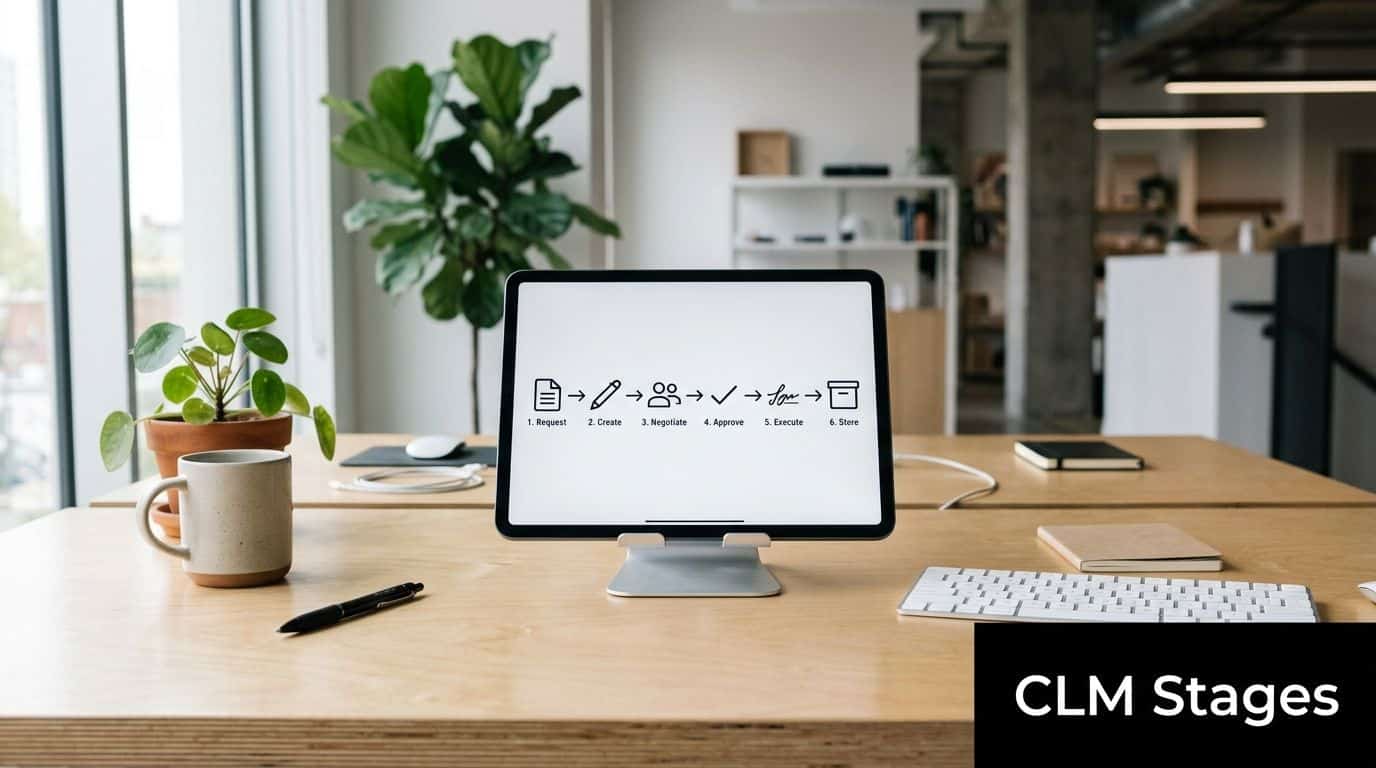
A mature contract lifecycle management model is typically a nine-stage process: intake/request, authoring/drafting, negotiation, approvals, signature/execution, obligation and performance management, amendments, renewal or termination, and archival/analytics, with automation around clause libraries, templating, workflow routing, metadata extraction, redlining, and integration into downstream systems, as described in this JAGGAER guide to CLM stages and capabilities.
The pre-signature stages
The first five stages determine whether the contract enters the business cleanly or creates problems from day one.
Intake and request
Someone initiates the need for a contract. This should capture contract type, parties, commercial purpose, branch, value owner, and required timeline. If intake is informal, every downstream step suffers.Authoring and drafting
Drafting should start from controlled templates, not old Word files copied from previous deals. Standard terms, legal language, and commercial fields need structure.Negotiation
During negotiation, businesses lose control if they rely on endless attachments called “final_v7” and “latest_final_revised”. Version control matters because commercial changes often affect billing, penalties, or service scope.Approvals
Approval must follow policy. High-value contracts, exceptions to standard terms, and branch-specific deals should route to the right people automatically.Signature and execution
Execution makes the agreement live, but many companies treat this as the finish line. It isn't. It's the handover point into operations.
Signed doesn't mean controlled. It means the business now has obligations to perform, bill, monitor, and close properly.
The post-signature stages
Mature companies separate themselves from businesses whose approach is limited to storing documents.
| Stage | What it should control |
|---|---|
| Obligation and performance management | Deliverables, service levels, payment terms, milestones, notices, and expiry alerts |
| Amendments | Approved changes, revised terms, linked versions, and commercial impact |
| Renewal or termination | Timely review, notice handling, renegotiation, closure planning |
| Archival and analytics | Searchable records, audit trail, clause analysis, and reporting |
What business owners should care about
The main value of contract lifecycle management isn't storage. It's control. A contract should move through a governed path where each stage leaves structured evidence behind.
For a GCC business owner, the practical test is simple:
- Can your team see who requested the contract?
- Can you prove who approved the final terms?
- Can finance read the commercial obligations without guessing?
- Can operations track milestones after signature?
- Can management report on renewals, deviations, and exposure?
If the answer is no, the business doesn't have contract lifecycle management. It has contract filing.
Chat on WhatsApp +971506228024 Quotation – Demo Request
Core Features and Capabilities of a Modern CLM System
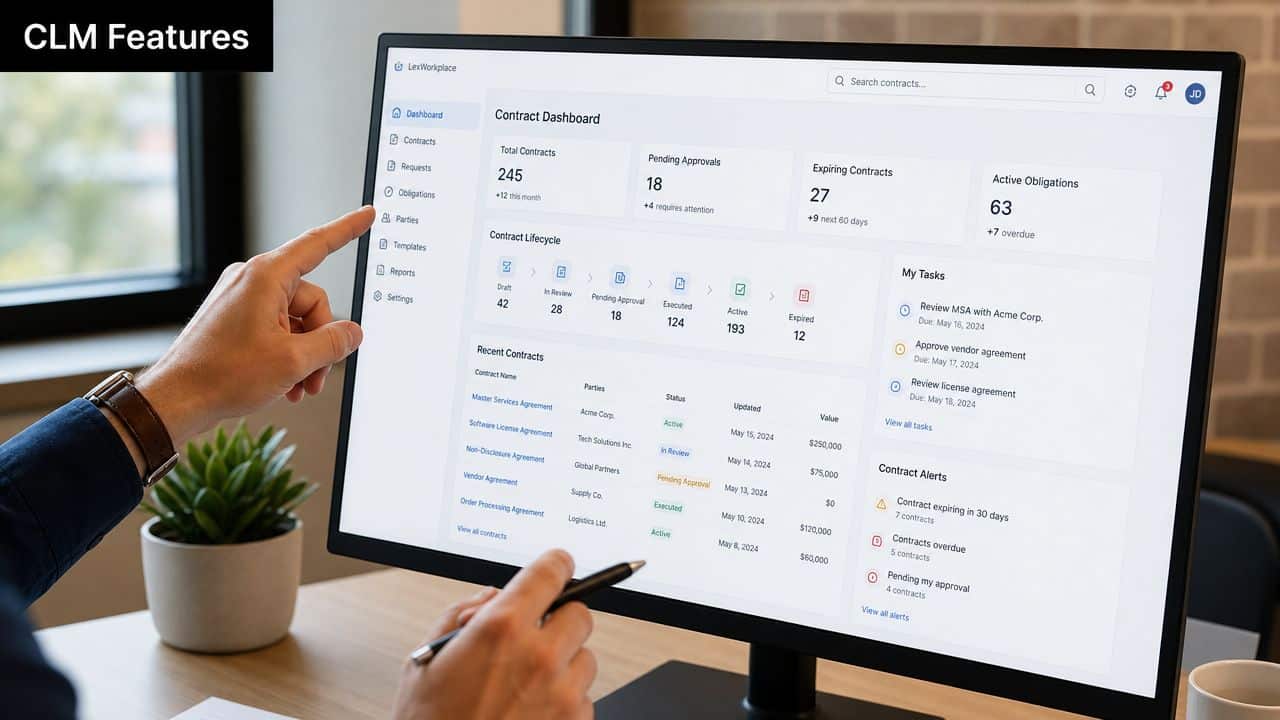
Most software labelled as contract management is just a repository with reminders. That isn't enough. A proper CLM system must control the process, standardise data, and connect contract events to financial and operational actions.
What a modern system must include
The best CLM environments usually share a small set of capabilities.
- Structured intake forms that force users to provide the information legal, procurement, and finance need before drafting starts.
- Template and clause control so the business stops recycling risky old contracts.
- Workflow routing for legal review, finance review, branch approval, and executive sign-off.
- Version and redline tracking so negotiation stays transparent.
- Metadata capture such as counterparty, term dates, value owner, branch, payment terms, and renewal conditions.
- Searchable central repository with role-based access.
- Alerts and tasking tied to obligations, deadlines, renewals, and notice periods.
- Integration capability so contract data flows into finance, procurement, CRM, and project controls.
A trading or contracting business in the GCC should be especially strict about the last point. If supplier agreements, project contracts, and customer terms don't connect with purchasing and invoicing controls, the software is only solving half the problem. That's why teams reviewing their vendor invoice management process often discover the contract itself is the missing upstream control.
Features that matter in UAE and GCC operations
Regional complexity changes the feature priority. Arabic-English document handling, branch-specific authority limits, and tax-sensitive billing rules require more than generic document storage.
A useful CLM setup should support:
- Bilingual operational use where summaries, ownership fields, and workflows are understandable across teams.
- Multi-entity and multi-branch control so approvals follow company structure.
- Commercial term visibility for billing, retention, milestones, penalties, and service obligations.
- Audit-ready history so every change and approval is traceable.
A contract system should reduce dependence on memory. If your process still depends on the procurement manager remembering a notice period, you haven't automated the risk.
What to reject during software selection
Business owners often get distracted by polished dashboards. Ignore that. Ask harder questions.
Reject any solution that:
- Can't link contract data to downstream transactions
- Requires manual re-keying of commercial terms into ERP or accounts
- Has weak approval logic
- Stores documents well but manages obligations poorly
- Doesn't give branch or department-level visibility
A useful CLM platform doesn't replace management discipline. It enforces it. That's the difference between a tool that gets used for a few months and a system that becomes part of daily operations.
Chat on WhatsApp +971506228024 Quotation – Demo Request
The Business Case for CLM Unlocking Tangible ROI

The financial case for contract lifecycle management is stronger than most owners realise. Contract work isn't confined to legal. According to World Commerce & Contracting data cited by Icertis, 29% of the average company's workforce participates in contract management, and 8.6% of a contract's value is lost because of poor contract management, as noted in this Icertis summary of CLM benchmark statistics.
Those figures matter in the GCC because many companies are contract-heavy by nature. Construction, real estate, distribution, services, and public-sector supply businesses all depend on accurate terms, timely approvals, milestone billing, and renewal control.
Where the return actually comes from
The return on CLM usually appears in three places.
Cost control
Manual contract handling creates rework. Legal reviews the same wording repeatedly. Operations chases missing approvals. Finance validates terms after signature because nobody trusts the handover.
A structured process reduces duplicated effort through templates, approval routing, and standard metadata. It also limits expensive exceptions because teams start from approved language instead of reinventing every agreement.
Risk reduction
This is the biggest win for many GCC businesses. Poorly controlled contracts create exposure in payment terms, scope obligations, penalties, termination rights, and tax handling. The risk doesn't sit in one department. It spreads across finance, procurement, projects, and executive management.
A controlled CLM approach gives the business a better grip on:
- Deviation from standard terms
- Approval breaches
- Untracked amendments
- Missed notices and renewals
- Weak audit evidence
When companies say they have a contract problem, they usually have a control problem that contracts are exposing.
Revenue protection
Revenue loss often comes from slow movement or weak follow-through rather than from the deal itself. A customer contract may be signed, but billing starts late because milestone conditions weren't visible to accounts. A supplier rebate clause may exist, but nobody tracks compliance. A lease review window may pass without action.
A practical GCC example
Consider a distribution company operating across several branches. Supplier agreements contain pricing rules, rebate conditions, return rights, and renewal terms. If those agreements are stored as PDFs without structured tracking, procurement negotiates one thing and accounts pays another.
The result is familiar. Overpayments slip through. Credit claims are delayed. Renewal dates arrive without an advantageous position because the team only notices once the contract is already rolling forward. A disciplined CLM model fixes this by turning the contract into an operational record, not just a scanned attachment.
That's the core ROI. Better contract lifecycle management protects value the business has already negotiated but often fails to realise.
Navigating Common CLM Implementation Challenges
Most CLM projects don't fail because the idea is wrong. They fail because the business underestimates the operational change required.
The first problem is usually people, not software
Legal may prefer manual drafting. Sales or commercial teams may resist structured intake because they think it slows things down. Branch managers may keep approving contracts informally because that's how they've always worked.
That resistance is predictable. The fix isn't more theory. It's policy-backed workflow. If a contract can bypass the process, users will bypass it. Owners need to decide early whether contract governance is optional or mandatory. If it's mandatory, approval rules and execution authority must be built into the system and enforced.
Legacy contracts create hidden complexity
Many GCC businesses have years of active contracts sitting in shared drives, filing cabinets, and mailbox archives. Migrating them into a CLM process sounds simple. It isn't.
Some contracts are complete, some are partially signed, some have amendments that nobody has linked properly, and many lack clean summaries. The right move is to separate legacy migration into tiers:
- Critical active contracts first
- Renewal-sensitive contracts second
- Archive-only records later
Trying to clean every historical document before go-live usually delays the project.
Integration mistakes weaken the whole model
A CLM project becomes fragile when it stays isolated from finance, procurement, HR, property, or project operations. The contract may be well stored, but the business still re-enters terms manually elsewhere. That creates a second version of the truth.
The implementation team should identify early where contract data must flow. Typical handoff points include purchase commitments, milestone billing, tenant charges, service obligations, and approval evidence for audits.
Clean workflow beats complicated workflow. If users need side emails, offline approval, and manual spreadsheets to complete a contract, the design is already wrong.
Data quality decides long-term value
Many companies focus on documents and ignore fields. That's a mistake. Without clean metadata, reporting becomes weak and reminders become unreliable. Counterparty name, effective date, expiry date, renewal terms, branch owner, contract type, and obligation category all need standard definitions.
You don't need perfect data on day one. You do need disciplined data standards from day one.
Implementing CLM in the UAE A Practical Roadmap

A branch manager approves a customer contract by email. Finance receives a PDF with different payment terms from the final signed version. The tax invoice goes out late, the milestone billing is wrong, and nobody can show who approved the exception. That is a process failure, not a legal filing problem.
In the UAE, CLM should be implemented as an operating control tied to ERP. If contracts sit outside finance, procurement, projects, and branch approvals, the business keeps rekeying terms, missing obligations, and exposing itself to VAT, audit, and revenue leakage risks. The national shift toward structured digital documentation and e-invoicing only raises the cost of poor contract control.
Step 1 define the operating objectives
Start with outcomes the business can measure and enforce. A contractor may need tighter milestone billing, retention tracking, and subcontract variation control. A property company may need notice management, tenant charge accuracy, and branch approval discipline. A trading business may need supplier rebate enforcement and cleaner links between commercial terms and payables.
Set objectives such as:
- Reduce approval delays across entities and branches
- Standardise templates, clauses, and authority limits
- Connect signed terms to billing, collections, and procurement
- Strengthen audit trails for approvals and amendments
- Control renewals, notices, and post-signature obligations
“Digitise contracts” is not an objective. It is a task.
Step 2 map the actual business flow
Document what happens from request to execution, then from execution to billing, procurement, and reporting. Include every handoff point where contract data is interpreted by a person instead of passed through a system. That is where errors start.
For UAE and GCC businesses, the process map should reflect real operating conditions. Include multi-branch approvals, bilingual contracts, delegated authority by entity, VAT-sensitive billing events, and project-specific commercial terms. If a step depends on email, WhatsApp, or spreadsheet tracking, treat it as a control gap.
A simple mapping exercise usually reveals the redesign priorities:
| Current-state issue | Future-state requirement |
|---|---|
| Email-based approvals | System-routed approval workflow |
| Manual billing interpretation | Structured commercial fields linked to finance |
| Spreadsheet renewal tracking | Automated renewal alerts and review tasks |
| Lost amendments | Version-linked amendment control |
| Contract isolation | ERP-connected operational visibility |
Step 3 choose an integrated solution
A file repository is not enough. You need contract data to drive transactions and controls across the business.
For UAE contracting and asset-heavy companies, the right system connects contract events to projects, procurement, finance, asset operations, and reporting. Approved payment terms should flow into receivables. Supplier obligations should inform procurement and payable controls. Variations, extensions, and claims should be visible to project teams before they hit margin. If your business runs project-led operations, review ERP construction software for contract-driven project control as part of the CLM evaluation.
Choose a platform that can enforce approval paths by branch, entity, value threshold, and contract type. If the software cannot support regional approval complexity, users will go back to side channels.
Step 4 set the governance before go-live
Software does not fix unclear authority. It exposes it.
Before launch, define the rules that the system will enforce:
- Approval matrix by company, branch, value, and contract category
- Template ownership across legal, procurement, finance, operations, and management
- Mandatory metadata fields for reporting, renewals, and compliance
- Migration scope for active, high-risk, and archive contracts
- User roles and permissions by function and responsibility
Training should match each role. Legal needs drafting control and clause discipline. Finance needs visibility into billing triggers, tax treatment, and amendment impacts. Operations needs obligation tracking. Management needs exception reporting and approval oversight.
If policy is vague, the system will automate inconsistency.
Step 5 roll out by contract type and business risk
Rollout should follow business exposure, not internal politics. Start where contract errors cause immediate financial impact.
A practical sequence for many UAE businesses is:
- Customer contracts tied to invoicing and collections
- Supplier and subcontract agreements tied to cost, delivery, and claims
- Lease, property, or service agreements with renewal and notice risk
- Legacy portfolio clean-up and reporting expansion
This phased approach gives early value and keeps the team focused. It also lets you refine workflows before adding lower-priority contract classes.
Step 6 enforce usage after launch
Go-live is the start of control, not the finish line. Review whether users are staying inside the workflow, whether approvals follow policy, whether amendments are linked properly, and whether finance is using contract data instead of re-entering terms.
Set a monthly review for exceptions. Check contracts approved outside workflow, missing metadata, overdue obligations, and billing events that do not match signed terms. In a GCC business with multiple branches, that discipline matters. Without it, local workarounds quickly break the standard process.
Chat on WhatsApp +971506228024 Quotation – Demo Request
Measuring Success CLM Governance and KPIs
The companies that get real value from contract lifecycle management don't stop at implementation. They govern it. They measure it. They treat post-signature performance as a management discipline.
Ironclad's CLM metrics discussion notes that a 20% increase in contract turnaround time can delay revenue by 15 days per deal, and it also stresses that obligations, milestones, and service-level commitments should be monitored throughout the contract term to identify compliance gaps and revenue leakage, as explained in this CLM metrics and reporting analysis.
The right KPIs for GCC businesses
A UAE or GCC company should track a focused set of indicators that management can act on.
Contract turnaround time
Measure how long contracts take from request to signature. Break it down by contract type and approver group so you can identify bottlenecks.Approval exception rate
Track how often contracts bypass standard workflow or deviate from authority policy.Template deviation trend
Review how often commercial or legal terms move away from approved language. This highlights where policy is too rigid or where risk is entering the portfolio.Renewal and notice control
Watch upcoming renewals, notice periods, and contracts pending review. This matters heavily in leases, supply agreements, and maintenance arrangements.Obligation completion status
Monitor whether milestones, deliverables, service commitments, and payment-linked events are being met on time.
Governance is more important than reporting volume
Many businesses build attractive dashboards and still fail to control contracts. The reason is simple. Nobody owns the governance cycle.
Assign ownership clearly:
| Governance area | Recommended owner |
|---|---|
| Template governance | Legal or authorised contract control team |
| Commercial field accuracy | Contract owner with finance review |
| Approval compliance | Management and internal control |
| Renewal review | Department head or contract owner |
| Portfolio reporting | Finance, operations, or MIS function |
For leadership teams, the best dashboard is not the biggest one. It's the one that shows what needs intervention now. That usually means bottlenecks, upcoming renewals, overdue obligations, and high-risk deviations. For broader business visibility, contract data should also feed management reporting through tools such as MIS and reporting systems, so executives can see contract exposure alongside finance and operations.
Post-signature is where value is either realised or lost. If you don't measure obligations after execution, you're only managing paperwork.
Take the Next Step with Hinawi ERP
For companies across the UAE and GCC, modern contract management needs to sit inside a broader business control environment. That means finance, HR, real estate, fixed assets, manufacturing, CRM, payroll, and operational approvals must work together instead of in separate systems.
Hinawi ERP UAE is a fully integrated ERP software platform developed in Abu Dhabi since 1998. It supports Accounting, HR & Payroll, Real Estate Management, Fixed Assets, Manufacturing, Garage & Maintenance, School Management, CRM, and complete business automation. For businesses managing contracts alongside accounting, payroll, project work, property operations, or procurement, that integration matters.
Hinawi ERP is built for regional requirements, including VAT and e-Invoicing compliance, UAE WPS payroll support, Arabic and English bilingual operation, flexible company policy settings, and real-time accounting integration across all modules. It suits factories, contracting companies, real estate businesses, schools, garages, trading companies, and manufacturers that need stronger control over daily operations.
If your business is still handling contract obligations, approvals, billing dependencies, and renewals through disconnected files and manual follow-up, it's time to modernise. Visit www.hinawierp.com or request a personalised demo to see how Hinawi ERP can help reduce manual work, improve financial accuracy, and give your management team better control.
For companies ready to improve contract control, financial accuracy, and operational visibility, speak with Explorer Computer LLC – Hinawi Software ERP for a consultation or personalised demo.