
Category: Accounting
Most construction companies don't lose control on-site first. They lose it in the office.
A widely cited survey reported that 9 out of 10 construction projects experience cost overrun (project management statistics on construction overruns). For a contracting company owner in the UAE, that isn't just a project issue. It's a margin issue, a cash flow issue, and often a compliance issue once delayed billing, disputed variations, payroll timing, and VAT reporting start drifting out of sync.
That's why construction project management should be treated as a financial control system, not just a site coordination function. In the GCC, especially in the UAE, the pressure goes beyond concrete, steel, labour, and deadlines. You also have WPS payroll obligations, VAT treatment across progress billings and subcontractor invoices, retention tracking, equipment allocation, approval bottlenecks, and branch-level reporting. If your project team works in one set of spreadsheets and your accounts team works in another, your business is already carrying unnecessary risk.
Owners often assume the problem is weak supervision. Usually, it's weak integration. The estimator, project manager, procurement officer, storekeeper, accountant, and payroll team are all working, but they're not working from the same live data. That's where project discipline starts to break.
A practical contracting business in Abu Dhabi, Dubai, Riyadh, or anywhere in the GCC needs one operating model. Site execution, cost control, procurement, payroll, invoicing, VAT, and management reporting must line up daily, not at month-end. That's also why firms increasingly move towards integrated systems such as Hinawi ERP, where financials, HR, project costing, and operational workflows connect instead of sitting in separate files.
If you want predictable margins, stop treating project management as a reporting exercise after the fact. Treat it as the mechanism that protects cash, compliance, and delivery from day one.
Chat on WhatsApp +971506228024 Quotation – Demo RequestIntroduction Mastering Construction Projects in a Competitive Market
The GCC construction market rewards firms that can control details at speed. It punishes firms that rely on delayed reports, manual approvals, and disconnected departments.
In the UAE, a contractor can appear busy and still be poorly managed. Projects may be progressing, subcontractors may be on-site, and invoices may be moving. But if cost updates lag, BOQ revisions aren't controlled, and payroll isn't tied properly to project activity, the owner is making decisions with stale information. That's how profitable jobs gradually become average jobs.
Why owners need to redefine project management
Construction project management isn't a stack of schedules and meeting minutes. It's the discipline that keeps scope, time, cost, procurement, labour, and billing aligned. In this region, that alignment also has to support VAT records, payroll timing under WPS, and the kind of reporting banks, auditors, and investors expect from a serious contractor.
Practical rule: If your project manager can't see committed costs, pending approvals, labour exposure, and billing status in one place, your control system is incomplete.
A lot of generic advice treats construction management as a field problem. In reality, many GCC contractors suffer from office-to-site disconnect. Approved materials aren't reflected in purchasing fast enough. Variation work starts before commercial approval. HR processes payroll without clean project allocation. Finance posts supplier invoices after the cost impact has already hit the job.
What strong control looks like
A well-run contractor does a few things differently:
- Locks budgets early: The estimate, BOQ, and contract values don't drift casually.
- Controls approvals: RFIs, variations, procurement requests, and payment workflows have named owners.
- Tracks actuals daily: Labour, materials, equipment, and subcontract costs update continuously.
- Links operations to finance: Every site action with cost impact reaches accounting correctly.
- Prepares for compliance naturally: VAT, payroll, and document trails are built into the process.
That operating discipline is what separates contractors who chase problems from contractors who prevent them.
Navigating the Construction Project Lifecycle in the GCC

Every project moves through familiar stages. What changes in the GCC is the level of commercial and administrative pressure attached to each one. If you manage these phases casually, delays and cost leakage begin long before site execution.
Planning and design
Planning starts with scope clarity, authority approvals, contract review, and budget structure. In Abu Dhabi, Dubai, and Riyadh, teams also deal with permit sequencing, consultant comments, client approval cycles, and document version control. A weak start creates months of confusion later.
Your pre-construction team should define:
- Commercial baseline: Contract value, expected margin, exclusions, and provisional items
- Cost structure: Labour, materials, plant, subcontract, overhead, and contingency buckets
- Approval map: Who signs drawings, material submissions, procurement requests, and variations
- Document discipline: One version-controlled repository for drawings, BOQ items, and correspondence
A contractor that still treats the Bill of Quantities in construction as a tender-only document is making a basic mistake. The BOQ should remain a live commercial and execution reference throughout the job.
Procurement and mobilisation
Procurement in the GCC is rarely straightforward. Imported materials face shipping uncertainty, local supply can tighten without warning, and client-approved vendor lists can narrow your options. On top of that, many firms still separate procurement from project cost visibility, which causes blind commitments.
Good procurement control means:
- Tie purchases to budget lines
- Track committed cost before invoices arrive
- Match supplier documentation to approvals
- Keep delivery status visible to project teams
Mobilisation also needs tighter management than many firms admit. Labour arrival, accommodation, access cards, equipment movement, and subcontractor onboarding all affect the schedule.
Chat on WhatsApp +971506228024 Quotation – Demo RequestConstruction and handover
During execution, the regional challenge is rarely just the work itself. It's the number of parties involved. Main contractor, subcontractors, suppliers, consultants, client reps, accounts, HR, and stores all affect site progress. If information moves slowly between them, the schedule suffers.
WPS matters here too. Labour deployment and payroll timing can't be treated as separate from project performance. If attendance, allocation, and payroll processing are disconnected, cost reporting becomes unreliable and management reacts too late.
Slow handover usually means slow control earlier. Missing approvals, unresolved snags, and incomplete documentation don't appear at the end by accident.
Handover should include commercial close-out, document completion, asset transfer where relevant, final supplier reconciliation, and retention visibility. Firms that rush to practical completion without cleaning the back office create disputes that continue long after site work ends.
Key Roles and Critical Workflows for Project Success
A construction company doesn't fail because one person made one bad decision. It fails because key roles work in isolation. The project manager pushes progress. Procurement chases deliveries. Accounts records invoices. HR processes labour costs. Nobody sees the full position soon enough.
Practitioners consistently rate time management, cost management, and scope management as highly important controls, with mean scores of 4.00 or higher on a 5-point scale in a construction project management knowledge model (construction PM knowledge model findings). That matches what I see on the ground. The core problem isn't knowing these controls matter. The problem is failing to connect them operationally.
The roles that carry the project
Here's the practical view. These roles need clear authority and clean data.
| Role | Primary Responsibility | Key Workflows |
|---|---|---|
| Project Manager | Overall delivery, coordination, progress, commercial awareness | Schedule review, variation follow-up, approval escalation, progress billing input |
| Cost Controller | Budget discipline and cost visibility | Budget setup, committed cost tracking, actual cost review, variance analysis |
| Site Engineer | Site execution and technical compliance | Daily progress updates, drawing control, material requests, inspection coordination |
| Procurement Officer | Purchasing and supplier coordination | RFQs, vendor comparison, purchase orders, delivery follow-up, invoice matching |
| QS or Commercial Team | Contract and variation control | BOQ review, interim valuation, subcontract measurement, change order management |
| HR and Payroll Team | Labour administration and payroll accuracy | Attendance capture, project allocation, WPS payroll processing, staff cost support |
| Finance Team | Financial posting and compliance | AP, AR, VAT treatment, retention accounting, reconciliation, management reporting |
The workflows that matter most
The first is BOQ control. If the BOQ changes informally, everything downstream becomes unstable. Budgeting, procurement, subcontracting, progress claims, and margin tracking all depend on BOQ discipline.
The second is schedule control. Not just a baseline programme sitting in a file. A live schedule linked to labour, procurement, and approvals. Delays usually show up first in decisions not made, materials not released, or access not cleared.
The third is change management, a domain where many contractors in the UAE lose money they technically earned. Teams execute extra work, but commercial records lag. The result is argument instead of recovery. Good contract lifecycle management reduces that gap by making approvals, obligations, and variations traceable.
Why silos destroy margin
Most firms separate time, cost, and scope into different conversations. That's a mistake.
- A scope change affects procurement, labour, billing, and margin.
- A delayed approval affects the programme and often creates cost impact.
- A late supplier delivery affects sequencing, labour productivity, and client claims.
- A payroll allocation error distorts job cost and management reporting.
The project doesn't care which department caused the problem. The margin takes the hit anyway.
That's why serious construction project management isn't just about capable people. It's about forcing the workflows to meet in one control model.
Common Pitfalls in GCC Construction and How to Mitigate Them
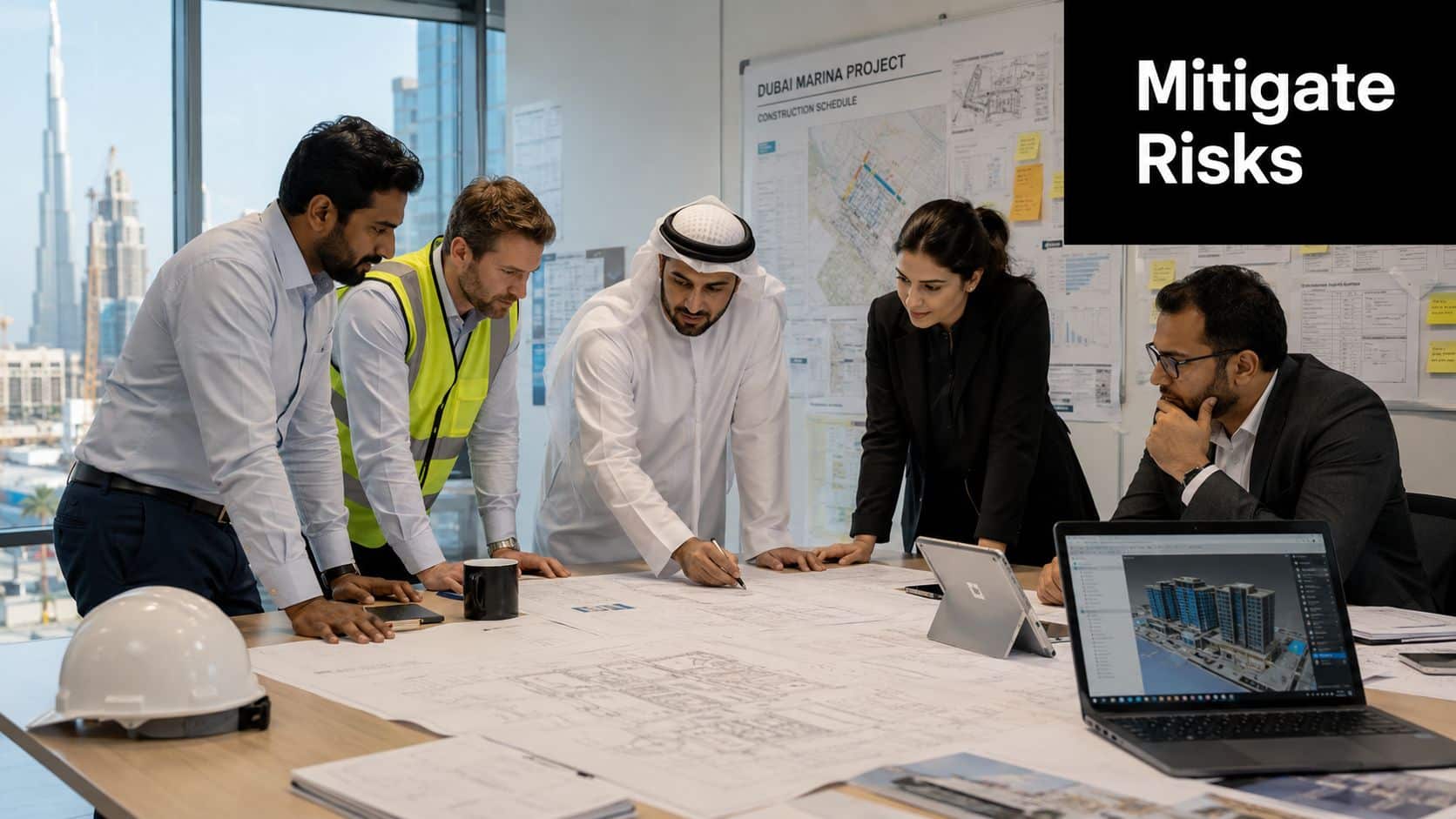
A common UAE contracting scenario looks like this. The company has multiple projects running. One site is waiting for consultant approval. Another has started variation work before the commercial team priced it properly. Procurement has issued urgent orders outside the normal process. Finance is asking for backup documents before posting invoices. Payroll is due, and site timesheets still haven't been finalised.
Nothing looks catastrophic in isolation. Together, it creates a control failure.
A major challenge in construction PM is the administrative bottleneck created by approvals, RFIs, and document control across multiple stakeholders. That pressure is especially relevant in the GCC, where firms often operate across multiple branches and subcontractor layers and need real-time data synchronisation (construction PM bottlenecks in multi-stakeholder environments).
Where contractors usually lose control
The most expensive problems are often administrative, not technical.
- Approval drag: Material submissions, shop drawings, RFIs, and client confirmations sit too long.
- Version confusion: Site teams build from outdated drawings or incomplete instructions.
- Untracked variations: Extra work starts before cost and scope are formally captured.
- Duplicate reporting: Project, procurement, HR, and finance each maintain separate records.
- Month-end blindness: Owners only see the financial impact after the damage is done.
That's why saying “communicate better” isn't enough. You need a controlled workflow.
Practical mitigation that actually works
Standardise the basics first. Every approval should have an owner, a status, and an expected turnaround. Every cost-triggering action should connect to a budget line or authorised variation. Every document that affects execution should have one current version.
Use this discipline:
- Create one document repository for drawings, submissions, RFIs, and approvals.
- Force change requests into a formal workflow before execution spreads across the site.
- Track commitments early so purchase orders and subcontract awards hit cost reports before invoices arrive.
- Update field data daily rather than waiting for weekly or monthly consolidation.
- Escalate blocked approvals fast because schedule slippage usually starts in administration.
A delayed decision is usually more expensive than a difficult decision. Good firms make the decision path visible.
For GCC contractors, the point isn't to add bureaucracy. It's to remove manual handoffs, uncontrolled WhatsApp approvals, and spreadsheet reconciliation that nobody fully trusts.
Essential KPIs and Local Compliance Considerations
Many owners ask for progress percentages. Fewer ask whether the numbers are financially usable. That's the better question.
Modern construction PM systems support real-time analytics such as CPI and SPI tracking to detect variance early, while connecting financial, operational, and site activities for better decisions (construction PM software and real-time variance tracking). You don't need a theoretical dashboard. You need indicators that trigger action before the month closes.
The KPIs that deserve management attention
CPI tells you whether cost performance is tracking against the value of work delivered. SPI shows whether progress is moving against the planned schedule. When these indicators weaken, management should investigate immediately, not wait for month-end commentary.
Watch them alongside a few practical controls:
- Committed cost visibility: Purchase orders and subcontract commitments not yet invoiced
- Approved versus pending variations: Work done commercially secured versus work still exposed
- Billing status: Certified, submitted, pending, and disputed amounts
- Labour cost allocation: Actual workforce cost linked correctly to projects and cost codes
- Retention position: Receivable and payable retention exposure by project
Why compliance must sit inside project control
In the UAE, project data and compliance data are connected whether teams like it or not. Progress billings affect VAT. Supplier invoices affect reclaim timing and reconciliation. Payroll must support WPS. If your project records are inconsistent, your compliance records become fragile.
That's also why e-invoicing readiness can't be treated as an accounting-only topic. Contract billing, variation billing, subcontract documentation, and approval trails all influence invoice accuracy. If you're reviewing your invoicing process, this matters directly to your e-invoicing obligations in the UAE.
A more useful management standard
Ask your teams for three things every week:
- What has changed in scope
- What has been committed but not invoiced
- What is delaying certification, billing, or payroll allocation
If they can't answer quickly, your KPI framework is too shallow.
Good compliance is usually the by-product of good operations. Weak operations force the finance team to clean up after everyone else.
That clean-up costs time, creates audit risk, and weakens credibility with clients, banks, and internal stakeholders.
How an Integrated ERP Transforms Construction Management

Construction companies outgrow spreadsheets long before they admit it. The spreadsheet doesn't fail because it can't calculate. It fails because it can't govern approvals, preserve version control, connect procurement to budgets, post payroll to projects correctly, and keep VAT-ready financials aligned with live operations.
That's why integrated systems have become the practical standard. According to a KPMG survey, 46% of engineering and construction firms had adopted integrated PMIS across all projects, while another 37% were gradually introducing them. The same survey identified accurate material and equipment cost estimation as the top priority for countering disruption (KPMG construction PMIS adoption findings).
Before and after integration
Before integration, a typical contractor works like this:
- Estimation in one file
- Purchasing in another
- Site reporting through email and WhatsApp
- Payroll processed separately
- Invoices entered by accounts after the fact
- Management reports rebuilt manually every period
That setup creates delay, argument, and rework.
After integration, the business can operate from one control chain. BOQ, project budget, purchasing, subcontracts, timesheets, payroll allocation, supplier invoices, client billing, VAT reporting, and management dashboards all connect. A change in one area becomes visible elsewhere without waiting for manual reconciliation.
What a practical ERP should handle
A usable construction ERP in the UAE should support:
- Project costing: Budget, actual, and committed cost by project and cost head
- Procurement control: Requisitions, RFQs, purchase orders, GRNs, and supplier invoice flow
- Subcontract administration: Measurement, certification, deductions, and payment tracking
- Payroll integration: Labour costs, WPS payroll, leave, and allocation to jobs
- Financial compliance: VAT-ready reporting, billing accuracy, audit trail, and branch reporting
- Asset control: Plant, machinery, and fixed asset tracking across sites
One practical example is ERP construction software. In a local ERP setup, that means project data should reach accounting in real time instead of waiting for manual summaries. For firms using Explorer Computer LLC – Hinawi Software ERP, the relevant point is functional, not promotional: contracting activity, accounting, HR and payroll, fixed assets, and reporting can sit in one system, which is exactly what contractors in the UAE need when WPS, VAT, and project costing all intersect.
Chat on WhatsApp +971506228024 Quotation – Demo RequestWhat owners should insist on
Don't buy software because it has a long feature list. Insist on these outcomes:
- One source of truth for project and financial data
- Live visibility into commitments, actuals, and approvals
- Clear compliance support for VAT, e-invoicing readiness, and WPS payroll
- Bilingual usability for Arabic and English operations
- Policy flexibility because every contractor has approval rules and commercial structures of its own
If the system can't support those realities, it won't fix your management problem. It will just digitise the mess.
Take the Next Step with Hinawi ERP
Cash leakage in contracting rarely starts with one big mistake. It starts with disconnected approvals, delayed site data, payroll posted late, VAT handled separately, and invoices that do not match project reality. In the UAE, that combination creates pressure fast. You feel it in margin erosion, WPS timing issues, disputed valuations, and month-end reports that arrive too late to correct anything.
Owners should stop treating project management software as a site tool. It is a financial control system. If it cannot connect BOQs, subcontractor costs, payroll allocation, VAT treatment, customer billing, and head-office approvals in one environment, it will keep producing blind spots.
Hinawi ERP was developed in Abu Dhabi for companies operating under UAE and GCC rules. That matters. Local contractors do not need generic project dashboards. They need a system built for regional operating requirements, including WPS payroll handling, VAT-ready billing, bilingual use, and policy-based approvals across branches and entities. You can review the Hinawi ERP solution for UAE businesses to see how the platform is structured.
For a contracting business, the value is practical:
- Project costs and finance stay connected, so management sees actual cost movement without waiting for manual consolidation
- Payroll and site operations stay aligned, which helps reduce WPS-related processing gaps and labour cost misallocation
- VAT treatment sits inside the transaction flow, which improves billing accuracy and audit readiness
- Approval rules match your company structure, whether you run one entity or several branches across the GCC
- Arabic and English users work in the same system, which reduces handover errors between site, accounts, HR, and management
Explorer Computer LLC, the company behind Hinawi ERP, has been building business software since 1998. That long operating history matters less than one simple point. The system is designed around how companies here operate.
If you want tighter control over project cash flow, cleaner reporting before month-end, and fewer compliance gaps between site activity and finance, request a personalised demo and review your workflow with the Hinawi team.