
Category: Accounting
You're probably looking at Oman as the next logical market. The sales team sees demand. Operations sees a workable logistics route. Finance sees a new ledger, a new tax authority, and a new compliance burden that nobody wants to clean up later.
That's where most GCC businesses make the same mistake. They treat VAT in Oman as a simple 5% pricing issue. It isn't. It affects how you classify revenue, when you register, how you issue invoices, how you recover input tax, and whether your ERP can separate taxable, zero-rated, and exempt activity without manual repairs at month-end.
Oman's modern VAT system started on 16 April 2021 with a 5% standard rate under Royal Decree No. 121/2020, and it was introduced as part of the GCC VAT framework, making Oman the fourth GCC state to activate VAT after the UAE, Saudi Arabia, and Bahrain, as outlined in PwC's Oman tax summary. That matters if your business already trades across the Gulf, because the broad logic is familiar, but the local execution still needs careful system setup.
If you run a trading company in Abu Dhabi, a contracting business in Dubai, a factory serving Oman distributors, or a real estate group with mixed-use assets, VAT in Oman isn't just the accountant's problem. It sits inside purchasing, stock movement, contract billing, branch accounting, and cash flow.
A modern ERP should carry that load from day one. If your team is still relying on spreadsheets to track turnover, invoice type, tax treatment, and return deadlines, you're not managing VAT. You're postponing a problem.
If your Oman operation is growing, build the tax logic into the system now, not after the first filing panic.
Chat on WhatsApp +971506228024 Quotation – Demo RequestIntroduction
A UAE business owner entering Oman usually asks the wrong first question. They ask, “What's the VAT rate?” The better question is, “Which of our transactions are taxable, which are zero-rated, which are exempt, and can our system prove the treatment?”
That distinction matters because VAT in Oman is operational before it is mathematical. A wrong tax code on a sales invoice affects reporting. A wrong purchase classification affects input recovery. A wrong setup in inventory, branch accounting, or project billing creates rework that spreads across finance and audit preparation.
For GCC businesses, the challenge gets sharper in cross-border activity. A company may sell from the UAE, import into Oman, issue invoices in a foreign currency, and recover VAT on some costs but not others. That mix isn't difficult because the rate is high. It's difficult because the documentation and transaction treatment must stay consistent across departments.
Practical rule: If your sales team, procurement team, and finance team don't use the same VAT logic, your filing will be wrong even if your tax return software works perfectly.
Decision-makers should treat Oman VAT as part of business design. Pricing policy, invoice workflow, vendor setup, chart of accounts, branch structure, and approval controls all need to align. That's why businesses expanding into Oman should configure ERP rules before volume builds up.
A practical system should track taxable supplies, manage currency handling, separate exempt revenue, and support audit trails without manual intervention. That's the difference between compliant growth and messy expansion.
Understanding Oman's VAT Framework
A lot of Oman VAT errors start with one bad assumption. Business owners see a 5% regime and expect a simple tax setup. In practice, Oman VAT is a classification system first and a reporting system second.
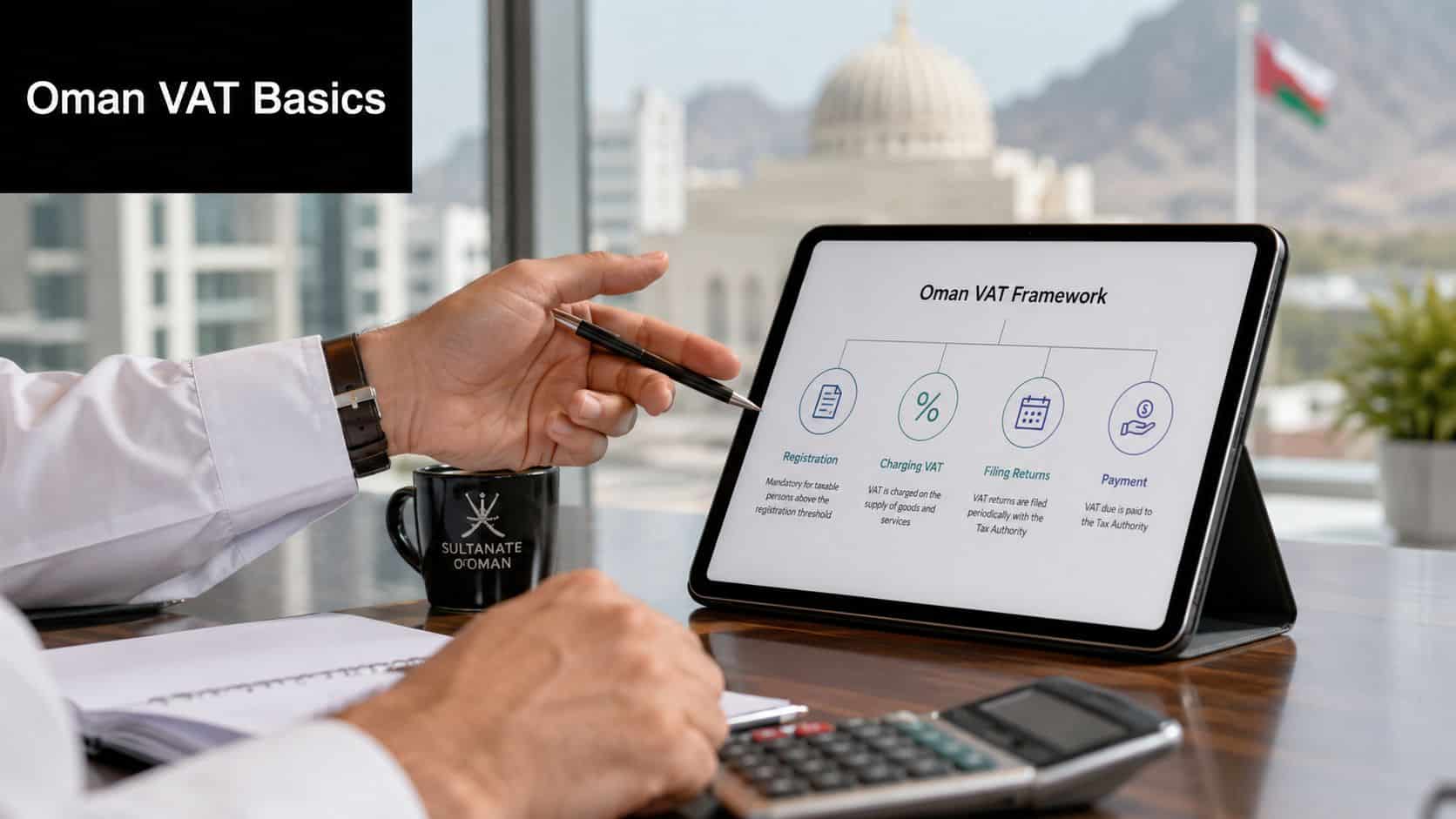
If your company trades across the GCC, imports into Oman, invoices services across borders, or earns a mix of taxable and exempt revenue, the question is simple. Can your ERP identify the correct VAT treatment at transaction level and keep that logic consistent through invoicing, purchasing, returns, and audit support?
The three classifications you must get right
Oman VAT broadly places supplies into three buckets. Your finance team must map each one correctly from the start.
| Supply type | General treatment | Business impact |
|---|---|---|
| Standard-rated | VAT applies at 5% | Output VAT is charged and related input VAT is usually recoverable, subject to the normal rules |
| Zero-rated | VAT rate is 0% | The supply still sits inside the taxable system, which affects reporting and input tax recovery |
| Exempt | No VAT charged | Input tax recovery may be blocked or restricted, which creates partial exemption issues |
The distinction is critical because zero-rated and exempt supplies do not produce the same recovery outcome. If your team treats both as “no VAT on the invoice,” your return may still be wrong.
That problem gets expensive fast.
A trading business exporting goods from Oman may apply a different VAT treatment from a landlord with residential property income or a business earning exempt financial income. On paper, the customer may see no VAT in more than one case. Inside the accounts, the recovery logic is completely different. Your ERP must reflect that difference in item setup, service categories, customer types, and tax codes.
Where GCC businesses usually fail
Regional familiarity creates false confidence. A company already registered for VAT in another GCC state often assumes Oman can be copied into the same template. That is poor practice.
Oman transactions need local tax logic, especially where imports, intercompany charges, and reverse charge obligations appear. If your team needs to review that area, use this guide to the reverse charge mechanism in GCC VAT. The tax treatment has to match your customs records, supplier invoices, and ledger postings. If those records diverge, the return becomes difficult to defend.
This is also where partial exemption starts to matter. The moment your business earns both taxable and exempt income, input VAT recovery stops being automatic. Shared costs such as rent, software, marketing, head office charges, and utilities may need allocation. Manual spreadsheets are a weak control for that job. Use ERP rules that separate direct attribution from shared-cost apportionment and preserve the audit trail.
Zero-rated revenue supports recovery differently from exempt revenue. Configure them as separate tax treatments, not as one generic “no VAT” outcome.
Common Oman-facing examples
These patterns come up repeatedly in GCC groups operating in Oman:
- Trading and distribution businesses: Export sales may qualify for zero rating only if shipping and customs evidence is complete and linked to the invoice.
- Healthcare and education operators: Parts of revenue may be exempt, which limits input tax recovery on overhead and mixed-use costs.
- Real estate groups: Residential property activity can create exempt income, while commercial activity may sit under a different treatment.
- Cross-border service providers: Place-of-supply analysis can affect whether VAT is charged locally, handled through reverse charge, or excluded from Omani output tax.
My recommendation is straightforward. Build a transaction map before volume increases. List your revenue streams, procurement categories, import flows, intercompany charges, and shared overheads. Then configure that logic inside the ERP.
Hinawi ERP is the practical fit for this job because VAT in Oman is not solved by a calculator. You need controlled tax codes, document links, approval flow, multi-entity visibility, and reporting that stands up under review.
Chat on WhatsApp +971506228024 Quotation – Demo RequestVAT Registration Thresholds and Process
Registration is where businesses often become reactive. That's a mistake. In Oman, registration isn't just based on a casual annual estimate. The threshold logic is stricter than many owners expect.
Under Oman's VAT rules, businesses must register once annual taxable supplies exceed OMR 38,500, and voluntary registration starts at OMR 19,250, with rolling 12-month look-forward and look-back tests that also include reverse-charge transactions, as noted in Tally Solutions' Oman VAT guide.
What this means in practice
A year-end review isn't enough. If your business is growing, the threshold can be triggered before finance closes the year. That's why manual monitoring fails. Owners think turnover is below the line, but procurement patterns, imports, or project billing may change the picture.
If your team already manages GCC tax registrations, this comparison with the UAE VAT registration threshold helps clarify why Oman monitoring also needs system-driven alerts.
The process should be planned, not rushed
You'll need your business details, tax-relevant records, and internal control over how revenue is classified before registration is submitted through the Oman Tax Authority portal. The paperwork matters, but the setup behind it matters more.
Use this practical sequence:
- Classify supplies first: Don't register before you know which revenue streams are standard-rated, zero-rated, or exempt.
- Review the rolling period: Check historical turnover and expected contracts, not just invoices already issued.
- Include cross-border exposure: Reverse-charge and import-related activity can affect the threshold analysis.
- Prepare internal owners: Sales, procurement, and finance must know what changes after registration.
- Configure system rules before go-live: Your invoice templates, ledgers, customer masters, and item tax settings should be ready before the first taxable transaction after registration.
Registration should happen before the business outgrows its controls, not after the tax authority forces the issue.
The companies that struggle with VAT in Oman aren't always the largest. They're the ones that delay registration analysis until finance discovers the problem after the fact.
Managing VAT Rates and Compliant Invoicing
In daily operations, VAT in Oman becomes an invoicing discipline, quickly exposing weak systems within businesses.
For invoicing and tax accounting, Oman allows a simplified tax invoice only where the supply is below OMR 500 excluding VAT, foreign-currency invoices must still show the VAT amount in OMR using the Central Bank of Oman rate at the tax due date, and VAT returns and payment are due 30 days after quarter-end, according to ClearTax's summary of Oman VAT invoicing and filing rules.

The invoice isn't just a document
It's a tax record. If your Oman invoice is generated outside the accounting system, you've already created risk.
A UAE seller invoicing in AED, USD, or another currency still needs the VAT amount shown in OMR. That means finance needs controlled exchange-rate handling on the tax point, not a casual conversion done later in Excel. The same applies to credit notes, debit notes, and branch-issued invoices.
Reviewing a proper sample tax invoice is a useful starting point, but the bigger issue is automation. Template compliance means very little if staff can override tax logic line by line.
The myth that everything is 5%
Many owners oversimplify VAT in Oman. Yes, the headline rate is low. No, that doesn't mean every transaction should carry 5%.
Some supplies may qualify for zero-rating, such as exports. Some sectors and activities may fall into exempt treatment, including healthcare, education, financial services, and residential property in published guidance. Once your business touches those categories, invoicing and documentation become more important than rate memorisation.
Use this checklist for invoice control:
- Validate supply type: Each item or service should carry the correct VAT treatment before the invoice is posted.
- Lock currency logic: The system should calculate and display VAT in OMR where required.
- Separate branch workflows: Multi-branch businesses need standard rules, not branch-by-branch improvisation.
- Protect document trails: If a transaction is zero-rated or exempt, the support file should be easy to retrieve during review.
- Control credit notes: Adjustments should follow the original VAT treatment and maintain audit traceability.
Where ERP makes the difference
This is one area where an integrated system matters more than a standalone tax calculator. You need item-level tax codes, customer-level treatment, foreign-currency control, credit note linkage, and direct posting into the general ledger.
Hinawi ERP is one practical option in this context because it connects accounting, inventory, fixed assets, payroll, real estate, and operational workflows in one system, which helps businesses apply tax rules inside the transaction rather than correcting them after posting.
The recommendation is simple. Don't let staff “remember” VAT treatment. Put the rule in the system.
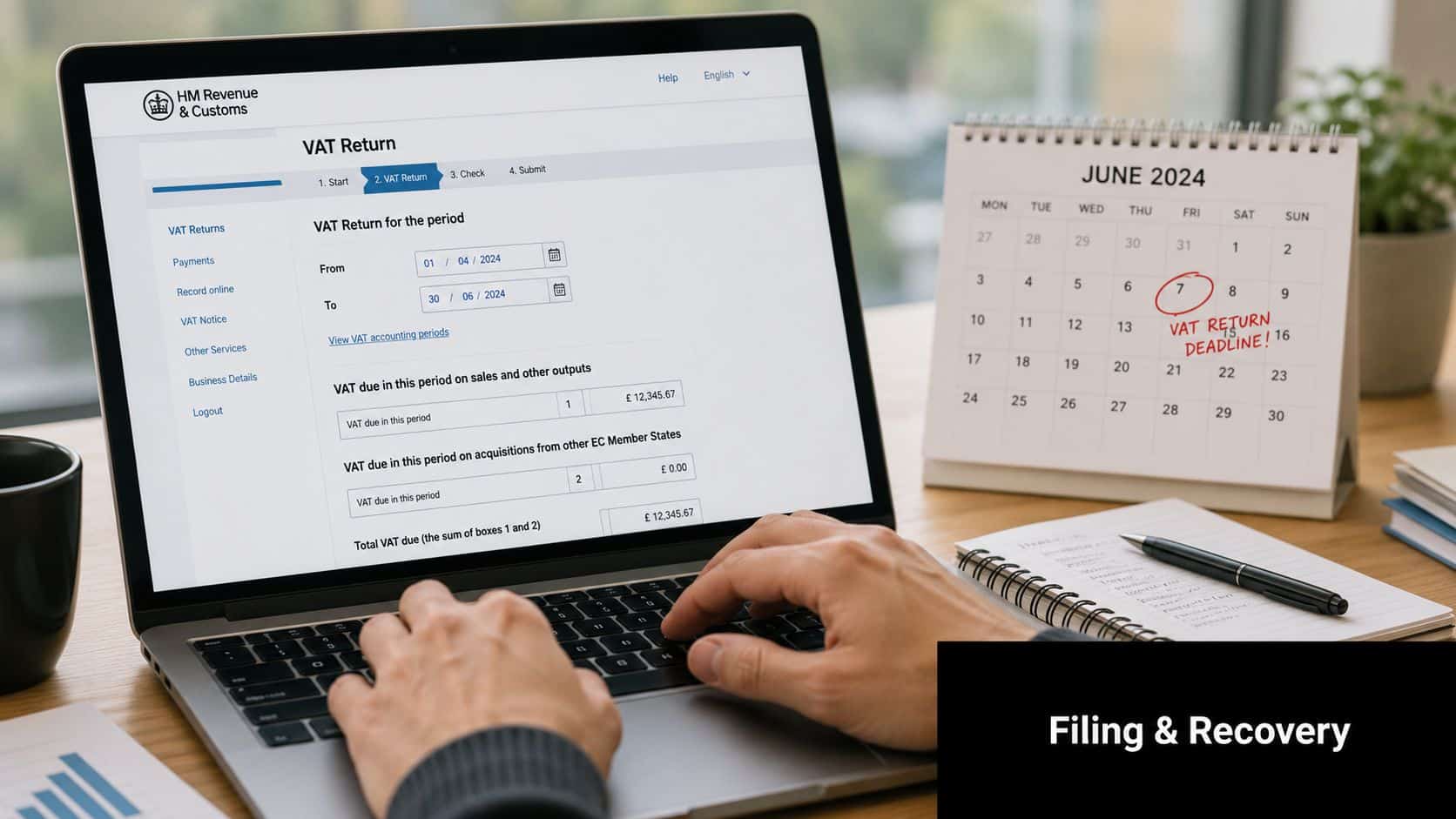
Filing VAT Returns and Recovering Input Tax
A VAT return exposes how well your business controls transactions. If tax codes, customer treatment, or purchase classification are wrong inside the ERP, the return converts those mistakes into a filed position.
For GCC businesses operating in Oman, the primary challenge is not the 5% rate. It is handling mixed supplies, cross-border treatment, shared overheads, credit notes, and input tax recovery with evidence that stands up to review. Oman applies standard-rated, zero-rated, and exempt treatment across different transactions, and that creates operational risk fast, especially for groups trading across the UAE-Oman corridor, as outlined in Gulf News coverage of taxable and non-taxable treatment in Oman.
A mixed-use business example
A contracting and property group in Oman develops a site with retail units and residential units. It buys materials, pays consultants, acquires equipment, and absorbs shared admin and project overheads across the same development.
Now the VAT problem becomes practical. Some costs relate directly to taxable activity. Some support exempt activity. Some support both, which means recovery cannot be claimed carelessly.
Manual accounting breaks down here because the errors are built into daily posting:
- Shared costs are coded too broadly: Finance teams post them to generic expense accounts under one tax treatment.
- Capital expenditure is reviewed too late: Fixed assets often need separate VAT analysis and supporting logic before posting.
- Input tax is overstated: Purchase VAT gets claimed without properly separating exempt-related costs or applying an allocation method.
Recover input tax with evidence, not assumptions
Input tax recovery in Oman depends on what the purchase supports and whether you can prove it. A manufacturer buying raw materials for taxable local sales or zero-rated exports may have a clear recovery position. The same business may face restricted recovery on costs tied to exempt activity, private use, or shared functions that were never allocated correctly.
Partial exemption becomes an operational issue, not just a tax concept. If your business makes both taxable and exempt supplies, you need a method for identifying direct attribution, separating blocked costs, and allocating residual input tax consistently. Spreadsheets do not handle that well at scale. They also fail under audit because they depend on manual judgment after the transaction is posted.
Use a filing process that starts with transaction control. Review exceptions before the period closes. Reconcile purchase tax to the ledger. Match credit notes to original invoices. Check foreign-currency transactions and cross-border sales separately. If you are reviewing how to structure that process inside the system, Hinawi's guide to VAT tax filing workflows in ERP is a useful reference.
Good VAT recovery comes from correct classification, documented allocation, and clear audit support.
Filing discipline protects cash flow
Late filing and weak review controls create avoidable cost. Late payment can also trigger monthly additions to the liability, as noted earlier in the article. The bigger issue for many businesses is internal. One wrong return can distort cash flow, delay recovery, and force time-consuming corrections across finance, procurement, and operations.
Serious businesses set this up inside the ERP. They use approval workflows, locked periods, tax code controls, and transaction-level audit trails. Hinawi ERP fits that requirement because it connects accounting, inventory, fixed assets, and operational records in one system, which lets your team file from validated data instead of rebuilding the return by hand at month-end.
A Practical Checklist for Full VAT Compliance
Most VAT problems in Oman don't start with a tax return. They start with poor setup. Asset-heavy sectors prove this repeatedly. Oman's VAT registration threshold is OMR 38,500, but in real estate, contracting, and manufacturing, VAT issues usually show up in fixed assets, partial exemption, and procurement timing, especially where exempt supplies coexist with taxable operations and businesses need integrated accounting and audit trails rather than isolated tax calculators, as explained in Sowaan ERP's discussion of VAT problem areas in Oman.
The checklist I'd insist on before expanding or scaling
Use this as a management checklist, not just a finance checklist.
- Map every revenue stream: Sales, leases, services, exports, and intercompany activity must each have a defined VAT treatment.
- Track registration exposure continuously: Don't rely on annual turnover summaries. Use rolling monitoring.
- Configure the ERP properly: Item masters, service codes, customer categories, branch rules, and ledger mappings need tax logic built in.
- Control purchasing: Procurement teams should know which purchases support recoverable activity and which may not.
- Review fixed assets separately: Capital items often create the biggest downstream errors.
- Train front-line staff: Sales, projects, logistics, and finance should understand the commercial effect of tax classification.
- Protect documentation: Zero-rated and exempt treatment must be supported by records that can be retrieved quickly.
- Reconcile before filing: VAT reports should tie back to the general ledger and supporting schedules.
- Manage mixed-use businesses carefully: If taxable and exempt activity coexist, partial recovery needs discipline.
- Standardise cross-border workflows: UAE and Oman teams should not invent local shortcuts.
Why the ERP is not optional
If you run multiple branches, warehouses, assets, properties, or projects, VAT compliance can't sit in a side tool. The tax effect begins inside the source transaction. A sales order triggers invoicing. A goods receipt affects input tax. A fixed asset purchase affects capital treatment. A lease contract affects exempt or taxable classification.
That's why I advise business owners to stop shopping for tax calculators and start fixing process design. The right ERP creates audit trails, posting discipline, reporting consistency, and less dependence on staff memory.
A multi-branch trading group operating in the UAE and Oman should be able to manage inventory, purchasing, sales, and tax reporting from one integrated platform, while still producing country-specific reports and controlled VAT treatment at transaction level. That's the standard to aim for.
Chat on WhatsApp +971506228024 Quotation – Demo RequestIf your Oman VAT process still depends on manual reconciliations after the transaction is posted, your controls are weaker than you think.
Take the Next Step with Hinawi ERP
A UAE or GCC business can look compliant on paper and still fail in Oman at transaction level. The usual pattern is familiar. Sales issues invoices from one system, finance adjusts VAT manually in another, and branch teams guess the correct treatment for imports, intercompany charges, and exempt versus taxable costs. That setup creates filing risk, recovery errors, and weak audit evidence.
Your next step is to fix the system, not add more spreadsheets.
For Oman operations, you need an ERP that controls tax logic inside the transaction flow. That means the invoice, stock movement, expense entry, asset purchase, credit note, and journal posting all carry the right VAT treatment from the start. It also means your finance team can separate standard-rated, zero-rated, exempt, and blocked input tax correctly, especially if your business deals with cross-border trading or partial exemption.
Hinawi ERP for UAE and GCC businesses gives you that operating control. It connects accounting, inventory, sales, purchasing, fixed assets, HR and payroll, real estate, manufacturing, CRM, and service operations in one platform, with bilingual use and real-time posting across modules. For a group working across Oman and other GCC entities, that matters. You get country-specific reporting without breaking process discipline or relying on staff memory to correct VAT after the fact.
The practical test is simple. Can your system identify the tax treatment at document level, preserve an audit trail, support branch and entity reporting, and help finance reconcile returns without rebuilding the numbers manually every period? If the answer is no, your VAT process is still too fragile.
Explorer Computer LLC – Hinawi Software ERP helps companies in the UAE and GCC manage VAT compliance, e-invoicing, accounting, HR & Payroll, real estate operations, fixed assets, manufacturing, CRM, garage management, school administration, and full business automation through one integrated ERP platform. If your business is expanding into Oman or tightening VAT controls across multiple GCC entities, speak with the Hinawi ERP team for a practical consultation or a personalised demo.