
Category: HR & Payroll
If you're still running payroll in spreadsheets, exporting data from one system, correcting IBANs in another, and then hoping your WPS file goes through without a rejection, you're carrying unnecessary risk.
That risk grows fast in the UAE. It grows again if you operate across branches, projects, warehouses, properties, or workshops. A simple monthly payroll run turns into a compliance event, a finance event, and an operational stress test at the same time. That’s exactly why WPS payroll UAE ERP should be treated as a business systems issue, not just an HR task.
I’ve seen the same pattern across contracting firms, manufacturers, real estate groups, trading companies, and service businesses in Abu Dhabi and Dubai. Payroll problems rarely start with salary calculations. They start with disconnected master data, inconsistent contract records, weak approvals, and manual WPS preparation. Hinawi ERP is relevant here because this kind of environment needs one integrated system, not another payroll patch.
If your team wants a practical starting point, review the basics of how payroll works in an ERP environment before you look at compliance automation.
Chat on WhatsApp +971506228024 Quotation – Demo RequestThe End-of-Month Payroll Challenge in the UAE
The last few days of the month are familiar to every payroll manager in the UAE. HR is checking attendance. Finance is asking for final numbers. Operations is sending late overtime changes. Someone notices a bank detail mismatch. Someone else realises an allowance was changed in an email but never updated in the payroll system.
That’s the actual payroll problem. It isn’t one mistake. It’s a chain of small manual dependencies.
Why manual WPS work breaks down
For many SMEs and multi-branch businesses, WPS isn’t just a file upload. It sits on top of employee records, contract terms, leave balances, bank data, and payroll rules. When those sit in separate files or disconnected software, HR and finance stop working from one version of the truth.
That misalignment matters at scale. For UAE SMEs and multi-branch operations, WPS covers over 99% of private-sector employees and monthly transfers exceed AED 35 billion, and poor ERP-WPS alignment leads to penalties and operational delays, especially in asset-heavy sectors where manual handling of deductions, allowances, and End-of-Service benefits doesn’t scale, according to Cercli’s review of UAE WPS challenges.
Manual payroll survives when headcount is small and operations are simple. It usually fails when branches, projects, and asset-linked allowances enter the picture.
Where multi-branch and asset-heavy firms get exposed
A manufacturer has shift allowances, overtime, and production-linked variable pay. A contracting company allocates labour across sites and BOQ items. A real estate group handles commissions, leave settlements, and branch-level approvals. A garage business mixes technicians, drivers, workshop supervisors, and service incentives.
None of that fits neatly into a spreadsheet process.
What these businesses need is straightforward:
- One employee master record: Contract, bank details, leave, payroll settings, and supporting documents must stay synchronised.
- Controlled payroll rules: Overtime, deductions, commissions, advances, and leave salary shouldn’t depend on manual formulas.
- A direct WPS output: The system should prepare the payroll result and generate the required file from the same source data.
- Real accounting impact: Payroll postings should hit the ledger, branch accounts, and cost centres immediately.
That’s why I advise clients to stop thinking in terms of payroll software alone. The better question is this. Can your ERP control payroll data tightly enough to make WPS routine instead of risky?
Navigating UAE WPS Rules and Critical Timelines
WPS isn’t an optional reporting layer. It’s a controlled payment process involving the employer, the employee, the agent handling submission, the Ministry of Human Resources and Emiratisation, and the Central Bank. If your systems are weak, that process exposes the weakness quickly.
The sequence you must respect
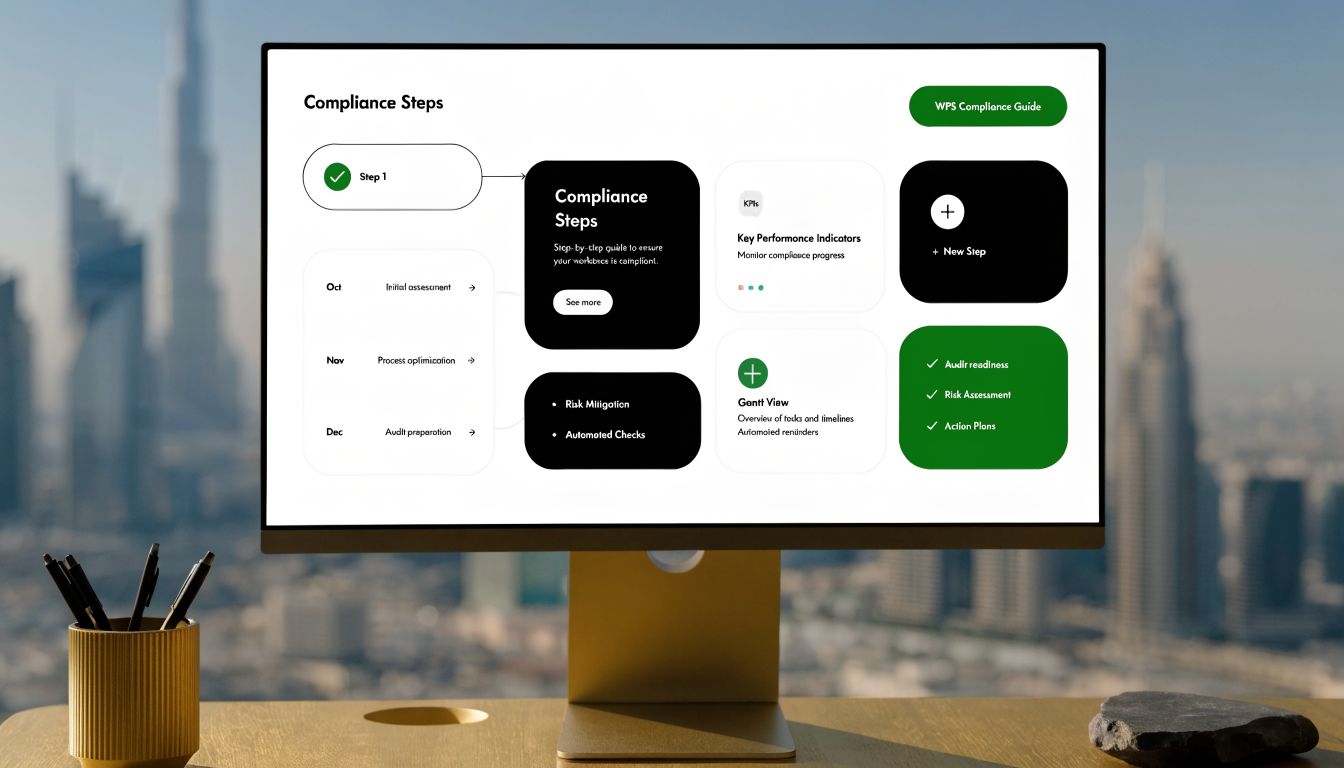
WPS payroll in the UAE follows a strict order. Payroll data is prepared. The Salary Information File is submitted through an authorised agent. MoHRE and the Central Bank review it. Then salary disbursement is completed. You can’t treat this as a casual payment batch. It’s a validated compliance workflow.
A practical payroll team should control these checkpoints every month:
Payroll cut-off is frozen
Final attendance, leave, and variable pay must be approved before file preparation.Employee data is verified
Contract-linked salary values, bank details, and employee identifiers must match current records.SIF is generated from the payroll engine
This should come from your ERP, not from manual re-entry.Submission happens through the approved channel
Your bank or authorised WPS agent becomes part of the control chain.Exceptions are resolved immediately
Rejections shouldn’t wait until payday.
Timelines are not flexible in practice
Owners often assume a few days’ delay is manageable. It isn’t. Once salaries drift beyond contractual timing, you create a compliance problem, an employee trust problem, and often a cash planning problem.
The operational discipline should look like this:
- Set a fixed payroll calendar: Don’t let every department negotiate the payroll date each month.
- Lock change approvals early: Last-minute salary edits are one of the main causes of bad submissions.
- Submit before pressure builds: Early submission gives your team time to resolve rejection issues without salary disruption.
Practical rule: The right payroll date isn’t the legal last minute. It’s the internal date that still gives you room to fix errors before employees are affected.
Future changes will punish weak master data
The next big shift is not cosmetic. It’s structural. The projected 2026 WPS upgrades will enable direct, real-time integration between MoHRE and financial institutions for higher efficiency and stricter automated enforcement, which means ERP systems must ensure pre-payment master-data accuracy such as IBANs and contracts to avoid escalated compliance flags, as outlined in Links International’s analysis of the 2026 upgrade.
That changes how you should think about payroll governance. The issue won’t just be whether salaries were eventually paid. The issue will be whether your data was correct before payment.
What managers should do now
If you’re running a growing business, prepare as if tighter real-time checks are coming into daily practice. I recommend four immediate controls:
- Audit employee master data now: IBANs, contract terms, branch assignment, and payroll setup should be reviewed before they become a rejection point.
- Remove duplicate data entry: If HR updates one system and payroll uses another, you already have a control gap.
- Tie payroll to finance: Salary cost should post directly to the correct accounts and cost centres.
- Choose an ERP that can scale with compliance changes: A rigid system creates more work every time regulation gets tighter.
The Technical Anatomy of WPS Integration in an ERP
When managers hear “WPS integration”, many assume it means exporting a file after payroll is finished. That’s too narrow. Proper integration starts much earlier. It starts in the employee master file and ends only when payroll, banking, and accounting all reflect the same approved result.
What the data journey looks like
In a properly designed ERP, payroll data moves through a controlled path:
- HR master data: Employee identifiers, contracts, joining dates, salary structure, leave policy, and bank information
- Operational inputs: Attendance, overtime, project or branch assignments, commissions, deductions, and approved advances
- Payroll engine: Gross-to-net calculation based on company rules
- WPS output: SIF generation from approved payroll data
- Accounting impact: Ledger postings, cost allocation, and payroll liability clearance
That’s why I tell management teams to stop asking whether a system can “do WPS”. The right question is whether it can maintain clean data all the way into the WPS file and then carry the result back into finance. If it can’t, you’ll still be correcting errors manually.
A connected HR and finance stack matters here. If you want to see how that relationship should work inside one environment, review integrated HRMS and accounting workflows.
The SIF structure you cannot get wrong
The Salary Information File (SIF) is built on two components. The Employee Details Record (EDR) and the Salary Control Record (SCR). The EDR requires precise details including 14-digit labour card numbers, 9-digit bank routing codes, IBANs, salary periods, fixed and variable salary splits, and leave days. The SCR aggregates file-level data such as the 13-digit agent ID and total salary amount. Incomplete or incorrect fields can trigger immediate MoHRE rejection and lead to penalties of up to AED 5,000 per violation, according to Akrivia’s explanation of UAE WPS file structure.
Spreadsheet-driven payroll usually collapses when a team, despite calculating salaries correctly, still fails on the submission file because the identifiers, codes, or period values were pulled from inconsistent sources.
Your payroll can be numerically right and still be operationally non-compliant if the SIF data is wrong.
Key fields in a UAE WPS Salary Information File SIF
| Field Name | Description | Example | Common Error Source |
|---|---|---|---|
| Labour card number | Employee identifier used in the EDR | 14-digit labour card number | Old employee record or missing update |
| Bank routing code | Bank identifier in the EDR | 9-digit bank routing code | Wrong bank mapping |
| IBAN | Employee salary account number | Employee IBAN | Manual typing error |
| Salary period dates | Start and end of salary period | Payroll month date range | Incorrect cut-off setup |
| Working days count | Days considered for payroll calculation | Approved working days | Attendance not finalised |
| Fixed salary | Contract-linked fixed component | Basic and fixed allowances | Contract not updated |
| Variable salary | Overtime, commission, incentives and other variable amounts | Variable pay amount | Manual adjustment outside payroll |
| Leave days | Relevant leave entitlement or leave values in the EDR | Leave day entry | Leave module not synchronised |
| Agent ID | File-level identifier in the SCR | 13-digit agent ID | Incorrect setup with agent or bank |
| Creation timestamp | File creation date and time in the SCR | System-generated timestamp | Manual file preparation |
| Payroll month and year | Reference payroll period in the SCR | Payroll month and year | Wrong period selection |
| Record count | Total employee records in the file | Number of records in run | Missing or duplicate employee lines |
| Total salary amount | Aggregate salary value in the SCR | Total payroll amount | EDR totals not matching file control total |
Why integrated validation matters
The value of ERP automation is not that it creates a file. It’s that the system validates the data before the file is created. Good validation catches mismatched salary structures, missing IBANs, inconsistent bank records, and period errors before submission.
For multi-branch firms, this becomes even more important. One branch may process overtime differently. Another may delay attendance approval. A central payroll team needs one system to enforce one set of controls while still handling branch-specific policies.
That’s where a mature ERP setup earns its place. It reduces dependence on tribal knowledge, reduces rework, and gives management a proper audit trail instead of a folder full of edited spreadsheets.
Your ERP Implementation and Migration Checklist for WPS
Moving to a WPS-compliant ERP isn’t a software installation project. It’s a payroll control project. If you migrate weak data and weak processes into a new system, you’ll generate cleaner-looking mistakes.

Start with data, not with screens
Most ERP projects fail at the beginning. The team rushes into forms, reports, and user roles, while employee master data remains inconsistent. That’s backwards.
Your first checkpoint should be a master data audit covering employee records, bank details, contract-linked salary structures, leave balances, branch assignment, and approval roles. If your current records are spread between HR files, finance spreadsheets, and emails, fix that before migration.
Configure policy logic carefully
Payroll isn’t just a list of earnings and deductions. It reflects company policy. The ERP must reflect how your business works.
Focus on these configuration areas:
- Salary structures: Fixed pay, variable pay, allowances, overtime categories, deductions, loans, advances, and leave-related payments
- Organisational mapping: Branches, departments, projects, properties, workshops, factories, and cost centres
- Approval routing: Who reviews attendance, who approves payroll changes, and who authorises final release
- Accounting mapping: Every payroll component should land in the correct ledger and cost bucket
If your business has special workflows such as third-party attendance tools, biometric devices, banking interfaces, or external finance systems, plan those early through ERP third-party integration requirements.
Chat on WhatsApp +971506228024 Quotation – Demo RequestDon’t go live without parallel testing
I strongly recommend a parallel payroll run. Run the old process and the new ERP process side by side for at least one cycle. Compare not only salary totals, but also employee-level values, leave handling, branch allocation, and WPS file readiness.
A payroll migration is successful only when HR, finance, and management all trust the output without manual rescue work.
A sensible implementation checklist should include:
Master data cleansing
Validate employee records against official documents and approved contract terms.Payroll rule setup
Build company-specific logic for earnings, deductions, leave, and variable components.Bank and agent alignment
Confirm WPS submission workflow, bank expectations, and internal approval timing.Parallel payroll testing
Compare outputs carefully before switching fully to the new process.User training
Payroll, HR, finance, and approvers must know exactly where their responsibility starts and ends.Controlled go-live
Freeze structural changes during the first live cycle unless they are essential.
This is especially important for contracting, real estate, and manufacturing businesses. Those sectors often have the messiest mix of fixed salaries, variable labour costs, and multi-location approvals. A rushed migration creates payroll risk immediately.
Hinawi ERP A Deep Dive into Its Integrated WPS Capabilities
Many payroll products can calculate salaries. Far fewer can connect payroll cleanly to accounting, operational control, and UAE compliance needs in one environment. That distinction matters if you manage assets, projects, branches, workshops, or properties.
What an integrated payroll setup should solve
A practical UAE ERP should handle payroll as part of business operations, not as an isolated monthly task. That means:
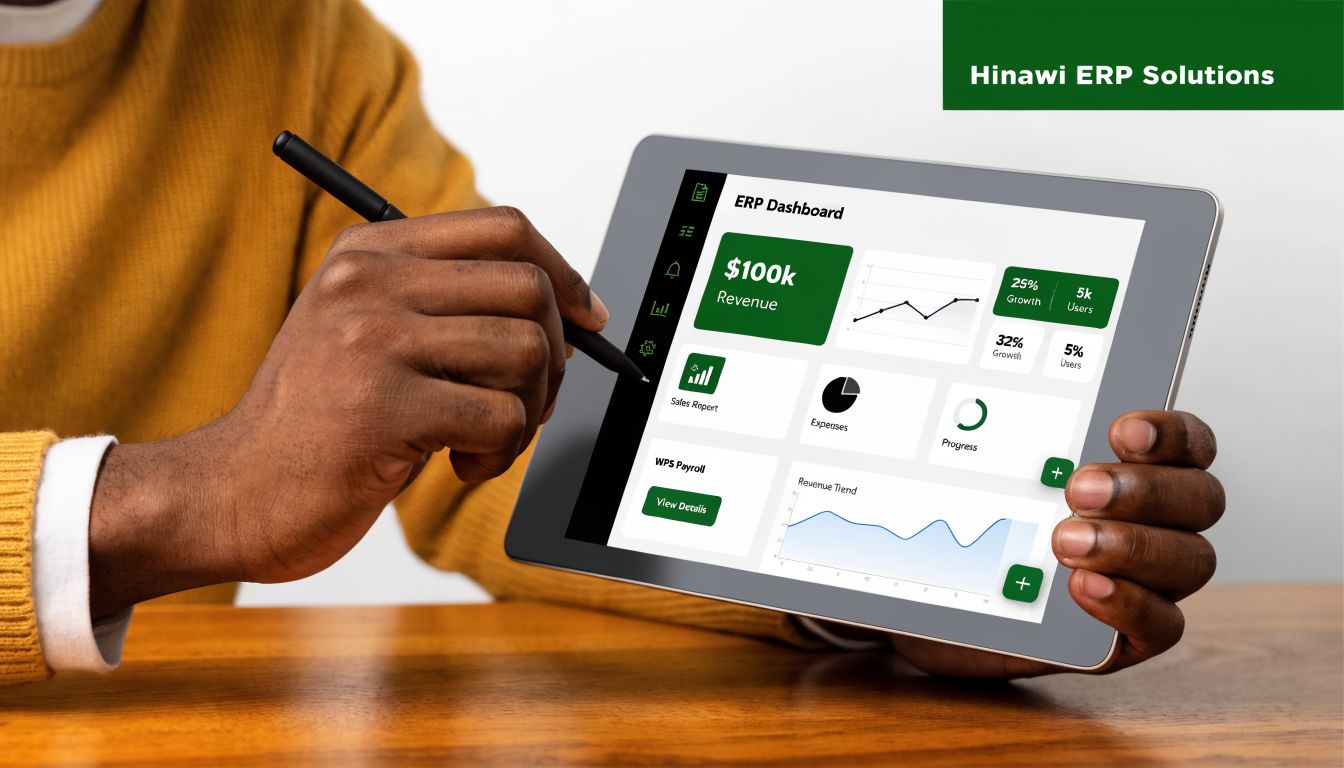
- Automated WPS preparation: Approved payroll data should flow into WPS outputs without retyping
- Bilingual operation: Arabic and English support matters for local administration, reporting, and user adoption
- Real-time accounting integration: Payroll postings should hit the general ledger, branch accounts, and cost centres immediately
- Flexible company policies: Businesses need to configure rules around overtime, commissions, benefits, and internal approvals
- Cross-module visibility: Payroll cost should connect to projects, properties, production, and service operations
You can see this logic clearly in a dedicated HR and payroll module built for integrated ERP control.
Why this matters by industry
A contracting company doesn’t just need to pay staff. It needs to push labour cost into the right project or BOQ category so management sees the actual position of the job.
A factory needs payroll tied to attendance discipline, production incentives, and department cost visibility. A real estate business needs commission structures, branch-level payroll control, and immediate accounting impact on profitability reports. A garage or maintenance company needs workshop labour cost reflected against service activity, not buried in one monthly expense total.
These are ERP questions, not only payroll questions.
One practical example of the right fit
Explorer Computer LLC – Hinawi Software ERP fits this type of requirement because it combines Accounting, HR & Payroll with WPS support, Real Estate Management, Fixed Assets, Manufacturing, Garage & Maintenance, School Management, CRM, VAT and e-Invoicing readiness, bilingual Arabic and English operation, and real-time accounting integration within one locally developed ERP environment.
That matters for businesses that don’t want payroll floating outside the core system.
What owners should look for before choosing
Don’t buy on interface alone. Review the operational depth:
| Decision area | What to check |
|---|---|
| Payroll control | Can the system manage earnings, deductions, leave, approvals, and WPS output from one payroll engine? |
| Finance linkage | Does payroll update accounting instantly and correctly by branch, project, or department? |
| Industry fit | Can labour cost be tracked in ways that reflect your business model? |
| Local readiness | Does the system support UAE WPS workflows, bilingual usage, and local compliance expectations? |
| Adaptability | Can policies and reports be adjusted without forcing manual workarounds? |
A good ERP choice reduces payroll stress. A poor one only hides the stress until the end of the month.
Compliance Best Practices and Avoiding Common WPS Errors
The most expensive WPS problems are usually predictable. Incorrect IBANs. Salary figures that don’t match contract records. Late file preparation. Leave or final settlement values handled outside the controlled payroll process. These aren’t rare edge cases. They’re the standard failures of disconnected payroll operations.
Where companies usually go wrong
The WPS process follows a strict sequence of SIF preparation, agent submission, dual review by MoHRE and the Central Bank, then disbursement. Non-compliance, including a mismatch between EDR salary totals and the official labour contract, can lead to automated fines ranging from AED 1,000 to AED 5,000, with escalations that include work permit blocks and judicial referrals, and MoHRE tracked over 15,000 violation cases in this area, according to Ramco’s review of WPS compliance in Dubai.
That should end the debate about whether manual control is “good enough”.
The best controls are boring and repeatable
The companies that stay compliant do the same simple things consistently:
- Keep contract data current: Don’t allow salary adjustments to live in email chains or side spreadsheets.
- Audit bank details regularly: IBAN corrections should be controlled and documented before payroll processing starts.
- Finalise attendance early: Payroll teams shouldn’t be chasing supervisors for basic time data at the last moment.
- Use one approval trail: HR, finance, and management must approve from the same system record.
- Store payroll evidence properly: SIF outputs, approval records, and payment confirmations should be easy to retrieve.
If your team still relies on ad hoc corrections, use a controlled support reference like payroll operational guidance in ERP workflows to formalise the process.
Good compliance is usually the result of routine discipline, not heroic effort on payday.
A stronger operating model
I recommend a monthly payroll governance routine with three layers:
Pre-payroll audit
Review changes to employee records, contracts, leave, and bank information.Payroll validation
Check anomalies before final approval. Unexpected deductions, missing attendance, and unusual variable pay should trigger review.Post-submission control
Confirm that submission, payment status, and accounting postings all match the approved payroll run.
ERP automation earns its value. It turns WPS from a monthly scramble into a managed control cycle.
Chat on WhatsApp +971506228024 Quotation – Demo RequestConclusion Future-Proofing Your Payroll with an Integrated System
WPS compliance in the UAE isn’t a side task. It sits at the centre of payroll control, employee trust, financial accuracy, and management discipline. If your team still treats it as a monthly upload exercise, you’re underestimating the operational risk.
Manual payroll breaks first in growing businesses. It breaks when headcount rises, when branches multiply, when project costing matters, and when finance needs immediate visibility instead of month-end reconstruction. Asset-heavy companies feel that pain even faster because payroll affects depreciation-linked operations, project cost, service margins, and cash planning at the same time.
The right response isn’t more checking in Excel. It’s an integrated ERP approach where employee data, payroll rules, WPS output, and accounting all work from the same controlled system. That reduces rework, limits rejection risk, improves reporting, and gives owners a clearer view of labour cost across the business.
If you operate in the UAE or the wider GCC, this is a strategic decision. A proper WPS payroll UAE ERP setup helps you stay compliant today and adapt faster when payroll controls become stricter tomorrow.
Take the Next Step with Hinawi ERP
Your payroll process is too important to leave to manual files, fragmented approvals, and month-end firefighting. If you run a business in the UAE or GCC, the smarter move is to modernise the whole payroll and finance workflow, not just patch the WPS output.
Hinawi ERP is a fully integrated ERP software developed since 1998 in Abu Dhabi. It supports Accounting, HR & Payroll, Real Estate Management, Fixed Assets, Manufacturing, Garage & Maintenance, School Management, CRM, and complete business automation for companies across the UAE and GCC.
With Hinawi ERP, your business can:
- Support UAE WPS payroll requirements through an integrated HR and payroll environment
- Maintain VAT and e-Invoicing compliance alongside payroll and accounting processes
- Operate in Arabic and English for smoother daily use across departments
- Apply flexible company policy settings for allowances, deductions, approvals, and operational workflows
- Connect payroll to real-time accounting across all major modules
- Manage industry-specific needs for factories, contracting firms, real estate companies, schools, garages, trading businesses, and manufacturers
If you want tighter payroll control, less manual work, stronger financial accuracy, and better management visibility, this is the right time to review your ERP setup. Visit Hinawi ERP’s official website or request a personalised demo with the Abu Dhabi team.
Explorer Computer LLC – Hinawi Software ERP helps companies across the UAE and GCC modernise payroll, accounting, HR, fixed assets, real estate, manufacturing, maintenance, schools, and wider business automation. If you want practical advice on implementing an integrated WPS-ready ERP environment, speak with the team through Explorer Computer LLC – Hinawi Software ERP.