Investing in powerful warehouse technology is only half the battle for businesses in the UAE and GCC. The crucial link between a new Warehouse Management System (WMS) and a real return on your investment is effective wms systems training. As an ERP consultant, I have seen it happen too many times: a company rolls out a new WMS, and instead of creating efficiency, it causes confusion and friction. This is where professional training comes in, turning hesitant users into experts who can make the system truly work for your business. For instance, a system like Hinawi ERP integrates warehouse operations directly with finance, meaning a well-trained team is essential for overall business health.
Chat on WhatsApp +971506228024
Quotation – Demo Request
Chat with Hinawi AI
Why WMS Systems Training Is Critical in the Middle East
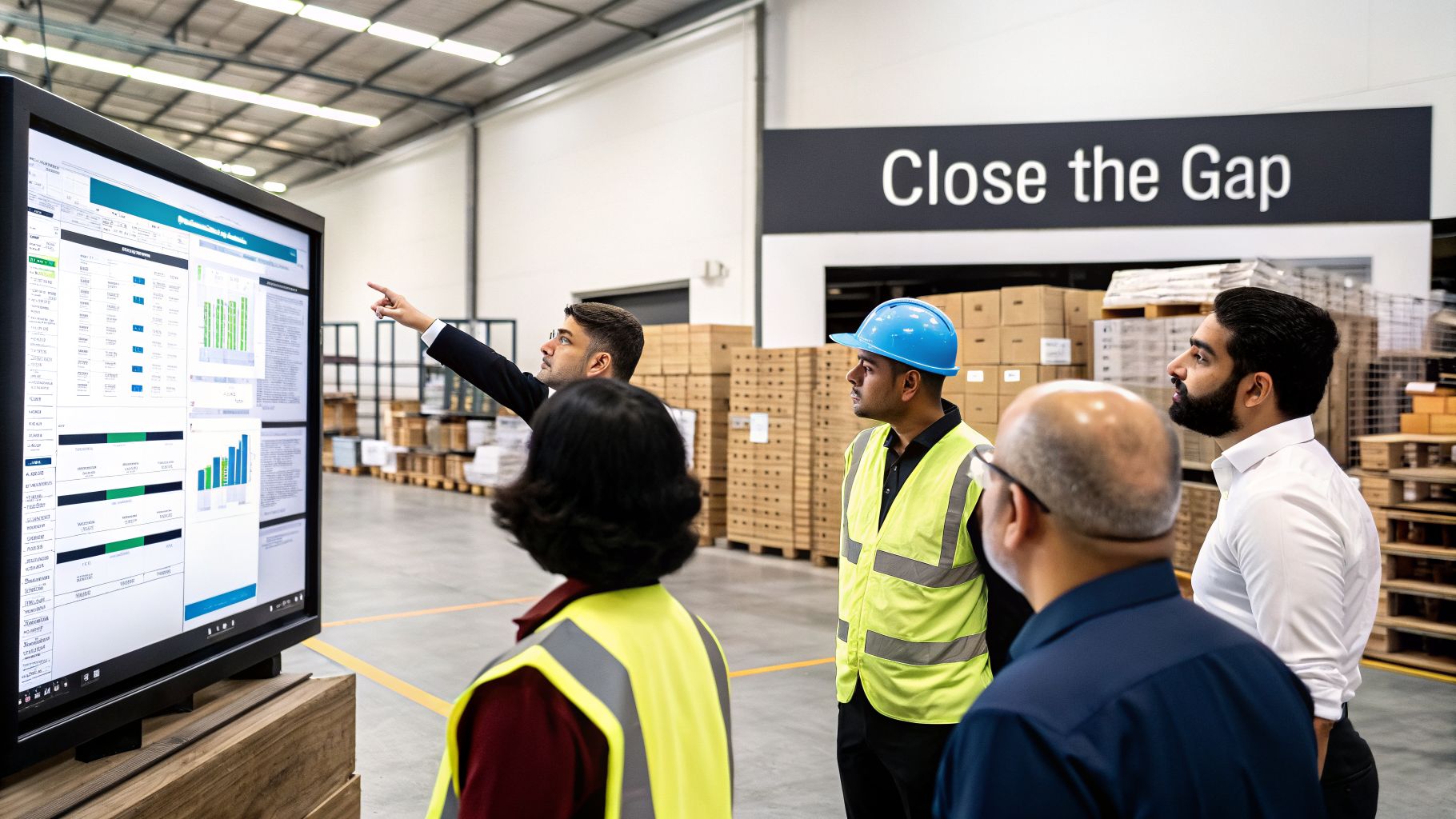
The logistics and e-commerce boom across the UAE, Saudi Arabia, and the wider GCC has pushed companies to adopt advanced WMS solutions faster than ever. The problem? This rapid adoption has created a major skills gap. Many businesses are learning the hard way that technology itself is not a magic wand. Without structured, hands-on training, even the most expensive WMS will fall short of its promise.
Consider a trading company in Dubai’s Jebel Ali Free Zone that just went live with a feature-packed WMS. They were expecting operations to run like clockwork. Instead, they face recurring challenges:
- Inventory counts are perpetually inaccurate because the team isn't scanning inbound goods correctly, leading to discrepancies in financial reports.
- Shipping delays become the norm as staff struggle with the dispatch module, impacting customer commitments.
- Picking errors are on the rise, leading to a surge in costly returns and a decline in customer satisfaction.
This is not a hypothetical scenario; it’s a daily reality for businesses that overlook proper training. The issue isn't the software—it's the gap in operational knowledge. A dedicated wms systems training program is not just an expense; it’s a strategic imperative.
From User Confusion to Strategic Asset
Good training does more than just teach people which buttons to press. It transforms your team into strategic operators who can use the WMS to gain a competitive edge. This is especially true when your WMS is part of a larger ERP system like Hinawi ERP, where warehouse transactions instantly impact your financial accounts, VAT reports, and inventory valuation. In that environment, accuracy is everything.
A well-planned curriculum ensures every person, from the receiving dock to the inventory control office, understands how their role affects the entire operation. They don't just learn how to perform a task; they learn why it’s critical for everything from VAT compliance to overall profitability. That level of understanding builds a culture of ownership and accountability.
To get a feel for the operational standards that WMS training helps you achieve, take a look at these actionable warehouse management best practices.
The Necessity of Localized, Bilingual Training
In the diverse workforce of the Middle East, one-size-fits-all training is ineffective. Your program must be localized. That means offering all materials and instruction in both Arabic and English to ensure everyone on your multilingual team is on the same page. A system with a bilingual interface, like Hinawi ERP, is an excellent foundation, but you only realize its full value when your training supports it.
A trained team is the difference between simply having a WMS and truly mastering your warehouse operations. It’s an investment in accuracy, efficiency, and long-term growth.
Ultimately, WMS systems training is about managing risk and maximizing your return. It minimizes the chances of a costly implementation failure, drives operational accuracy, helps ensure regulatory compliance, and turns your tech investment into a real competitive advantage in the tough GCC market. If you're looking to understand the bigger picture, you might want to check out our guide on supply chain management (SCM) software.
Chat on WhatsApp +971506228024
Quotation – Demo Request
Chat with Hinawi AI
The First Step: A Reality Check with a Training Needs Assessment
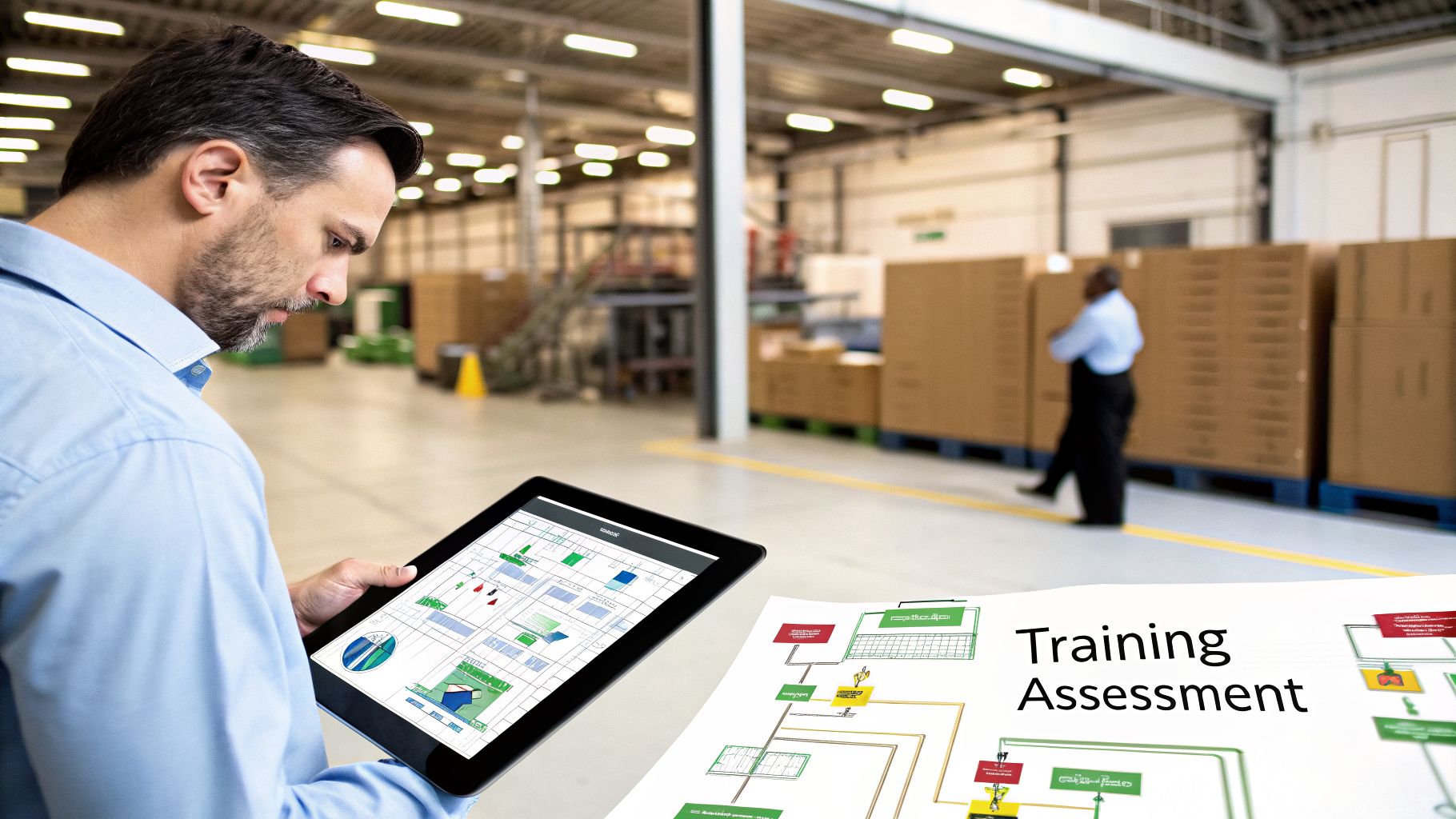
Before you book a single training room or print a single manual, the success of your wms systems training hinges on a thorough needs assessment. I’ve seen companies get excited about new technology and dive straight into generic training. The result is almost always wasted time, frustrated staff, and a system that never delivers on its promise.
Especially for businesses here in the UAE and across the GCC, skipping this step is a critical mistake. Your goal isn't just to teach people which buttons to press. It's to build a specific, targeted plan that solves your unique operational headaches. You need a brutally honest picture of where you are today versus where this new WMS needs to take you.
Get a Clear Picture of Your Current Operations
Start by walking the warehouse floor and mapping every single process. Don’t rely on old documentation; see it with your own eyes. Where are the bottlenecks? Where do mistakes happen most often?
- Receiving: How often does your team find discrepancies between a supplier's invoice and what actually arrives? Are new pallets left in the receiving bay for hours, causing congestion or, worse, going missing before they’re scanned in?
- Putaway: Is there a logical system for where goods are stored, or is it a free-for-all based on whoever finds an empty shelf first? This is a classic recipe for lost inventory and wasted time during picking.
- Picking & Packing: What’s your real order accuracy rate? Look for patterns in the errors. Is it consistently the wrong item or the wrong quantity? This tells you exactly where your training needs to be most intensive.
- Shipping: Are manifests and shipping labels a source of constant delays? For companies shipping across GCC borders, are you running into compliance issues that a properly configured WMS could solve?
By answering these questions, you uncover the specific pain points your wms systems training must address. If picking errors for small, similar-looking items are high, for example, your training curriculum needs to hammer home scanner verification and hands-on practice in that area.
Assess Your Team's Readiness and Define Their Roles
Next, you need to get a realistic sense of your team's technical skills. In a diverse workforce like we have in the Middle East, you'll have everyone from digital natives to people who are far less comfortable with new technology.
A needs assessment isn't about finding fault; it's about gathering intelligence. It ensures your training budget is invested in solving real problems, not just teaching features.
This is a huge factor in our region. The Middle East's logistics sector is grappling with a significant skills gap, with estimates pointing to a shortage of around 250,000 trained professionals. This is compounded by the fact that nearly 80% of warehouses here still rely on manual processes. For them, the jump to a modern WMS is massive.
Whether you're a real estate company in Abu Dhabi managing maintenance parts or a large-scale manufacturer in Saudi Arabia, targeted training is the only way to achieve the 25% higher automation uptake seen in well-prepared teams. You can find more data on these regional WMS market dynamics on Ken Research.
Once you have a baseline, map out exactly who will use the WMS and what they need to do. A warehouse manager requires access to inventory reports and performance dashboards. A picker just needs to master the handheld scanner for their specific tasks. This role-based approach is the foundation of a good training plan.
For a deeper dive into structuring this phase, our work plan for starting new software can provide a helpful framework. A proper assessment ensures your training delivers real competence where it matters most, turning a technology expense into a powerful operational investment.
Developing Your Role-Based Training Curriculum
Once you’ve mapped out who needs training, it’s time to build the actual curriculum. I’ve seen companies try a one-size-fits-all approach to wms systems training, and frankly, it never works. You can't expect a picker to care about the finer points of purchase order receiving, and you can't teach a forklift driver the same way you teach an inventory analyst.
Effective training has to be specific to the job. Think of your warehouse not as one big unit, but as a series of specialized teams. The person on the receiving dock needs a completely different skill set than the person managing cycle counts. Our goal here is to build a curriculum for each role, giving every team member the confidence and competence to master their part of the process within the WMS.
And as you get into the weeds of curriculum development, grounding your work in solid instructional design principles will make a world of difference in how well your team absorbs the new material.
Receiving and Putaway Team
Everything starts here. An error at the receiving dock can create phantom stock, cause picking delays, and throw off your entire inventory for weeks. The training for this team must be laser-focused on getting the data right from the very beginning.
- PO Verification: Your curriculum needs hands-on practice for scanning goods against purchase orders in the WMS. For a system like Hinawi ERP, this means getting a scanner in their hands and having them physically match items to digital POs, learning how to immediately flag quantity or product mismatches.
- System-Directed Putaway: It's not about just finding an open spot. We need to train them to trust the WMS. The system should tell them the best place to store an item based on its sales velocity, size, or other rules you've set. A great exercise is to have them receive a mix of fast-moving products and slow-moving bulk goods, so they can see how the WMS directs them to different zones.
- Real-World Scenarios: Have them process a complicated mixed shipment from an overseas supplier. This is a daily reality for many trading companies in the UAE. It forces trainees to juggle multiple POs, handle items that weren't on the order, and use the WMS to solve the kinds of problems they'll actually face.
When you get this right, your receiving team becomes the guardian of your inventory accuracy.
Picking and Packing Crew
This team is the face of your fulfillment operation; their speed and accuracy directly shape the customer's experience. Their training has to be all about efficiency and precision using the system's order fulfillment tools.
- Picking Methodologies: Your WMS might use wave picking, zone picking, or batch picking. Don't just tell them about it—create practical labs where they have to pick real orders using each method. They need to get a feel for following the scanner's path and trusting its logic to be efficient.
- Order Accuracy Drills: I always recommend creating practice orders with items that look almost identical or have tiny variations. This builds the muscle memory to "scan-to-confirm" every single item, which is the single most effective way to eliminate picking errors.
- Packing and Consolidation: Training doesn't stop once the item is picked. The team needs to know how to use the WMS at the packing station to bring items together from different pick zones, print the right shipping labels, and generate the correct packing slips for the box.
Chat on WhatsApp +971506228024
Quotation – Demo Request
Chat with Hinawi AI
Shipping and Inventory Control
These two functions are about final-mile execution and big-picture oversight. The skills here lean more towards compliance, documentation, and analysis rather than pure speed.
A role-based curriculum does more than teach tasks; it instills a sense of ownership. When a picker understands their impact on financial reports, their attention to detail skyrockets.
For the Shipping team, the curriculum must nail the process of generating compliant paperwork, which is especially critical for cross-border logistics within the GCC. They need to be experts at creating accurate shipping manifests, bills of lading, and commercial invoices straight from the WMS.
The Inventory Control team's training is all about maintaining data integrity over the long term. Their curriculum needs to cover:
- Running Cycle Counts: Show them how to perform system-guided cycle counts without bringing the warehouse to a standstill.
- Investigating Discrepancies: Give them a clear process for using WMS audit trails to figure out why a discrepancy exists and how to correct it.
- Using System Reports: This is key. Train them to run and interpret WMS reports to analyze stock movements, spot slow-moving or dead inventory, and help forecast replenishment needs.
This is where a training sandbox environment is non-negotiable. You need a safe space where your teams can practice on real-world scenarios—like processing a complex return from a customer in Riyadh—without any risk to your live operations. If you need help building out this level of detail, you can always work with a certified trainer or reseller who specializes in developing and delivering this kind of hands-on curriculum.
Bringing Your WMS Training to Life on the Warehouse Floor
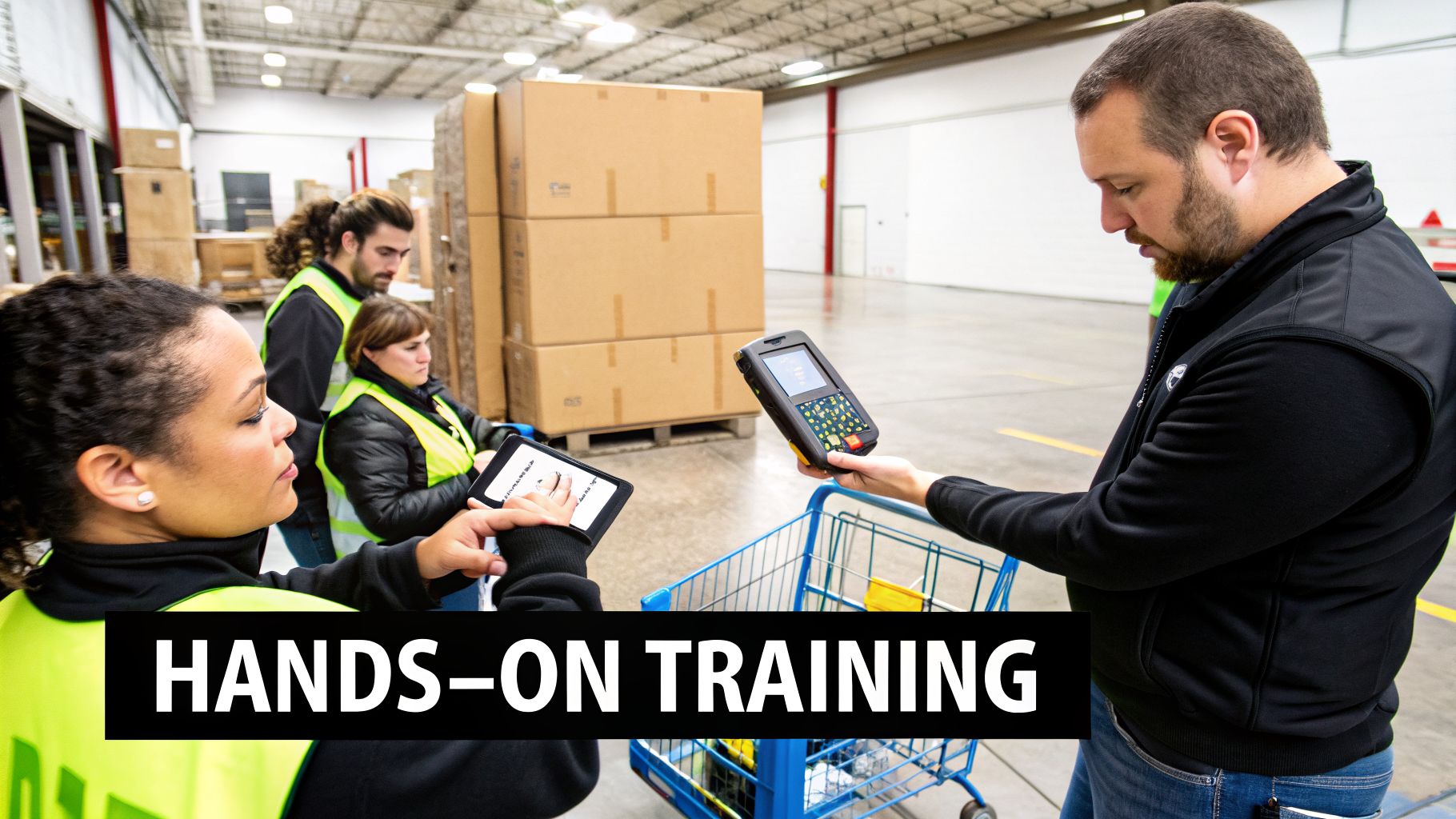
A great training plan on paper is useless if it doesn't translate to the fast-paced reality of the warehouse floor. Theory is one thing, but muscle memory is what prevents errors at 2 AM during peak season. From my experience as a consultant, the only way to get there is through a blended learning model.
This isn't just about splitting time between a classroom and the floor. It’s a strategic one-two punch. First, you gather the team in a classroom to cover the "why." This is where you walk them through the big picture on a large screen, showing how their actions in the WMS affect everything from inventory valuation to VAT reporting. Then, you immediately move to the warehouse for the "how." You put scanners in their hands and let them work in a safe, sandboxed training environment. This is where the concepts click, and the real learning happens.
The Power of Blended Learning
A solid blended approach isn't just a mix of activities; it reinforces knowledge by hitting it from different angles.
- Classroom for Concepts: Use this time to explain the entire flow of goods within the WMS. Connect the dots for them. Show how a single accurate scan during putaway is what allows a picker to find that exact item six weeks later without a hitch.
- Hands-On Warehouse Labs: This is where the reps come in. Have your teams run through simulated receiving, picking, and cycle counting tasks. I’ve seen great success by turning it into a friendly competition—see which team can pick a mock order list with 100% accuracy in the shortest time.
- Peer-to-Peer Mentoring: Don't underestimate the power of your own people. Designate your sharpest operators as "super users" and empower them to coach their colleagues. The most practical, real-world tips often come from the person working right next to you.
This hands-on approach is especially vital here in the Middle East. The regional WMS market is set to explode, projected to hit USD 438 million by 2033, largely thanks to e-commerce. The problem? There's a massive skills gap, with an estimated shortage of 250,000 qualified logistics professionals on the horizon. With so few people receiving formal supply chain education, practical, effective wms systems training becomes a serious competitive advantage. You can see more on these trends and projections from Grand View Research.
Scaling Your Efforts with a Train-the-Trainer Program
If you're running a larger operation or have multiple sites across the GCC, it’s not feasible to train every single employee directly. That's where a "train-the-trainer" model really shines.
The idea is simple: you select a small group of internal champions. Think of a motivated warehouse supervisor, a sharp shift lead, or a high-performing operator who just gets it. These folks receive intensive, deep-dive training from the WMS vendor or your implementation partner, turning them into your resident experts.
Once certified, they become the trainers for their own teams. This strategy is a game-changer because it’s scalable, sustainable, and far more effective. Your internal trainers already know the unique quirks of your facility and the people in it, making the training immediately relevant. You’re not just training for a launch; you’re building a permanent capability to onboard new hires and run refresher courses for years to come.
Change management is not a separate step; it's woven into the fabric of your training. When people feel heard and understand the 'why' behind the new system, resistance transforms into engagement.
Win Hearts and Minds with Smart Change Management
Let’s be honest: no WMS rollout is just about technology. It's about people. And people, by nature, are often wary of change. The key is to address that resistance head-on, not as an afterthought.
I saw a perfect example of this at a manufacturing company in an Abu Dhabi industrial zone. They were implementing Hinawi ERP and faced significant pushback from a team that had relied on paper and clipboards for years. Their secret weapon was building change management right into the training itself.
They made brilliant use of Hinawi ERP’s bilingual Arabic and English interface, which instantly removed language as a barrier for their diverse workforce. More importantly, every training module focused on "what's in it for you." Instead of dwelling on the old paper system being replaced, they highlighted the gains: no more lost pick tickets, crystal-clear instructions on their handhelds, and an end to wasted time searching for misplaced inventory. By showing the team how the new WMS made their individual jobs easier, they didn't just get compliance; they got genuine buy-in.
For more ideas on structuring your own training delivery, check out the resources available on Hinawi ERP training and support.
Measuring Training Success and Driving Continuous Improvement
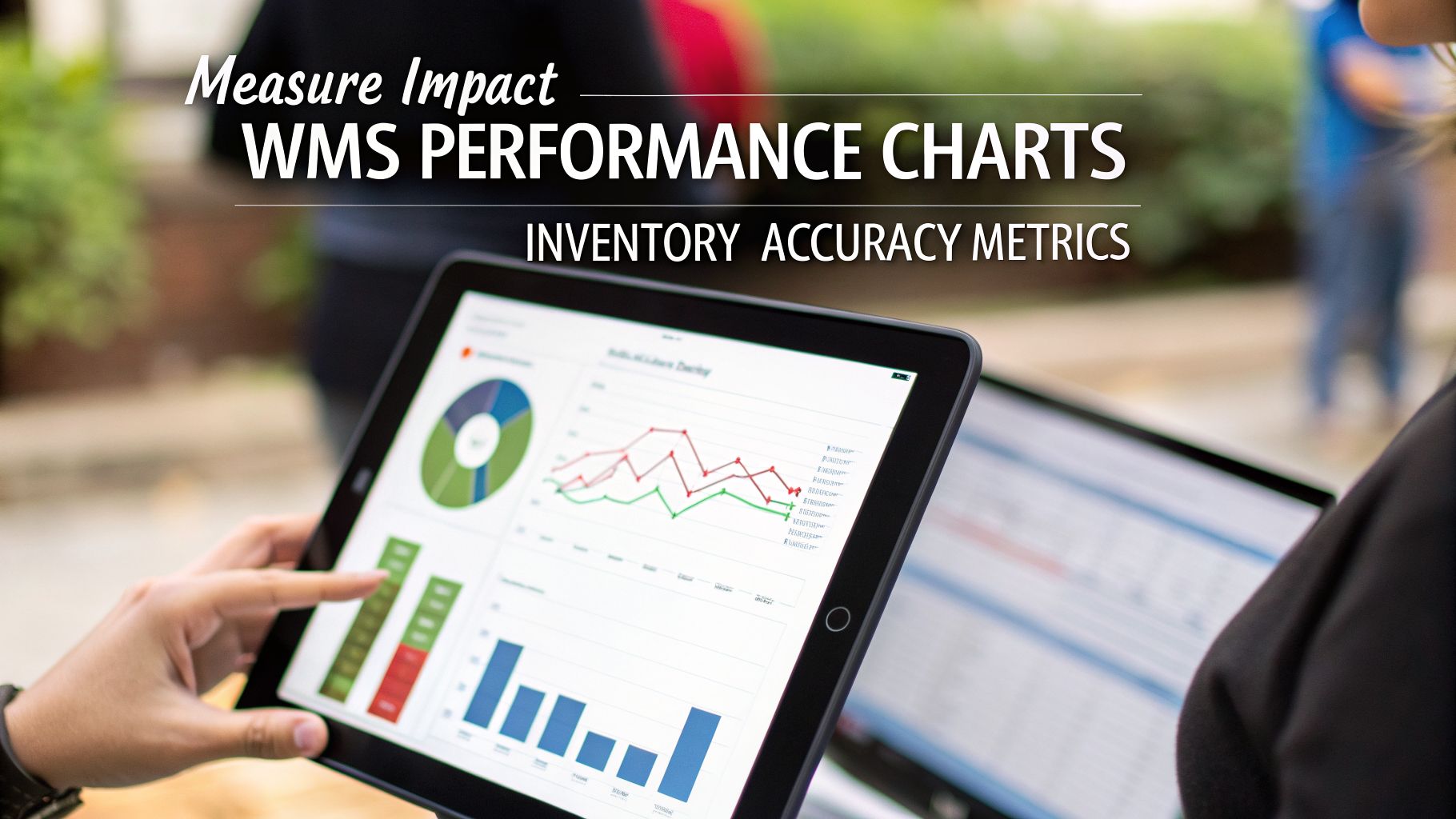
Here’s a hard truth: your wms systems training isn't over when the last employee signs off. I've seen it time and again with companies across the UAE—the real work begins after the initial sessions. The difference between a WMS that just "works" and one that transforms your operation lies in treating training as a living, breathing part of your business.
You need to be able to prove your training investment is paying off. This isn't about warm feelings or anecdotal wins; it's about connecting the dots between your training program and hard numbers on the warehouse floor. Without that data, you're just guessing, making it impossible to justify the budget or pinpoint where your team needs more support.
Defining and Tracking Key Performance Indicators
The most straightforward way to see if your training is hitting the mark is to watch the very metrics your WMS was meant to fix. These Key Performance Indicators (KPIs) give you an honest look at how well your team understands and uses the new system.
Before you even start training, you need to capture a baseline. What do these numbers look like right now? That's your starting line. Once you go live, start tracking these same KPIs weekly, then monthly.
- Inventory Accuracy Rate: This is the big one. With a properly trained team and a solid WMS, you should be pushing for an accuracy rate above 99%. If that number isn’t climbing after go-live, it’s a red flag that something is off in your receiving or cycle counting training.
- Order Picking Accuracy: This KPI hits your bottom line directly through customer satisfaction and returns. Watch the percentage of orders picked perfectly. Seeing a sharp drop in picking errors is a clear, undeniable win for your training.
- Order Fulfillment Cycle Time: How long does it take to get an order out the door, from click to ship? Effective training gives your team the confidence to move faster within the system. Shaving even a few minutes off this cycle time gives you a massive leg up on the competition.
- New Hire Onboarding Time: Think about how long it takes a new team member to become genuinely productive. A well-designed training playbook should cut that ramp-up time significantly, saving you real money on labor and ensuring everyone works the same way.
Chat on WhatsApp +971506228024
Quotation – Demo Request
Chat with Hinawi AI
Creating a Powerful Feedback Loop
KPIs tell you what is happening, but it's your people on the floor who can tell you why. Setting up a formal feedback system is non-negotiable for continuous improvement. These are the people using the WMS all day, every day; their insights are pure gold.
I’ve always found that the most brilliant process improvements don't come from a manager’s office—they come from an operator on a forklift who found a smarter way to do things. Turn your team from system users into system owners.
Make it easy for them to share ideas or flag problems. It could be a simple channel on your internal chat, a dedicated part of the weekly team huddle, or even a low-tech suggestion box. When an operator tells you a specific workflow feels clunky or a certain scan keeps failing, you need to listen. That small observation can lead to a tweak that saves everyone hours. This constant conversation also helps you spot the need for quick, targeted refresher training long before a small issue becomes a massive operational headache.
Evolving Training for Long-Term Excellence
Your business isn't static, and neither is your WMS. As you grow and processes change, your training has to keep pace. This is where you shift from one-off training to a long-term investment in your team's skills.
Take a real-world example: a contracting company in Abu Dhabi running Hinawi ERP for its warehouse. When they land new projects, they often set up temporary job-site storage. Suddenly, their team needs to go beyond basic WMS functions and learn how to manage inventory across multiple, disconnected sites—a much more complex challenge.
This kind of evolution means you need a plan for:
- Refresher Training: Schedule these regularly to make sure core processes stick and to correct any bad habits that have crept in over time.
- Advanced Modules: Offer specialized training for your senior staff or "super users." Let them unlock the more powerful features of your WMS, like advanced analytics, labor management, or slotting optimization.
- Cross-Training: This is a game-changer. Teaching a picker how receiving works, or a putaway driver how to pack, builds a flexible, resilient team. When peak season hits or someone calls in sick, you’ll be glad you did.
By measuring what matters, listening to your team on the ground, and constantly adapting your training, you ensure your WMS doesn't just get implemented—it becomes the engine driving your efficiency for years to come.
Answering Your Top Questions on WMS Systems Training
When you're looking at a big investment like a new WMS, it’s natural to have questions about the training involved. Getting these answers upfront is the key to a smooth rollout and seeing a real return on your investment. Let's tackle some of the most common ones I hear from business leaders.
How Long Will This Actually Take?
The honest answer is: it depends. I’ve seen small, single-site warehouses get their teams up and running in a few focused days. This works when you have a simple, linear workflow and a small group of users.
But for larger companies—say, a distribution center with multiple zones or several warehouses across the UAE—you should plan for a more extended timeline, often spanning several weeks. This isn't a bad thing. It allows you to phase the rollout, deliver deep-dive training for specialized roles, and give everyone enough hands-on time without bringing your operations to a standstill.
What's the Single Biggest Mistake to Avoid?
The most expensive mistake you can make is focusing only on the technology and forgetting the people. I've seen it happen time and again: a company invests in a powerful system but fails to create a detailed, role-specific training plan. They don't get buy-in from the warehouse team on the floor.
When you don't engage the people who will actually use the system every day, you're setting yourself up for resistance, workarounds, and ultimately, low adoption. The best software in the world is useless if your team doesn't want to use it correctly.
Can We Train Staff Without Shutting Down Operations?
That's a great question, and the answer is absolutely yes. In fact, you should train while keeping the business running—a complete shutdown is almost never a practical option. The trick is to be strategic about it.
Here are a few proven methods:
- Phased Rollouts: Don’t go live everywhere at once. Start with one process, like receiving, or one section of the warehouse. Master it, then move to the next.
- Train During Slow Periods: Use quieter shifts, or even weekends, to run hands-on lab sessions where mistakes don't impact live orders.
- The "Super-User" Strategy: Identify a few sharp, enthusiastic team members. Train them intensively first. These "super-users" become your on-the-floor champions who can then help train their colleagues during daily work.
A well-designed training program is meant to weave into your operational rhythm, not break it. The goal is to build confidence and skill without sacrificing productivity.
How Does Training Tie Into Financial Compliance?
Proper WMS training is the bedrock of your financial accuracy—it’s that important. Every time a team member scans an item correctly, they are capturing precise data that feeds directly into your inventory valuation and cost of goods sold (COGS). This data integrity is absolutely critical for generating accurate financial statements and error-free VAT reports, which is non-negotiable for any business in the GCC.
When you're using an integrated system like Hinawi ERP, every scan on the warehouse floor instantly updates the accounting module. That means accurate training isn't just an operational issue; it's the foundation of your financial and regulatory compliance.
Take the Next Step with Hinawi ERP
For companies and business owners across the UAE and GCC, modernizing your operations is no longer optional—it's essential for survival and growth. If you are still battling manual work, financial inaccuracies, and a lack of control over your management processes, it's time for a change.
Hinawi ERP is a fully integrated ERP software developed since 1998 in Abu Dhabi, designed specifically for the unique challenges of the Middle East market. Our platform provides a single, unified solution for Accounting, HR & Payroll, Real Estate Management, Fixed Assets, Manufacturing, Garage & Maintenance, School Management, CRM, and complete business automation.
By partnering with Hinawi ERP, you gain significant operational advantages:
- Full Compliance: Stay ahead of regulations with built-in VAT and e-Invoicing compliance and full UAE WPS payroll support.
- Bilingual Operation: Empower your entire workforce with a seamless Arabic and English interface across all modules.
- Unmatched Flexibility: Adapt the system to your exact needs with flexible company policy settings.
- Real-Time Insight: Benefit from real-time accounting integration, where every transaction from any department is instantly reflected in your financial records.
- Industry-Specific Solutions: Hinawi ERP is the trusted choice for factories, contracting companies, real estate businesses, schools, garages, trading companies, and manufacturers throughout the region.
Stop letting operational delays and manual errors dictate your success. It's time to modernize your operations, reduce manual work, improve financial accuracy, and gain better control over your management.
We invite you to speak with our expert consultants. Visit www.hinawierp.com to learn more or request a personalized demo to see how Hinawi ERP can transform your business.
Chat on WhatsApp +971506228024
Quotation – Demo Request
Chat with Hinawi AI