
Category: Accounting
If you're still issuing invoices from Excel, checking customer balances in a separate accounting file, and chasing approvals over WhatsApp, your billing process is already costing you more than you think. The problem isn't only speed. It's control. One missed VAT field, one duplicated invoice number, or one branch using a different process can create a mess that lands on your accountant's desk at month-end.
Many UAE business owners often make a critical error, opting for a cheap invoicing app when what they need is small business software for billing that can support compliance, operational discipline, and growth. In the UAE and GCC, billing can't be treated as a standalone document exercise. The core issue is whether your system can handle VAT compliance, audit trails, and e-invoicing readiness, especially if you run branches or bill mixed goods and services, as noted in Salesforce's small business invoice software guidance.
A mid-sized trading company in Dubai usually starts the same way. Sales sends numbers. Accounts formats the invoice. Someone checks VAT manually. Stock is updated later, if at all. Credit notes sit in email chains. Management asks for receivables ageing and gets three different answers. That isn't a software problem alone. It's a workflow problem.
A proper system pulls billing into one controlled process. The invoice updates accounts receivable. The stock movement posts correctly. The tax treatment follows rules, not memory. The customer history stays visible. If your team regularly prepares quotations or pre-sales documents before billing, review a practical proforma invoice sample and compare that workflow with how your business currently works. The gap is usually obvious.
Hinawi ERP fits this conversation because it was built for integrated operations, not isolated billing tasks. That matters if you want fewer manual corrections and cleaner reporting.
Chat on WhatsApp +971506228024 Quotation – Demo RequestIntroduction Moving Beyond Manual Billing
Manual billing breaks first in busy companies. Not in theory. In the daily handover between sales, stores, finance, and management.
A company in Abu Dhabi may think it has a billing system because it can print invoices quickly. Then issues show up. One branch uses old item codes. Another branch applies tax treatment differently. Accounts has to correct customer balances manually. Management wants branch profitability and gets delayed reports because billing data isn't posted properly into the ledger.
Why invoice speed is the wrong benchmark
Most owners still judge billing software by the front screen. Can it print? Can it email? Can it generate a PDF? Those questions are too basic for the UAE market.
What matters is what happens after the invoice is issued.
- Ledger impact: Does the invoice post directly to receivables and revenue?
- Tax control: Does VAT flow correctly without re-entry?
- Stock effect: If you sell goods, does the system reduce inventory immediately?
- Audit readiness: Can your team trace who changed, approved, or cancelled a document?
Billing should be treated as a financial control point, not an admin form.
What operationally mature businesses do differently
Better-run businesses don't separate billing from accounting discipline. They connect quotations, sales orders, delivery, invoicing, receipts, and reporting into one chain. That cuts confusion because each department works from the same transaction.
This is especially important for GCC businesses with recurring service billing, contract-based work, or branch operations. A small workshop, school, contractor, real estate firm, or distributor may all invoice differently, but they need the same discipline. Clean master data. controlled numbering. approval workflows. and reliable posting.
The right small business software for billing gives you that structure. The wrong one gives you attractive screens and more reconciliation work later.
Understanding Modern Billing Software
Modern billing software isn't one thing. It sits on a spectrum. At one end, you have lightweight invoice generators. At the other, you have fully integrated ERP billing linked to accounting, stock, CRM, approvals, and reporting.

A lot of SMEs buy the first and later realise they needed the second.
Standalone invoicing versus integrated billing
A standalone invoicing tool creates and sends documents. That's useful if your business is simple, your volume is low, and compliance complexity is limited. Regional guidance referenced by QuickBooks notes that free tools such as Wave and Zoho Invoice can cover basic invoicing needs, while buyers in the UAE also look at multi-currency support, customisation, and secure integrations in QuickBooks' invoicing software overview.
But basic invoicing isn't enough once your sales process touches stock, tax, contracts, branches, or customer credit limits.
An integrated billing system does more:
| Billing event | Basic app | Integrated ERP billing |
|---|---|---|
| Invoice creation | Creates document | Creates document and posts accounting entries |
| VAT handling | Often manual review | Follows embedded tax logic |
| Inventory update | Usually separate | Updates stock as part of the transaction |
| Customer balance | Tracked separately | Visible in real time |
| Audit trail | Limited | Better workflow traceability |
| Multi-step approvals | Often weak | Usually structured |
Why this matters in day-to-day operations
Let's keep it practical. A trading company invoices a customer for stocked items. If billing is disconnected, accounts sends the invoice, warehouse updates stock later, and finance adjusts revenue or cost postings after the fact. That's how month-end becomes painful.
If billing sits inside an ERP, the sale moves through one governed process. The invoice isn't an isolated file. It's a transaction with consequences across the business.
For retailers and front-counter operations, this becomes even more important when billing starts at the cashpoint and flows into central accounting. If your business mixes POS and back-office invoicing, understand how point of sale and accounting integration changes control and reporting.
My advice to owners
If you're a freelancer or very small service provider, a lightweight tool may be enough for now.
If you run a UAE company with inventory, branches, service contracts, approval layers, or recurring billing, skip the temporary app mentality. Buy for process control.
Chat on WhatsApp +971506228024 Quotation – Demo RequestEssential Billing Features for UAE and GCC Businesses
The Gulf market changes the buying criteria. You don't choose billing software here based only on invoice templates, reminder emails, or whether it looks easy to use.
You choose it based on whether it survives audit, scales across branches, and supports local compliance.

VAT-compliant invoice control
For small businesses in the UAE, billing software absolutely must be built around VAT compliance. The UAE Federal Tax Authority requires tax invoices with specific fields including the supplier's TRN, invoice date, a unique invoice number, taxable amount, VAT rate, and VAT amount, which is why businesses are pushed toward integrated billing and accounting systems in Tridens Technology's enterprise billing discussion.
That requirement has direct software implications:
- Controlled numbering: You can't afford duplicate or inconsistent invoice sequences.
- Validated customer and supplier data: Missing TRN or poor master data creates bad invoices.
- Tax logic inside the transaction: VAT shouldn't be fixed later in Excel.
- Shared ledger posting: Billing, tax posting, and return reporting should connect.
If you're reviewing tax readiness, this overview of new tax considerations in the UAE is a useful checkpoint for finance teams.
Practical rule: If your accountant still edits VAT results outside the billing system, the system isn't doing its job.
Multi-currency and branch control
Dubai, Abu Dhabi, and wider GCC businesses often sell across currencies, customer types, and entities. A billing tool that works for one-office local trading may fail once the business adds project billing, inter-branch fulfilment, or export customers.
The software should support:
- Multi-currency billing: Important for import-export, services, and regional trade.
- Branch-wise visibility: Each location must follow the same rules while management still sees consolidated results.
- Customer-specific pricing and terms: Credit limits, discounts, and approvals should be controlled.
- Arabic and English operation: This matters for internal users and customer-facing documentation.
Recurring billing and operational workflows
Recurring billing sounds simple until contracts change mid-cycle, service periods differ, or credits need to be applied across multiple invoices. The same problem shows up in real estate rentals, school fees, annual maintenance contracts, and subscription-style service businesses.
A good system handles recurring charges as part of an operational workflow, not a manual monthly routine. It should also support credit notes, partial collections, customer statements, and ageing reviews.
Inventory-linked billing for trading and manufacturing
If you sell physical products, don't let billing run separately from stock. That creates false inventory, delayed costing, and sales reports nobody trusts.
Look for tight coordination between:
- Sales order and delivery
- Invoice generation
- Inventory movement
- Receivable posting
- Collection tracking
Integrated ERP billing earns its place in real deployments, where businesses often choose systems that connect inventory, accounting, and billing in real time. Hinawi ERP is one example used in this way across accounting-led operations where billing can't be separated from stock, finance, and approvals.
Strategic Selection Criteria for Long-Term Success
Most billing software comparisons are shallow. They compare screen features. They ignore business risk.
That approach will age badly in the UAE.
Buy for regulatory direction, not current comfort
The UAE Ministry of Finance announced a phased mandatory e-invoicing regime on 16 July 2026 for large and mid-sized businesses, with other segments following from 1 July 2027, shifting software selection toward systems that can generate structured electronic invoices and maintain audit-ready records, as summarised in this review of UAE invoicing software and reform milestones.
That should immediately change how you evaluate billing software.
A PDF generator may solve today's admin issue. It won't necessarily solve tomorrow's compliance requirement. You need a system architecture that can support structured invoice data, clean records, and integration capability.
The five criteria that actually matter
ERP integration
If billing doesn't connect to accounting, inventory, procurement, CRM, or service operations, your team will keep re-entering data. That's not a temporary inefficiency. It becomes a permanent control problem.
Ask direct questions:
- Does the invoice post instantly to receivables?
- Can sales and finance see the same customer position?
- Will delivery, stock, and billing stay aligned?
- Can management review profitability without manual consolidation?
Localisation for GCC operations
A system may be good globally and still be awkward locally. UAE and GCC companies need Arabic and English capability, local tax handling, practical document formats, and support that understands regional workflows.
For many businesses, payroll also sits close to billing and accounting because cash flow, project costing, and branch reporting all meet in finance. If you want one platform rather than disconnected tools, local fit matters.
Flexibility and policy control
Your business has its own approval logic. Maybe discounts above a threshold need management review. Maybe one branch can issue credit notes and another can't. Maybe project billing follows contract milestones.
You need configurable policy settings, not hard-coded shortcuts.
Support and implementation depth
Billing software is easy to sell. It's harder to implement properly. The vendor should be able to review your current process, clean your data, train users, and support the go-live period without disappearing.
A fancy interface doesn't fix a weak implementation partner.
Ownership and customisation path
Some companies need light standardisation. Others need deeper adaptation. That's why it helps to compare systems based on how far they can be customized for your operation. A useful place to start is this review of Hinawi ERP versus other ERP systems, especially if you're deciding between generic cloud tools and region-focused ERP deployment.
Chat on WhatsApp +971506228024 Quotation – Demo RequestThe wrong billing software locks you into workarounds. The right one removes them.
What I recommend by business type
| Business type | What to prioritise |
|---|---|
| Trading company | Inventory integration, multi-currency, branch billing |
| Contractor | Progress billing, retention handling, project-cost linkage |
| Real estate business | Recurring invoices, contract tracking, receipts and ageing |
| School or training centre | Scheduled fee billing, parent statements, follow-up control |
| Workshop or garage | Job card linkage, parts billing, service history |
| Manufacturer | Order-based billing, costing visibility, dispatch linkage |
If your billing requirements touch more than one of those columns, stop evaluating invoicing software as a simple back-office purchase. Treat it as a finance and operations decision.
An ERP-Led Implementation and Migration Checklist
A billing system fails at implementation long before it fails in software. The usual cause isn't technology. It's messy data, unclear workflows, and weak user discipline.
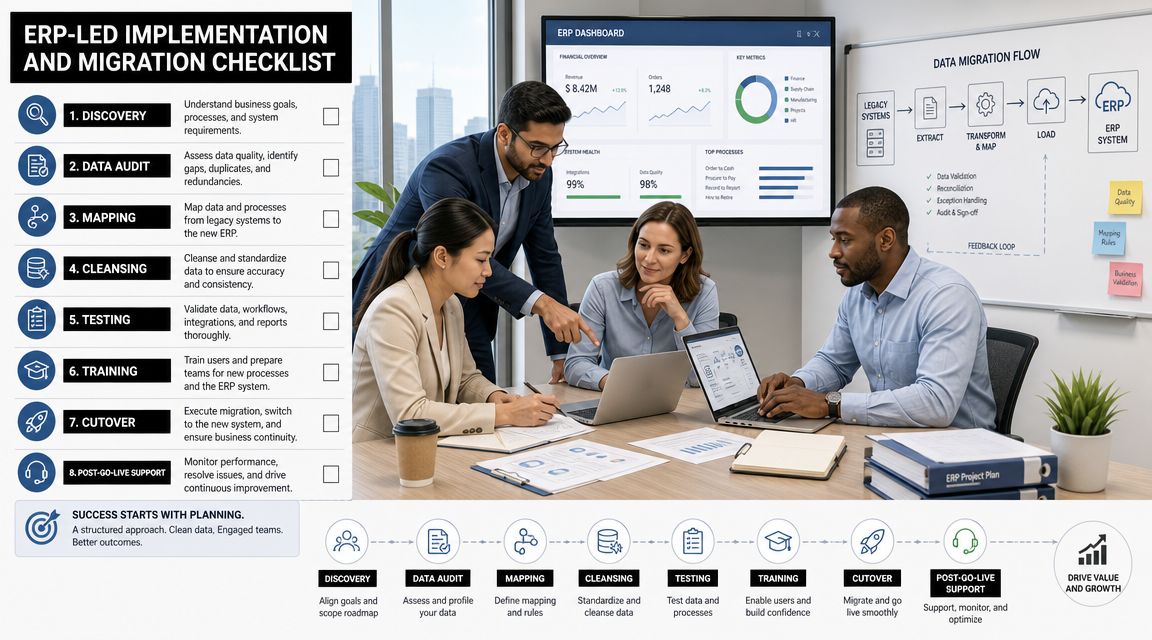
Start with process ownership
Don't hand the project to IT alone. Billing touches finance, sales, stores, customer service, and management approvals. Put the right people in one room and map how billing currently works.
Document the basics:
- Who creates the invoice
- Who approves price changes or discounts
- How credit notes are issued
- Where VAT errors usually happen
- How receipts and customer balances are tracked
Clean your master data before migration
Most billing confusion starts with bad customer and item records. Duplicate customer names, missing tax details, inconsistent unit pricing, and old stock codes will poison the new system on day one.
Use migration as a cleanup exercise.
- Review customer records for duplicates, tax details, payment terms, and branch mapping.
- Standardise item codes and remove obsolete products or services.
- Check opening balances so receivables and stock values transfer correctly.
- Define document numbering before users start transacting.
A new system won't correct old discipline problems unless you correct the data first.
Test real scenarios, not only sample invoices
Many teams test software with simple examples that never reflect actual operations. That's a mistake.
Run realistic cases such as:
- mixed taxable and non-standard billing situations
- branch-level invoicing
- partial collections
- credit note issuance
- recurring invoice generation
- approval escalation for discount exceptions
If you're moving from an entry-level tool, this guide on how to switch from QuickBooks to Hinawi ERP reflects the kind of migration planning businesses should review before go-live.
Train by role and review after launch
Don't train everyone the same way. Sales users need one workflow. Finance users need another. Branch cashiers, storekeepers, and managers all interact with billing differently.
After launch, schedule a short review cycle. Check where users still bypass the system, where approvals stall, and where reports don't yet match management expectations. That's where the real improvement happens.
Calculating ROI and Understanding Pricing
The return on billing software isn't just about software cost. It's about what manual billing is already costing you in labour, delays, corrections, and management uncertainty.
Where the return actually comes from
The strongest ROI usually appears in four areas:
- Less manual work: Your team spends less time preparing invoices, checking tax values, and correcting ledgers.
- Cleaner cash collection: Payment follow-up becomes more organised because receivables are visible and current.
- Fewer compliance errors: Better controls reduce invoice mistakes and month-end rework.
- Better management visibility: Owners and finance managers can see what has been billed, collected, and disputed without waiting for offline reports.
Some returns are financial and immediate. Others are operational. A calmer audit period, fewer customer disputes, and less dependency on one experienced accountant all matter.
How to think about pricing
Don't compare pricing in isolation. Compare total cost of ownership.
A low-cost subscription may look attractive, but if it forces double entry into accounting, separate stock updates, and manual VAT correction, it isn't cheap. A perpetual licence model with support may suit some companies better if they want long-term control. A subscription model may work if the operational fit is strong and the implementation is handled properly.
The question isn't "What does it cost per month?" The better question is "How much extra work will this remove, and how much risk will it prevent?"
Chat on WhatsApp +971506228024 Quotation – Demo RequestTake the Next Step with Hinawi ERP
If your business in the UAE or GCC is still treating billing as a separate admin task, now is the right time to fix it. Billing should connect directly to accounting, tax handling, inventory, payroll impact, approvals, customer balances, and management reporting.
Hinawi ERP is a fully integrated ERP software developed since 1998 in Abu Dhabi. It supports Accounting, HR & Payroll, Real Estate Management, Fixed Assets, Manufacturing, Garage & Maintenance, School Management, CRM, and complete business automation. For companies that need more than invoice printing, this matters.
The platform is designed for practical regional requirements, including:
- VAT and e-Invoicing compliance
- UAE WPS payroll support
- Arabic and English bilingual operation
- Flexible company policy settings
- Real-time accounting integration across all modules
It suits factories, contracting companies, real estate businesses, schools, garages, trading companies, and manufacturers that need proper control over billing and the wider operation. Instead of relying on disconnected tools, your team can work inside one system with cleaner workflows and better visibility.
If you want to modernise operations, reduce manual work, improve financial accuracy, and gain stronger management control, visit Hinawi ERP's official website or request a personalised demo. Speak with the Hinawi ERP team to review your current billing process, compliance concerns, and migration options for your UAE or GCC business.
A CTA for Explorer Computer LLC – Hinawi Software ERP.