If you’re managing properties in the UAE, you know it can feel like you're juggling a dozen different jobs at once. Spreadsheets for tenants, another app for accounting, WhatsApp for maintenance requests—it’s a constant struggle to keep everything in sync. A dedicated Real Estate Management ERP for UAE businesses is designed to end that chaos. Think of it as the single control panel for your entire property portfolio, connecting everything from lease agreements and finances to maintenance and compliance. An integrated system like Hinawi ERP, developed in Abu Dhabi since 1998, provides this unified control, which is essential for growth in the competitive GCC market.
Ready to see how an ERP can streamline your operations and improve profitability?
Chat on WhatsApp +971506228024 Quotation – Demo Request Chat with Hinawi AIWhy Your UAE Real Estate Business Needs an ERP
In a market as fast-paced as the UAE's, patching together manual methods just doesn’t cut it anymore. Relying on separate spreadsheets, accounting software, and random communication channels almost guarantees that things will fall through the cracks. This disjointed way of working leads to expensive mistakes, missed renewal dates, and no clear, immediate picture of your portfolio's financial performance. A specialised real estate ERP is built to fix these exact problems.
The real power of an ERP is that it creates one reliable source for all your data. For instance, what happens when a tenant's payment is late? A good system can automatically flag the overdue account, calculate and apply late fees based on the tenancy contract, and send a notification to both the tenant and your accounts team. This kind of automated, organised response is simply not possible when your information is scattered across different, unconnected tools.
Ready to see how these modules come together in a live environment? Get in touch with our team to explore a system designed for the realities of the UAE market.
Chat on WhatsApp +971506228024 Quotation – Demo Request Chat with Hinawi AIFrom Manual Chaos to Integrated Control
Let's look at the difference this makes in practice. The following table breaks down the day-to-day reality of running a property business with manual tools versus an integrated ERP.
| Feature | Manual Methods (Spreadsheets & Siloed Apps) | Integrated Real Estate ERP (e.g., Hinawi ERP) |
|---|---|---|
| Lease Tracking | Manual data entry for dates, renewals, and escalations. High risk of missed deadlines. | Automated alerts for renewals, expirations, and rent increases. Digital contract management. |
| Financials | Separate accounting software. Hours spent reconciling rent rolls with bank statements. | Every financial transaction (rent, fees, expenses) posts directly to the general ledger in real-time. |
| Tenant Payments | Manually tracking post-dated cheques and bank transfers. Delayed follow-ups on late payments. | Automated payment reminders, online payment gateways, and instant reconciliation of funds. |
| Reporting | Compiling data from multiple sources is slow and often inaccurate. No real-time P&L per property. | Instant, accurate reports on occupancy, profitability, cash flow, and more, available on demand. |
| Maintenance | Service requests via phone or WhatsApp are hard to track. No clear view of costs per unit. | Tenant requests become trackable work orders. Costs and progress are monitored from start to finish. |
| Compliance | Manually calculating VAT and handling WPS payroll. Prone to errors and compliance risks. | Built-in features for UAE VAT on rental income and WPS-compliant payroll. |
As the table shows, an integrated system doesn't just make work easier; it fundamentally changes how you manage your assets. An ERP platform like Hinawi ERP, developed right here in Abu Dhabi since 1998, was purpose-built to handle these specific regional challenges. It connects all the dots so nothing gets missed.
By bringing all these functions under one roof, a Real Estate Management ERP UAE solution lets property managers and owners stop putting out fires and start thinking strategically. It’s this shift that allows you to grow your portfolio and boost profitability in such a competitive market. To see how different systems measure up, it's worth exploring a detailed comparison of Hinawi ERP against other solutions.
Exploring the Core Modules of a Real Estate ERP
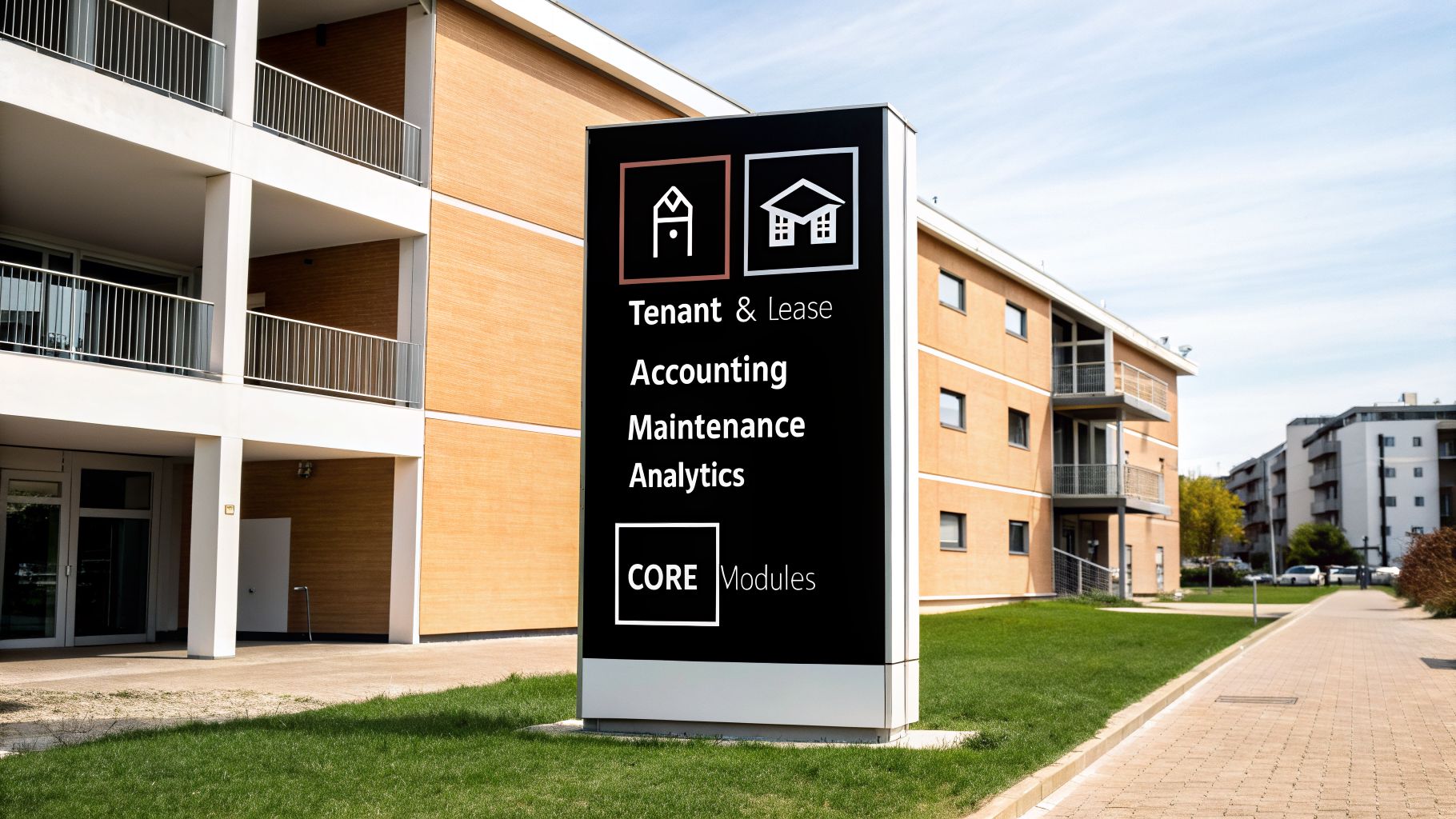
Think of a modern Real Estate Management ERP UAE solution less like a single piece of software and more like a well-designed building. Each department gets its own specialised floor, but they're all connected by a central data elevator. This setup ensures that information—from a new lease signing to a maintenance request—flows instantly and accurately between teams.
To truly grasp how an ERP can pull a fragmented real estate operation into a cohesive, data-led business, you need to understand these core modules. Let's walk through the essential components that every property manager and owner in the UAE should look for.
Tenant and Lease Management
This is the engine room of any real estate business. The Tenant & Lease Management module takes the entire tenancy lifecycle—from initial enquiry to final move-out—and moves it out of messy spreadsheets and into a clean, digital workflow. It becomes the single source of truth for every contract and automates the activities that often fall through the cracks.
Here’s what that looks like in practice:
- Contract Creation and Storage: Quickly generate standardised tenancy contracts and keep digital copies on hand for immediate access. No more digging through filing cabinets.
- Automated Reminders: The system proactively sends alerts for lease renewals, upcoming expirations, and notice periods. This helps you prevent missed revenue and accidental holdovers.
- Post-Dated Cheque (PDC) Management: This is a non-negotiable feature for the UAE market. The module automates the tracking and depositing of PDCs, linking each cheque directly to its corresponding payment schedule.
- Rent Escalation: Automatically applies scheduled rent increases according to the contract, ensuring you capture every dirham you're entitled to without having to manually track it.
When all this information is centralised, you shift from putting out fires to proactively managing your portfolio. You can see more about how a purpose-built Real Estate Module handles these tasks.
Property and Unit Management
This module is essentially the digital blueprint of your entire property portfolio. It gives you the power to build a detailed, organised database of every asset you manage—from whole buildings and communities right down to individual apartments, offices, or warehouses.
Having this central registry is fundamental to maintaining an accurate, real-time picture of your inventory. At a glance, your team can see which units are vacant, occupied, or reserved. They can also pull up detailed information like square footage, specific features, and a full rental history. This kind of clarity is what allows for effective marketing and lightning-fast leasing.
A robust Property & Unit Management module provides a single source of truth for your asset inventory. It eliminates the guesswork and reliance on outdated spreadsheets, ensuring that leasing agents, accountants, and maintenance teams are all working with the same accurate information.
This operational clarity is what makes growth possible, allowing you to scale your portfolio without your administrative workload spiralling out of control.
Financial Accounting Integration
Here’s where you see the real magic of a truly integrated ERP. Instead of juggling a separate accounting system, a Real Estate Management ERP UAE platform has financials baked right into its core. Every single action—a signed lease, a collected rent payment, a logged maintenance expense—automatically triggers the correct entry in your general ledger.
This direct link delivers incredible financial clarity and control. For instance, when a tenant's payment is processed, the system doesn’t just mark an invoice as paid. In one seamless step, it also updates your accounts receivable, posts the revenue, and reflects the cash deposit for bank reconciliation. The days of tedious, error-prone manual data entry between different programs are over.
For example, a large property management firm in Dubai faced constant delays in its month-end closing process due to manual reconciliation between its leasing software and accounting books. After implementing an integrated solution like Hinawi ERP, their closing time was reduced from seven days to just one. Real-time integration meant revenue and expenses were always aligned, eliminating reconciliation errors and providing daily P&L visibility per property.
Explore how your business can achieve similar results.
Chat on WhatsApp +971506228024 Quotation – Demo Request Chat with Hinawi AIMastering UAE Compliance with Your ERP System
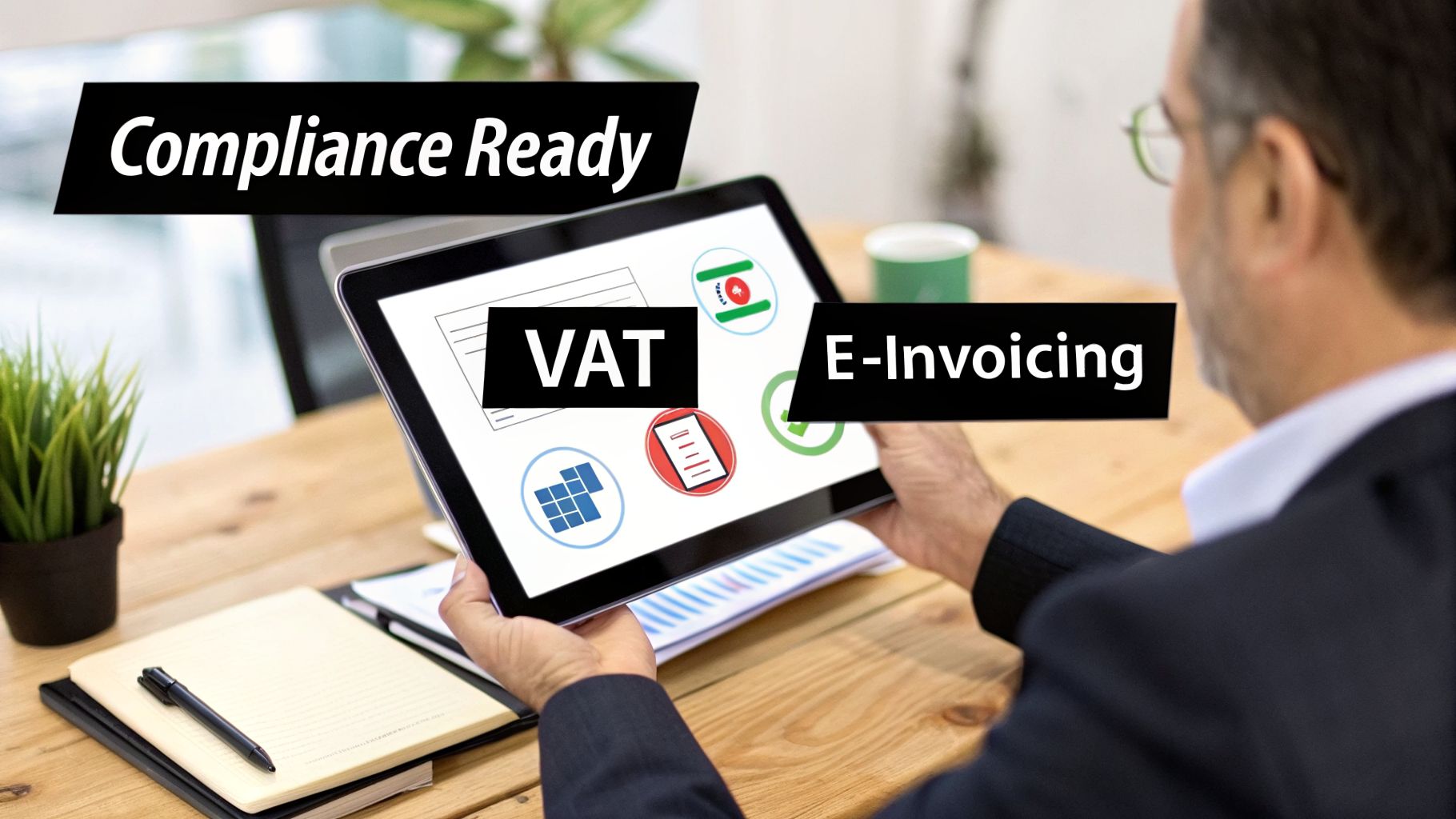
Running a real estate business in the UAE means compliance isn't just a box to tick—it's woven into the very fabric of your operations. From the Federal Tax Authority (FTA) to other regulatory bodies, staying on top of the rules is non-negotiable. This is where a specialised Real Estate Management ERP UAE solution stops being a "nice-to-have" and becomes your most valuable player.
Think of it as having an automated compliance officer built right into your workflow. Instead of constantly looking over your shoulder, worrying about changing regulations and potential fines, the system handles the heavy lifting. It turns a source of stress into a seamless, reliable background process.
VAT Automation for Rental Income
One of the biggest headaches for any property manager is dealing with Value Added Tax (VAT). When you're processing thousands of rental payments, service fees, and other charges, trying to calculate VAT manually is a recipe for disaster. It's not just tedious; it's an open invitation for costly human errors.
A purpose-built ERP for the UAE market takes this entire burden off your plate. The system is designed to automatically apply the correct VAT rate to every single invoice generated from a lease. Accuracy is built-in from the start.
And when it’s time to file your returns? The ERP gathers all this transaction data and organises it into the exact format the FTA requires. A task that once took days of wrestling with spreadsheets is now done in a few clicks, giving you a complete and accurate VAT return ready for submission.
Preparing for Mandatory E-Invoicing
The next major compliance shift on the horizon is the UAE's move to mandatory e-invoicing, often referred to as Fatoorah. This will require businesses to issue and report invoices in a new, standardised digital format. A modern Real Estate Management ERP UAE platform is already built to handle this.
By having the right system in place now, you can avoid the last-minute scramble when the mandate takes full effect. Your ERP will be set up to:
- Create invoices that are 100% compliant with the new e-invoicing standards.
- Connect directly with the government's tax portal for effortless submission.
- Maintain a secure, searchable, and fully auditable digital archive of every invoice.
Getting an e-invoicing-ready ERP today is a smart, strategic decision that protects your business from future compliance shocks. Want to see how an integrated ERP can prepare your business for the next wave of compliance? Explore our guide on understanding the new tax landscape in the UAE.
Scenario: A VAT Audit in Abu Dhabi
Picture this: your Abu Dhabi real estate firm gets that dreaded notification for an FTA VAT audit. Without a central system, it's all hands on deck. Your team starts a frantic hunt through filing cabinets, email archives, and various spreadsheets, trying to piece together a coherent trail of invoices, contracts, and payment records. The risk of missing documents or finding conflicting numbers is huge.
With an integrated ERP like Hinawi ERP, the experience is night and day. The system maintains a perfect, unbroken audit trail for every single transaction. When the auditor asks for details, you can pull up the original lease, the corresponding VAT invoice, the payment confirmation, and its link to the general ledger—all in a single, unified view.
An audit transforms from a major business disruption into a straightforward review. Having this level of organised, transparent data on demand doesn't just prove compliance; it shows a high degree of professionalism and control, building trust with regulators and dramatically lowering your administrative risk.
What's the Real Financial Impact and ROI of an ERP?
Let's get straight to the point. For any UAE business owner, the bottom-line question is always the same: what’s the payback? Putting money into a Real Estate Management ERP isn't just about upgrading your tech; it's a serious financial decision. You need a realistic breakdown of the Return on Investment (ROI) and the Total Cost of Ownership (TCO).
It’s easy to think ROI just means saving money on admin staff, but that’s only scratching the surface. The real financial wins are much bigger and come from two places: direct and indirect gains.
The direct gains are the ones you'll see on your balance sheet almost immediately. These are the quick, tangible wins.
- Faster Rent Collection: When you automate reminders and offer simple online payment portals, you shrink the time it takes to get paid. Better cash flow is the immediate result.
- Reduced Vacancy Periods: With real-time data on every unit, your leasing agents can start marketing a property the moment it becomes available, cutting down on empty, non-earning days.
- Smarter Maintenance Spending: By tracking every work order and expense tied to a specific unit, you can spot those recurring problems, negotiate better deals with your vendors, and stop overspending.
Ready to see how an ERP can streamline your operations and improve profitability?
Chat on WhatsApp +971506228024 Quotation – Demo Request Chat with Hinawi AILooking Beyond the Obvious Wins
While the direct savings are great, the indirect benefits are often where the real, long-term value is unlocked. These gains might be a bit harder to nail down with a number at first, but they are absolutely crucial for lasting growth.
Think about it: a happy tenant who gets quick responses and service is far less likely to leave. Better tenant retention means you spend less time and money on marketing empty units and processing new leases. That’s a massive saving.
And then there's the power of good data. When you can pull up a complete Profit & Loss statement for each building with a single click, you start making much sharper decisions. You know exactly which properties justify capital improvements and where to adjust rents for maximum return. That's a level of strategic insight you simply can't get from a pile of disconnected spreadsheets.
Understanding the Total Cost of Ownership
Now, for the other side of the equation: the Total Cost of Ownership (TCO). A smart business owner knows the sticker price is just the beginning. The TCO covers every single cost over the ERP's entire life—from implementation fees and data migration to employee training and ongoing support contracts.
This is where having a local solution really proves its worth. An international ERP might look like a good deal upfront, but you can get hit with surprise costs for the customisation needed to make it work with UAE regulations and business practices.
A system like Hinawi ERP, developed right here in Abu Dhabi, gives you a much more predictable TCO. According to a Middle East property software market report, firms using automation see significant cost savings. For many UAE businesses, keeping data on-premises for security and regulatory control is non-negotiable, a preference that locally-focused solutions understand. Hinawi ERP is designed to deliver these savings while ensuring your data stays secure.
At the end of the day, understanding the true financial picture means weighing both the potential returns and the complete costs. By automating tedious work and giving you crystal-clear financial oversight, a good ERP helps you precisely calculate and improve your business profit.
Your Practical ERP Implementation Checklist
Bringing a new Real Estate Management ERP into your UAE business is a bit like swapping out the entire engine of a running ship. It’s a massive upgrade, but to get it right, you need a meticulous plan. Breaking the project down into clear, manageable phases turns what feels like a monumental task into a step-by-step process.
Ultimately, a successful switch isn't just about the software. It’s a transformation of your people, your daily processes, and your data. With a solid blueprint, you get your team ready, your workflows refined, and your data clean, paving the way for a smooth transition to a far more efficient and controlled way of working.
Phase 1: Pre-Implementation Planning
If there's one stage you absolutely cannot afford to rush, this is it. The groundwork laid here determines the success of the entire project. Before a single line of code is installed, your team needs to be completely aligned on the 'why' and the 'how'.
Here’s where your focus should be:
- Set Crystal-Clear Goals: What problem are you truly trying to solve? Is the goal to cut vacancy rates by 10%? Are you trying to accelerate rent collection or finally automate VAT reporting? You need measurable targets, not vague ambitions.
- Assemble Your Internal Champions: You need to identify a project lead and key people from every department—leasing, finance, maintenance. These are the folks on the ground who will drive adoption and make critical decisions.
- Clean Your Data: This is, without a doubt, the most crucial job. You have to comb through your existing tenant files, lease contracts, and financial records. Standardise everything. Migrating messy data into a shiny new system just means you'll have a shinier, more expensive mess.
Phase 2: Implementation and Data Migration
With a robust plan in hand, it’s time to get technical. This is where the ERP is configured to fit your specific business rules and your squeaky-clean data is carefully moved into its new home. This is also where having a local partner becomes a game-changer.
An experienced provider who understands the UAE market will know all about post-dated cheque management, Ejari integration, and the unique service charge structures here. A consultant with on-the-ground expertise, like our team at Hinawi ERP in Abu Dhabi, can configure the system to mirror your exact leasing policies from day one. This level of customisation is what makes a Real Estate Management ERP in the UAE truly work for you.
This phase is all about bending the software to your will, not the other way around. Want to see what a typical project plan looks like? Take a look at our detailed guide on the work plan for starting with new software.
Phase 3: User Training and Go-Live
A powerful system is completely worthless if your team is too intimidated to use it. This phase is dedicated to training everyone who will touch the ERP, from property managers handling maintenance requests to accountants closing the books. The training has to be role-specific, focusing only on the tasks each person will perform daily.
The "Go-Live" is the moment of truth. It's the day you switch off the old spreadsheets and legacy systems, and the new ERP officially takes over. A smooth go-live doesn't happen by accident; it's the direct result of all the planning, data cleaning, and training you've already done.
Phase 4: Post-Implementation and Support
Your ERP journey doesn't stop when the system goes live. The final phase is all about optimisation and finding new efficiencies as your team gets more comfortable. Once people truly understand the tool, they'll start spotting opportunities to refine workflows you hadn't even considered.
This is where ongoing support from your ERP partner is vital. They can help you troubleshoot any teething issues, offer refresher training, and show you how to use advanced features you might not have needed at first. This long-term relationship is what ensures you get the absolute maximum return on your investment.
Take the Next Step with Hinawi ERP
Are you ready to modernize your operations and move beyond the endless spreadsheets and outdated methods holding your real estate business back? For property owners and managers across the UAE and GCC, finding a path to better efficiency, watertight compliance, and complete control means partnering with a software provider who truly understands the local landscape.
Hinawi ERP is a fully integrated ERP software developed since 1998 in Abu Dhabi. We provide a single, unified platform for Accounting, HR & Payroll, Real Estate Management, Fixed Assets, Manufacturing, Garage & Maintenance, School Management, CRM, and complete business automation. Our solution is purpose-built for the challenges and opportunities in the GCC.
By partnering with us, you can naturally achieve:
- Full VAT and E-Invoicing Compliance: Our system is always up-to-date with FTA regulations, making audits and reporting straightforward.
- Seamless UAE WPS Payroll Support: Manage your payroll with confidence, knowing it aligns perfectly with local labor laws.
- Bilingual Operation: Operate effortlessly in both Arabic and English across all modules.
- Flexible Company Policy Settings: We configure the ERP to your business rules, not the other way around.
- Real-Time Accounting Integration: Every transaction from any module—from a new lease to a payroll run—instantly updates your financial records.
- Industry-Specific Functionality: Hinawi ERP is ideal for real estate businesses, contracting companies, factories, schools, garages, trading companies, and manufacturers.
It's time to reduce manual work, improve financial accuracy, and gain better control over your management. Modernize your operations with a partner that has been trusted in the UAE for decades.
Want to see this process inside a real ERP?
Chat on WhatsApp +971506228024 Quotation – Demo Request Chat with Hinawi AICommon Questions About Real Estate ERP in the UAE
Switching to a dedicated Real Estate Management ERP UAE platform is a big move, so it's only natural to have a few questions. Making this kind of investment in your operations isn't something you do lightly, and getting clear on the details is the first step.
Let's tackle some of the most common questions we hear from property owners and managers across the country.
How Long Does It Take to Implement a Real Estate ERP?
For a typical mid-sized property portfolio in Dubai or Abu Dhabi, you should realistically budget for an implementation timeline of 4 to 8 weeks. This window gives you enough time for the important stuff: migrating your data, setting up the system to reflect your specific leasing and accounting rules, and properly training your team.
What’s the single biggest factor that can speed up or slow down this process? The state of your current data. If your tenant records and financial history are already clean and well-organised in spreadsheets, you’re off to a flying start. If they’re a bit messy, it'll take longer.
This is also where working with a local provider like Hinawi ERP really pays off. They’re already familiar with UAE business practices and data formats, which cuts down on a lot of the back-and-forth.
Can an ERP Handle Multiple Property Types?
Absolutely. In fact, that's one of their biggest strengths. A well-built real estate ERP is designed from the ground up to manage a diverse portfolio. You can easily categorise your assets—think residential towers, commercial offices, and industrial warehouses—and then apply unique rules to each one.
This means you can have completely different lease terms for a retail space versus a residential flat. You can set up specific service charge structures for a commercial building and create distinct maintenance schedules for an industrial park.
A system like Hinawi ERP pulls all of this information into a single, unified dashboard. This gives you a consolidated view of your entire portfolio's financial health, no matter how varied your assets are.
Is an On-Premise or Cloud ERP Better?
There’s no single "better" option here; it really comes down to your company's specific situation, IT infrastructure, and security needs. Each model has its own clear advantages.
- Cloud ERP: This is all about flexibility. You get lower upfront costs since you don't need to buy and maintain servers, and you can easily scale up or down as your portfolio grows.
- On-Premise ERP: This model gives you maximum control. Your data stays on your own servers, which is often a non-negotiable for businesses with very strict internal security or data governance policies.
Because both options are valid, providers like Hinawi ERP offer both deployment models. This gives businesses in the UAE the freedom to choose the path that makes the most sense for their budget, operational strategy, and long-term vision.