
If you're a business owner or HR manager in the UAE, getting the MoHRE gratuity calculation right is non-negotiable. This isn't just about good HR practice; it's a legal obligation under Federal Decree-Law No. 33 of 2021. For companies in Abu Dhabi, Dubai, and across the GCC, manual calculations for payroll and end-of-service benefits are a significant operational risk, often leading to compliance issues and financial inaccuracies.
Think of gratuity not as a discretionary bonus, but as a mandatory end-of-service payment. It's calculated based on an employee's final basic salary once they've been with you for at least one continuous year. An integrated system like Hinawi ERP, developed in Abu Dhabi since 1998, is designed to automate these complex calculations, ensuring both compliance and accuracy.
Want to see this process inside a real ERP? Use these quick links:
Chat on WhatsApp +971506228024
Quotation – Demo Request
Chat with Hinawi AI
The Fundamentals of MoHRE Gratuity in the UAE
The Ministry of Human Resources and Emiratisation (MoHRE) has established a clear, tiered framework for this compensation. As an ERP consultant, I advise businesses that mastering these fundamentals is the first step toward achieving compliance and treating departing employees fairly.
The calculation is straightforward and based on the employee's length of service:
- You owe 21 days of basic salary for each of the first five years they've worked for you.
- After the five-year mark, this increases to 30 days of basic salary for each additional year.
One crucial detail to remember is the cap. The law states that the total gratuity payment cannot exceed two years' worth of the employee's basic salary, no matter how long they've been with the company. This provides a clear ceiling, which is incredibly helpful for financial planning and forecasting. You can find more practical examples of how this works in this Gulf News guide.
Juggling these calculations manually for every employee can quickly become a headache, especially as your team grows. This is where an integrated payroll system becomes essential. If you're new to the topic, our guide on what payroll entails provides some great background. A specialised system built for the UAE market has these rules baked in, which helps prevent the kind of costly errors that often come from manual calculations.
Want to see how this works inside a real ERP? Use these quick links:
Chat on WhatsApp +971506228024
Quotation – Demo Request
Chat with Hinawi AI
How Your Contract Type Shapes the Gratuity Calculation
When you’re calculating end-of-service gratuity, the first question to ask is: what kind of contract did the employee have? The MoHRE gratuity calculation isn't a single, rigid formula. It changes significantly depending on whether the employee was on a limited (fixed-term) or unlimited contract.
Since the major labour law updates in February 2022, understanding this distinction is more critical than ever, especially when an employee resigns.

Here's where it gets particularly tricky: for employees on unlimited contracts who choose to leave the company, their final gratuity payment is often reduced. It’s a graduated scale based on their total years of service, a detail that many HR managers can overlook, leading to incorrect payouts.
Resignation Rules for Unlimited Contracts
If an employee on an unlimited contract resigns, their gratuity entitlement is calculated on a sliding scale. This is a common point of confusion for businesses, so a clear breakdown is essential.
The table below outlines exactly how much gratuity is payable based on the employee's tenure.
Gratuity Entitlement for Resigning Employees on Unlimited Contracts
| Years of Service | Gratuity Entitlement (Unlimited Contract) | Calculation Basis |
|---|---|---|
| 1 to 3 Years | One-third (1/3) of the total gratuity amount. | A significant reduction for early departures. |
| 3 to 5 Years | Two-thirds (2/3) of the total gratuity amount. | A partial reward for medium-term service. |
| Over 5 Years | Full (100%) gratuity entitlement. | Same as if terminated by the employer. |
As you can see, an employee who stays for more than five years is entitled to their full gratuity, regardless of who initiated the separation.
To put this into a real-world context, imagine a contracting company in Abu Dhabi with a AED 10,000 basic salary employee who resigns after 2.5 years. Instead of the full amount, they would only be eligible for one-third of their calculated gratuity. This is a significant difference that manual calculations can easily miss, leading to overpayment and affecting the company's cash flow.
This is exactly why relying on spreadsheets is operationally risky. Think about a typical Dubai-based trading company that has a mix of project-based staff on limited contracts and permanent employees on unlimited ones. Manually applying the right set of rules for every final settlement is a recipe for errors and potential disputes.
This is where an integrated system like Hinawi ERP provides immense value. It completely removes the guesswork. The system automatically applies the correct gratuity logic based on the employee’s contract type, which you define during the initial HRMS setup. This ensures you’re always compliant and prevents costly overpayments or frustrating underpayments.
Want to see this process inside a real ERP? Use these quick links:
Chat on WhatsApp +971506228024
Quotation – Demo Request
Chat with Hinawi AI
Getting to Grips with Gratuity Calculations: Real-World Examples
Theory is one thing, but applying the MoHRE gratuity calculation to the situations you face every day is what really matters. Let's walk through a few common scenarios to see how the numbers play out in practice.
The single most important figure in all of this is the employee's last drawn basic salary. Decision-makers must ensure their teams use this number and not the total salary; all allowances must be excluded, or the entire calculation will be wrong from the start.

Example 1: Termination After 7 Years on an Unlimited Contract
This is a very typical case for a long-serving employee whose contract is terminated by the company. Here, the employee gets their full gratuity entitlement.
- Employee: Aisha
- Basic Salary: AED 15,000 per month
- Service Period: 7 years
- Reason for Leaving: Termination by employer
First, we need to figure out her daily wage based on her basic salary:
(AED 15,000 × 12 months) / 365 days = AED 493.15 per day.
Now, we calculate her gratuity in two parts. For her first 5 years, she accrues 21 days' pay per year:
(AED 493.15 × 21 days) × 5 years = AED 51,780.75.
For the remaining 2 years, the rate increases to 30 days' pay per year:
(AED 493.15 × 30 days) × 2 years = AED 29,589.00.
Adding them together gives us the total gratuity:
AED 51,780.75 + AED 29,589.00 = AED 81,369.75.
Aisha’s final end-of-service payment is AED 81,369.75. This amount is well below the legal cap, which is set at two years' total basic salary.
Example 2: Resignation After 3.5 Years on an Unlimited Contract
Things get a bit trickier when an employee on an unlimited contract resigns. The length of service directly impacts the payout. Let's see how it works for someone leaving after 3.5 years.
- Employee: Omar
- Basic Salary: AED 8,000 per month
- Service Period: 3.5 years
- Reason for Leaving: Resignation
Again, we start with the daily wage:
(AED 8,000 × 12 months) / 365 days = AED 263.01 per day.
Next, we calculate what his full gratuity would be if he were terminated. Since his entire service is under 5 years, we use the 21-day rate:
(AED 263.01 × 21 days) × 3.5 years = AED 19,331.48.
Because Omar resigned with a service period between 3 and 5 years, he's only entitled to two-thirds (2/3) of that full amount. So we apply the reduction:
AED 19,331.48 × (2/3) = AED 12,887.65.
Omar’s final gratuity is AED 12,887.65. As you can see, resigning within this specific timeframe makes a significant difference. If you want to explore these nuances further, our detailed guide on end-of-service calculations can be a great resource.
Example 3: Completing a 2-Year Limited Contract
What about an employee on a fixed-term contract who sees it through to the end? The calculation is straightforward, much like a termination, and they receive their full entitlement.
- Employee: Fatima
- Basic Salary: AED 12,000 per month
- Service Period: 2 years (contract completed)
- Reason for Leaving: Contract completion
Let's find her daily wage:
(AED 12,000 × 12 months) / 365 = AED 394.52 per day.
Since her service is less than 5 years, we use the 21-day rate for the entire period:
(AED 394.52 × 21 days) × 2 years = AED 16,569.84.
Upon completing her contract, Fatima is due a gratuity payment of AED 16,569.84.
As these examples demonstrate, performing these calculations manually isn't just tedious—it’s prone to human error. A simple slip-up with a decimal point or applying the wrong reduction rule can lead to incorrect payments, unhappy ex-employees, and potential compliance headaches. This is why automating these workflows is not a luxury, but a strategic necessity for modern businesses.
Want to see this process inside a real ERP? Use these quick links:
Chat on WhatsApp +971506228024
Quotation – Demo Request
Chat with Hinawi AI
Automating Gratuity Management with Hinawi ERP
Let's be honest: calculating gratuity manually is a recipe for trouble. I've seen it time and again—companies relying on complex spreadsheets for the MoHRE gratuity calculation are walking a tightrope. This isn't just slow; it opens you up to compliance errors, inaccurate financial reports, and frustrating disputes with departing staff. The only real solution is to move away from manual methods and embrace an automated system built specifically for the nuances of UAE Labour Law.
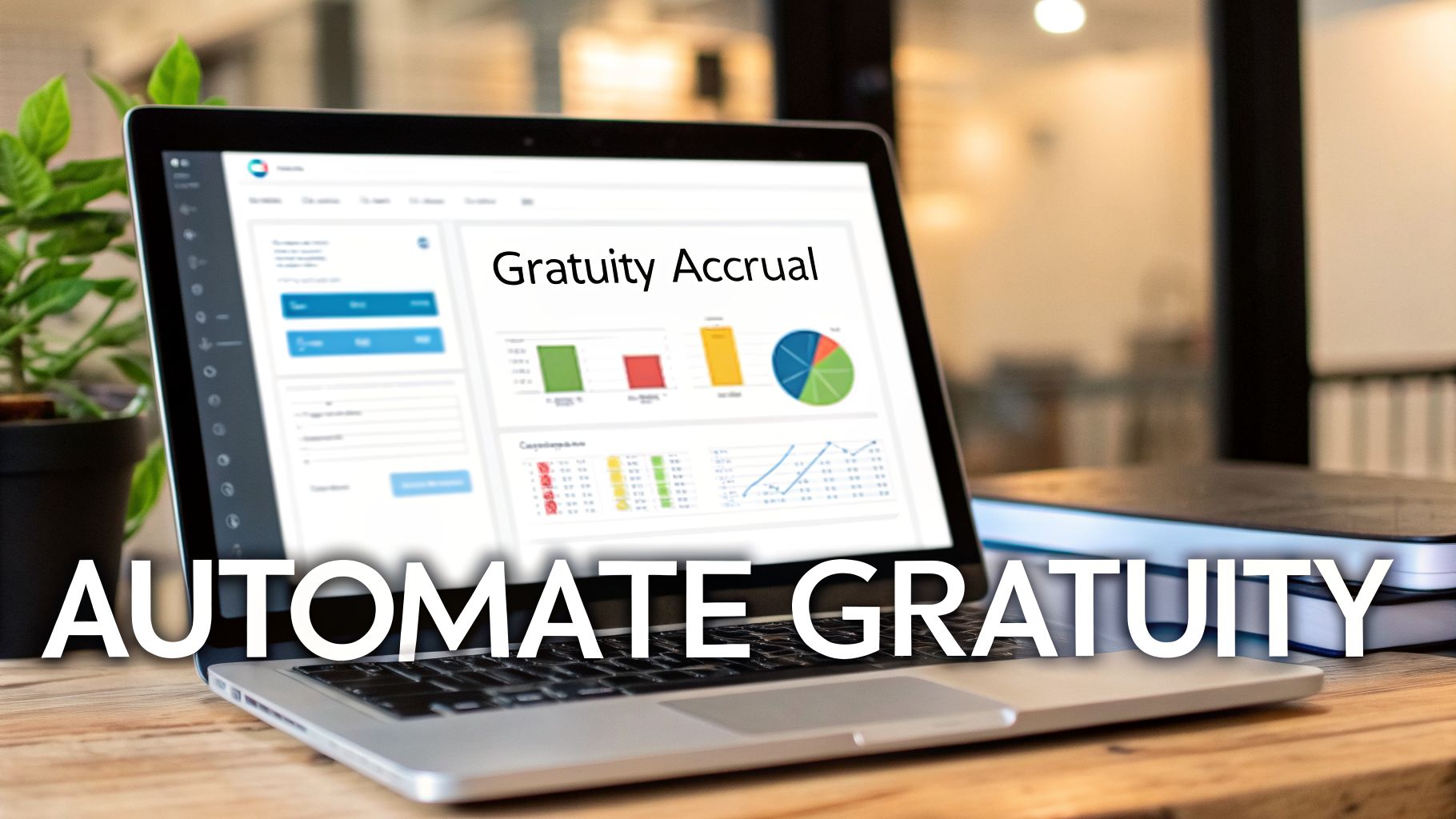
Switching to a dedicated ERP isn't just about making life easier. It's a strategic decision that gives you real financial control and shores up your operational integrity. You're turning a high-risk, periodic chore into a smooth, compliant, and ongoing process.
Centralising HR Data for Accurate Calculations
Perfect gratuity calculations start with perfect data. A purpose-built system like Hinawi ERP's HR & Payroll module becomes the single source of truth for all your employee information. Instead of digging through files and spreadsheets, HR managers simply set up the core details one time.
- Employee Start Date: The system automatically calculates the exact length of service.
- Contract Type: It knows the difference between limited and unlimited contracts, applying the correct rules if an employee resigns.
- Basic Salary: It cleanly separates the basic salary from allowances, which is crucial for avoiding the common error of overpaying gratuity.
- Unpaid Leave: Any periods of unpaid leave are logged and correctly excluded from the service period calculation.
Once this information is in the system, it eliminates the manual cross-checking and guesswork that breed mistakes.
Real-Time Accrual and Financial Visibility
Here’s the real game-changer: an automated system calculates gratuity entitlement in real time. As each day passes and an employee's service period grows, Hinawi ERP is constantly updating their accrued gratuity.
This isn't just an HR task; it's a vital accounting function. The system automatically posts these accruals to the general ledger, so your financial statements always reflect your true end-of-service liability. It gives decision-makers an accurate, up-to-the-minute picture of the company's financial health, which is essential for any serious budgeting or forecasting.
This kind of visibility completely does away with the panic and frantic calculations that happen at the end of the financial year.
The Hinawi ERP dashboard gives you a clear, consolidated view for managing everything from payroll to final settlements.
As you can see, all the critical employee data, contract details, and salary components are organised in one place. This is what makes automated gratuity and WPS-compliant payroll runs possible.
Streamlining the Final Settlement Process
When an employee leaves, the final settlement needs to be fast and flawless. With automation, a process that used to take hours of manual work and double-checking is done in just a few minutes.
The system generates a complete final settlement statement that covers all the bases:
- The final gratuity payment, calculated precisely according to law.
- Accurate payment for any unused annual leave.
- Any other pending payments or deductions.
Because this is fully integrated with UAE WPS support, the final payment is compliant and ready for transfer. Automating this not only saves a huge amount of time but also creates a clear, auditable trail of the calculation, giving you solid protection in case of a dispute. The value of dedicated platforms is clear, and for a wider look at automation, exploring general HR software solutions can offer insights into optimising other key functions.
Want to see this process inside a real ERP? Use these quick links:
Chat on WhatsApp +971506228024
Quotation – Demo Request
Chat with Hinawi AI
Take the Next Step with Hinawi ERP
For business owners and decision-makers in the UAE and GCC, wrestling with spreadsheets for the MoHRE gratuity calculation is an outdated and risky practice. It's time to modernize your operations, reduce manual work, and gain real-time control over your financial and HR management.
Hinawi ERP is a fully integrated ERP software developed in Abu Dhabi since 1998, specifically designed to meet the unique challenges of the regional market. Our solution supports Accounting, HR & Payroll, Real Estate Management, Fixed Assets, Manufacturing, Garage & Maintenance, School Management, CRM, and complete business automation.
By implementing Hinawi ERP, you naturally benefit from:
- VAT and e-Invoicing Compliance: Stay ahead of regulatory requirements with a system built for the UAE.
- UAE WPS Payroll Support: Ensure accurate, timely, and compliant payroll processing every cycle.
- Bilingual Operation: A seamless Arabic and English interface for your entire team.
- Flexible Company Policy Settings: Configure gratuity, leave, and other HR policies to match your company's rules.
- Real-time Accounting Integration: All HR and payroll activities, including gratuity accruals, are automatically reflected in your general ledger for unparalleled financial accuracy.
- Industry-Specific Solutions: Whether you are in manufacturing, real estate, contracting, or trading, our modules are tailored to your needs.
Stop risking payroll delays, compliance penalties, and manual accounting errors. It’s time to gain the operational visibility and control needed to drive your business forward. Speak with our expert consultants to discover how Hinawi ERP can transform your business.
Visit us at www.hinawierp.com or request a personalized demo today.
Want to see this process inside a real ERP? Use these quick links:
Chat on WhatsApp +971506228024
Quotation – Demo Request
Chat with Hinawi AI