
Category: HR & Payroll
A resignation lands on HR’s desk. Finance needs the final settlement. Payroll has to confirm the correct base salary. Accounts wants the liability cleared properly. The employee wants a number they can trust.
That’s the moment when many UAE businesses realise gratuity isn’t just a payroll formula. It sits at the intersection of labour law compliance, employee trust, and financial reporting. If the number is wrong, the problem doesn’t stay inside HR. It reaches accounting, approvals, audit files, and often management escalation.
In practice, the hardest part isn’t understanding that gratuity is due. The hard part is computing it consistently, using the right salary basis, the right service period, and a process that can survive review. That’s why businesses that still rely on spreadsheets often run into avoidable disputes, especially when payroll, HR, and accounting each hold different versions of the same employee record.
The Challenge of Accurate End-of-Service Calculations
A common situation in Dubai, Abu Dhabi, and other UAE business centres is this: an employee exits after several years, and three different teams start checking three different figures. HR checks the joining date. Payroll checks the latest salary structure. Finance checks whether a gratuity provision already exists and whether the final payout will match the balance sheet. If even one field is wrong, the settlement becomes delayed or disputed.
For employers, gratuity is a legal obligation. For employees, it’s part of their financial transition. For finance teams, it’s also a liability that should not appear only at termination. If the company records salary changes casually, or if basic salary is mixed with allowances in payroll data, the final calculation can become difficult to defend.
That’s why I treat gratuity as an operational workflow, not a one-time formula. The number at exit depends on how well the company maintained records throughout employment. If your HR and accounting teams are still reconciling service dates and manual provisions separately, it’s worth reviewing how journal entries work in UAE accounting practice before the next employee settlement reaches your desk.
Practical rule: If HR, payroll, and finance can’t pull the same employee data from one system, gratuity errors become much more likely.
A well-configured ERP such as Hinawi ERP is built for exactly this kind of control. It gives businesses a structured way to hold salary components, employee dates, and accounting entries in one place, so the final settlement isn’t assembled from emails, spreadsheets, and memory.
Chat on WhatsApp +971506228024 Quotation – Demo RequestUnderstanding the Legal Framework for Gratuity in the UAE

Before anyone asks how to compute gratuity, the first check is legal basis. In UAE payroll operations, the calculation should start from the labour law rule, not from a spreadsheet template copied from another country. Many online calculators blur UAE and non-UAE methods, which is where mistakes begin.
For monthly-paid workers, the core UAE rule is clear. Under Article 51 of the UAE Labour Law, gratuity for monthly-paid workers is calculated based on 21 days' basic salary per year for the first five years of service, and 30 days' basic salary for each subsequent year, with the total amount capped at two years' salary, as noted in this gratuity valuation explanation.
What the salary basis actually means
The most important compliance point is the phrase basic salary. In practical payroll work, that means the gratuity basis should exclude variable or non-basic components such as housing, transport, or bonus elements where they are not part of the defined basic pay structure.
If a company stores only total gross salary and leaves payroll officers to split the components manually at exit, the risk rises immediately. That’s why teams reviewing what payroll includes in an integrated HR process usually find that gratuity accuracy depends heavily on how salary components are classified at the start of employment, not only at the end.
The compliance checks employers should make
A clean gratuity process usually rests on these checks:
- Confirm the employee category: The UAE calculation applied must match the employment context and payroll structure used by the company.
- Verify the service period: The company should use the correct joining date and confirmed termination date from the HR record.
- Use the correct salary field: The gratuity base should come from the employee’s basic salary field, not total package.
- Check the legal cap: The final payout should not exceed the cap stated under the rule cited above.
A gratuity dispute often starts with a simple question from the employee: “Why did you use this salary figure?” If the company can’t answer that clearly, the process is already weak.
The legal framework matters because every later step depends on it. Once the wrong salary basis enters the calculation, even a perfectly built formula will still produce the wrong result.
Chat on WhatsApp +971506228024 Quotation – Demo RequestThe Step-by-Step Gratuity Calculation Formula
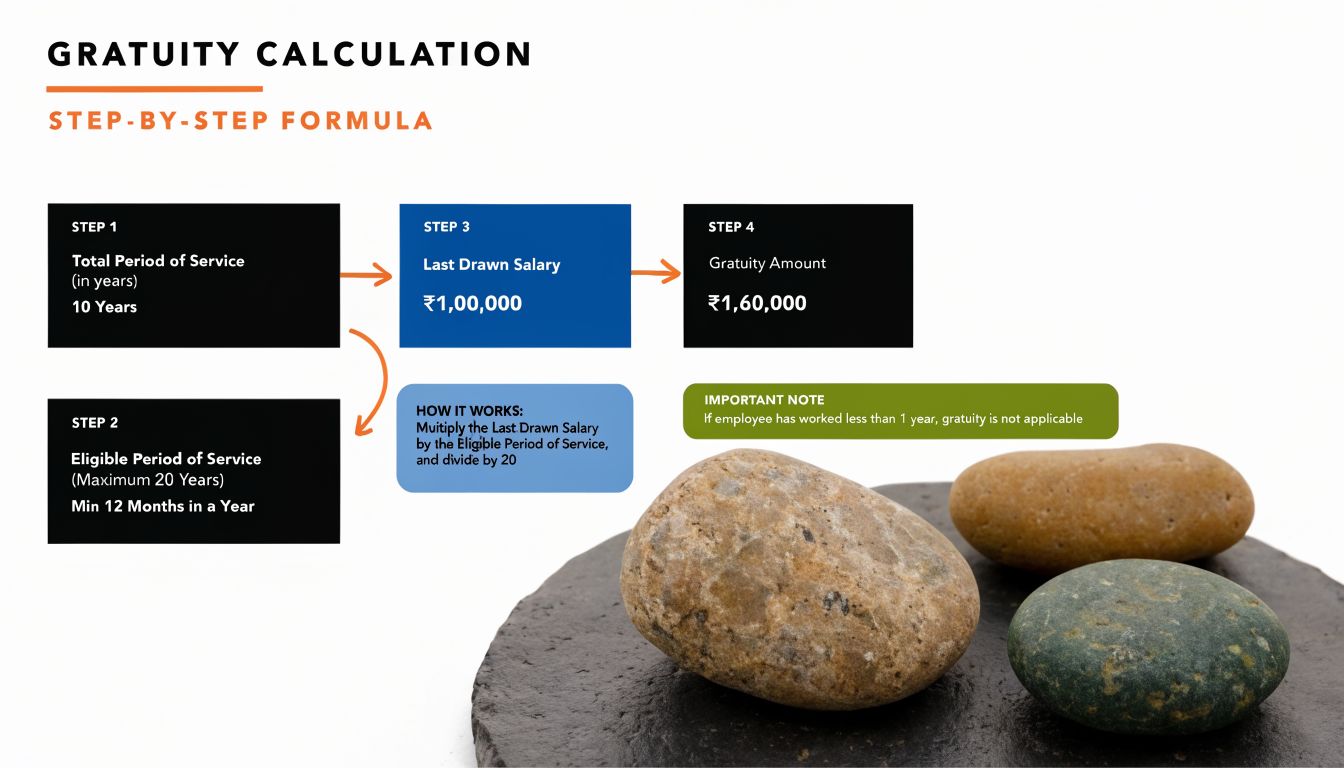
When businesses ask how to compute gratuity, they usually want one thing: a method the payroll officer can apply the same way every time. The cleanest approach is to calculate from basic salary, convert that to a daily basis under the company’s method, apply the applicable rule for tenure, then check the cap.
A practical ERP-oriented method used in UAE and GCC payroll guides is this: identify the last drawn base salary, count completed years of service, apply the formula Gratuity = (Base Salary × 15 × Tenure) ÷ 26 for a 26-day month or ÷ 30 for a 30-day month depending on the company framework, and cap the result where required. The same guidance also notes that periods over six months in the terminal year are commonly rounded to a full year in the methodology used by many systems, and warns that including irregular salary components can trigger audit exceptions in 15–20% of manually audited payroll samples in mid-sized GCC firms, according to this HR glossary explanation of gratuity practice.
A practical sequence for payroll teams
Use this order every time:
- Pull the employee’s last basic salary from the approved payroll structure.
- Confirm the service dates from joining to termination.
- Decide the company divisor rule used in payroll configuration, typically 26 or 30 where that framework applies.
- Apply the UAE service band rule for first years and subsequent years where relevant.
- Review the result against company records before final settlement approval.
Example using the 30-day basis
Take a monthly-paid employee in a UAE trading company with a basic salary of AED 10,000 and 3 years of service.
A 30-day basis gives a daily basic salary of:
- AED 10,000 ÷ 30 = AED 333.33
For service within the first band, the gratuity is:
- AED 333.33 × 21 × 3 = AED 21,000 approximately
This example is useful because it shows a common payroll pattern. The total package might be much higher than the basic salary, but gratuity still depends on the basic component only.
Example for service beyond five years
Now take a second employee with a basic salary of AED 25,000 and 8 years of service.
The daily basic salary on a 30-day basis is:
- AED 25,000 ÷ 30 = AED 833.33
Then split the service:
| Service band | Calculation | Result |
|---|---|---|
| First 5 years | AED 833.33 × 21 × 5 | AED 87,500 approximately |
| Next 3 years | AED 833.33 × 30 × 3 | AED 75,000 approximately |
Total gratuity:
- AED 162,500 approximately
Field note: Most payroll disagreements don’t come from the multiplication. They come from choosing the wrong salary component or the wrong tenure.
What usually goes wrong
One issue causes repeated trouble in payroll audits. A common pitfall leading to audit exceptions is including irregular components in the last drawn salary. Best practice for ERP systems such as Hinawi is to store the base salary, joining date, and termination date as separate fields and compute gratuity in a dedicated payroll module. That prevents the final figure from being inflated by allowances or distorted by incomplete HR data.
This matters most in companies with changing salary structures, temporary allowances, or manual payroll adjustments. If the system doesn’t isolate the gratuity basis from the rest of the package, the final settlement won’t be reliable.
Accounting for Gratuity Accruals and Journal Entries

Many gratuity articles stop at the formula. Finance teams can’t stop there. They need to know how the liability appears in the books, how it is updated over time, and how the final settlement clears against provisions already recognised.
That gap is real. Existing content often separates gratuity calculation from its accounting treatment, leaving finance teams without clear guidance on automating accruals. Critical gaps exist around how to accrue gratuity monthly in accounting records while complying with UAE's WPS payroll requirements, according to this gratuity calculator commentary.
Why accrual accounting matters
If a company records gratuity only when an employee resigns or is terminated, the financial statements can understate employee-related liabilities during the service period. That may not be visible in a small team, but it becomes a serious control issue in larger payroll environments or multi-branch operations.
The better method is to accrue gratuity progressively. HR confirms service data. Payroll applies the configured rule. Accounting posts the accrued amount to the ledger. Where organisations want a practical workflow for this handoff, posting HRMS entries into accounting becomes a core process, not an optional extra.
A simple journal entry structure
A common accounting treatment looks like this:
| Stage | Debit | Credit |
|---|---|---|
| Monthly or periodic accrual | Gratuity Expense | Provision for Gratuity |
| Final settlement payment | Provision for Gratuity | Cash / Bank / Payables |
This structure does two useful things. It recognises the expense over time, and it stops the full termination payout from hitting one reporting period without prior provision.
Record the obligation before the employee leaves. If you wait until exit, you’re not managing gratuity. You’re reacting to it.
What finance teams should review each period
A good review cycle usually includes the following:
- Employee master data alignment: HR and payroll should agree on joining date, salary basis, and employment status.
- Provision movement: Finance should compare opening provision, current-period accrual, utilisation, and closing balance.
- Termination reconciliation: The gratuity paid at exit should tie back to the latest approved calculation and the provision balance.
- WPS timing: The payout process should align operationally with payroll controls and settlement approvals.
What does not work well in practice
Spreadsheets can handle a one-off gratuity estimate. They don’t handle well a live workforce with increments, transfers, unpaid periods, and final settlements passing through multiple approvals.
Problems usually show up in three places:
- The liability in accounting doesn’t match payroll reports.
- The employee’s exit calculation uses a salary figure different from the provision basis.
- The final entry is posted manually with no audit trail.
That’s why gratuity should be treated as part of the accounting lifecycle, not as a disconnected HR event.
Automating Gratuity Management in Your ERP System

Manual payroll teams often assume the actual risk in gratuity is legal interpretation. In day-to-day operations, the larger risk is usually system configuration. If the ERP doesn’t isolate the salary base, doesn’t map tenure rules correctly, or doesn’t recalculate at termination, the company can still produce the wrong number even when everyone thinks the formula is understood.
That problem shows up clearly in implementation work across the region. In GCC payroll implementations, 80–90% of gratuity computation errors arise from failing to index the base salary correctly at termination or not mapping local labour-law thresholds into the ERP configuration. This leads to discrepancies in 25–30% of manual recalculation checks, according to this payroll implementation analysis.
The ERP fields that matter most
When I review a payroll setup, I look for a few essential controls:
- Separate salary components: Basic salary must be stored independently from allowances and variable pay.
- Clean service dates: Joining date and termination date should come from the employee master, not free-text payroll notes.
- Dedicated gratuity logic: The system should calculate gratuity inside payroll or end-of-service workflows, not in an external spreadsheet.
- Audit trail: Any manual override should be logged and reviewable.
These controls are especially important in businesses with multiple branches, such as contractors, manufacturers, property companies, and school groups, where the same employee data may be touched by several departments.
What a good automation flow looks like
A practical automation design usually follows this pattern:
| Process point | What the system should do |
|---|---|
| Employee setup | Store basic salary and employment dates in structured fields |
| Payroll cycle | Recalculate gratuity accruals on a defined basis |
| Salary revision | Preserve history so the correct basis can be applied at exit |
| End of service | Generate final gratuity calculation and send accounting impact automatically |
For businesses evaluating payroll software, how payroll works inside HRMS is a useful starting point because it shows whether the system is handling employee data as a process, not just as monthly payslip output.
One practical example is Explorer Computer LLC – Hinawi Software ERP, which supports HR and payroll workflows with WPS processing and real-time accounting integration. In a gratuity context, that kind of setup matters because the calculation, accrual, and ledger impact can sit inside one controlled environment rather than being split across spreadsheets and separate accounting tools.
Operational insight: Automation doesn’t remove the need for payroll judgement. It removes repeatable clerical mistakes so payroll can focus on exceptions.
What works and what doesn’t
What works:
- A single employee master record
- A locked basic salary field for gratuity basis
- Automated accrual posting
- Termination workflows that trigger recalculation and review
What doesn’t:
- Rebuilding the gratuity figure manually at every exit
- Allowing payroll users to type over salary history
- Running HR and finance balances separately with no reconciliation
- Treating GCC countries as if one rule applies everywhere
Handling Gratuity Across Different GCC Jurisdictions
Regional businesses often assume the hard part is calculating UAE gratuity correctly. For groups operating in more than one GCC country, the harder issue is governance. A formula that is valid in one jurisdiction may not fit another country’s labour code or salary basis rule.
That’s why generic online guidance causes trouble. Most online guides provide generic gratuity formulas but lack specific guidance for how UAE, Saudi Arabia, and Qatar regulations differ, which is critical for regional companies using ERP systems to manage multi-country payroll, as noted in this gratuity comparison discussion.
Gratuity Rule Comparison UAE vs KSA vs Qatar
| Parameter | UAE | Saudi Arabia (KSA) | Qatar |
|---|---|---|---|
| Main risk area | Basic salary definition and service-band application | Country-specific labour-code mapping in payroll | Country-specific labour-code mapping in payroll |
| Salary basis handling | Requires careful distinction between basic salary and allowances | Must be configured according to local rule set | Must be configured according to local rule set |
| ERP requirement | Country-specific gratuity formula and cap control | Separate localisation logic | Separate localisation logic |
| Multi-country payroll approach | Don’t reuse UAE setup automatically | Build rule set for KSA | Build rule set for Qatar |
For group finance and HR leaders, the lesson is straightforward. Don’t create one regional gratuity formula and deploy it everywhere. Create a country-specific payroll rule library, then control the data fields consistently across all entities.
Chat on WhatsApp +971506228024 Quotation – Demo RequestTake the Next Step with Hinawi ERP
Accurate gratuity management depends on more than knowing a formula. The business needs clean employee data, a payroll engine that uses the right salary basis, an accrual process that keeps accounting current, and a final settlement workflow that finance and HR can both defend.
That’s why many UAE and GCC companies move away from manual spreadsheets and disconnected systems. Value isn’t only speed. It’s control. When gratuity sits inside an integrated ERP environment, payroll teams reduce rework, accountants get cleaner provisions, and management gets more reliable reporting across the whole employee lifecycle.
Hinawi ERP has been developed in Abu Dhabi since 1998 as a fully integrated ERP platform supporting Accounting, HR & Payroll, Real Estate Management, Fixed Assets, Manufacturing, Garage & Maintenance, School Management, CRM, and end-to-end business automation. It supports VAT and e-Invoicing compliance, UAE WPS payroll, Arabic and English bilingual operation, flexible company policy settings, and real-time accounting integration across modules. That makes it suitable for factories, contracting companies, real estate businesses, schools, garages, trading companies, and manufacturers across the UAE and GCC.
If your team is reviewing how to compute gratuity more accurately, the next step is to review the system behind the calculation. Compare your current process against an integrated ERP model, especially if you’re also managing payroll approvals, VAT reporting, real estate contracts, production costing, or fixed asset controls. A useful reference point is how Hinawi ERP compares with other ERP systems.
Visit Hinawi ERP’s official website to explore the platform or request a personalised demo. If your company wants to modernise operations, reduce manual work, improve financial accuracy, and gain better management control, this is the right conversation to have.
Explorer Computer LLC – Hinawi Software ERP helps businesses in the UAE and GCC manage payroll, gratuity, accounting, VAT, e-Invoicing, HR, real estate, fixed assets, manufacturing, schools, garages, CRM, and full business automation in one integrated system. Visit www.hinawierp.com or request a personalised demo to see how your company can improve payroll accuracy, strengthen financial control, and reduce manual work with a practical ERP built in Abu Dhabi for regional businesses.