In a market as competitive as the UAE, trying to run a business without a proper Enterprise Resource Planning (ERP) system is like trying to conduct an orchestra where every musician is playing from a different sheet of music. For companies in Dubai, Abu Dhabi, and beyond, an ERP software in the UAE isn’t just another piece of technology—it's the core system that brings order to the chaos and sets the foundation for real, sustainable growth. For instance, a system like Hinawi ERP, developed in Abu Dhabi since 1998, is engineered to address these specific regional challenges head-on.
Want to see this process inside a real ERP? Use these quick links:
Chat on WhatsApp +971506228024
Quotation – Demo Request
Chat with Hinawi AI
Why An ERP Is The Engine of Modern UAE Businesses

Let's get practical. Think of an ERP as your company’s central nervous system. It’s the one platform connecting all your vital departments—from finance and HR to your warehouse and sales teams—into a single, cohesive unit. In the fast-moving economy of the UAE, this kind of integration is no longer a "nice-to-have." It's essential.
Many businesses here are still wrestling with disconnected spreadsheets, legacy accounting software, and standalone apps. The daily reality? Your finance team spends hours manually matching numbers that don't add up. Your HR manager is navigating complex payroll rules with an outdated system. Your warehouse is either running out of key products or sitting on a mountain of overstock. Every one of these issues eats away at your profit margins.
An integrated ERP system solves this by creating what we call a single source of truth.
A well-implemented ERP is no longer a luxury but a strategic necessity. It transforms fragmented data into actionable intelligence, allowing leaders to make informed decisions that drive the business forward with confidence and clarity.
Gaining A Competitive Edge In A Dynamic Market
The UAE's economy is defined by its speed, diversification, and government-led digital initiatives. If your company is still relying on manual processes and outdated software, you're not just inefficient—you're at risk of being left behind. An ERP gives you the operational agility needed to keep pace and pull ahead.
What does this look like day-to-day?
- Serious Efficiency Gains: By automating repetitive work like creating invoices, processing payroll, and generating reports, you free up your best people to focus on activities that actually grow the business.
- Smarter, Faster Decisions: When managers have real-time dashboards and clear analytics at their fingertips, they can spot trends, tackle problems, and seize opportunities immediately—not a month later when the reports are finally ready.
- Scalability for Growth: A good ERP is built to grow with you. As you add more employees, open new locations, or launch new business lines, the system scales effortlessly without the disruption of starting over.
A system developed here in the region, like Hinawi ERP, has a distinct advantage. Built in Abu Dhabi since 1998, it was designed from the ground up to handle the specific challenges faced by local industries—from real estate and manufacturing to contracting and trading. It provides a solid platform for achieving operational excellence. Of course, choosing the right system is a critical decision, and it's worth seeing how different options stack up. You can explore a detailed analysis in our article on Hinawi ERP vs Other ERPs.
This guide is designed to give you a clear, professional roadmap for selecting and implementing the right ERP for your business.
Want to see this process inside a real ERP? Use these quick links:
Chat on WhatsApp +971506228024
Quotation – Demo Request
Chat with Hinawi AI
Staying on the Right Side of the Law: UAE Compliance and Your ERP
If you do business in the UAE, you know that following the rules isn't just good practice—it's non-negotiable. The country's regulations demand pinpoint accuracy and complete transparency. Trying to manage these duties with a generic system is a recipe for disaster, leading to hefty fines, failed audits, and the kind of operational headaches that can grind your entire business to a halt.
This is precisely why a purpose-built ERP software UAE solution is so essential. Rather than juggling compliance as a separate, manual chore, a localised ERP builds these rules right into your everyday operations. It takes the stress of compliance and turns it into a smooth, automated process that just works.
Navigating Value Added Tax (VAT) with Confidence
Since its introduction, Value Added Tax (VAT) has woven itself into the fabric of UAE business. The Federal Tax Authority (FTA) is uncompromising in its demand for perfect record-keeping and on-the-dot reporting. Even one small mistake in a VAT calculation can snowball into a major reporting error, putting you squarely in the path of an audit.
Many generic accounting packages force you into a world of manual calculations and messy spreadsheets to track VAT, which is just asking for human error. For a trading company that sends out hundreds of invoices a day, the risk is simply too high.
A properly configured local ERP, such as Hinawi ERP, takes that risk off the table. It automatically applies the correct VAT rate to every single transaction—from sales invoices and purchase orders to expense claims. The system then keeps a complete, tamper-proof audit trail for everything.
When the FTA comes knocking for an audit, you can generate the required FTA Audit File (FAF) in a matter of seconds. This isn't just about saving time; it's about confidently showing that you have solid controls in place, letting you get back to business without disruption.
Mastering the Wages Protection System (WPS)
The Wages Protection System (WPS) is another pillar of UAE regulation, ensuring every employee is paid correctly and on time. It's mandatory, and failing to meet the strict deadlines and file formats for salary transfers can lead to serious fines and even a block on issuing new work permits.
We see so many companies struggle with this, trying to patch together WPS-compliant files from their payroll data by hand. The process is frustratingly slow and full of opportunities for tiny formatting mistakes that get the file rejected by the bank or the Ministry of Human Resources & Emiratisation (MOHRE). To properly manage the local regulatory environment, businesses require powerful compliance management solutions.
An ERP with a built-in, WPS-compliant HR & Payroll module makes this whole process painless.
- It calculates everything: The system accurately works out all salaries, allowances, deductions, and overtime, all according to UAE labour law and your company's policies.
- It generates the right file: When it's time to pay your staff, the ERP automatically creates the Salary Information File (SIF) in the exact format required by the UAE Central Bank. No manual data entry, no formatting errors.
- It keeps you on schedule: What used to take hours of manual work is now done in a few clicks, guaranteeing you never miss a deadline.
Preparing for E-Invoicing and Bilingual Reporting
The government's push for total digitalisation is continuing with the planned e-invoicing mandates. Soon, businesses will have to issue and receive electronic invoices in a specific, structured format. This change will make any non-compliant accounting software instantly obsolete. A modern ERP is already built with this future in mind. You can get ahead of this change by reading our guide on the new tax system in the UAE.
On top of that, doing business in a multicultural hub like the UAE means language matters. An ERP that supports both Arabic and English—not just in the menus but on all official documents like invoices, payment vouchers, and financial reports—is a must. This dual-language feature ensures everyone is on the same page and that you meet legal reporting standards without a second thought.
Want to see this process inside a real ERP? Use these quick links:
Chat on WhatsApp +971506228024
Quotation – Demo Request
Chat with Hinawi AI
Choosing the Right ERP Modules for Your Industry
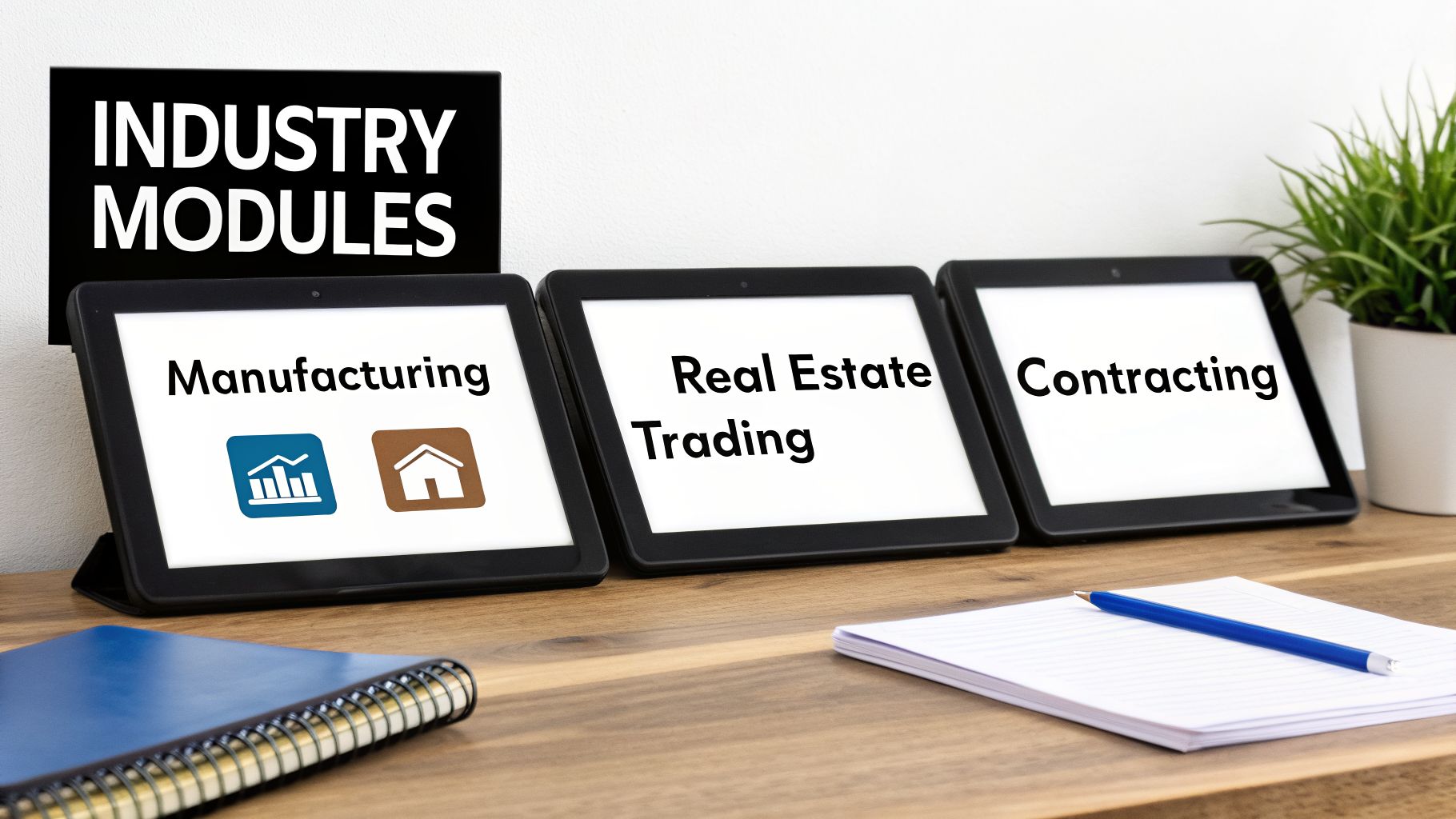
Let's be clear: the notion of a one-size-fits-all ERP is pure fiction. Anyone who tells you otherwise probably hasn't seen the real-world difference between a Dubai-based trading company, a manufacturing plant in Abu Dhabi, and a property portfolio manager in Saudi Arabia. Their daily operations are worlds apart.
True success with ERP software UAE comes from ditching the generic checklists. It's about hand-picking specific modules that directly solve your most pressing industry challenges.
This modular approach is what separates a successful implementation from a costly failure. You build a system that mirrors your actual workflows, not one that forces your team into a rigid, unfamiliar box. You're assembling a digital toolkit piece by piece, ensuring every component you pay for delivers a clear return.
For Manufacturing and Contracting Companies
In construction and manufacturing, your profitability hinges entirely on how well you control your projects and production lines. A standard accounting package just doesn't have the muscle to manage complex job sites, track costs with any real accuracy, or keep operations running smoothly.
Here’s where you need to focus:
- Job Costing & Project Management: This is your command centre. It’s the only way to track every dirham—labour, materials, subcontractor invoices, overheads—against a specific project or Bill of Quantities (BOQ). Without it, you’re flying blind, only discovering if a job was profitable long after it’s finished.
- Manufacturing/Production: This module takes you from job cards and raw material planning all the way to tracking work-in-progress and finished goods. It gives you the clear line of sight you need onto the factory floor.
- Inventory & Warehouse Management: For these industries, this is about more than just counting boxes. It’s managing material requisitions, tracking stock across multiple project sites, and making sure the right materials are in the right place at the right time to prevent very expensive delays.
Business Scenario: Imagine a contracting firm in Dubai takes on a massive project. They're using a generic accounting system and can't properly track expenses. By the end, they discover a 15% cost overrun that completely erased their profit margin. With an ERP like Hinawi ERP, the Job Costing module would have tied every purchase order and timesheet to the project in real-time, sending alerts the moment costs started creeping toward the budget.
For Real Estate and Property Management
The UAE's fast-moving real estate market has its own unique set of headaches. Trying to manage properties, tenants, and mountains of post-dated cheques (PDCs) with spreadsheets is a recipe for chaos, missed renewals, and inaccurate owner statements.
Your essential modules are:
- Real Estate Management: This is where you centralise everything—all property and unit details, occupancy and vacancy rates, and lease agreements. It should automatically flag contract expiries and renewal dates so nothing slips through the cracks.
- Tenant Management & PDC Tracking: This is non-negotiable in the GCC. The module must log every post-dated cheque, track its status (cleared, bounced, under-collection), and automate reminders. This single function can save hundreds of hours of manual work and massively reduce financial risk.
- Advanced Financial Reporting: You need the ability to pull detailed reports by property, by owner, or by building. This is how you gain clear, actionable insights into revenue, expenses, and the true performance of your portfolio.
For Trading, Retail, and Distribution
If you're in trading or distribution, you know it's a game of small margins, rapid turnover, and perfect inventory control. Your biggest challenge is managing the constant flow of goods from procurement to the final sale, all while keeping a death grip on costs and stock levels.
These modules are your bread and butter:
- Advanced Inventory Control: This gives you a live, real-time view of your stock across every warehouse and retail branch. It needs to support different costing methods (like FIFO or Weighted Average) and help you walk the fine line between stockouts and having too much cash tied up in overstocked goods.
- Supply Chain Management (SCM): This automates the entire buying process. It should handle everything from raising purchase orders and managing supplier data to tracking shipments and calculating landed costs.
- Sales & CRM: A powerful sales module processes orders and generates invoices, but when it's integrated with a Customer Relationship Management (CRM) tool, it becomes invaluable. You get a complete picture of every customer interaction and their entire purchase history.
To help you see how this all comes together, we've created a table outlining the essential ERP modules for the UAE's key industries.
Essential ERP Modules by Industry in the UAE
| Industry Sector | Essential ERP Modules | Key Features for UAE Market |
|---|---|---|
| Manufacturing & Contracting | Job Costing, Manufacturing/Production, Advanced Inventory, Project Management | BOQ-based tracking, real-time cost vs. budget analysis, multi-site material management, subcontractor payment processing. |
| Real Estate & Property Mgmt. | Real Estate Management, Tenant Management, Advanced Financials | Automated lease renewal alerts, PDC management (Post-Dated Cheques), owner statement generation, service charge calculation. |
| Trading, Retail & Distribution | Advanced Inventory, Supply Chain Management (SCM), Sales & CRM, Warehouse Management (WMS) | Landed cost calculation, multi-warehouse visibility, FIFO/Weighted Average costing, batch/serial number tracking, POS integration. |
| Human Resources & Payroll | Core HR, Payroll, Employee Self-Service (ESS), Recruitment | WPS compliance, gratuity calculation (end-of-service benefits), leave management, multi-currency payroll. |
| Asset-Intensive Operations | Fixed Asset Management, Maintenance Management, Financials | Asset depreciation (multiple methods), maintenance scheduling, tracking repair costs, asset life-cycle management. |
This table provides a starting point, but the real power of an ERP is unlocked when these modules start talking to each other.
For instance, when the manufacturing module uses raw materials, the inventory module should instantly update stock levels, and the accounting module should record the cost—no manual data entry required. You can see how these parts connect by exploring the software modules in Hinawi Software. This seamless, real-time integration is what separates a truly effective ERP from just a bunch of disconnected programs.
Want to see this process inside a real ERP? Use these quick links:
Chat on WhatsApp +971506228024
Quotation – Demo Request
Chat with Hinawi AI
Building the Financial Case for Your ERP Investment
Let's be honest. Investing in an ERP is a huge decision, and for any business owner or finance manager in the UAE, it always comes down to one question: "Will this actually pay for itself?"
The answer is yes, but with a major condition. It's not about buying software; it's about making a strategic investment in how your business runs. A proper ERP system doesn't cost you money in the long run. It finds and creates value by fixing the hidden inefficiencies that are quietly draining your profits.
Understanding the Market and Calculating Your Return
Adopting an ERP isn't some niche trend anymore—it's become a standard playbook for staying competitive in the region. The ERP software UAE market is exploding for a reason. In 2026, it is projected to generate significant revenue, continuing the massive growth seen in previous years.
With projections showing the market will hit USD 1,026.9 million by 2030 (a CAGR of 16.2%), it's clear that sitting on the sidelines is no longer an option. This growth is driven by real, measurable financial returns. To make the case for your own business, you need to look at both the obvious cost savings and the less tangible, but equally powerful, strategic gains.
Tangible Gains (The Hard Numbers)
These are the immediate, easy-to-measure benefits you can take to the bank.
- Fewer Manual Errors: Every time someone copies data from one spreadsheet to another, there's a risk of a costly mistake. Automating data entry and connecting your processes eliminates these human errors for good.
- Lower Inventory Costs: Real-time stock visibility means you stop tying up cash in products that aren't selling (overstocking) and you stop losing sales because you ran out of a popular item (understocking).
- Faster Financial Closing: When all your numbers live in one system, your finance team can close the books in a matter of days, not weeks. This gives you a clear picture of your business health much faster.
Intangible Gains (The Strategic Value)
These benefits are harder to put a dirham figure on, but they're often where the real magic happens.
- Smarter, Faster Decisions: With live dashboards and accurate reports, your managers aren't guessing. They're making informed decisions based on what's happening right now.
- Room to Grow: A solid ERP system is built to scale. As your business expands, your systems won't crack under the pressure.
- Effortless Compliance: Managing VAT, WPS, and new e-invoicing rules manually is a recipe for risk. An ERP automates this, protecting you from significant financial penalties.
A key part of this whole process is solid financial modelling. Getting your projections right is critical, and understanding how modern tools can help with budgeting and forecasting is a great place to start.
The point of building a business case for an ERP isn't just to get a purchase approved. It's to map out a clear path to better profitability and show decision-makers exactly how this investment will boost the bottom line.
A Practical Scenario From Dubai
Imagine a typical mid-sized trading company in Dubai. They use one system for accounts and a totally separate one for inventory. It's a daily struggle.
The sales team is constantly selling products that, unbeknownst to them, are already out of stock because the inventory system only gets updated overnight. This leads to a cascade of problems: cancelled orders, frustrated customers, and last-minute panic to find another supplier—usually at a higher cost.
Meanwhile, the accounting team dedicates the first week of every month to the painful task of manually matching inventory reports with sales records. By the time management gets the financial reports, the information is already stale, making it impossible to react to market shifts.
Now, picture that same company after implementing an integrated ERP software UAE solution like Hinawi ERP. The moment a sale is confirmed, the system updates everything in real-time.
- The sales team knows exactly what's in stock and can promise delivery with 100% confidence.
- The warehouse gets an instant, accurate order to pick and pack.
- The accounting ledger is updated automatically, with no manual entry needed.
The results are immediate. Capital isn't tied up fixing stock-out errors. Customer satisfaction skyrockets. And the finance team is freed from tedious reconciliation to focus on high-level analysis that actually grows the business. This is the moment an ERP stops being an expense and starts acting like a profit centre.
Your Blueprint for a Flawless ERP Implementation
It’s a common misconception that buying the 'best' ERP software is the final step. In reality, it's just the beginning. I've seen it time and again in the UAE: a successful project is 80% smart planning and only 20% technology. True success comes from a meticulously managed implementation, transforming a software purchase into a genuine competitive advantage.
This isn’t just a technical checklist. Think of this as your hands-on guide to rolling out your new ERP. It's about navigating the process of change—for your people, your data, and your daily operations—without grinding your business to a halt.
Step 1: Assemble Your Internal Champions
Your first move, long before any software gets installed, is to build your A-team. This internal project group should be a cross-section of your business, with representatives from finance, operations, HR, and IT who know your company inside and out. They are the essential link between your business realities and your ERP provider.
This team's mission is clear:
- Set the project’s goals and define what success looks like (KPIs).
- Act as advocates for the new system, building excitement and encouraging adoption.
- Have the authority to make key decisions about new workflows and system settings.
- Keep everyone in the loop, managing expectations and communicating progress.
Without this dedicated internal team driving the project, even the most powerful ERP software UAE will struggle to get off the ground.
Step 2: Get Your Data Migration Right
An ERP system is a mirror; it reflects the quality of the data you feed it. That's why your plan for migrating your database from old systems is so critical. Frankly, this is the part of the project that trips up most companies.
Don't wait. Start cleaning your data now—get rid of duplicates, fix the obvious errors, and standardise your formats. You'll also need to make a firm decision on how much historical data you really need to bring across versus what can be archived. Starting with messy data will instantly undermine your new system, leading to bad reports and zero confidence from your team.
Think of your ERP implementation as a "data spring clean." It forces every department to take ownership of its information, ensuring you begin this new chapter with a single source of truth you can actually trust.
Step 3: Test Everything in a Sandbox
You wouldn't drive a new car off the lot without a test drive, and you should never go live with an ERP without thorough testing. Your provider will create a "sandbox" for you—a safe, isolated copy of the ERP loaded with your cleaned-up data. This is your playground and your proving ground.
This is where your team needs to try and break things. Have your finance team run a complete payroll cycle. Get your warehouse manager to process a complicated stock transfer. Ask the sales team to enter a non-standard order. The idea is to find every potential hiccup and configuration gap before it can affect a real customer or a real invoice.
The demand for these systems is skyrocketing. The Middle East ERP software market was valued at USD 1,421.73 million in 2024 and is forecast to hit USD 3,199.51 million by 2030. With so many companies making the move, a smooth implementation is what separates the leaders from the pack. You can dive deeper into this trend in the full market report.
Step 4: Choose a Phased Rollout and Train Your People Well
Going all-in with a "big bang" launch—switching everything on at once—is a high-wire act with no safety net. A much smarter approach is a phased rollout. You could start by launching the core finance modules, then introduce HR and Payroll a few months later, and then bring manufacturing online. This breaks the change down into manageable pieces and lets your team learn at a comfortable pace.
Training is just as crucial. This can't be a one-time, two-hour lecture. It needs to be an ongoing process with hands-on, role-specific sessions. Show your people exactly how the new ERP makes their specific tasks simpler and more efficient.
Want to see this process inside a real ERP? Use these quick links:
Chat on WhatsApp +971506228024
Quotation – Demo Request
Chat with Hinawi AI
Take the Next Step with Hinawi ERP
We’ve walked through the ins and outs of choosing and implementing an ERP system in the UAE. From navigating local regulations to finding a system that truly fits your industry, you now have a solid roadmap. The next step is turning that knowledge into action.
For businesses here in the UAE and across the GCC, the daily operational headaches—VAT compliance, payroll delays, and disconnected departments—are very real. That’s precisely why Hinawi ERP was created. Developed in Abu Dhabi since 1998, it’s not just another ERP software UAE system; it is a fully integrated solution born from decades of understanding regional business needs. It brings your Accounting, HR & Payroll, Real Estate Management, Fixed Assets, Manufacturing, Garage & Maintenance, School Management, CRM, and complete business automation under one powerful, unified roof.
A System That Speaks the Language of GCC Business
What does this mean for your company? It means getting ahead of compliance instead of chasing it, modernizing operations, and gaining full management control. With Hinawi ERP, you get:
- VAT and e-Invoicing compliance built-in, so you can meet FTA requirements without the last-minute scramble.
- Reliable UAE WPS payroll support to ensure your salary processing is always accurate, compliant, and on time.
- Full bilingual (Arabic and English) operation, from the login screen to the final financial report.
- Flexible company policy settings that adapt the system to your unique workflows.
- Real-time accounting integration across all modules, eliminating manual data entry and ensuring financial accuracy.
- Industry-specific modules suitable for factories, contracting companies, real estate businesses, schools, garages, trading companies, and manufacturers.
It’s time to stop wrestling with spreadsheets and trying to make outdated software work for a modern business. By modernizing your operations with Hinawi ERP, you can reduce manual work, improve financial accuracy, and gain better control over your management.
Our expert consultants, based in Abu Dhabi, are ready to have a real conversation about your specific challenges. They can offer a personalized consultation and show you exactly how Hinawi ERP can be configured to solve them.
Ready to take the next step? Visit www.hinawierp.com or request a personalized demo today.
Chat on WhatsApp +971506228024 Quotation – Demo Request Chat with Hinawi AIFrequently Asked Questions About ERP in the UAE
Thinking about bringing an ERP system into your UAE business? It's a big step, and you’ve probably got a lot of questions buzzing around. We get it. Here are the straightforward answers to the queries we hear most often from companies on the ground here.
How Much Does ERP Software Cost in the UAE?
This is often the first question, and the honest answer is: it varies—a lot. There's no one-size-fits-all price tag. The final cost really depends on the unique needs of your business.
Key factors include the number of people who will use the system, which specific modules you need (finance, HR, real estate, etc.), and whether you choose a cloud-based or on-premise solution. A small business might start with a basic cloud subscription for a few hundred AED per user each month. A large manufacturer, on the other hand, could be looking at a significant upfront investment for a custom, on-premise system.
Don't forget to factor in the costs of implementation, training your team, and ongoing support. Solutions like Hinawi ERP are designed with scalable pricing to suit both growing SMEs and established corporations across the GCC.
Is ERP Software Difficult to Implement?
An ERP implementation is definitely a major project, but it doesn't have to be a painful one. The difficulty really depends on a few things: the scope of your project, the state of your current data, and—most importantly—the skill of your implementation partner.
A successful rollout always starts with meticulous planning and clear communication. You'll also need to dedicate some of your own team's time to the project.
The biggest headaches we see are rooted in trying to migrate messy, inaccurate data from old systems, employee resistance to new ways of working, and weak project management. This is where partnering with a seasoned local vendor like Hinawi ERP, who’s been operating from Abu Dhabi since 1998, makes a world of difference. We provide the hands-on support and local know-how to make the transition as smooth as possible.
Can I Integrate an ERP with My Existing Software?
Absolutely. In fact, this is one of the most common ways businesses start with ERP. Most modern systems are built to integrate and play nicely with the tools you already use.
Perhaps you're happy with your current bookkeeping software but are struggling to manage a WPS-compliant payroll or track your fixed assets effectively. You don't have to rip and replace everything at once.
An ERP like Hinawi ERP can act as the central hub, allowing you to add powerful modules for real estate, manufacturing, or HR as you need them. This ensures all your data flows into one place, giving you a single, reliable source of truth for making critical business decisions.
Why Is a UAE-Specific ERP Better Than a Generic One?
Choosing an ERP built specifically for the UAE gives you a massive advantage that generic, global software just can't provide. It’s not just about an Arabic language option; it’s about compliance and local business practices being baked in from the start.
A UAE-specific system is already configured to handle local regulations like VAT, corporate tax, e-invoicing, and the Wages Protection System (WPS). It also understands and automates uniquely regional processes like post-dated cheque (PDC) management.
With a local provider like Hinawi ERP, you get more than just compliant software. You get a team that understands the nuances of the GCC market, provides support in your time zone, and ensures your business stays ahead of regulatory changes. That’s a level of peace of mind an international vendor thousands of miles away struggles to offer.