
An Enterprise Resource Planning (ERP) system is the central nervous system of a modern business, connecting all critical departments—from finance and HR to inventory and sales—onto a single, unified platform. For any company operating in the UAE, a solid ERP software solution is no longer a luxury; it's a core requirement for staying compliant, efficient, and competitive. As a consulting-oriented firm, we've seen countless UAE businesses transform their operations with the right ERP, and solutions like Hinawi ERP, developed in Abu Dhabi since 1998, exemplify this local advantage.
Why an ERP Is the Engine of a Modern UAE Business

Think of your business as a high-performance vehicle. Finance is the fuel system, HR is the expert crew, and your supply chain is the cargo you're moving. Each part is essential, but if they aren't working together, you get a disjointed, inefficient, and bumpy ride. An ERP software UAE solution is that powerful, integrated engine.
It ensures every component communicates and runs in perfect sync, giving you the control and power needed to accelerate past the competition. To truly appreciate this, it's worth understanding the fundamental significance of ERP systems in bringing all these moving parts together.
In the UAE, this level of integration isn't just a smart business move—it's a strategic necessity. With national initiatives pushing for rapid digitalization, businesses are under more pressure than ever to modernize, follow strict regulations, and operate at peak efficiency. This is precisely where a locally-focused ERP proves its worth.
Ready to see how a fully integrated ERP can transform your UAE operations? Get a first-hand look at a system built for regional success.
Chat on WhatsApp +971506228024 Quotation – Demo Request Chat with Hinawi AIThe Digital Drive in the UAE Market
The UAE's relentless push towards a diverse, knowledge-based economy has created huge demand for powerful digital tools. The country's ERP software market tells this story clearly: it reached USD 465.9 million in 2024 and is forecast to surge to USD 1,026.9 million by 2030.
This explosive growth isn't happening by accident. It’s being driven by government mandates for things like e-invoicing and digital payroll systems (WPS), forcing sectors like trading, retail, and manufacturing to upgrade their operations or risk being left behind.
A Real-World Example of Localised Excellence
Consider a real estate company in Abu Dhabi struggling with manual contract tracking and delayed VAT reporting. Before implementing an ERP, their team spent days cross-referencing spreadsheets, leading to missed renewal dates and potential FTA penalties. After adopting a localized solution like Hinawi ERP, which was first developed in Abu Dhabi in 1998, they gained a unified dashboard. VAT calculations became automated, and lease renewal alerts were system-generated. This is a practical example of how a true ERP software UAE solution provides a direct competitive advantage by embedding local requirements like VAT compliance, WPS payroll, and full bilingual (Arabic-English) support from its core design.
Recognising the Hidden Costs of Disconnected Systems
For any growing business in the UAE, some of the biggest expenses never actually show up on a balance sheet. These are the hidden operational costs that creep in when teams work with disconnected systems: the wasted hours, the critical mistakes, and the missed opportunities that slowly erode profits. These are the tell-tale signs of a deeper problem known as data silos.
When every department—from sales to finance to HR—is stuck using its own separate software and spreadsheets, your business isn't a single, cohesive entity. It’s a collection of separate islands of information. This separation creates friction, breeds inefficiency, and leads to expensive mistakes that hurt your bottom line.
Are you seeing the signs of disconnected operations? An integrated system can show you a much clearer path forward.
Chat on WhatsApp +971506228024 Quotation – Demo Request Chat with Hinawi AIThe Real Price of Data Silos
Think about these all-too-common scenarios playing out in offices across Dubai, Abu Dhabi, and the wider GCC region every single day:
The Accountant's Dilemma: At the end of every quarter, a Dubai accountant spends a full week manually pulling sales figures from one system, inventory reports from another, and expense claims from dozens of spreadsheets. They stay late, trying to reconcile all the numbers for the VAT return. A single copy-paste error slips through, leading to an incorrect filing and a potential audit from the Federal Tax Authority (FTA).
The HR Manager's WPS Struggle: An HR manager is buried under multiple files, trying to calculate salaries, overtime, and deductions. The manual process is not only slow but also full of opportunities for mistakes. This delays the generation of the SIF file for the Wages Protection System (WPS), resulting in late salary payments, unhappy employees, and the very real risk of non-compliance penalties.
The Real Estate Manager's Oversight: A property manager in Abu Dhabi uses one piece of software for tenant contracts and a completely separate one for maintenance requests. With no single view of their portfolio, they completely miss a critical lease renewal date for a prime commercial unit. The oversight leads to an unexpected vacancy and a significant loss of revenue.
These aren't just one-off problems; they are the direct result of working with disconnected data. Manual processes and separate systems are famous for creating hidden costs. One of the first things an ERP helps with is allowing businesses to automate accounts payable and other painful financial tasks.
ERP as the Cure for Inefficiency
Bringing in a solid ERP software UAE solution isn't just another line item on your expense report—it’s a direct investment in your company's operational health. A truly integrated system like Hinawi ERP gets to work dismantling those data silos and building a single source of truth for your entire organisation.
By pulling data from accounting, HR, sales, and operations into one shared platform, an ERP gets rid of the very thing that causes manual errors and reconciliation headaches. It turns departmental data into a shared, real-time asset that everyone can use to make better, more confident decisions.
Imagine your finance team seeing live sales data as it comes in, or your HR department processing payroll instantly with accurate, up-to-the-minute timesheets. The entire business simply runs better. Managers get back hundreds of hours they used to waste on manual data entry and checking spreadsheets. To dig deeper into this, you can learn more about the dangers of missing or incomplete data in our detailed article. That reclaimed time can be put back into activities that actually grow the business, instead of just keeping things afloat.
Struggling with compliance? See how an ERP built for the UAE automates these critical requirements.
Chat on WhatsApp +971506228024 Quotation – Demo Request Chat with Hinawi AIMust-Have ERP Features for UAE Compliance and Success
When you're choosing an ERP software UAE solution, it's easy to get lost in the standard modules. Of course, functions like accounting, CRM, and inventory are the foundation. But for any business operating here, real success depends on features designed specifically for our local rules and business realities.
Picking a system without these capabilities is like trying to navigate the Dubai-Abu Dhabi highway with a map from ten years ago. You’re bound to hit roadblocks, fines, and expensive delays.

For decision-makers across the UAE and GCC, this isn't just a software purchase; it's a high-stakes decision. The right system becomes your company’s central nervous system, while the wrong one is a source of constant operational headaches. Think of this section as your practical checklist for asking the right questions and finding a solution that genuinely fits.
Critical ERP Features for UAE & GCC Businesses
To give you a clearer picture, this table breaks down the non-negotiable features your ERP must have. These aren't just "nice-to-haves"; they are fundamental for staying compliant and competitive in the local market.
| Feature Category | Specific Requirement | Business Impact in the UAE |
|---|---|---|
| Financial Compliance | FTA-Compliant VAT & E-Invoicing Readiness | Avoids FTA penalties. Ensures accurate tax reporting and prepares your business for mandatory e-invoicing without manual effort. |
| HR & Payroll | Automated WPS Payroll (SIF file generation) | Guarantees compliance with Ministry of Human Resources regulations, prevents salary delays, and removes hours of manual admin work each month. |
| User Experience | Bilingual Interface (Arabic & English) | Improves adoption and reduces errors across a diverse workforce. Allows different teams to work in their preferred language. |
| Operations | Localised Policy Configuration | Accurately calculates end-of-service benefits, gratuity, and leave entitlements according to UAE Labour Law, preventing disputes and legal issues. |
| Core Accounting | Real-Time General Ledger Integration | Provides a live, accurate view of your company's financial health. Eliminates the need for manual data reconciliation at month-end. |
| Global Business | Multi-Currency & Multi-Company Support | Essential for companies with GCC operations or international clients/suppliers. Simplifies financial consolidation and foreign exchange management. |
An ERP that ticks all these boxes isn't just a tool—it's a strategic asset built to handle the specific pressures and opportunities of doing business in the UAE.
Core Financial and Regulatory Features
The financial engine of your ERP has to be absolutely solid and perfectly aligned with UAE law. There's no room for error here, as non-compliance can attract significant penalties from the Federal Tax Authority (FTA).
Here’s what to look for:
FTA-Compliant VAT and E-Invoicing: At a minimum, your ERP must automatically calculate VAT and generate proper tax invoices. But with the government’s push towards e-invoicing, your system must also be ready to create and manage digital invoices that meet official standards. This removes the risk of manual errors and makes audits far less painful.
Integrated Accounting: This is the heart of the entire system. Every transaction—from a sales invoice to a payroll run—should post to the general ledger in real-time. This gives you a constantly accurate picture of your financial position without the nightmare of manual journal entries and month-end reconciliations.
Multi-Currency and Multi-Company Support: If your business operates across the GCC or deals with international suppliers, this is non-negotiable. The ability to handle transactions in different currencies and consolidate accounts from multiple legal entities is crucial for a clear overview.
These aren't just convenient features; they are the absolute baseline for financial integrity and legal operation in the UAE.
Localised Operational and HR Capabilities
Beyond the numbers, your ERP has to understand the unique ways we handle operations and human resources in the UAE.
An ERP's true value in this region is measured by how well it handles local specifics. A system that cannot generate a WPS-compliant file or operate in Arabic is fundamentally incomplete for a UAE business.
1. Automated UAE WPS Payroll Support
The Wages Protection System (WPS) is a legal requirement, not a choice. Your ERP's payroll module must be able to calculate salaries, deductions, and allowances, and then automatically generate the specific SIF (Salary Information File) that banks need for processing. This single feature eliminates risky manual work, ensures on-time payments, and guarantees you are compliant with the Ministry of Human Resources & Emiratisation. For a deeper look, check our guide on what is payroll and its local complexities.
2. Bilingual (Arabic/English) Interface
In a country with such a diverse workforce, a bilingual system is essential. Your accountants might prefer working in English, while your warehouse staff or data entry team might be faster and more accurate in Arabic. An ERP that lets users switch languages ensures everyone can use the software effectively, which means fewer mistakes and less time spent on training.
3. Flexible Policy Configuration
UAE Labour Law has its own rules for things like gratuity, annual leave, and end-of-service benefits. A generic ERP won't cut it. Your system needs to be flexible enough to let you configure these policies to perfectly match both the law and your own company's internal standards.
These localised features are what separate a generic, one-size-fits-all ERP from a powerful ERP software UAE solution that delivers real efficiency and peace of mind.
Does your current process make payroll a challenge? A regionally focused ERP simplifies it completely.
Chat on WhatsApp +971506228024 Quotation – Demo Request Chat with Hinawi AIChoosing Your Deployment Model: On-Premise vs. Cloud
One of the biggest decisions you'll face when choosing an ERP is where it will live. This isn't just a tech question; it's a strategic one that shapes your budget, security, and how your team works every day. When you're looking at ERP software UAE options, the choice between running it on your own servers (on-premise) or accessing it online (cloud) needs a hard look.
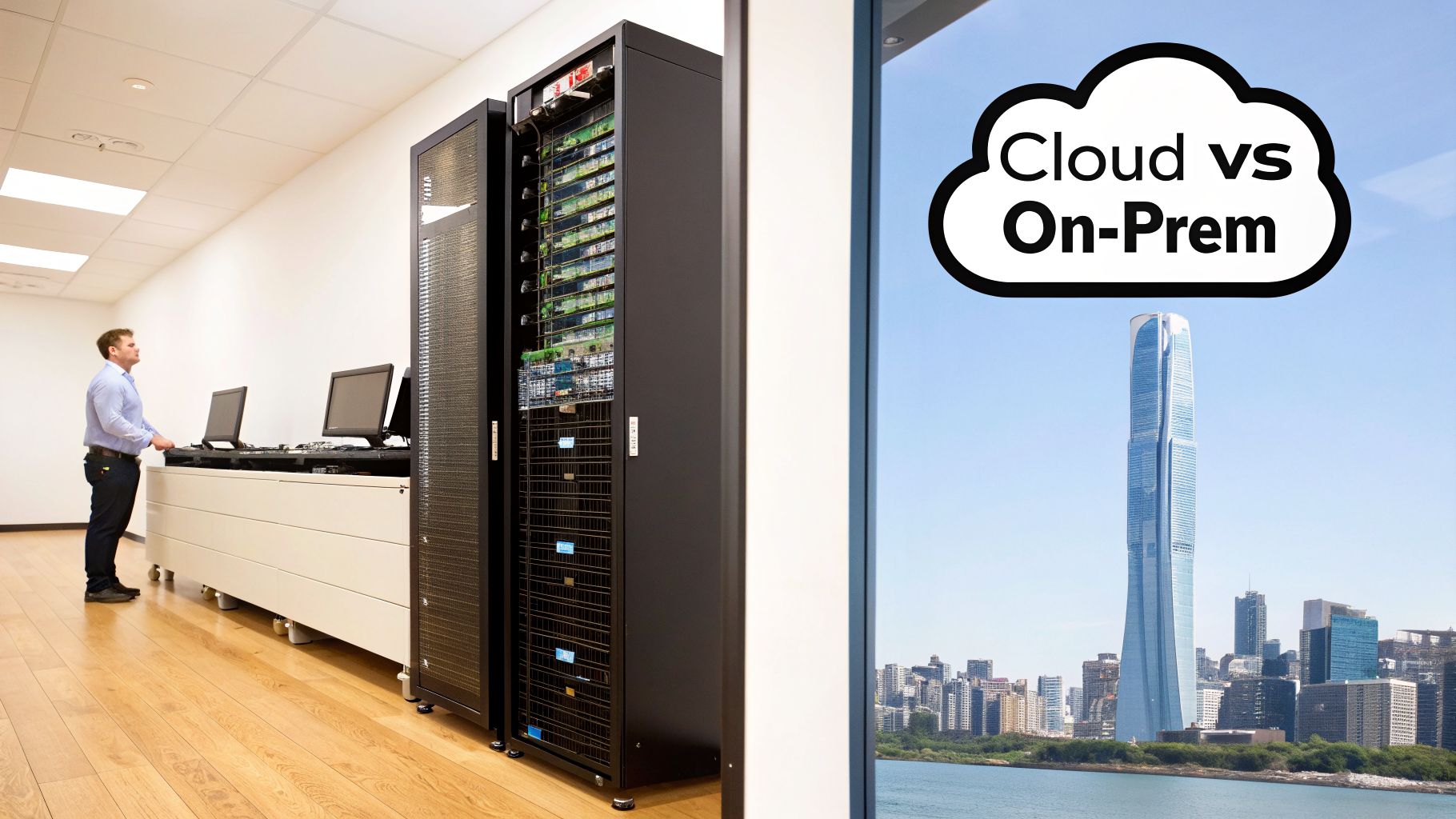
There’s no one-size-fits-all answer here. The right choice depends entirely on your company's operations, budget, and where you see your business going in the next few years.
The Case for On-Premise ERP
The traditional way is the on-premise model. You buy the software licences and install the system on servers you own, right there in your office. For many established businesses in the UAE and the wider GCC, this is still the go-to approach for some very good reasons.
- Total Data Control: If you handle highly sensitive information—think large-scale manufacturing, finance, or government contracts—keeping your data completely in-house is often non-negotiable. You have the final say on security, access, and data sovereignty.
- Deep Customisation: On-premise gives you the ultimate freedom to modify the software to match your unique and often complex workflows. This is a huge plus for specialised industries that have processes no standard software can handle out of the box.
- One-Time Investment: The upfront cost is significant, no doubt. But it's a one-time capital expense for the software licence. Many companies prefer this CAPEX model to avoid adding another recurring monthly bill.
Of course, this approach means you need a dedicated IT team to manage the servers, security, and all the maintenance that comes with it. It’s a commitment to owning your infrastructure.
The Rise of Cloud ERP
On the other hand, we have cloud ERP, also known as SaaS (Software-as-a-Service). This model is quickly becoming the default choice, especially for the small and medium-sized enterprises (SMEs) that power the UAE's economy. In fact, this shift is a major reason the market is projected to grow at an 8.38% CAGR through 2028. Since SMEs are the engine of the UAE's non-oil sector, their need for flexible, cost-effective solutions is driving this powerful trend. You can see more on the UAE ERP market drivers in this research.
The appeal of the cloud is easy to understand:
- Lower Upfront Cost: Instead of a huge capital investment, you pay a predictable subscription fee. This operational expense (OPEX) model puts powerful software within reach for businesses that don't have a massive IT budget.
- Scalability and Flexibility: A cloud ERP grows with you. Need to add more users or new features? It’s a simple process without the headache of upgrading server hardware.
- Remote Accessibility: This is a true game-changer. For businesses with teams spread across the GCC, or staff working from home, this is essential. Authorised users can log in securely from anywhere with an internet connection. To see what this means in practice, you can explore the benefits of how you can access your business anywhere with Hinawi Online.
Making the Strategic Choice with a Flexible Partner
The best ERP vendor doesn't force you into one model. Instead, they provide the flexibility to choose what aligns with your business strategy, security policies, and financial planning.
A partner like Hinawi ERP, which offers both on-premise and cloud options, puts the power back in your hands. You get to make the decision that works for your business.
Whether you're a large factory in Abu Dhabi that needs iron-clad control or a growing trading company in Dubai that needs agility, the choice is yours. This flexibility ensures your ERP software UAE investment doesn't just solve today's problems but is ready for whatever comes next.
A Practical Roadmap to Selecting and Implementing Your ERP
Let's be honest, the thought of switching your company's core software is a big deal. Choosing and launching a new ERP software UAE solution can feel overwhelming, but it doesn't have to be a headache. The trick is to have a clear roadmap.
Think of it less as a single, massive project and more as a series of manageable steps. By approaching it methodically, you can move from initial research to a successful launch with confidence. This isn't just about buying software; it's a strategic move to reshape how your business operates, and a structured approach is your best guarantee of success.
Phase 1: Conduct an Internal Needs Audit
Before you even think about looking at software vendors, you need to look in the mirror. What are the real, day-to-day problems you're trying to fix? Where are the frustrating bottlenecks that slow your team down? You have to get specific.
- Finance: Is your team drowning in spreadsheets just to handle VAT reporting and close the books each month?
- HR & Payroll: Are you constantly doing manual workarounds to stay compliant with the WPS? Is managing employee leave and benefits a mess of paperwork and emails?
- Operations: If you're in real estate, is tracking lease expiries a manual nightmare? For a contracting firm, is getting a grip on job costing and inventory almost impossible?
Write these pain points down. This list becomes your compass for evaluating every potential solution. You can't find the right answer until you've clearly defined the problem.
Want to see this process inside a real ERP? Explore how an integrated system handles these exact challenges.
Chat on WhatsApp +971506228024 Quotation – Demo Request Chat with Hinawi AIPhase 2: Evaluate Vendors and Demand a Personalised Demo
With your needs clearly defined, it’s time to start looking at potential partners. For any business in the UAE, local expertise is non-negotiable. A vendor with a team on the ground in Abu Dhabi or Dubai will have a deep understanding of regional compliance and business culture that a remote provider simply can't match.
A generic sales presentation is not enough. You must insist on a personalised demo where the vendor shows you exactly how their software solves your specific challenges, using your real-world scenarios.
Ask them to run a payroll cycle demonstrating full WPS compliance. Get them to show you how the real estate module handles post-dated cheques. This is the moment of truth where you separate genuine, tailored solutions from one-size-fits-all software.
Phase 3: Craft an Implementation Blueprint
Once you’ve chosen your vendor, the real work begins. The next crucial step is creating a detailed implementation plan, a blueprint co-developed by your team and the ERP provider. For a great example of what this entails, you can review a detailed work plan for starting new software.
A solid blueprint must cover these key areas:
- Data Migration: A clear, step-by-step process for safely moving your essential data from old systems into the new ERP.
- Team Training: A practical training schedule for all users, customised to what they actually do in their roles.
- Go-Live Strategy: A decision on whether you'll switch everything over at once (a "big bang") or roll it out department by department.
- Post-Implementation Support: An agreed-upon plan for ongoing help, system adjustments, and future training needs.
A well-thought-out plan is the difference between a chaotic launch and a smooth operational upgrade. It minimises disruption and empowers your team to hit the ground running from day one.
Take the Next Step with Hinawi ERP
Choosing the right ERP software in the UAE is a pivotal decision that will define your company's operational efficiency for years. It’s about moving beyond the limitations of manual processes and fragmented spreadsheets into a unified, intelligent platform. This transition enables you to gain superior control, reduce costly errors, and drive strategic growth.
This is precisely why Hinawi ERP was developed. Conceived in Abu Dhabi in 1998, it is a fully integrated system designed from the ground up to address the unique business challenges of companies in the UAE and GCC. Our mission is to connect and automate every facet of your operation, ensuring seamless information flow across all departments.
One System to Manage Your Entire Business
Hinawi ERP centralizes your entire business, offering a single source of truth for all operational and financial data. We support a wide range of industries with specialized modules tailored to their needs:
- Integrated Core Modules: Benefit from real-time integration across Accounting, HR & Payroll, CRM, and Fixed Assets.
- Industry-Specific Solutions: We offer specialized modules for Real Estate Management, Manufacturing, Garage & Maintenance, and School Management.
- Complete Business Automation: Streamline workflows, reduce manual work, and improve efficiency from lead management to financial reporting.
Built for the UAE, Trusted Across the GCC
Hinawi ERP is more than just software; it is a business solution that understands the local regulatory landscape and operational nuances of the GCC market.
- VAT and e-Invoicing Compliance: Stay ahead of FTA regulations with automated tax reporting and readiness for upcoming e-invoicing mandates.
- UAE WPS Payroll Support: Ensure full compliance with the Wages Protection System through automated SIF file generation and salary processing.
- Arabic and English Bilingual Operation: Empower your diverse workforce with a fully bilingual interface, allowing users to operate in their preferred language.
- Flexible Company Policy Settings: Configure gratuity, leave, and other internal policies to align perfectly with UAE Labour Law and your company standards.
- Real-time Accounting Integration: Every transaction, from a manufacturing work order to a real estate lease, instantly updates your general ledger, providing accurate, real-time financial visibility.
This powerful combination of deep integration and local expertise makes Hinawi ERP the ideal choice for factories, contracting companies, real estate businesses, schools, garages, trading companies, and manufacturers across the region. Discover more about our platform at the Hinawi Web ERP Online Business Management System.
It's time to modernize your operations, enhance financial accuracy, and gain the management control needed to scale your business. We invite you to speak with our Abu Dhabi-based consultants for a personalized demo and discover how Hinawi ERP can be configured to meet your unique operational needs.
Chat on WhatsApp +971506228024 Quotation – Demo Request Chat with Hinawi AIFrequently Asked Questions About ERP Software in the UAE
Thinking about an ERP for your UAE business? It’s a big decision, and it’s natural to have questions. Let's walk through some of the most common queries we hear from managers and owners trying to find the right fit.
How Long Does a Typical ERP Implementation Take?
Honestly, it really depends. There's no single answer because every business is unique. For a smaller company with clear-cut processes, we might see them up and running in just a few weeks.
On the other hand, a larger enterprise needing significant customisation and migrating years of data could be looking at a project spanning several months. The key is planning a realistic timeline based on your specific needs, not a generic one.
Is ERP Software Affordable for a Small Business in Dubai?
Yes, it absolutely is now. The days of needing a massive, one-time capital investment for an ERP are long gone. Modern, cloud-based systems like Hinawi ERP use a subscription model (SaaS). This makes it a much more manageable operating expense.
The smart way to look at it is through the lens of Return on Investment (ROI). Think about the money you'll save from increased efficiency, fewer costly errors, and the peace of mind that comes with guaranteed compliance. That's where the real value lies.
Can an ERP System Integrate With My Other Software?
It must. Any modern ERP worth considering should act as the central hub for your business, not an isolated island. A well-designed system will have robust integration capabilities.
For example, a solution like Hinawi ERP is built with APIs (Application Programming Interfaces) that allow it to connect and share data with your other essential tools. This creates a seamless flow of information across your entire operation, preventing data silos and manual double-entry.
What Kind of Support Can I Expect After Purchase?
This is a make-or-break question, and one you should ask every vendor. You absolutely want to prioritise a provider with a real, on-the-ground support team right here in the UAE.
Having access to local consultants who genuinely understand the region's business culture is invaluable. When you have a problem, getting help from someone who speaks both Arabic and English and can even visit your office is far more effective than being stuck with a remote international call centre.