
Category: Real Estate
If you're running a construction company in Dubai, Abu Dhabi, or anywhere in the UAE, you probably already know the problem. Your project team is chasing site updates on WhatsApp, procurement is buried in email approvals, costing sits in Excel, payroll is handled in a separate system, and finance only gets a partial picture after the damage is done.
That setup works when you're small. It fails when you scale.
Construction is unforgiving. Margin disappears through procurement delays, weak subcontractor controls, inaccurate BOQ handling, slow billing, payroll mistakes, and compliance gaps. In the UAE, those risks are amplified by VAT at 5%, WPS payroll requirements, and the coming shift to mandatory e-invoicing in 2027. ERP for construction companies UAE isn't an IT upgrade. It's an operating model decision.
Boards that still treat ERP as a back-office software purchase are making the wrong call. The right view is clearer. You need one system that connects project costing, procurement, inventory, payroll, fixed assets, subcontractor management, and finance in real time. If it doesn't do that, it won't give you control.
That's why local fit matters. A generic global ERP may look polished in a demo, but if it struggles with Arabic workflows, WPS, VAT treatment on progress billing, retention handling, or project-based procurement, it becomes expensive friction. UAE construction firms need systems designed around local compliance and field reality. That's where solutions such as Hinawi ERP become relevant in practical evaluations, especially for companies that want integrated accounting, payroll, and operational control in one environment.
Current State of Managing UAE Construction Projects in 2026
A project manager at a growing contractor in Dubai starts the day with four versions of the same truth.
The site engineer has one version in a spreadsheet. Procurement has another in email threads. Finance has a delayed version in accounting. HR has attendance data that may or may not match the labor deployed on site.

That isn't a software problem. It's a management control problem.
What boards usually miss
Most construction firms don't lose control in one dramatic event. They lose it gradually.
- Costs drift: Material usage isn't reconciled quickly enough against BOQ and budget.
- Approvals slow the job: Purchase requests sit with the wrong manager while site teams wait.
- Payroll risk builds up: Attendance, overtime, and labour allocation don't align cleanly with payroll processing.
- Finance works backwards: Accountants produce reports after transactions happen, not while decisions are being made.
This is why many firms feel busy but not in control.
Generic reporting doesn't fix poor operational data. Integrated process control does.
The UAE market is moving in one direction. The UAE ERP software market is valued at approximately USD 2.1 billion and is projected to reach USD 3.45 billion by 2028, with over 60% of companies planning ERP adoption to improve productivity and manage compliance including 5% VAT and 2027 e-invoicing according to Ken Research's UAE ERP software market analysis.
Why old tools break under UAE construction pressure
Construction companies in the UAE don't just manage projects. They manage variations, subcontractors, plant, labour, staged billing, retention, cash flow pressure, and regulator scrutiny.
If budgeting is still disconnected from execution, forecasting becomes cosmetic. A board pack may look organised while the site position is deteriorating. That's why firms need live cost visibility tied to operational activity, not just accounting entries. For companies reviewing how planning should connect to execution, this is the practical logic behind proper budgeting and forecasting workflows.
The right ERP does three things immediately:
- It creates a single source of financial and operational truth.
- It reduces manual handoffs between departments.
- It makes compliance part of the workflow instead of a clean-up exercise.
That is the difference between a contractor that reacts and one that controls.
Chat on WhatsApp +971506228024 Quotation – Demo Request
The Foundation of Control Core ERP Modules for UAE Construction
Not every ERP module matters equally.
For a UAE contractor, some modules are optional enhancements. Others are essential. If your shortlist doesn't cover these properly, stop the evaluation.
The modules that matter
The first priority is project costing. If the system can't show budget, commitment, actual cost, and variance by project package, you won't manage margin. You'll only report on lost margin later.
The second is BOQ and estimation control. BOQ mistakes don't stay in estimating. They flow into procurement, billing, cash flow, and project claims. If your BOQ process is weak, your entire project lifecycle is weak.
The third is procurement and inventory integration. In construction, purchasing speed matters, but control matters more. A fast but disconnected buying process creates waste and duplicate orders. An integrated process creates accountability.
According to DoFort's construction ERP overview, integrated ERP modules address project cost overruns that average 20-30% in the sector, while systems that automate material requisitions can reduce procurement delays by up to 40% and cut material costs by 10-20% through more optimised purchasing.
Essential ERP Modules for UAE Construction Firms
| Module | Primary Function | Key Problem Solved in UAE Context |
|---|---|---|
| Project Costing | Tracks budget, actuals, commitments, and variances by project and cost head | Prevents late visibility into cost overruns |
| BOQ Management | Controls estimated quantities, rates, revisions, and cost links | Reduces estimation errors that damage margin |
| Subcontract Management | Handles subcontract agreements, billing, retention, and payment certificates | Improves control over subcontract-heavy projects |
| Procurement | Manages RFQs, approvals, POs, receipts, and supplier invoices | Cuts approval delays and weak purchasing discipline |
| Inventory and Stores | Tracks stock, issues, transfers, and site consumption | Reduces stock shortages and over-ordering |
| WIP and Billing | Manages progress billing, work-in-progress, and revenue recognition | Supports cleaner project financial reporting |
| Fixed Assets and Plant | Tracks equipment use, maintenance, and depreciation | Improves plant control and asset accountability |
| HR and Payroll | Connects attendance, labour allocation, overtime, and payroll | Supports labour-intensive site operations |
What to demand in each module
Don't accept vague promises like "fully customisable" or "supports projects." Ask hard questions.
- For project costing: Can you track committed cost before the invoice arrives?
- For BOQ: Can estimators revise quantities while finance still maintains auditability?
- For subcontracts: Can the system handle retention and staged valuation cleanly?
- For procurement: Can site requests follow approval hierarchy without losing speed?
- For payroll: Does labour time flow into payroll without manual re-entry?
A contractor doesn't need pretty dashboards first. It needs transactional discipline.
Practical rule: If a vendor shows reports before showing transaction flow, you're probably looking at presentation software, not operational control software.
The payroll link most firms undervalue
Construction businesses often isolate payroll from project operations. That's a mistake.
Labour cost is one of the largest moving parts in a contractor's margin. If attendance, overtime, and site allocation don't connect to payroll and costing, your project P&L is partly fictional. If you're reviewing this area in detail, this is why understanding how payroll should work inside an ERP environment matters for contracting firms.
One practical example in this category is Hinawi ERP. It includes contracting, accounting, inventory, HR, payroll, and fixed assets in one connected environment, which is the structure essential for a UAE contractor aiming for control rather than fragmented automation.
Prioritise by business model
A civil contractor, MEP firm, fit-out company, and developer-contractor hybrid won't weigh these modules the same way.
- Civil and infrastructure firms: Prioritise plant, subcontracts, and material control.
- MEP contractors: Focus heavily on BOQ revisions, procurement, and project billing.
- Fit-out businesses: Demand fast quotation, variation tracking, and margin visibility.
- Developer-linked contractors: Need stronger integration between project, contract, and finance data.
The key is simple. Buy for how your business runs, not for how a vendor categorises modules.
Chat on WhatsApp +971506228024 Quotation – Demo Request
Navigating UAE Compliance VAT WPS and E-invoicing
Most ERP buying mistakes in construction happen because leadership treats compliance as a finance issue.
It isn't. In the UAE, compliance is an operational issue first. Finance carries the final liability.
VAT in construction is a workflow issue
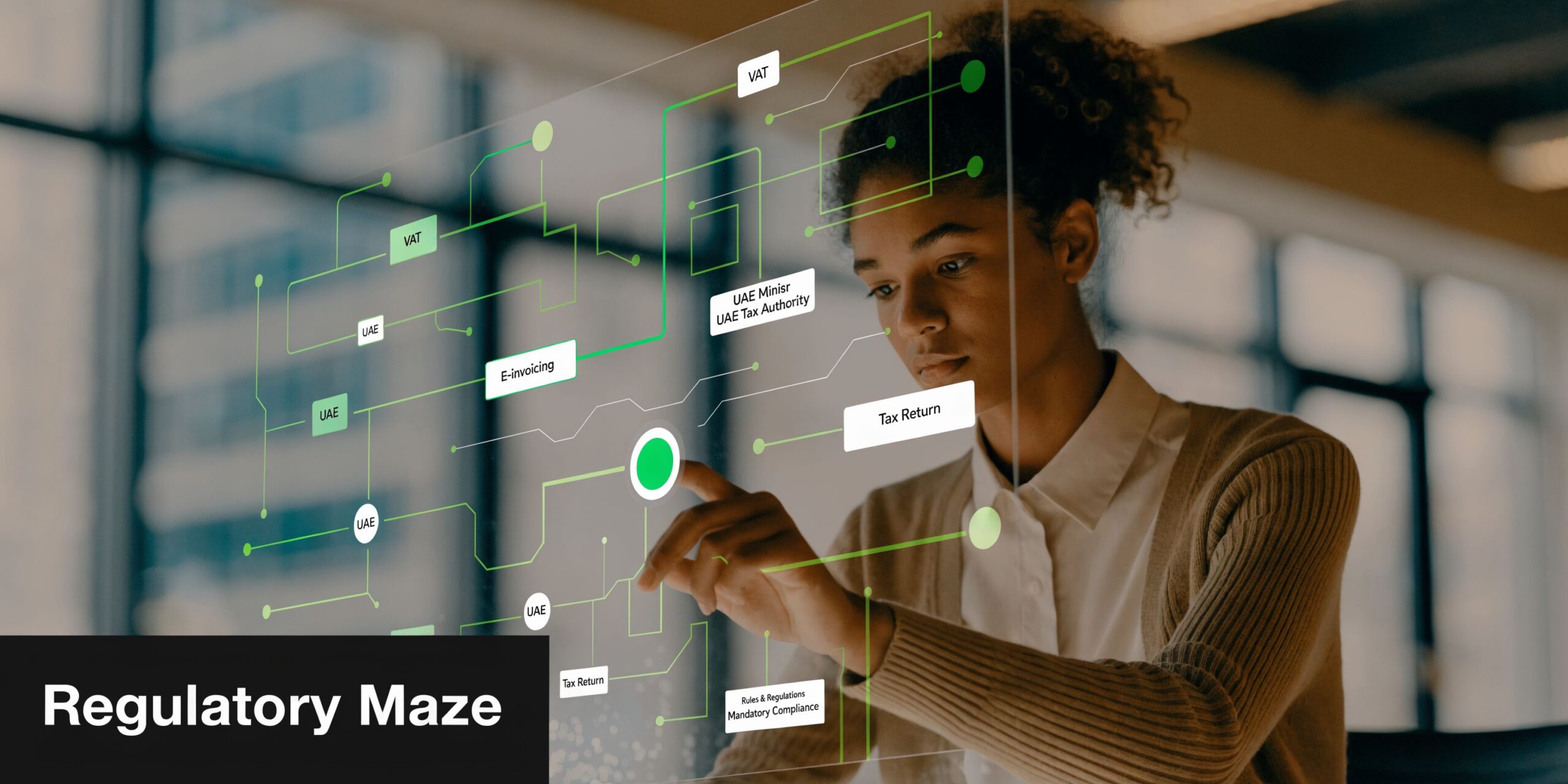
Construction companies don't deal with simple retail transactions. They handle staged invoices, project retention, advance payments, subcontractor bills, material purchases, variations, and cross-functional approvals.
If VAT logic sits outside the main process, errors are inevitable. Teams then try to fix them at month-end, which is exactly when problems become expensive.
UAE boards should insist on these controls:
- Tax treatment inside transactions: VAT shouldn't be manually adjusted after the fact.
- Audit trail: Every procurement, billing, and accounting event should leave a clear trace.
- Project-level visibility: Finance should be able to see tax impact in the same environment as project activity.
- Bilingual usability: If the people entering and approving data can't work comfortably in the system, compliance quality drops.
For businesses reviewing the tax side in more depth, this local context is why many finance teams prioritise systems built around new tax requirements in the UAE.
WPS is where weak ERP setups get exposed
Payroll errors in construction don't stay inside HR.
They trigger labour complaints, management escalation, operational disruption, and regulatory risk. This is especially serious in the UAE because the construction sector relies heavily on expatriate labour. WPS exposes weak ERP setups, which is critical given the sector's 90% expatriate workforce and non-compliance fines of up to AED 100,000 per violation, as noted by In4Velocity's discussion of construction ERP in the UAE.
That fact should change how boards evaluate ERP.
A compliant construction ERP must support more than salary calculation. It should connect:
- Attendance capture
- Overtime control
- Employee records
- Payroll processing
- WPS output
- Visa and document monitoring
A payroll module that isn't tied to workforce operations is an accounting convenience, not a compliance control.
The visa renewal blind spot
Many construction firms still manage visa expiry and employee document tracking outside the ERP. That's poor governance.
If labour availability depends on timely renewals, the ERP should help operations and HR see upcoming issues before they become site disruptions. This isn't a luxury feature for large groups only. Mid-sized contractors feel the impact faster because fewer people are handling more responsibilities.
E-invoicing is approaching fast
Mandatory e-invoicing scheduled for 2027 changes the conversation. The challenge isn't just generating compliant invoices. The key challenge is structured transaction data.
If your current systems are fragmented, you won't fix this by adding a small invoicing tool later. You need master data, tax logic, supplier information, customer billing structures, and approval history aligned in one system.
That's why ERP for construction companies UAE should be assessed against future reporting readiness, not just current invoicing output. The firms that prepare early will migrate more cleanly. The firms that wait will rush integration and expose weak data foundations.
Future-Proofing Your Operations Deployment Customization and Integration
The next wrong decision after buying the wrong ERP is deploying the right ERP in the wrong way.
Construction companies in the UAE need to decide early how the system will be accessed, extended, and connected. That means deployment model, integration architecture, and customization boundaries.
Cloud versus on-premise
There isn't one universal answer.
Cloud deployment suits companies that want easier remote access across sites, simpler updates, and lower infrastructure burden. That's attractive if your teams move constantly between head office, site offices, and multiple project locations across the UAE or GCC.
On-premise still appeals to companies that want tighter internal control over hosting and prefer heavier custom process handling inside their own environment. Some boards also feel more comfortable when core systems sit under direct infrastructure ownership.
Choose based on operating reality, not fashion.
- Choose cloud if: Your teams need strong mobility, multi-site access, and faster rollout.
- Choose on-premise if: Your workflows are highly customized and your internal IT governance is strict.
- Choose either only if: The vendor can support long-term construction process complexity.
Integration is not optional
A contractor's ERP rarely lives alone.
It may need to connect with CRM, document workflows, estimating tools, time capture systems, supplier interactions, or external reporting processes. If the system doesn't integrate well, teams go back to spreadsheets and shadow systems. That defeats the entire investment.
Supply chain integration deserves special attention because procurement delays and poor stock visibility hurt project delivery early. A more connected supply chain management ERP approach becomes operationally important, especially for firms managing multiple sites and store locations.
Customize where it matters
Many international ERP products fail in UAE construction because they expect the business to adapt to the software too aggressively.
That rarely works in contracting. Approval layers, bilingual documentation, retention treatment, project billing logic, and HR compliance processes often need local customization. The answer isn't unlimited customization. The answer is selective customization around business-critical workflows.
Use this filter:
- Standardise commodity processes such as basic accounting controls.
- Customize local processes that directly affect compliance or project execution.
- Avoid cosmetic changes that only recreate old habits.
Chat on WhatsApp +971506228024 Quotation – Demo Request
Keep an eye on predictive controls
The next step in construction ERP isn't another dashboard. It's predictive intervention.
According to Onsite Teams' review of UAE construction ERP trends, AI modules are being piloted in 2025-2026 to forecast delays and flag budget variances greater than 10% in real time, targeting the 15% project cost overruns from subcontractor disputes seen in 2025.
That matters because subcontractor-heavy projects generate noisy data. Manual review catches issues late. Predictive logic can surface abnormal billing patterns, delay signals, and variance risk earlier.
You don't need to buy every advanced tool today. But you do need an ERP architecture that won't block those capabilities tomorrow.
Your Blueprint for a Successful ERP Implementation
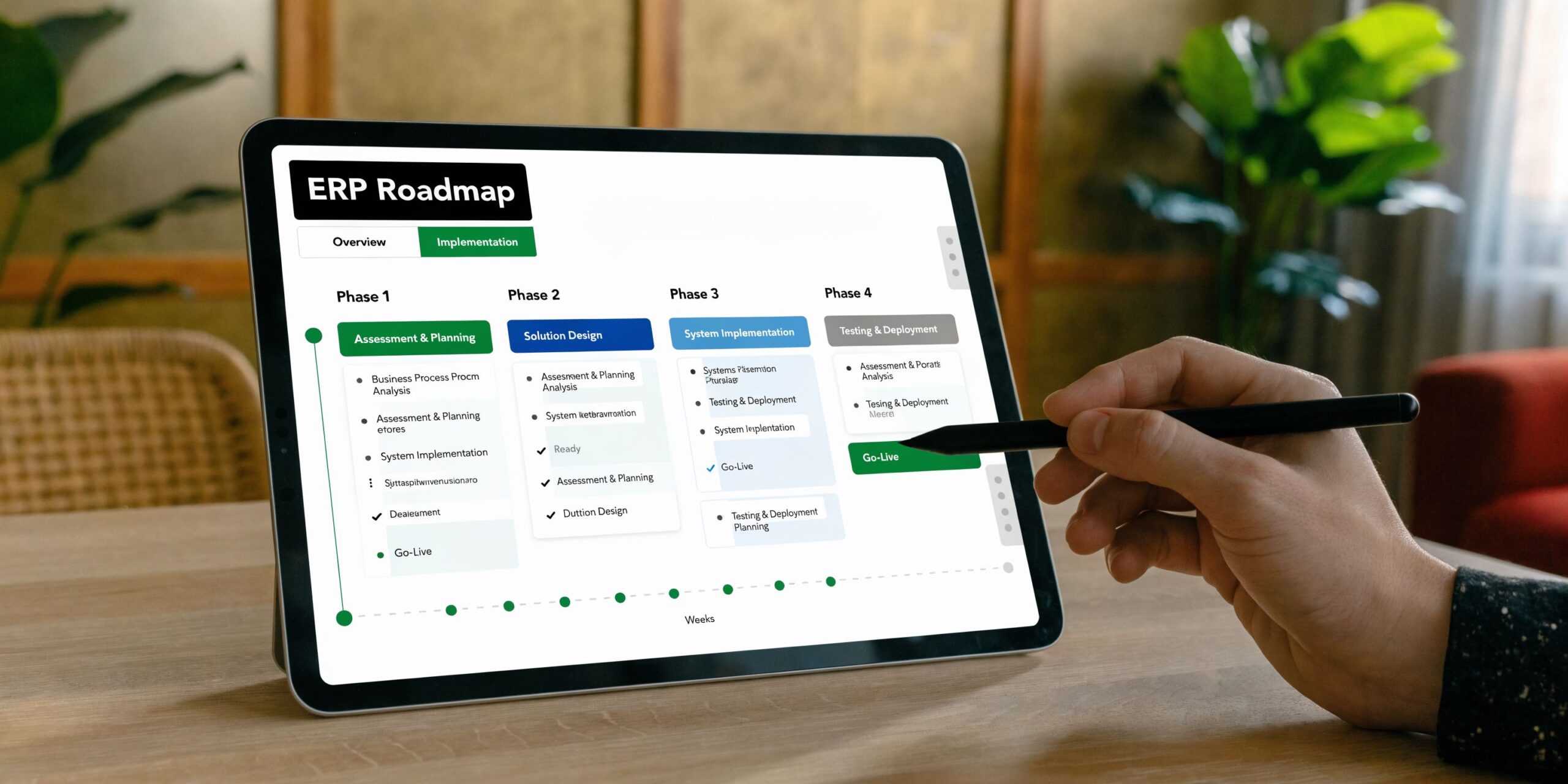
ERP projects fail when companies treat implementation as a software installation.
It isn't. It's a controlled business change programme with system, data, process, and people all moving together.
Phase one starts with business discipline
Before configuration begins, leadership needs to define what success means.
Not "go live by a certain month." Clear objectives. Faster month-end close. Better project cost visibility. Cleaner subcontractor billing. WPS-ready payroll. Fewer manual reconciliations. Without that clarity, the project turns into a generic software exercise.
Common failure point: senior management delegates the ERP decision and then disappears. That creates endless internal debate and slow approvals.
Data migration is where bad history reappears
Old masters, duplicate suppliers, inconsistent item names, incomplete employee records, and broken project coding all surface during migration.
This phase needs firm decisions. Clean what should be cleaned. Archive what shouldn't move. Standardise codes before loading data into the new system.
A practical checklist helps:
- Customers and suppliers: Remove duplicates and inactive records.
- Items and materials: Standardise descriptions and unit structures.
- Projects: Align cost codes and project hierarchies.
- Employees: Validate IDs, payroll fields, and document dates.
- Financial opening balances: Reconcile before import, not after.
Clean data isn't an IT luxury. It's the base layer of reliable reporting.
Configuration, testing, and user ownership
Many companies rush at this stage. They shouldn't.
System configuration should reflect actual approval paths, cost centres, project structures, payroll rules, and reporting requirements. Then comes user acceptance testing. Not vendor testing. User testing with real scenarios.
For a construction company, that means testing flows like:
- site purchase request to supplier invoice
- subcontractor valuation to payment
- attendance to payroll
- material issue to project cost
- progress billing to accounting entry
If users don't test their real work, they'll reject the system after go-live.
Training and go-live need operational realism
Training should be role-based.
Project engineers don't need the same training as finance controllers. Storekeepers don't need the same workflow depth as payroll officers. Give each team what they need to perform confidently from day one.
Then go live in a controlled way. Some firms prefer phased rollout. Others go broader. Both can work if accountability is clear and support is visible on the ground during the first weeks.
Post-go-live is where value either compounds or stalls
Don't close the project too early.
After launch, management should review exceptions, user friction, reporting gaps, and process bottlenecks. That's when the ERP starts becoming part of how the company runs, rather than a new piece of software staff tolerate.
The companies that get strong results don't just implement. They govern the system after implementation.
Measuring What Matters KPIs ROI and Common Pitfalls
Boards shouldn't ask whether the ERP went live successfully.
They should ask whether the business got more controlled, faster, and safer.
Measure outcomes, not software activity
The right KPI set should connect directly to margin, speed, and compliance quality.
Track indicators such as:
- Project cost variance control: Are overruns identified earlier?
- Procurement cycle time: Are approvals moving faster with fewer bottlenecks?
- Quotation turnaround: Is estimating producing output faster and more consistently?
- Financial reporting speed: Can management trust current numbers sooner?
- Payroll and compliance exceptions: Are fewer issues requiring manual correction?
- Subcontractor billing accuracy: Are payment disputes becoming easier to resolve?
For finance teams building margin visibility, a disciplined understanding of gross margin analysis helps anchor ERP reporting to business performance rather than broad revenue numbers alone.
The ROI discussion should be blunt
A construction ERP doesn't need to justify itself with abstract digital transformation language.
It should justify itself through reduced waste, fewer delays, stronger billing discipline, cleaner payroll processing, tighter compliance, and better decision timing. Those are not soft benefits in construction. They directly affect cash and margin.
According to Factserp's construction contracting ERP page, the right ERP can reduce quoting time by 70%, integrated site progress tracking can help prevent delays that typically cost 10-15% of project budgets, and ERP adoption has been shown to cut project delivery timelines by up to 24%.
Those are meaningful outcomes because they hit estimating speed, execution quality, and project duration. All three matter to board-level ROI.
If your ERP only changes reporting, ROI will be modest. If it changes how projects are bought, staffed, billed, and controlled, ROI becomes strategic.
Common pitfalls that still derail good projects
Some mistakes are predictable.
Over-customising too early is one. Companies recreate every historical habit inside the new system, then blame the ERP for complexity.
Weak training is another. Management assumes users will adapt on their own. They won't. In construction, pressured teams always default to familiar workarounds.
A third is measuring adoption instead of control. Logging in isn't value. Using the ERP to prevent bad decisions is value.
Chat on WhatsApp +971506228024 Quotation – Demo Request
The practical test is simple. Six months after go-live, can the board see project risk sooner, trust payroll and finance more, and run fewer critical processes outside the ERP? If the answer is yes, the investment is working.
Take the Next Step with Hinawi ERP
If your construction company still depends on spreadsheets, disconnected approvals, manual payroll coordination, and delayed project reporting, you don't have a software gap. You have a control gap.
That gap gets expensive in the UAE.
VAT treatment has to be right. E-invoicing readiness can't be delayed. WPS payroll must be accurate and timely. Project costing needs to reflect what is happening on site, not what finance discovers later. Subcontractor management, inventory, fixed assets, HR, payroll, and accounting must work together.
Hinawi ERP is built for that kind of environment.
Developed in Abu Dhabi since 1998, Hinawi ERP gives UAE and GCC companies a fully integrated business management platform covering Accounting, HR & Payroll, Real Estate Management, Fixed Assets, Manufacturing, Garage & Maintenance, School Management, CRM, and complete business automation. For contracting and construction businesses, that means one connected system instead of fragmented tools.
The practical advantages are clear:
- VAT and e-Invoicing compliance: Support the reporting and transaction controls UAE businesses need.
- UAE WPS payroll support: Connect payroll operations with compliant salary processing.
- Arabic and English bilingual operation: Improve adoption across mixed teams.
- Flexible company policy settings: Match approval structures and internal rules to how your business runs.
- Real-time accounting integration across all modules: Keep project, payroll, procurement, inventory, and finance aligned.
- Broad business fit across the UAE and GCC: Suitable for factories, contracting companies, real estate businesses, schools, garages, trading companies, and manufacturers.
If you're serious about modernising operations, reducing manual work, improving financial accuracy, and gaining better management control, this is the point to act.
Visit www.hinawierp.com or request a personalised demo. A serious ERP decision should be based on your workflows, your reporting needs, your compliance exposure, and your growth plans. Speak with the Hinawi ERP team and evaluate the process properly.
Chat on WhatsApp +971506228024 Quotation – Demo Request
A CTA for Explorer Computer LLC – Hinawi Software ERP.