Category: Fixed Assets
You're probably dealing with this already. A maintenance request comes in by WhatsApp. A technician logs the issue on paper or in Excel. Finance doesn't see the actual repair cost until days later. Asset records sit in one file, depreciation sits in another system, and payroll for the maintenance team is handled somewhere else entirely.
That setup works until it doesn't. In a UAE property company, factory, school, workshop, or multi-branch business, disconnected facility management creates avoidable cost. It delays repairs, weakens financial visibility, and makes compliance harder than it should be. The actual problem usually isn't maintenance itself. It's fragmented operational data.
Computer-aided facility management software fixes that when it becomes the operational control layer for buildings, equipment, work orders, and space usage. But I'll be direct. Standalone CAFM is not enough for most UAE and GCC businesses. If your CAFM system doesn't connect properly with accounting, fixed assets, payroll, stock, contracts, and VAT workflows, you've only created a better silo.
That's why regional companies should think about CAFM together with ERP from the start. A connected setup gives management one version of the truth. The facilities team sees asset condition. Finance sees cost. HR sees labour time. Management sees return on assets. That's where the operational and financial value appears.
If you want a practical example of what an integrated business platform looks like, review Hinawi Web ERP online business management system in the context of your own facility workflows, not as a separate software purchase.
Introduction Streamlining Facility Management in the UAE
A company owner in Abu Dhabi with a commercial building portfolio usually sees the symptoms before seeing the cause. Complaints about air conditioning increase. Tenants chase updates. The facilities supervisor says spare parts were ordered. Accounts says the invoice hasn't been coded correctly. Nobody can answer a simple question quickly: what is this asset costing us, and is it worth repairing again?
In manufacturing, the same pattern shows up differently. A machine stops, production slows, and maintenance reacts. The cost doesn't stop at the technician visit. It reaches labour disruption, delayed output, emergency purchasing, and confused reporting at month end. If the fixed asset register isn't aligned with maintenance history, management is making capital decisions with partial information.
Computer-aided facility management software earns its place. It gives you a live operating record of your buildings, equipment, spaces, service requests, and maintenance activities. It replaces scattered files and informal communication with structured workflows.
Practical rule: If your team still needs three phone calls and two spreadsheets to understand one maintenance issue, your facility operation is under-digitised.
The market direction supports that shift. The global CAFM market is projected to reach USD 1.86 billion by 2030, driven by demand for centralised solutions, sustainability goals, and technologies such as IoT integration, according to Research and Markets' CAFM market outlook.
For UAE and GCC businesses, that matters because your buildings and equipment are not side issues. They sit at the centre of cost control, tenant satisfaction, compliance, and service quality. The right move is to treat facility management as part of core business operations, not as an isolated technical department.
Defining CAFM and Its Core Capabilities
Most owners don't need another software definition. They need clarity. Computer-aided facility management software is the system that organises how you manage buildings, equipment, maintenance work, and usable space from one operational platform.
Think of it as the digital record and workflow engine for your physical assets. Instead of asking different people for updates, you open one system and check asset status, job progress, maintenance history, occupancy data, and service records.
A wider review of available business functions also helps when assessing fit with finance and operations. You can compare CAFM-related needs against software modules in Hinawi software to see how facility processes should connect with the rest of the business.
Space and move control
In real estate and corporate offices, CAFM tracks floor plans, room allocations, occupancy, movement requests, and workspace changes. That matters when your business is carrying underused space, handling frequent tenant or staff moves, or managing multiple branches.
Instead of relying on old drawings and manual notes, teams can work from current layouts and approved allocation records. That improves planning and reduces arguments about what is currently available.
Asset visibility and lifecycle tracking
Many UAE businesses, despite owning equipment, fail to maintain a reliable operational record for each item.
A solid CAFM setup should let you track:
- Asset identity: Equipment type, serial reference, location, and service category.
- Service history: Inspections, repairs, recurring faults, and technician actions.
- Operational context: Which building, floor, unit, or production area the asset supports.
- Replacement logic: Whether the item is still serviceable or becoming a repeated cost problem.
Maintenance management that people will actually use
The most practical CAFM value comes from work order control. A request enters the system. It's assigned. Progress is tracked. Completion is recorded. Documentation stays attached to the job.
That sounds basic, but it changes discipline across the operation. Teams stop depending on memory, informal chats, and scattered approvals.
Good CAFM doesn't make maintenance complicated. It makes maintenance visible.
Real estate and lease support
For landlords, property managers, and mixed-use operators, CAFM can also support lease-related facility processes. It helps track service obligations, tenant requests, common area maintenance activities, and location-linked records.
Facility operations and property income are linked. If tenant-facing maintenance is disorganised, occupancy quality suffers even when finance reports still look acceptable.
The Business Case ROI in Asset-Intensive Organizations
Owners shouldn't buy computer-aided facility management software because it looks modern. They should buy it because poor maintenance control is expensive.
In asset-intensive businesses, reactive work undermines budgets. You pay for emergency call-outs, unscheduled shutdowns, repeated part replacement, technician inefficiency, and management blind spots. Then finance closes the month and sees a maintenance number, but not the operational reasons behind it.
The strongest financial case for CAFM sits in predictive and controlled maintenance. Infraspeak's review of CAFM integration states that integrating CAFM enables predictive maintenance for fixed assets, which can reduce equipment downtime by 25 to 30 percent and cut overall maintenance costs by up to 30 percent. That's not a cosmetic gain. That changes budgeting, service continuity, and asset life decisions.
If you're evaluating this through a finance lens, also look at how facility records should connect with fixed assets management workflows, because maintenance value only becomes visible when it links to financial asset treatment.
Where the return actually comes from
The return is usually generated in four places, not one:
- Less downtime: Critical assets stay available longer and fail less often.
- Lower repair cost: Emergency jobs reduce when maintenance is planned and tracked.
- Better asset decisions: Management can compare repeated repair cost against replacement timing.
- Cleaner compliance: Records are easier to produce during audit, review, and internal control checks.
A realistic UAE operating view
A property company managing chilled water systems, lifts, pumps, and HVAC units doesn't just need maintenance completion. It needs cost traceability by building and asset. A factory needs the same discipline by machine line and production area. A school needs it by campus and safety-critical equipment.
Without that structure, every maintenance invoice becomes a historical document rather than a management tool.
Owner's view: If an asset keeps failing and your system can't show total repair history fast, you're not managing the asset. You're funding its decline.
The right CAFM setup turns maintenance from a reactive expense into a controlled operating function. That's exactly how owners should judge ROI.
Unlocking Full Potential Integrating CAFM with Hinawi ERP
Most CAFM projects underperform for one reason. The software manages the job, but not the business impact of the job.
A work order is raised. Fine. A technician attends. Fine. But where is the cost posted? Was stock consumed? Was labour captured? Did the repair affect asset value decisions? Did procurement issue the right purchase? Did payroll recognise technician time correctly? If the answer depends on retyping data into another system, your process is still manual.
That's why integration matters more than features. A NexGen Asset Management article discussing CAFM interoperability cites a 2025 Deloitte GCC Facilities Report stating that 68 percent of UAE facility managers identify ERP-CAFM interoperability as a top challenge, and that this silo can lead to 15 to 20 percent higher compliance costs.
For businesses planning proper systems architecture, this is the right place to assess third-party integration options before selecting any CAFM workflow.
What integrated data flow should look like
A serious UAE business should expect these links between CAFM and ERP:
| Process area | What CAFM handles | What ERP should handle |
|---|---|---|
| Asset operations | Location, service history, breakdown records | Depreciation, asset value, accounting treatment |
| Work orders | Requests, assignments, task status, completion | Cost posting, purchase control, supplier accounting |
| Labour usage | Technician time and job activity | Payroll linkage, cost allocation, compliance reporting |
| Materials | Parts required for repairs | Inventory movement, valuation, replenishment |
| Tenant or branch service | Service ticket by unit, property, or site | Billing, VAT treatment, financial reporting |
Why this matters in the GCC
Regional businesses don't run on maintenance data alone. They run on operational accountability. If a technician spends a day at a site, that should connect to labour cost. If a spare part is issued, stock and accounts should reflect it. If a repair supports a leased property, management should see the cost against that revenue-producing asset.
Hinawi ERP is a practical example of the right regional approach. The useful point isn't branding. The useful point is architecture. In the UAE and GCC, businesses need CAFM tied directly to accounting, fixed assets, payroll, inventory, and contract workflows. Otherwise, management gets activity reports without financial control.
Regional Considerations for CAFM in the UAE and GCC
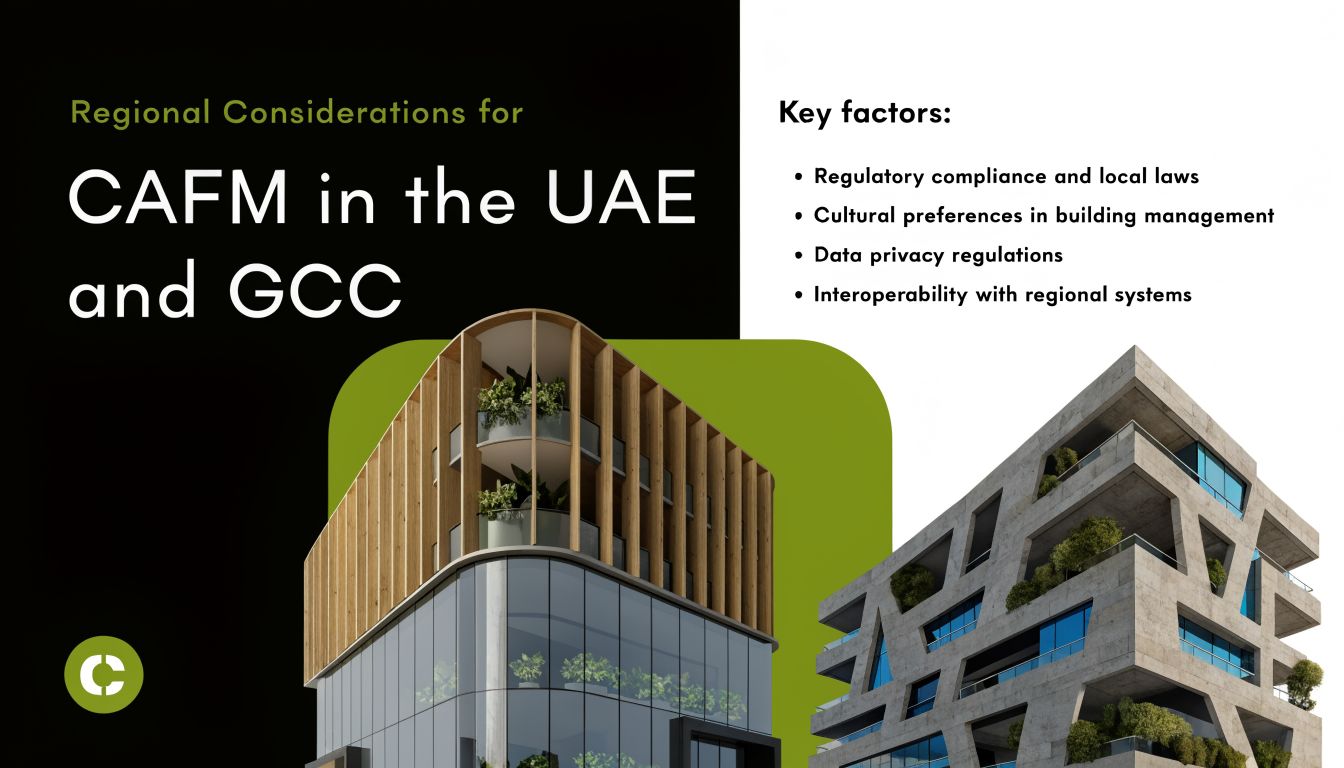
Global CAFM vendors often look strong in a demo and weak in daily GCC operations. The reason is simple. Regional requirements aren't cosmetic extras. They shape whether the system gets used properly.
The first issue is language. A bilingual workforce needs a bilingual system. If supervisors work in English, finance reviews in English, and site teams need Arabic screens or documents, poor localisation slows adoption and creates mistakes. That problem is bigger than convenience.
A Maintenance World article referencing a 2025 PwC Middle East survey states that 72 percent of UAE SMEs avoid CAFM due to high implementation costs and a lack of Arabic UI. That's a direct warning to decision-makers. If the system doesn't fit your workforce, staff will bypass it.
The regional checklist most foreign vendors miss
In the UAE and GCC, your CAFM environment should support or align with:
- Arabic and English operation: Screens, reports, and user workflows must match your workforce.
- VAT and e-invoicing readiness: Maintenance billing and service-related financial records must connect cleanly to tax workflows.
- WPS-aware payroll flow: If internal technicians and service teams are involved, labour records should fit payroll operations.
- Multi-branch logic: Properties, warehouses, schools, workshops, and plants often run across separate legal entities or sites.
- Local support: Configuration, training, and change requests need local understanding, not only offshore ticketing.
Why cloud matters more for SMEs
Many SMEs in the UAE don't need enterprise-scale complexity. They need control without technical burden. Cloud-enabled deployment usually suits that requirement better when support, access, and branch visibility matter more than internal server ownership.
That's also why ERP connection matters at the selection stage. If you're in real estate, review how service and maintenance workflows affect tenancy and billing logic. A practical starting point is to consider tenancy contract calculations as part of your wider systems fit, not as a separate admin topic.
A UAE facility system that ignores language, payroll reality, and tax process isn't regionally ready. It's just imported software.
A Practical Checklist for CAFM Selection and Implementation
Don't start with vendor presentations. Start with operational questions. Most failed software purchases happen because the company buys what looks complete, not what fits actual workflow.
A disciplined selection process is much simpler than people think. Ask hard questions early and reject weak answers quickly.
Questions to ask before you shortlist anyone
Can the CAFM system integrate with accounting, fixed assets, inventory, and payroll?
If not, stop there. You don't need another island of data.Will it work for multiple branches, properties, sites, or companies?
Many UAE businesses outgrow basic tools because they manage diverse operations.Is Arabic and English operation built in properly?
Don't accept partial translation as localisation.Can the workflows match your company policy?
Approval chains, service levels, labour capture, vendor control, and reporting should fit the business.Does the vendor understand UAE compliance and operational practice?
That includes VAT, e-invoicing, payroll realities, and documentation expectations.
What to prepare internally
Implementation goes wrong when the business expects software to fix unclear processes. Clean up ownership first.
Use this internal checklist:
- Define asset scope: Decide which buildings, equipment, vehicles, rooms, or production assets will be managed.
- Standardise naming: Asset codes, locations, fault categories, and service types must be consistent.
- Assign decision owners: Someone must own approvals, master data, vendor setup, and reporting.
- Set reporting priorities: Decide what management wants to see weekly and monthly.
- Train by role: A technician, accountant, property manager, and owner should not all get the same training.
The implementation mistake to avoid
Don't digitise bad habits. If your current process depends on informal approvals, undocumented site work, or after-the-fact invoice coding, software will expose the weakness but won't solve it automatically.
The better approach is phased control. Start with core assets, standard work orders, service response rules, and cost posting logic. Expand after your team is using the basics properly.
Measuring Success Practical CAFM KPIs for Your Business
If you can't measure outcomes, your CAFM rollout becomes another software story with no management discipline behind it. The right KPIs should connect facility activity to service reliability, asset control, and financial effect.
For UAE property and multi-tenant operations, space management is one of the clearest examples. FMX's CAFM benchmarks note that CAFM software with interactive CAD/BIM integrations can boost space utilisation by 20 to 25 percent in UAE multi-tenant properties. That matters because unused or poorly allocated space drains return.
Key Performance Indicators for CAFM Success
| KPI | What It Measures | Business Impact |
|---|---|---|
| Asset uptime | How often key equipment remains available for use | Higher uptime supports service continuity and reduces disruption |
| Planned vs unplanned maintenance ratio | Whether your team is controlling maintenance or reacting to failure | More planned work usually means tighter cost control |
| Work order completion rate | How reliably tasks are finished within expected timeframes | Strong completion discipline improves service quality |
| Recurring fault frequency | Which assets keep generating repeat issues | Helps identify replacement candidates and poor repair quality |
| Maintenance cost by asset | The running cost of each important asset | Supports repair-versus-replace decisions |
| Technician response time | How quickly the team attends service requests | Affects tenant satisfaction and operational credibility |
| Space utilisation rate | How effectively buildings, floors, or units are used | Better use of space improves return on occupied property |
| Compliance task completion | Whether inspections and scheduled obligations are completed on time | Reduces audit and operational risk |
How to use KPIs properly
Don't overload management with dashboards. Pick the measures that support decisions.
For example:
- Owners and finance leaders should watch maintenance cost by asset, asset uptime, and planned versus unplanned work.
- Operations managers should monitor response time, completion rate, and recurring faults.
- Property managers should focus on service speed, tenant-related issues, and space utilisation.
- HR and administration teams should monitor labour capture quality where technician time feeds payroll or costing.
Track fewer KPIs, but review them consistently. That's what changes behaviour.
The best result of computer-aided facility management software isn't prettier reporting. It's better managerial control. You know which assets are failing, which sites are inefficient, which teams are overloaded, and where money is leaking.
Take the Next Step with Hinawi ERP
If you run a business in the UAE or GCC, your facility operation shouldn't sit outside your accounting, payroll, fixed assets, and real estate processes. That separation is where delays, duplicate entries, weak reporting, and compliance problems begin.
Hinawi ERP is a fully integrated ERP software developed since 1998 in Abu Dhabi, built for businesses that need practical control across departments. It supports Accounting, HR & Payroll, Real Estate Management, Fixed Assets, Manufacturing, Garage & Maintenance, School Management, CRM, and full business automation.
For companies managing buildings, equipment, contracts, labour, and financial reporting together, that integration matters. You need one connected platform that supports:
- VAT and e-Invoicing compliance
- UAE WPS payroll support
- Arabic and English bilingual operation
- Flexible company policy settings
- Real-time accounting integration across all modules
- Operational fit for factories, contracting companies, real estate businesses, schools, garages, trading companies, and manufacturers
If your current setup still depends on spreadsheets, isolated software, or manual handovers between departments, this is the right time to modernise. Reduce manual work. Improve financial accuracy. Strengthen reporting. Gain tighter control over maintenance, property operations, payroll, inventory, and asset performance.
Visit www.hinawierp.com or request a personalised demo to review how an integrated regional ERP can support your facility and business operations.
A practical next move for UAE and GCC companies is to speak directly with Explorer Computer LLC – Hinawi Software ERP. If you need an ERP and facility-related workflow approach that fits local compliance, bilingual operations, WPS payroll, VAT handling, and real-time accounting integration, request a consultation or personalised demo from the Hinawi team.