
For many businesses in the UAE and across the GCC, relying on basic bookkeeping isn't just a headache; it's a significant operational risk. In our dynamic economy, modern business accounting programs have evolved beyond simple number-crunching. They are now the core of smart, compliant, and sustainable growth. However, choosing and implementing the right system requires a clear understanding of your specific operational needs and the regional regulatory landscape. As ERP consultants, we see many companies struggling with disconnected systems and manual processes. This guide provides a professional overview to help you make an informed decision. For example, a locally developed solution like Hinawi ERP, created in Abu Dhabi, directly addresses these regional challenges by integrating financial management with day-to-day operations.
Ready to see how a modern ERP can streamline your operations? Explore how Hinawi ERP centralizes your financial data, automates compliance, and provides real-time insights tailored for the GCC market.
Chat on WhatsApp +971506228024
Quotation – Demo Request
Chat with Hinawi AI
Moving Beyond Spreadsheets in the Modern GCC Market
In the competitive GCC market, clinging to outdated financial methods is a serious operational risk. Many companies in the UAE and the wider region still rely on traditional spreadsheet solutions like Google Sheets and Excel. While familiar, these tools are prone to human error, disconnected data, and significant security gaps. As your business scales, these limitations become critical liabilities.
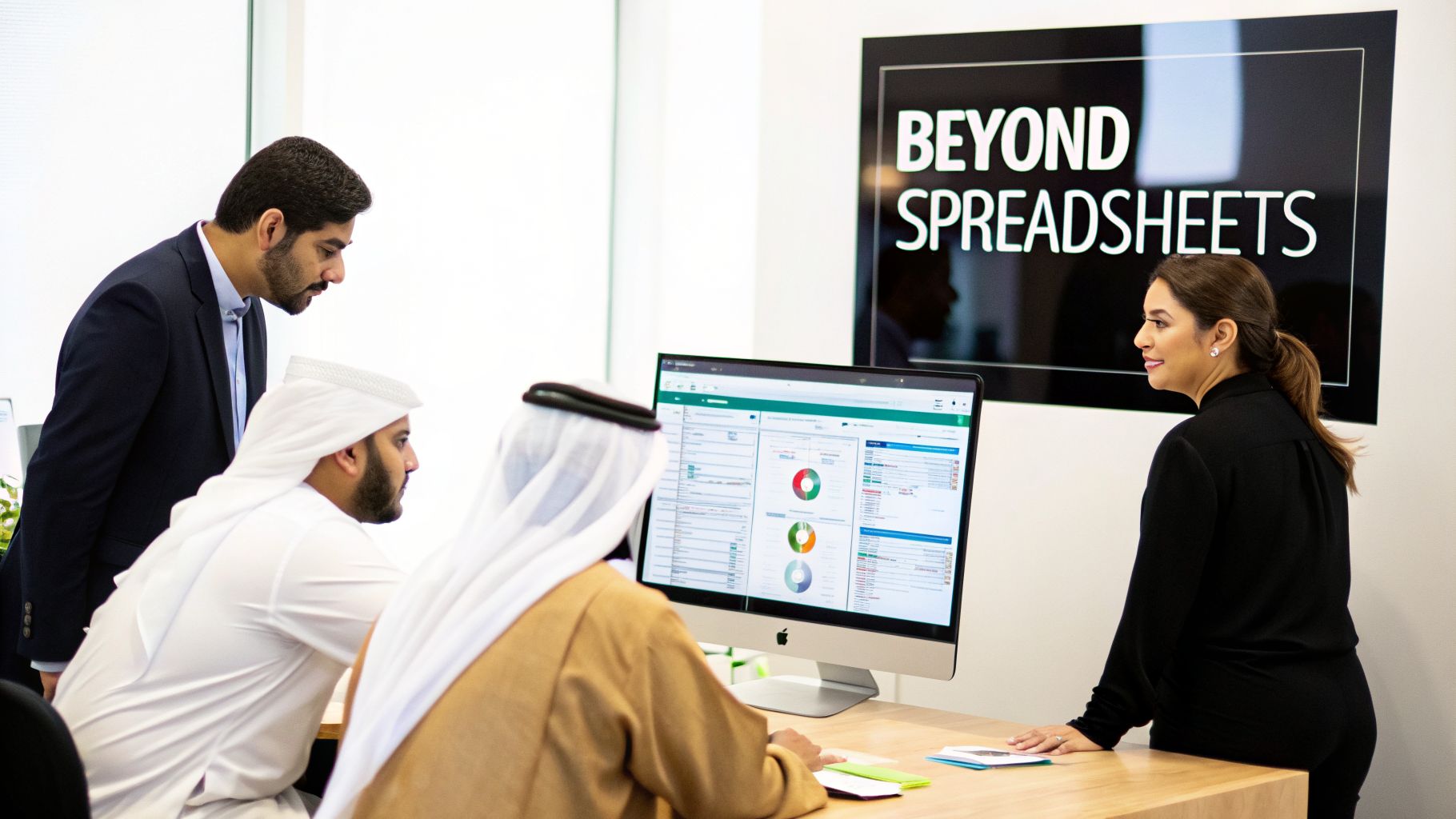
The transition from manual data entry to automated, real-time financial oversight is a strategic necessity, driven by tangible pressures within our region:
- Complex Regulatory Demands: With the implementation of VAT across the GCC and evolving e-invoicing standards like Saudi Arabia's FATOORAH, businesses require a level of accuracy and traceability that spreadsheets cannot provide.
- Industry-Specific Needs: A real estate firm in Abu Dhabi must track tenant contracts and service charges, while a contracting company needs to manage project profitability and subcontractor payments. A generic ledger in accounting is insufficient for these specialized operational demands.
- Operational Drag: Manual payroll, invoicing, and inventory management create significant bottlenecks. These inefficiencies slow down reporting and divert skilled personnel toward repetitive tasks instead of strategic analysis.
This operational landscape underscores the value of locally-focused solutions. Hinawi ERP, for instance, was developed in Abu Dhabi specifically to solve these regional challenges by integrating financial management with core business operations. For a practical perspective on this transition, consider our guide on switching from outdated software to a modern ERP.
Ultimately, the objective is to move beyond historical record-keeping and leverage financial data for proactive, confident decision-making.
What Every Business Accounting Program Must Have
The fundamental difference between a professional accounting system and a spreadsheet lies in the core features that automate and control financial processes. For any company in the UAE, moving past simple data entry is essential for making strategic financial decisions that drive sustainable growth.
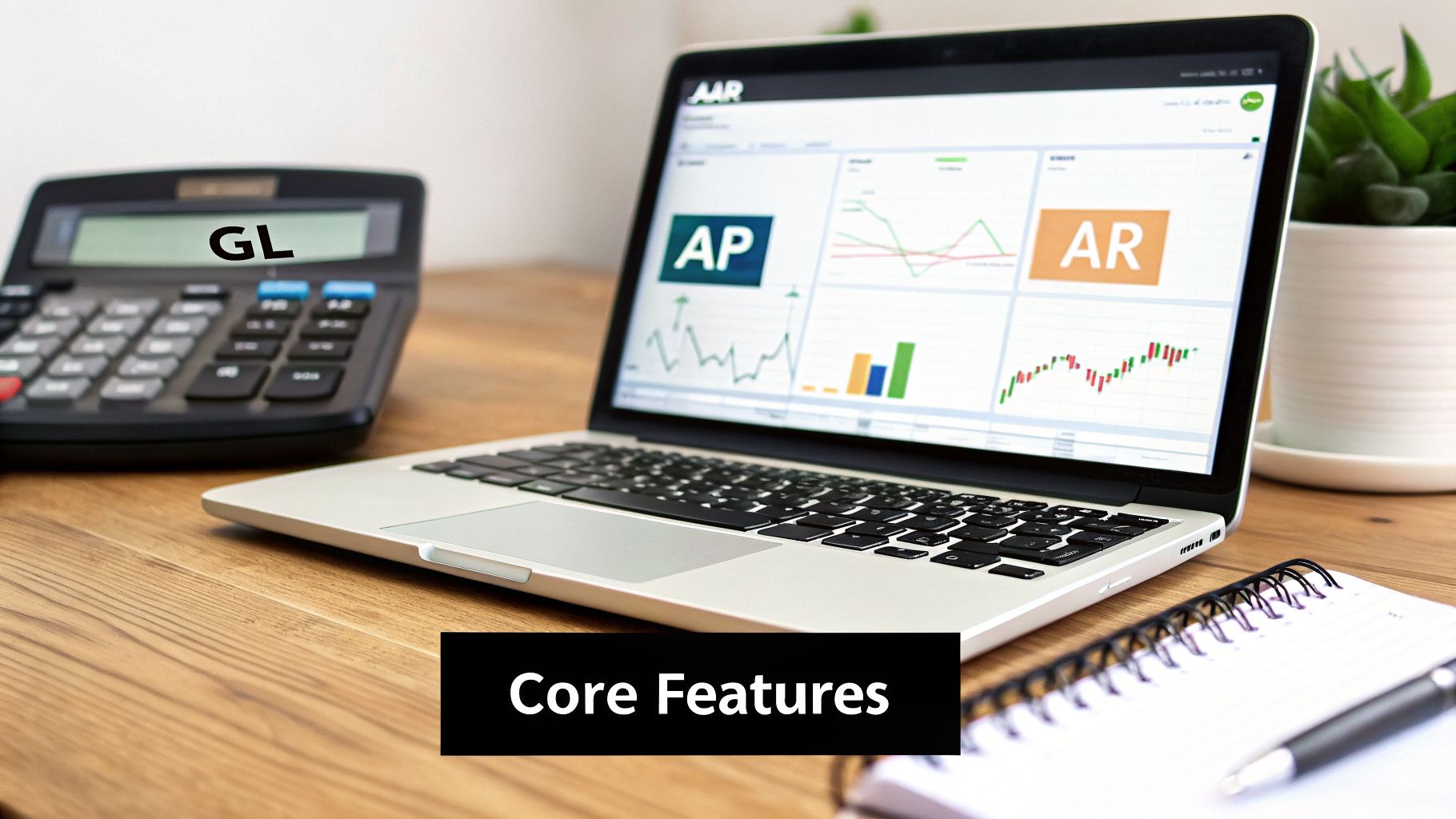
Here are the non-negotiable components that should be on every decision-maker's evaluation checklist.
The General Ledger (GL): Your Financial Command Center
The General Ledger (GL) is the central repository for all of a company's financial transactions. Every sale, purchase, and payment is recorded and organized here, creating a complete and immutable audit trail. A well-maintained GL serves as the single source of truth for the entire business. Without a robust GL, generating reliable financial reports is impossible.
Accounts Payable and Receivable: Mastering Your Cash Flow
A company's liquidity depends directly on the efficient management of cash inflows and outflows. The Accounts Payable (AP) and Accounts Receivable (AR) modules are critical for this function.
Accounts Payable (AP): This module automates the process of paying suppliers and managing liabilities. For a contracting company in Dubai managing multiple international suppliers, a strong AP module handles multi-currency payments and tracks due dates automatically, helping to avoid late fees and maintain strong supplier relationships.
Accounts Receivable (AR): This module streamlines the collection of payments. A robust AR system automates invoicing, sends payment reminders, and flags overdue accounts. This significantly improves cash flow and frees up finance teams from the manual task of chasing payments.
A strong AP/AR system is often the difference between having cash on hand for payroll and growth, versus constantly struggling to make ends meet. When these processes are automated, your finance team can shift its focus from administrative tasks to strategic analysis.
Financial Reporting: Turning Numbers into Insight
Raw financial data is of little value without interpretation. The power of a professional accounting program lies in its ability to transform transactional data into clear, actionable financial reports. Every business owner and manager must understand these three fundamental statements:
- Profit & Loss (P&L) Statement: This report summarizes revenues and expenses over a specific period, answering the critical question: is the business profitable?
- Balance Sheet: This provides a snapshot of the company's financial position at a single point in time, detailing assets, liabilities, and equity.
- Cash Flow Statement: This tracks the movement of cash in and out of the business, providing a clear picture of liquidity.
Modern systems like Hinawi ERP generate these reports in real-time. This gives a leader in Abu Dhabi or Riyadh the immediate visibility needed to make confident decisions based on current data, not historical estimates.
Essential vs. Advanced Accounting Program Features
As a business grows, its requirements evolve. It is crucial to distinguish between foundational features and the advanced tools that support scaling and complex operations.
| Feature Category | Essential Functionality (Must-Have) | Advanced Functionality (Growth-Oriented) |
|---|---|---|
| Core Accounting | General Ledger (GL), Accounts Payable (AP), Accounts Receivable (AR). | Multi-currency management, multi-company consolidation, intercompany transactions. |
| Reporting | Standard P&L, Balance Sheet, Cash Flow statements. | Customizable dashboards, industry-specific KPIs, real-time analytics, budget vs. actuals analysis. |
| Inventory | Basic stock tracking, manual adjustments. | Barcode scanning, serial/batch number tracking, automated reordering, landed cost calculation. |
| Payroll & HR | Basic salary calculation and WPS compliance. | Integrated HR management, leave and attendance tracking, employee self-service portals. |
| Compliance | VAT/GST calculation and basic tax reporting. | Automated e-invoicing (Fatoorah), advanced tax audit reports, industry-specific compliance modules. |
While essential features ensure financial control, advanced functionality provides a true competitive advantage by enabling deeper insights and greater operational efficiency during expansion.
Explore how Hinawi ERP's integrated modules can be tailored to your business, whether you need core accounting today or a full suite of advanced features for tomorrow.
Chat on WhatsApp +971506228024
Quotation – Demo Request
Chat with Hinawi AI
Staying Compliant in the UAE and GCC
For any business operating in the Middle East, maintaining compliance with local regulations is a critical function. In the UAE and across the GCC, compliance is not merely an administrative task—it is essential for mitigating risk and avoiding significant penalties. This is precisely why a business accounting program built for the region is a core business tool.
Manual spreadsheets and generic international software often fail to address the unique and evolving rules of our region. A modern accounting program designed for the GCC, however, embeds these complex requirements directly into financial workflows, making compliance a systematic and automated process.
Mastering UAE VAT and E-Invoicing
The introduction of Value Added Tax (VAT) fundamentally changed business operations across the UAE. Proper VAT management requires more than just adding 5% to invoices; it demands meticulous record-keeping and precise calculations.
A locally focused accounting system automates this process. It correctly applies VAT to each transaction, generates tax invoices compliant with Federal Tax Authority (FTA) standards, and compiles the necessary reports for tax filings. This automation eliminates the minor errors that can lead to time-consuming and costly audits. For more details, our resource on the new tax landscape in the UAE provides further context.
Furthermore, with Saudi Arabia’s FATOORAH system setting a precedent, e-invoicing is becoming the standard for the entire region. Proactive companies are adopting systems already equipped for these digital mandates, ensuring a seamless transition as e-invoicing becomes mandatory in the UAE.
Automating WPS Payroll Compliance
The UAE's Wages Protection System (WPS) is a cornerstone of labour law, ensuring employees are paid accurately and on time. For companies handling payroll manually, this represents a significant administrative burden and a constant compliance risk.
The most effective solution is an accounting program with a fully integrated HR and payroll module. It manages salary calculations, deductions, and bank transfers, then automatically generates the specific Salary Information File (SIF) required by the WPS. This eliminates manual data entry and guarantees compliance.
Consider a construction firm in Abu Dhabi with hundreds of employees. A system like Hinawi ERP, with its native WPS functionality, can process the entire payroll and generate the SIF file in minutes, not days. This frees up the finance team and protects the business from potential fines and payment delays.
Reducing Risk with Integrated Solutions
From a consulting perspective, the greatest advantage of a localized business accounting program is its ability to manage risk. Disparate systems for accounting, HR, and operations create data silos where errors can hide and compound. For any company in the GCC, it is vital to have robust systems for specific regulations, including advanced financial reporting frameworks like those discussed in this guide on FATCA CRS reporting systems.
An integrated ERP solution like Hinawi consolidates all functions into a single system. Because it was built in the UAE, compliance is not an add-on feature; it is integral to its architecture.
- Audit-Ready Records: Every transaction is recorded with a clear and traceable audit trail, simplifying the process of producing data for an FTA audit.
- Real-Time Accuracy: Financial reports are always a true reflection of the business, as payroll, project costs, and sales data feed into a single general ledger.
- Bilingual Operation: To serve a diverse market, systems offering both Arabic and English interfaces ensure the entire team can operate with clarity and confidence.
Investing in a program with local compliance at its core is a strategic decision that protects the business, enhances operational efficiency, and builds a strong financial foundation for growth.
Choosing the Right Program for Your Industry
Implementing a generic accounting program for a specialized business is operationally inefficient. A trading company in Dubai and a contracting firm in Abu Dhabi have fundamentally different operational models, and their software must reflect these differences. The value of an accounting system lies not just in balancing ledgers, but in providing features tailored to your industry.
Before evaluating software, a thorough internal analysis is necessary. Where are the primary revenue streams, and what are the key operational bottlenecks? For most companies, the challenges are not in the general ledger but in managing job costing, inventory, or project expenses. Specialized modules are essential for maintaining a competitive edge.
For Manufacturing Companies
In the manufacturing sector in the UAE or Saudi Arabia, profitability is determined by the ability to accurately calculate the cost of production. A basic accounting program that only tracks revenue and expenses is inadequate. A system must understand the entire production lifecycle, from raw materials to finished goods.
We often consult with factories that struggle due to inaccurate product costing. They use disconnected spreadsheets to estimate material and labour costs, leading to inconsistent pricing and, in some cases, hidden losses on key products. Specific features address this directly:
- Job Costing: This is non-negotiable. It allows for the assignment of all costs—raw materials, labour, and overhead—to a specific production run. This provides precise profit visibility for every item produced.
- Bill of Materials (BOM): A detailed BOM acts as the formula for a product, listing every component and sub-assembly. It is essential for accurate inventory planning and production scheduling.
- Manufacturing Resource Planning (MRP): This integrates sales orders with production schedules and procurement. To understand how this transforms efficiency, our guide on Manufacturing Resource Planning offers valuable insights.
A system like Hinawi ERP, which integrates these manufacturing tools with its accounting core, provides a live dashboard of production costs, enabling managers to make informed decisions on pricing and resource allocation.
For Contracting and Real Estate
The contracting and real estate sectors across the GCC are project- and asset-centric. Success depends on managing a portfolio of properties, tenants, and contracts without operational gaps.
Consider a contracting company in Abu Dhabi managing multiple construction projects. Without project-based accounting, they cannot determine a project's profitability until it is complete, by which time it is too late to implement corrective measures. They require a program that delivers:
- Project-Based Profit & Loss: The ability to generate a P&L statement for each individual project, tracking revenue against subcontractor invoices, materials, and labour in real time.
- Tenant and Lease Management: For property firms, this automates rent collection, lease renewals, maintenance tickets, and service charges, with all transactions flowing directly into the general ledger.
- Post-Dated Cheque (PDC) Management: This is a critical feature for the region, providing a reliable system for tracking and managing rental and installment payments.
Choosing a system without these features forces companies to rely on a patchwork of spreadsheets. This almost always leads to cash flow problems, missed renewals, and an inability to see which projects are profitable and which are bleeding money.
Is your current software holding you back? See how Hinawi ERP's industry-specific modules for manufacturing, contracting, and real estate provide the control and visibility needed to thrive in the GCC market.
Chat on WhatsApp +971506228024
Quotation – Demo Request
Chat with Hinawi AI
For Trading and Retail Businesses
In trading and retail, inventory management is paramount. Excess stock ties up capital, while insufficient stock leads to lost sales. This is particularly challenging for businesses with multiple warehouses or retail locations across the UAE.
The demand for ERP software in the UAE is growing rapidly, driven by the expansion of retail and e-commerce. This growth is directly linked to the need for business accounting programs that can handle complex inventory, VAT compliance, and logistics. According to the Middle East ERP Software Market report, the UAE's e-commerce market is projected to grow from USD 7.48 billion in 2023 to USD 13.3 billion by 2028, making modern systems a necessity.
For this sector, essential features include:
- Advanced Inventory Control: This goes beyond simple stock counts to include serial number and batch tracking, FIFO costing, and automated reorder points for intelligent stock management.
- Multi-Warehouse Management: A single, real-time view of stock levels across all locations is crucial for managing stock transfers and generating branch-specific sales reports.
- Landed Cost Calculation: For importers, this feature is indispensable. It calculates the true cost of products by automatically adding shipping, customs, and other charges, providing a clear picture of actual profit margins.
Ultimately, selecting the right accounting program is not about a feature checklist. It is about finding a solution that understands and resolves the real-world operational challenges of your industry.
Cloud Versus On-Premise: What Makes Sense for Your Business?
A critical decision in selecting an accounting program is determining the deployment model: a cloud-based service (SaaS) or a traditional on-premise installation. Having guided numerous businesses through this choice, it is clear there is no single correct answer. The optimal path depends on your company's budget, security posture, and IT resource availability.
An on-premise solution involves purchasing a software license and installing it on your own servers within your physical office. This provides direct control over your financial data and the hardware it resides on.
A cloud-based solution is hosted by the software provider. You access the system via a web browser or application, and the provider manages the underlying infrastructure, security, and maintenance.
Comparing the Key Business Factors
To make an informed decision, it's important to compare these models based on what matters most to business owners in the UAE and GCC.
Upfront Investment: On-premise solutions require a significant capital expenditure on server hardware, software licenses, and IT implementation. Cloud solutions convert this into a predictable operating expense through a monthly or annual subscription.
Maintenance and IT Headaches: With an on-premise system, all maintenance—security patches, software updates, and server management—is your responsibility. A cloud provider handles these tasks automatically, allowing your team to focus on business operations, not IT administration.
Scalability and Access: The cloud offers superior scalability. Adding new users or branches is typically a simple process. Furthermore, cloud business accounting programs provide secure access from any location with an internet connection—a critical feature for managers traveling between Dubai and Riyadh or for teams working remotely.
Why the Cloud is Winning Over SMEs
For most small and medium-sized enterprises (SMEs) in our region, the agility and lower upfront cost of cloud solutions have made them the preferred choice. SMEs are driving the adoption of cloud-based accounting. According to a Fortune Business Insights report, they were the largest segment of the Middle East & Africa ERP market in 2023 and are projected to grow the fastest.
The data is compelling: 53.1% of enterprises now run on cloud ERP, which can reduce deployment times by up to 50% compared to on-premise projects.
For an SME, avoiding a heavy IT burden is a game-changer. It means you can pour your resources into growing the business, innovating, and serving customers instead of managing servers.
A common question is about data security in the cloud. Reputable providers offer security measures that often exceed what a single SME can implement on its own, including robust data encryption, automated backups, and strict compliance with data protection laws in the UAE.
A flexible system like Hinawi ERP offers both cloud and on-premise options. This allows you to choose the model that aligns with your company's security policies and operational strategy, ensuring full compliance with regional laws regardless of the deployment method.
From Standalone Accounting to a Fully Automated Business Engine
A standalone accounting software is effective for tracking financial transactions. However, when it operates in isolation, its strategic value is limited. The most significant operational advancement occurs when the accounting function is integrated with all other business processes, becoming the financial core of an Enterprise Resource Planning (ERP) system. This marks the transition from bookkeeping to true business automation.
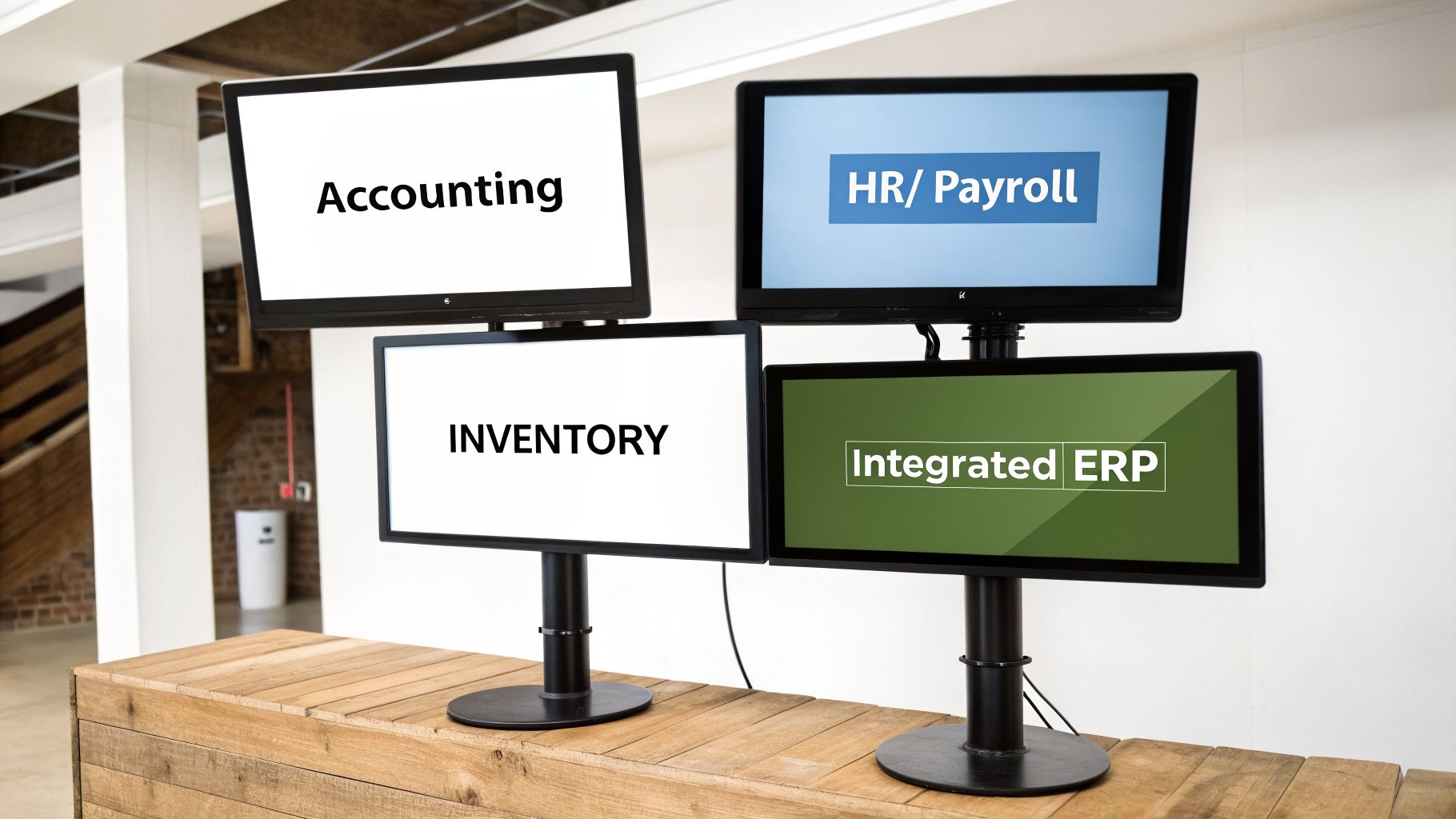
Integration allows disparate business tools—HR and Payroll, inventory management, CRM, and fixed assets—to share data with the accounting module automatically. This creates a single, reliable view of the entire business, breaking down departmental silos and eliminating redundant data entry.
Breaking Down the Data Silos
Without integration, departments operate in isolation. The sales team uses a CRM, the warehouse team tracks stock in spreadsheets, and HR processes payroll in a separate program. The accounting team is then tasked with manually consolidating this information, a process that is slow, inefficient, and prone to error.
An integrated ERP system transforms this workflow. When your business accounting programs are part of a connected system, the benefits are immediate. Consider these real-world scenarios for a business in our region:
- From Sale to Ledger in Seconds: A salesperson closes a deal in the CRM. The system instantly verifies stock availability, generates a VAT-compliant e-invoice, and updates accounts receivable without manual intervention.
- Airtight Procurement: A purchase order is raised for raw materials. This automatically creates a future liability in accounts payable. Upon invoice receipt, the system matches the PO, delivery note, and invoice before scheduling payment.
- Smart Asset Management: When a new vehicle is purchased, the fixed assets module is automatically updated. It adds the asset to the register and begins calculating depreciation, posting the monthly expense directly to the general ledger.
This seamless information flow is a key attribute of systems like Hinawi ERP, which were designed to unify these functions. For businesses using multiple tools, exploring third-party integration strategies can also help bridge these gaps.
Making Strategic Decisions With a Clear View
The primary benefit of integration is the clarity it provides to leadership. When every business activity has an immediate and visible financial impact, decisions are no longer based on outdated information.
An integrated system gives you a live, 360-degree view of your business's health. You can see the exact profitability of a project in real-time, understand the true cost of goods sold for a specific product line, or see how a marketing discount is affecting your cash flow today, not next quarter.
This enables confident, strategic choices that drive growth. The move from a basic accounting package to a fully integrated ERP provides the efficiency, accuracy, and foresight needed to thrive.
Before concluding, take a moment to evaluate your own systems. Are you struggling with data silos and manual reconciliation? See how an integrated solution can provide a single source of truth for your entire operation.
Chat on WhatsApp +971506228024
Quotation – Demo Request
Chat with Hinawi AI
Take the Next Step with Hinawi ERP
Choosing the right business accounting program is a strategic decision that shapes your company's future efficiency and growth. For businesses in the UAE and GCC, the optimal solution is one built with a deep understanding of the regional market.
Hinawi ERP is that solution. Developed in Abu Dhabi since 1998, our software was created from the ground up to address the specific challenges faced by companies in the Middle East. We offer a fully integrated ERP software that unifies Accounting, HR & Payroll, Real Estate Management, Fixed Assets, Manufacturing, Garage & Maintenance, and School Management into a single, cohesive platform.
Our deep local expertise means Hinawi ERP comes standard with features critical for the region:
- VAT and e-Invoicing compliance to meet FTA and regional mandates.
- UAE WPS payroll support for automated, accurate, and compliant salary processing.
- Bilingual (Arabic and English) operation for seamless use across your entire team.
- Flexible company policy settings to adapt the software to your unique workflows.
- Real-time accounting integration across all modules for a single source of financial truth.
- Suitable for diverse industries, including factories, contracting companies, real estate businesses, schools, garages, trading companies, and manufacturers.
It is time to modernize your operations. Move beyond manual data entry, improve financial accuracy, and gain superior control over your management processes with Hinawi ERP. We invite you to speak with our Abu Dhabi-based ERP consultants to discuss your specific operational challenges.
Request a personalized demo to see firsthand how a proven, locally-developed system can automate your processes and drive a more profitable future.
Frequently Asked Questions
When considering a new accounting program, a few key questions always come up. Here are some straightforward answers based on our experience helping businesses make this exact transition.
How Long Does It Take to Implement a New Accounting Program?
The implementation timeline depends on your company's size, the volume of data to be migrated, and any required customizations. For most small to medium-sized businesses in the UAE, implementing a cloud-based system like Hinawi ERP typically takes a few weeks. The process includes data migration from old tools (like QuickBooks or spreadsheets), system configuration to match your workflows, and comprehensive team training. A phased rollout, starting with core accounting and then adding modules like HR or inventory, is often the most effective approach.
Is an Integrated ERP System Too Complex for My Small Business?
While the term "ERP" can seem intimidating, modern systems are designed for scalability. Many small business owners worry about complexity, but managing separate programs for sales, inventory, and payroll becomes far more complex and error-prone as you grow. An integrated platform like Hinawi allows you to start with only the accounting module and activate other modules as your business expands. This provides a scalable foundation where all your data is connected and accurate in real-time—a significant competitive advantage.
Is My Financial Data Truly Secure in a Cloud-Based Program?
Yes. Reputable cloud ERP providers invest heavily in security measures that often surpass what an individual SME can afford. This includes end-to-end data encryption, automated backups, and hosting in secure data centers compliant with regional regulations like the UAE's data protection laws. Think of it as using a bank vault versus a safe at home; the bank's security is far more robust. When evaluating providers, always inquire about their security certifications and protocols. Protecting your sensitive financial data is the top priority for systems like Hinawi ERP.