Category: Garage
If your maintenance team spends more time chasing breakdowns than preventing them, you don't have a maintenance department. You have an emergency response unit.
That's the reality in many UAE businesses. A chiller trips in August. A production machine stops during a busy shift. A fleet vehicle misses service because the workshop was overloaded. Then finance gets the bill, operations absorb the delay, and management treats it as normal. It isn't normal. It's poor preventive maintenance planning.
In the GCC, equipment doesn't operate in gentle conditions. Heat, dust, extended operating hours, distributed sites, and tight labour availability punish weak maintenance systems. Calendar reminders and spreadsheets aren't enough. You need a structured programme, a clear execution model, and an integrated system that connects assets, work orders, inventory, labour, and accounting. That's where a practical ERP setup such as Hinawi ERP becomes useful. It gives management one place to control maintenance instead of relying on disconnected logs, calls, and memory.
Your Equipment Broke Again? It's Time for a Maintenance Strategy
A commercial building in Dubai loses a main HVAC unit in peak summer. Tenants complain immediately. The facility team calls a technician. Spare parts aren't ready. Purchase approval takes time. Someone discovers the last service record is buried in WhatsApp messages and paper files. That failure didn't start when the unit stopped. It started months earlier when no one owned the maintenance plan.
The same pattern shows up in factories, contracting companies, workshops, schools, and property portfolios. Teams react. They improvise. They survive the week. Then they repeat the cycle.
Preventive maintenance planning fixes that pattern by turning maintenance into a managed business process. The shift is simple in principle. Identify critical assets, decide what work must happen before failure, schedule it properly, and make sure parts, labour, and approvals are ready before the task is due. If you run a workshop or service operation, the discipline used in a proper garage management software setup in the UAE applies directly to broader maintenance control as well.
Preventive maintenance planning is not about doing more work. It's about doing the right work before failure forces you into expensive decisions.
If you want fewer surprises, lower disruption, and cleaner accountability, stop waiting for equipment to tell you what your process should have told you already.
Chat on WhatsApp +971506228024 Quotation – Demo RequestThe Business Case for Proactive Maintenance
Reactive maintenance feels practical because the spending is visible only when something breaks. That thinking is wrong. Reactive work hides its true cost inside downtime, overtime, delayed service, emergency buying, tenant complaints, lost production, and poor forecasting.
A proactive maintenance programme gives management a measurable way to control reliability. The strongest justification is the difference between planned work and reactive work. Independent maintenance guidance notes that organisations using preventive and predictive maintenance experienced 52.7% less unplanned downtime, along with a 12% cost reduction, 9% higher availability, and 20% longer asset life according to maintenance KPI guidance from Accruent.

What management should monitor
If you want maintenance to be managed like a business function, track the KPIs that expose whether your team is gaining control or drifting back into firefighting.
- MTBF: This shows whether reliability is improving or whether the same assets keep failing.
- MTTR: This reveals how quickly your team restores service once failure happens.
- Planned Maintenance Percentage: This tells you how much labour is spent on scheduled work instead of breakdown response.
- PM compliance: This shows whether planned tasks were completed on time.
These are not workshop-only metrics. They matter to finance, operations, and compliance teams because they affect budget discipline, service continuity, and risk.
Why this matters in the UAE
The UAE business environment is heavily asset-driven. Real estate companies depend on building systems. Contracting firms depend on equipment and vehicles. Manufacturers depend on production uptime. Workshops depend on throughput and service quality. In each case, maintenance failure becomes a business failure.
That's why preventive maintenance planning should be tied to budgeting and operational reviews, not left inside a technical silo. If your leadership team already reviews cost control through budgeting and forecasting processes, maintenance should sit inside that same management discipline.
Practical rule: If maintenance reporting doesn't show planned versus reactive work every month, management is approving costs without understanding the cause.
A company that plans maintenance properly doesn't just repair assets. It protects revenue continuity, reduces avoidable operating noise, and gives finance cleaner cost visibility.
Chat on WhatsApp +971506228024 Quotation – Demo RequestBuilding Your Framework Scoping and Asset Criticality
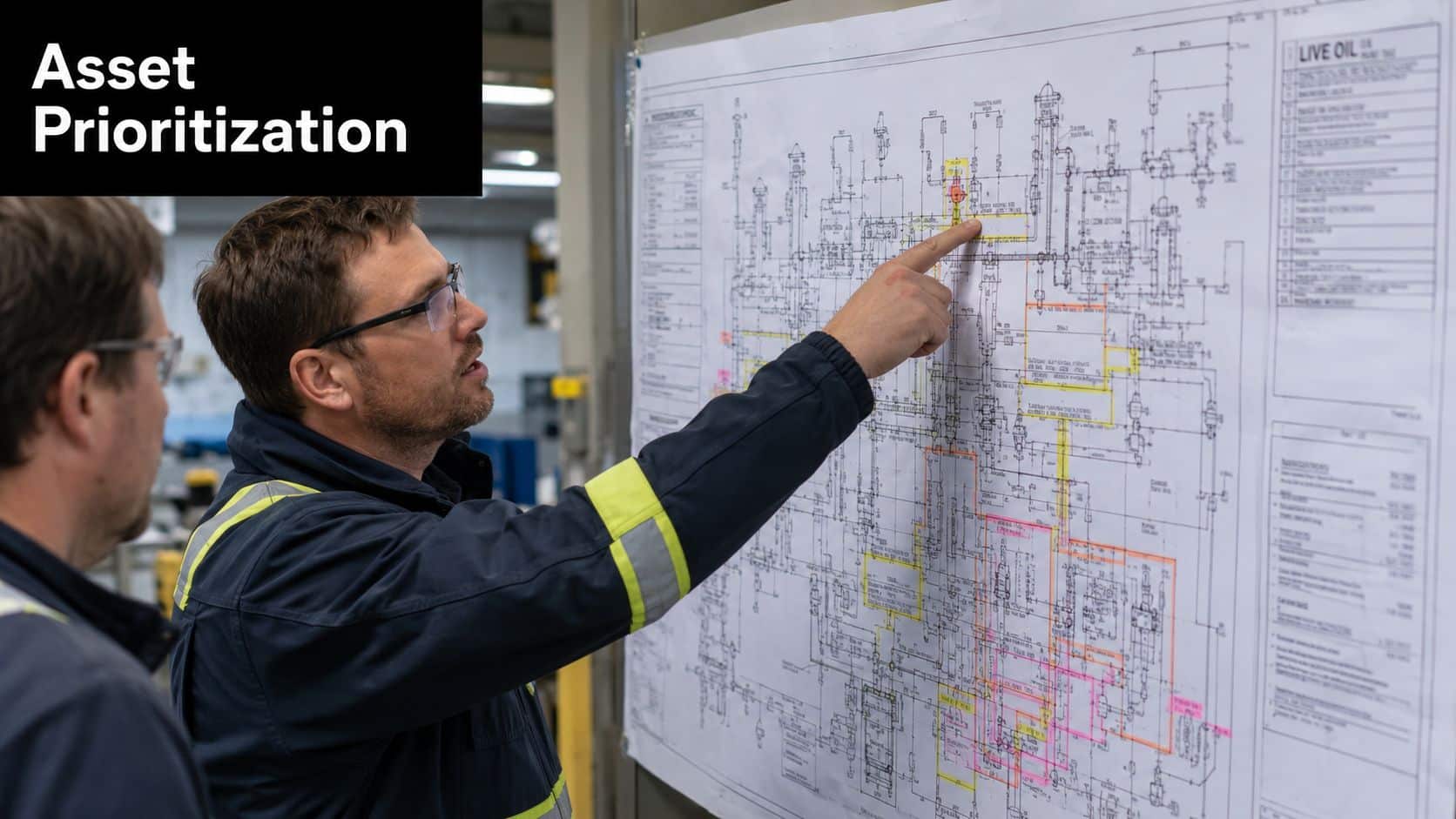
Most maintenance programmes fail at the start because they treat every asset as equally important. That wastes technician time and creates false urgency everywhere. You need a scope, and you need priorities.
A robust programme starts by ranking assets by criticality, defining task triggers from OEM guidance and historical data, and standardising work orders with steps, tools, parts, and labour estimates so the workflow can be automated and audited in a CMMS or ERP, as outlined in CityFM's preventive maintenance programme guidance.
Start with a proper asset register
Your asset list must be more than a name and serial number. At minimum, capture:
- Location: Site, building, line, bay, room, or yard position.
- Date details: Installation or purchase date so you can track age and lifecycle context.
- Condition and history: Service records, recurring faults, and inspection notes.
- Execution details: Estimated task duration, required tools, and usual parts.
If this data sits in notebooks, Excel sheets, and technician memory, your programme will never scale. Asset control belongs in a system. For companies already managing depreciation and ownership records, the logical foundation is a structured fixed assets management environment.
Rank assets the way operations actually feels the risk
Use a simple 1 to 5 criticality scale. Don't overcomplicate it.
| Criticality | Typical meaning | Example |
|---|---|---|
| 5 | Failure stops operations or creates major compliance/service risk | Main chiller, production bottleneck machine, fire pump |
| 4 | Failure causes serious disruption but not full shutdown | Secondary line equipment, delivery vehicle group |
| 3 | Important but manageable with workaround | Backup unit, non-core workshop equipment |
| 2 | Limited business impact | Low-use support asset |
| 1 | Minimal operational consequence | Office support equipment |
A score is only useful if people respect it. Don't let every department declare its assets critical. If everything is urgent, nothing is.
Rank assets by business consequence, not by who complains the loudest after a breakdown.
Define the boundary of the programme
Not every asset needs the same treatment. Split your estate into three groups:
- Assets that require formal PM because failure is expensive or disruptive.
- Assets that need basic inspection routines but not heavy scheduling.
- Assets that can stay on simple corrective control because the risk is low.
That scoping decision protects your labour capacity. It also improves compliance because technicians spend time where the business needs discipline.
Designing the Schedule From Calendars to Data-Driven Triggers
At 2:00 p.m. in August, a chiller trips, a line slows, and the maintenance team discovers the asset was serviced on time but not for the right condition. That is the problem with calendar-only planning. It creates activity, not control.
A monthly or quarterly schedule is easy to issue. It is also blunt. UAE operating conditions punish equipment differently. Heat accelerates degradation. Dust loads filters, fouls cooling systems, and shortens bearing life. Long run hours, contractor shift patterns, and limited maintenance access during production peaks change the maintenance need far faster than an OEM booklet assumes.
Time-based PM still has a place. It should not be your default for everything.
Match the trigger to the failure pattern
Build the schedule around how the asset fails and how the site operates.
- Calendar-based triggers fit statutory inspections, safety checks, warranty obligations, and simple assets with stable duty.
- Usage-based triggers fit generators, fleet, pumps, compressors, forklifts, and process equipment where hours, kilometers, starts, or cycles track wear better than dates.
- Condition-based triggers fit assets where temperature, vibration, pressure, current draw, oil quality, or inspection readings give early warning before failure.
That mix matters in the GCC. A standby generator in a clean indoor room does not need the same schedule logic as a rooftop package unit pulling dusty air through peak summer load. Treating both with the same monthly template is lazy planning.
Start with the OEM. Then correct it with your own history
Use the manufacturer schedule as a starting point, not as policy.
Your own work order history should decide what happens next. If technicians keep finding clogged filters, belt wear, overheating, or lubrication breakdown before the planned date, tighten the interval. If repeated PMs produce no actionable findings, extend the interval where risk and compliance allow. The goal is not more work. The goal is the right work before failure.
Hinawi ERP supports this shift well because the maintenance schedule sits inside the wider operating system. For plants that need maintenance windows aligned with production output, procurement, and manpower, that connection to a manufacturing ERP system in the UAE matters.
Recalibrate for local operating reality
Most schedule errors come from ignoring site conditions. Use these signals to adjust intervals and trigger types:
- Repeat defects appearing before the next PM date
- High dust contamination, filter choking, or fouling in air intake systems
- Summer stress on HVAC, refrigeration, electrical panels, and cooling assets
- Heavy usage periods, extended shifts, or seasonal demand spikes
- Remote sites where technician travel time makes missed visits expensive
- Work order history showing the task frequency is either wasteful or too late
One more rule. Put trigger reviews on a fixed cadence. Quarterly is practical for most sites. If you never review PM intervals, the schedule becomes administrative clutter. If you review it with failure history, parts usage, and downtime records, it becomes a control system.
An ERP and CMMS setup should work as the central nervous system for maintenance operations. It should generate triggers, capture readings, flag exception patterns, and help planners adjust schedules with evidence. Logging completed jobs after the fact is not enough. Asset-intensive companies in the UAE need a system that converts operating reality into scheduling decisions. That is how you cut wasted PM hours without increasing breakdown risk.
Chat on WhatsApp +971506228024 Quotation – Demo RequestExecution Planning Parts Labor and ERP Automation
A schedule on paper means nothing if the technician is unavailable, the permit isn't ready, and the spare part is out of stock.
Most preventive maintenance planning often collapses. Management approves the concept, maintenance creates recurring tasks, and then reality wins. Parts arrive late. Production refuses access. Bilingual teams interpret job steps differently. Backlogs grow. Soon the company says the programme “doesn't work” when the actual problem is poor execution planning.

A commonly cited target is 80% planned work and 20% unplanned work, highlighted in WorkTrek's discussion of preventive maintenance planning mistakes. That target matters because it forces one uncomfortable question. Can your team execute the schedule you created?
What a usable work order must include
A proper PM work order is not just a title and due date. It should include:
- Task steps: Clear instructions in the correct sequence.
- Tools and parts: So the technician arrives ready to work.
- Safety requirements: Isolation, access, and compliance checks.
- Estimated labour time: So planners can load the week realistically.
If these details are missing, you haven't standardised anything. You've only digitised confusion.
Connect maintenance to stock and labour
An integrated ERP matters more than a standalone logbook. Maintenance planning should trigger inventory checks, reserve stock where needed, and raise internal procurement actions before the due date becomes a crisis. It should also show whether the assigned team has capacity that week.
Explorer Computer LLC – Hinawi Software ERP fits this operational need in a factual, practical way because it combines accounting, inventory, fixed assets, manufacturing, HR, and garage or maintenance workflows in one system. That matters when a PM task affects stock consumption, technician allocation, service billing, or cost posting.
A PM task should fail in the planning screen, not in front of the machine.
Make the plan executable
Use these decision rules:
| Execution issue | Wrong response | Better response |
|---|---|---|
| Parts lead times are unstable | Add more PM tasks | Prioritise critical assets and reserve critical spares |
| Labour is limited | Keep all intervals unchanged | Reduce low-value PM and protect high-criticality work |
| Production resists downtime | Force maintenance anytime | Align PM with planned windows and bottleneck analysis |
| Multi-site inconsistency | Let each site improvise | Standardise task templates and approval rules |
If your PM schedule creates backlog, overtime, or stockouts, the schedule is wrong. Maintenance planning must respect operational capacity.
Measuring Success and Optimizing Performance
A PM programme earns its budget only if it changes failure patterns, labour use, and asset cost. If your review meeting ends with screenshots, excuses, and no schedule changes, you do not have performance management. You have reporting.

In the GCC, weak measurement gets expensive fast. Heat shortens equipment life. Dust increases wear. Multi-site operations stretch technicians and supervisors across long travel windows, remote camps, and tight permit schedules. Under those conditions, maintenance software must work as the operational control layer, not a digital filing cabinet. A connected ERP system for UAE maintenance and operations teams should show what was planned, what was done, what it cost, and what needs to change this month.
Track a short KPI set that drives decisions
Keep the scorecard tight and operational:
- PM compliance: Are planned tasks completed by the due date?
- Planned Maintenance Percentage: Are technician hours shifting toward planned work instead of breakdown response?
- MTBF: Are critical assets failing less often after the PM plan is applied?
- MTTR: Is the team restoring service faster when failures happen?
- Maintenance cost by asset class and critical asset: Which machines are consuming a disproportionate share of labour, parts, and contractor spend?
Do not track twenty metrics. Track the few that force action.
The common failure is obvious. Work orders sit in one system, spare parts in another, labour attendance somewhere else, and finance receives delayed summaries at month end. Then every KPI review turns into an argument about whose spreadsheet is correct. Hinawi ERP solves that operational problem by connecting maintenance activity with stock, labour, asset history, and accounting entries in one environment. That gives management one version of the truth.
Use KPI reviews to change the plan
A metric matters only when it triggers a decision.
- PM compliance is low: Reduce schedule overload, fix supervisor discipline, and stop assigning more work than the crew can finish.
- MTBF is not improving: Change the task content, shorten or extend the interval, or move from calendar-based PM to usage or condition triggers.
- MTTR is too high: Check spare availability, technician skill mix, access approvals, and escalation rules.
- Asset maintenance cost keeps rising: Start a repair versus replace review. Do not keep funding repeat failure.
Management insight: Review meetings should end with approved changes to intervals, task lists, spare stocking rules, contractor scope, or replacement plans.
For UAE and GCC companies, this review loop also improves audit readiness and budget control. Cost postings should hit the right asset, department, and period without manual rework. Managers should see which sites are burning overtime, which assets are draining spare parts, and which preventive tasks are producing no measurable reliability gain. That is how maintenance becomes controlled, defendable, and aligned with uptime targets.
Chat on WhatsApp +971506228024 Quotation – Demo RequestTake the Next Step with Hinawi ERP
If your company still manages maintenance with spreadsheets, paper job cards, phone calls, and disconnected approvals, you're making planning harder than it needs to be. Preventive maintenance planning only works when the underlying system connects the moving parts. Assets, work orders, stock, purchasing, payroll, costing, and accounting must speak to each other.
Hinawi ERP is a fully integrated ERP software developed since 1998 in Abu Dhabi. It supports Accounting, HR & Payroll, Real Estate Management, Fixed Assets, Manufacturing, Garage & Maintenance, School Management, CRM, and complete business automation. For UAE and GCC companies, that matters because maintenance doesn't sit alone. It affects spare parts, technician time, depreciation, invoices, service revenue, payroll, and financial reporting.
For an asset-intensive business, the practical value is straightforward:
- Automated maintenance control: Schedule recurring work, standardise job cards, record service history, and keep asset records organised.
- Real-time accounting integration: Maintenance costs flow into financial reporting without manual re-entry.
- Bilingual operation: Arabic and English support helps mixed teams use the same system consistently.
- Flexible company policy settings: Match approval rules, maintenance workflows, and internal controls to how your business operates.
- Regional compliance support: VAT and e-Invoicing compliance, plus UAE WPS payroll support, reduce the gap between operations and compliance.
- Fit across sectors: Factories, contracting companies, real estate businesses, schools, garages, trading companies, and manufacturers can manage maintenance inside a broader business platform.
This matters in real operating situations. A contracting company can track equipment service alongside spare parts and labour costs. A property business can connect building maintenance with tenant operations and accounting. A garage can control job cards, inventory, payroll, and invoicing in one environment. A manufacturer can align maintenance windows with production and stock control. That's the advantage of using an integrated platform instead of isolated tools.
If you want to modernise operations, reduce manual work, improve financial accuracy, and gain tighter management control, visit Hinawi ERP in the UAE or go directly to www.hinawierp.com to request a personalised demo.
Chat on WhatsApp +971506228024 Quotation – Demo RequestA CTA for Explorer Computer LLC – Hinawi Software ERP.