
Category: Accounting
An Abu Dhabi finance team receives a vendor invoice linked to Saudi operations. The service is complete, the supplier wants payment, and accounts payable is ready to release funds. Then someone asks the question that usually arrives too late. Does withholding tax in KSA apply, and if it does, what exactly are we withholding against?
That moment exposes a bigger problem. Most businesses don't struggle because withholding tax is impossible. They struggle because the invoice description is vague, the contract language is worse, and the ERP or accounting workflow wasn't built to force a proper tax decision before payment. That's how routine cross-border payments turn into rework, gross-up surprises, month-end adjustments, and uncomfortable compliance conversations.
This is especially common with modern digital purchases. A software renewal, hosted platform fee, API access charge, cloud subscription, or bundled support invoice looks simple. It isn't. In Saudi tax practice, the commercial label on the invoice is rarely enough. The core issue is classification. If your team treats everything as “service fees”, you're taking a shortcut that can cost you.
If your wider finance process is still fragmented, fix that first. Strong digital controls around invoices, approvals, and tax data matter just as much as the tax rule itself, especially in environments already managing VAT and electronic invoicing requirements across the region. That's the same operational discipline companies are building through UAE e-invoicing readiness and automation.
Chat on WhatsApp +971506228024 Quotation – Demo RequestIntroduction Navigating Your First KSA Payment
The first KSA payment usually looks ordinary until finance reviews the tax side properly. A UAE contractor engages a specialist from outside Saudi Arabia for work tied to a Saudi project, or a Saudi entity in the group pays a non-resident consultant, software provider, or head-office function. The invoice arrives. Treasury wants it cleared. Procurement says the service is complete. Finance suddenly realises the tax treatment wasn't decided when the contract was signed.
That's where mistakes begin. Teams focus on commercial urgency and leave the tax classification to the end. By then, the payer may already have promised a net amount, the supplier may refuse any deduction, and accounts payable may not know whether the charge is a royalty, consulting fee, technical service, or management fee.
Practical rule: If your team decides withholding tax after invoice approval, you're already late.
The operational risk isn't abstract. A wrong tax code affects vendor payment, expense recognition, tax liability, and compliance filing. It also creates tension between legal, tax, procurement, and finance because each team reads the same contract differently.
Three situations trigger the most confusion:
- Software and SaaS purchases: A recurring access fee may not be treated the same way as a licence granting rights over software.
- Bundled consulting contracts: One invoice can include implementation, advisory work, support, and IP-related rights.
- Intercompany allocations: Head-office or shared service charges often arrive with weak descriptions, which creates classification risk immediately.
Businesses that handle Saudi transactions well don't rely on memory or manual interpretation every month. They build a review process at vendor onboarding, contract setup, and invoice entry. That's the difference between controlled compliance and repetitive clean-up.
Understanding Saudi Arabia's Withholding Tax Framework
Saudi withholding tax is not a tax the foreign recipient settles later on its own timetable. It is a source-based levy collected when a resident entity or permanent establishment pays a non-resident for Saudi-sourced income. The payer withholds and remits the tax. That basic point matters more than often appreciated because it turns tax into an accounts payable control, not just a tax department issue. The standard domestic rates and the at-source structure are outlined in Saudi Arabia withholding tax rates and compliance guidance.

The authority involved is ZATCA. The return and payment are generally due by the 10th day of the following month, which means withholding tax doesn't sit comfortably in a loose month-end process. It needs discipline in invoice coding, approval routing, and payment scheduling. If your finance calendar is already under pressure from other obligations, a structured tax timetable like these corporate tax filing deadline practices gives a useful benchmark for tightening controls.
Who carries the responsibility
The payer carries the obligation. That changes how you should design approvals internally.
If your Saudi resident company or permanent establishment makes a payment to a non-resident, finance must determine whether the payment falls into a withholding category before cash leaves the bank. Waiting for the vendor to tell you the rate is poor practice. Vendors don't own your KSA compliance risk.
Why classification matters so much
Withholding tax in KSA is easy in principle and messy in practice. The legal nature of the payment determines the rate. That means contract language matters, scope of work matters, and invoice detail matters.
A few examples make the point:
- A straightforward dividend payment follows one treatment.
- A royalty follows another.
- A technical service fee may look similar to a consultancy arrangement, but the category still needs to be supported by the contract.
- A software arrangement may involve access, support, and rights over intellectual property in one commercial package.
The tax outcome follows the character of the payment, not the label your procurement team typed into the purchase order.
That is why experienced finance teams push classification upstream. They don't wait for month-end. They set vendor types, tax codes, and review rules before the first invoice hits the ledger.
Chat on WhatsApp +971506228024 Quotation – Demo RequestKSA Withholding Tax Rates and Taxable Payments
Your AP team receives three invoices from the same foreign software vendor. One is for annual platform access. One is for implementation support. One is for expanded user rights under an enterprise licence. If all three get coded as "IT services 5%", you have a classification problem, not an accounting shortcut.
That is a major challenge with KSA withholding tax. The rate table is simple. The payment character is not.
Standard domestic rates
Use the domestic framework as your starting point, then test whether the contract supports that category.
| Payment Type | WHT Rate | Notes |
|---|---|---|
| Dividends | 5% | Domestic rate under the Saudi WHT framework |
| Interest | 5% | Domestic rate under the Saudi WHT framework |
| Royalties | 15% | Often relevant where rights over IP, software, or licensed use are granted |
| Technical and consulting services | 5% | Common category for many service arrangements, subject to contract support |
| Management fees | 20% | Highest standard domestic category in the listed framework |
Memorising this table does not protect you. Correct classification does.
The digital services problem
SaaS, software subscriptions, cloud hosting, API access, and licence renewals create the most confusion. Procurement sees "software". AP sees "service". Legal sees licensing language. Tax has to decide what the payment is.
That decision matters because a recurring software charge can point in different directions. If the customer is only receiving hosted access, support, or processing capability, the payment may be closer to a service analysis. If the agreement gives the customer rights to use, exploit, distribute, or benefit from intellectual property in a defined way, royalty treatment becomes a serious issue. The contract drives the result.
The ambiguity is well illustrated in guidance on software subscription withholding treatment in Saudi Arabia, which discusses how software subscriptions, licence renewals, and similar digital arrangements can trigger different withholding outcomes depending on the rights transferred.
A practical decision framework
Use this sequence before the invoice is posted and certainly before payment is released.
- Read the commercial terms first: Ignore the vendor's invoice label. Check whether the agreement grants access to a service or rights over software or IP.
- Ask what the customer can do: Can your company only log in and use the platform, or does it receive broader usage rights, licensed rights, or exploitation rights?
- Split bundled contracts: Implementation, training, support, hosting, API calls, and licence rights should be reviewed line by line. One tax code for the whole package is where errors start.
- Check renewal wording carefully: A renewal often carries forward the same tax character as the original agreement. If the original contract was weakly reviewed, the error repeats every year.
- Force escalation on mixed contracts: If finance, legal, and procurement describe the same payment differently, stop the workflow and resolve the classification before payment approval.
A simple ERP rule helps here. Route any non-resident invoice with keywords such as licence, subscription, hosted platform, API, source code, user rights, or renewal into a WHT review queue. That one control catches a large share of preventable mistakes.
Management view: WHT exposure in KSA usually starts with poor contract mapping, then gets repeated through vendor master data and invoice coding.
Treaty relief changes cash flow only after classification is correct
Treaty relief can reduce the final withholding burden, but only after you have classified the payment properly under the domestic rules and collected the right support.
For example, a payment that is a royalty starts from the royalty analysis. A payment that is a technical service starts there. Teams that jump straight to treaty rates without settling the base category create two risks at once. They may apply the wrong domestic bucket, and they may claim reduced treatment without the documentation to support it.
The practical rule is simple. First classify the payment. Then test treaty eligibility. In that order.
Payer Obligations and the Compliance Lifecycle
Knowing the rate doesn't protect you if the process breaks. Withholding tax in KSA is a monthly discipline tied to invoice handling, payment timing, and filing controls.
What the payer must do
For technical and consulting services paid to a non-resident, the withholding tax is generally 5%, it is calculated on the gross payment with no deduction for related expenses, ZATCA requires the withholding agent to file the monthly withholding return and the annual withholding form, and late-payment penalties apply at 1% for every 30 days of delay, according to Andersen's Saudi withholding tax overview.
That single rule set creates four operational obligations:
- Classify the payment correctly before payment approval.
- Calculate the tax on the gross amount.
- File the monthly withholding return within the required timetable.
- Remit on time and maintain support for the annual form and audit trail.
Where teams usually fail
The weak points are predictable:
- Vendor setup errors: The supplier is marked as a normal foreign vendor with no withholding review flag.
- Invoice coding shortcuts: AP uses a generic expense account and bypasses tax review because the service description is unclear.
- Net payment contracts: Treasury pays the supplier in full, then finance discovers tax should have been withheld.
- Disconnected filing responsibility: Tax assumes AP handled it. AP assumes tax will catch it later.
That last one is common in groups with separate UAE and Saudi teams. Nobody owns the end-to-end workflow.
A clean monthly control cycle
A workable compliance routine looks like this:
- At onboarding: Confirm residency status, service nature, and supporting contract terms.
- At purchase order or contract stage: assign a provisional withholding category.
- At invoice entry: validate whether the invoice matches the contract treatment.
- Before payment run: review all flagged foreign payments for withholding impact.
- At month-end: reconcile withholding payable against filed obligations.
- After remittance: archive support in one place, not across email threads.
If you're still running this on spreadsheets, email approvals, and memory, you don't have a process. You have exposure.
Practical Calculations and Accounting Journal Entries
The failure point is usually not the tax rate. It is the posting logic. A foreign supplier invoice gets entered as a full payable, treasury pays the full amount, and finance notices the withholding issue only during filing. By then, the company is funding tax that should have been withheld and explaining the mismatch after the fact.

If your team needs a cleaner posting structure, this guide to accounts payable journal entries and posting flow is a useful baseline.
The main practical issue is classification. Modern digital spend rarely arrives with a label that says "service" or "royalty." A SaaS invoice, API access fee, hosted software subscription, or annual licence renewal can sit in a grey zone. If you post first and debate later, you create both tax risk and accounting rework.
Use this decision rule before you book the entry:
- If the payment is for a service performed for you, start with service treatment.
- If the payment gives the customer rights to use intellectual property, source code, or licensed software rights, test royalty treatment.
- If the contract bundles access, support, implementation, and licence rights in one fee, split the components where the contract allows it. If it does not, review the dominant element before payment, not after.
Example one: technical service payment
Assume a non-resident provides technical or consulting services and the invoice amount is SAR 100,000. If the payment falls under 5% withholding, the tax is SAR 5,000 and the vendor receives SAR 95,000.
Entry at invoice recognition:
- Debit technical or consulting expense: SAR 100,000
- Credit accounts payable to vendor: SAR 95,000
- Credit withholding tax payable: SAR 5,000
When you pay the supplier:
- Debit accounts payable to vendor: SAR 95,000
- Credit bank: SAR 95,000
When you remit the tax:
- Debit withholding tax payable: SAR 5,000
- Credit bank: SAR 5,000
That is the clean version. It works only if AP identifies the withholding impact before the payment run.
Example two: software licence or royalty-style payment
Assume the same SAR 100,000 invoice, but the contract gives the customer use rights that support royalty treatment. At 15%, withholding becomes SAR 15,000, and the vendor receives SAR 85,000.
Entry at invoice recognition:
- Debit software licence or royalty expense: SAR 100,000
- Credit accounts payable to vendor: SAR 85,000
- Credit withholding tax payable: SAR 15,000
The journal is straightforward. The audit file is not. You need the contract, invoice wording, and internal classification memo to support why the payment was treated as a royalty and not as a standard service.
Gross-up is where bad contract wording becomes a real cost
If the contract promises the foreign vendor a net amount, your company may carry the withholding cost itself. That changes the accounting immediately.
Assume the supplier must receive SAR 100,000 net and the applicable withholding rate is 5%. The gross amount becomes SAR 105,263.16. Your withholding is SAR 5,263.16, and the supplier still receives SAR 100,000.
Illustrative gross-up entry:
- Debit expense: SAR 105,263.16
- Credit accounts payable to vendor: SAR 100,000
- Credit withholding tax payable: SAR 5,263.16
Procurement mistakes hit margin. A careless net-of-tax clause on recurring SaaS fees, cloud subscriptions, or API charges can turn a manageable foreign payment into a permanent cost increase.
My recommendation is simple. Do not let AP decide digital-service classification from invoice text alone. Review the contract first, decide whether the payment is service, royalty, or mixed, then lock that treatment into the posting. That discipline avoids under-withholding, avoids gross-up surprises, and keeps your journal entries aligned with the legal position.
Automating WHT Compliance with an Integrated ERP
Manual withholding control works only until volume increases, one key staff member goes on leave, or a contract falls into a grey area like SaaS, cloud access, or bundled software support. Then the cracks show immediately.
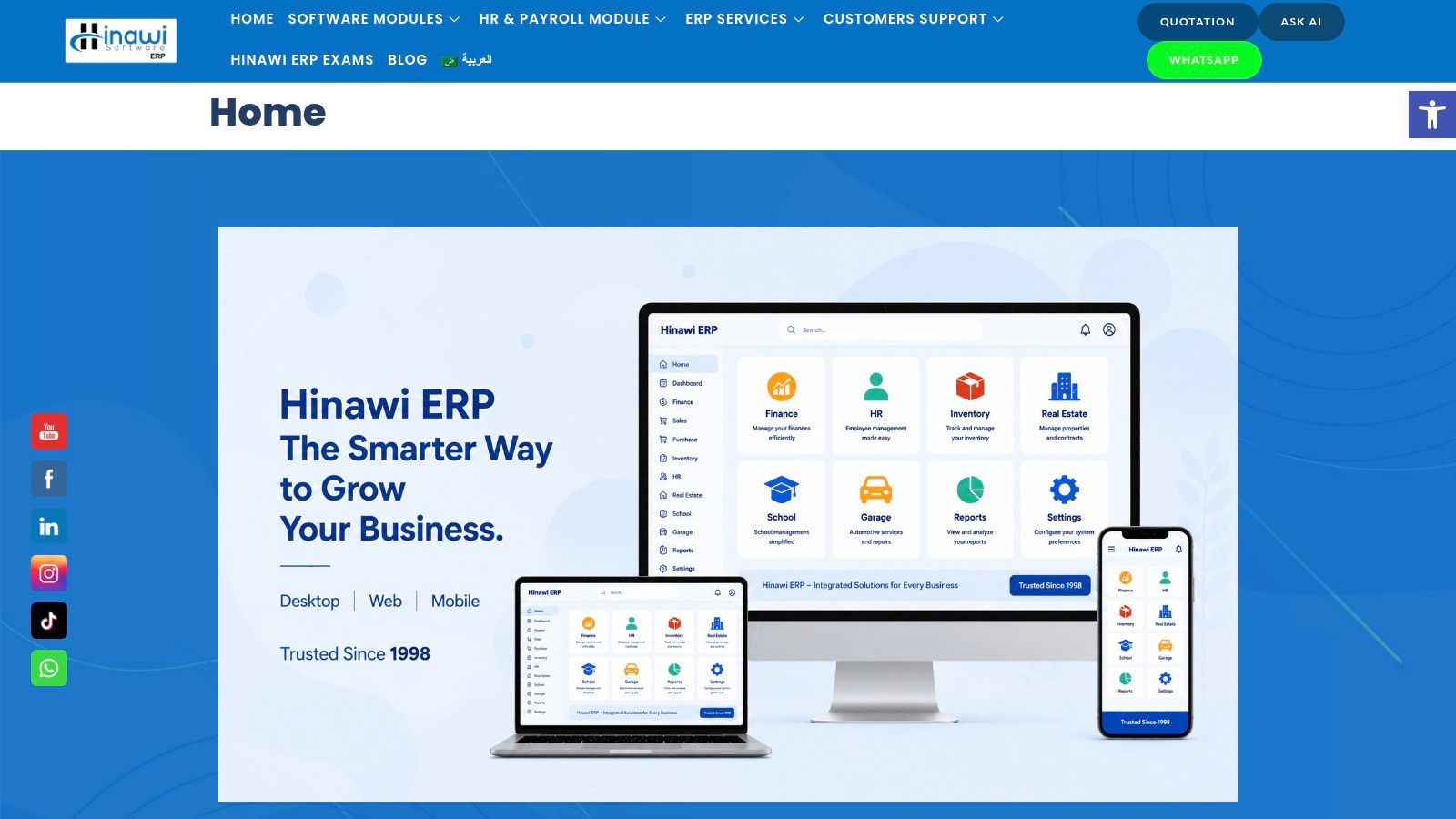
A proper ERP setup doesn't replace judgement. It enforces judgement consistently. That matters because software and digital services often sit in the most disputed zone of Saudi withholding treatment. An ERP with configurable tax rules is built precisely for this problem, helping teams apply company policy consistently across recurring software access fees, licence renewals, APIs, and similar payments, while reducing audit exposure. The same governance logic is central to a strong VAT-compliant ERP environment in the UAE and GCC.
What should be automated
An ERP should control at least these points:
- Vendor master defaults: Foreign vendors should carry residency and withholding review attributes.
- Transaction-level tax codes: AP staff should choose from governed classifications, not free-text guesses.
- Approval routing: Ambiguous digital service invoices should move to tax or finance management before payment.
- Automatic postings: The system should create withholding payable entries alongside the vendor liability.
- Exception reporting: Finance should see every payment with manual overrides, gross-up exposure, or missing support.
Why spreadsheets fail in digital service scenarios
A spreadsheet can list rates. It cannot enforce contract-driven logic at transaction level without constant manual discipline. That's why SaaS, software licensing, cloud subscriptions, and API invoices often get treated inconsistently across branches or users.
One month the invoice is coded as technical services. The next month, another AP clerk books the same supplier as software expense with no withholding review. By quarter-end, finance is reconciling contradictory treatments for the same contract.
What good control looks like in practice
A well-configured ERP workflow should force these questions before payment:
- Is the vendor non-resident?
- Is the payment Saudi-sourced?
- Does the contract involve IP rights, access rights, support, or a mix?
- Is treaty relief being claimed?
- Does the contract require gross-up if tax is withheld?
Good ERP design doesn't make tax decisions for your team. It prevents your team from skipping them.
Integrated systems outperform disconnected accounting tools. AP, contract records, approval hierarchy, general ledger, and tax reporting sit in one controlled flow. That's how you reduce inconsistency, not by sending more reminder emails.
Chat on WhatsApp +971506228024 Quotation – Demo RequestTake the Next Step with Hinawi ERP
If your business deals with Saudi payments, foreign vendors, software subscriptions, intercompany charges, or cross-border consulting, you need more than tax knowledge. You need system control. Manual review alone won't hold up once transaction volume grows or staff changes.
Hinawi ERP is a fully integrated ERP software developed since 1998 in Abu Dhabi for companies operating across the UAE and GCC. It supports Accounting, HR & Payroll, Real Estate Management, Fixed Assets, Manufacturing, Garage & Maintenance, School Management, CRM, and complete business automation. For finance leaders, that matters because withholding tax issues rarely stay inside one module. They start with contracts and vendors, then move through AP, accounting, reporting, and compliance.
Hinawi ERP is a practical fit for businesses that need:
- VAT and e-Invoicing compliance across regional operations
- UAE WPS payroll support for accurate salary processing
- Arabic and English bilingual operation for mixed teams
- Flexible company policy settings that match internal approval and tax rules
- Real-time accounting integration across all modules
- A system suitable for factories, contracting companies, real estate businesses, schools, garages, trading companies, and manufacturers
If you want tighter control over withholding tax in KSA, cleaner month-end closing, fewer posting errors, and better audit readiness, move away from fragmented tools. Build a workflow where policy, accounting, and operational data work together.
Visit Hinawi ERP in the UAE and GCC or go directly to www.hinawierp.com to request a personalised demo and review how your finance, payroll, compliance, and operational processes can run in one integrated environment.
Chat on WhatsApp +971506228024 Quotation – Demo RequestA practical next move is to speak with the team at Explorer Computer LLC – Hinawi Software ERP about how your company can automate tax-sensitive payables, strengthen compliance, reduce manual work, and gain better control across accounting, payroll, operations, and management reporting.