
Category: Accounting
Revenue is up. Stock is moving. Yet your margins still look wrong, VAT feels harder than it should, and every month your accountant gives you a profit number that operations doesn't fully trust.
That usually means one thing. Your cost of goods sold equation isn't under control.
I see this often with UAE trading companies, distributors, importers, and manufacturers. They know sales. They know purchasing. But they don't have a clean bridge between inventory movement, landed cost, gross profit, and VAT reporting. The result is predictable: confused pricing, weak margin visibility, and unnecessary audit risk.
This isn't just an accounting issue. It's an operating model issue. If your system can't tell you what inventory really cost, you can't price properly, you can't trust gross profit, and you can't close the books with confidence. A practical ERP setup matters here because inventory, purchasing, sales, and finance must post together, not sit in separate spreadsheets waiting for month-end clean-up.
If you're reviewing stock valuation in Excel, chasing freight allocations manually, or adjusting gross profit after the fact, you're already behind.
Chat on WhatsApp +971506228024 Quotation – Demo RequestWhy Mastering COGS Is Critical for UAE Business Success
A Dubai trading business can look healthy on the surface and still bleed margin underneath. Sales teams push volume. Purchasing negotiates supplier prices. Finance closes the month. Then the owner asks a simple question: why is cash tight if revenue is growing?
The answer often sits inside the cost of goods sold equation.
In the UAE, this isn't optional bookkeeping. The COGS equation is legally tied to the VAT environment introduced under Federal Decree-Law No. 8 of 2017, and the FTA's 2024 audit results found that 12% of tax discrepancies in the UAE were directly linked to incorrect COGS calculations, leading to over $420 million in adjusted tax liabilities, as noted in this UAE and GCC COGS compliance discussion.
Why owners get this wrong
Many business owners think COGS is just an accountant's line on the income statement. It isn't. It's the number that tells you whether your pricing is realistic, whether your purchasing team is protecting margin, and whether your stock records reflect commercial reality.
If COGS is understated, gross profit looks better than it really is. If it's overstated, management may panic and cut pricing or overhead in the wrong place. Either way, decisions become unreliable.
A useful starting point is understanding how to calculate profit correctly in a UAE business, because profit only makes sense when inventory cost is measured properly.
Practical rule: If your gross profit changes after every stock count adjustment, you don't have a profit problem first. You have a costing problem first.
What strong COGS control gives you
When a UAE company masters COGS, three things improve quickly:
- Pricing discipline because management sees actual product cost, not guessed cost
- Inventory control because slow-moving, overstated, or under-costed stock becomes visible
- VAT confidence because finance can support gross profit and inventory values with clean records
For importers and manufacturers, this becomes even more important. Freight, customs, production costs, and warehouse handling can distort margin if they're treated casually. That's why good businesses stop treating COGS as a year-end accounting adjustment and start managing it as a live operational metric.
Chat on WhatsApp +971506228024 Quotation – Demo RequestThe Core Cost of Goods Sold Equation Explained
The basic formula is simple:
Beginning Inventory + Purchases – Ending Inventory = Cost of Goods Sold
That's the standard cost of goods sold equation for a merchandising business. It looks basic because it is basic. The confusion starts when companies stop respecting what each part means.
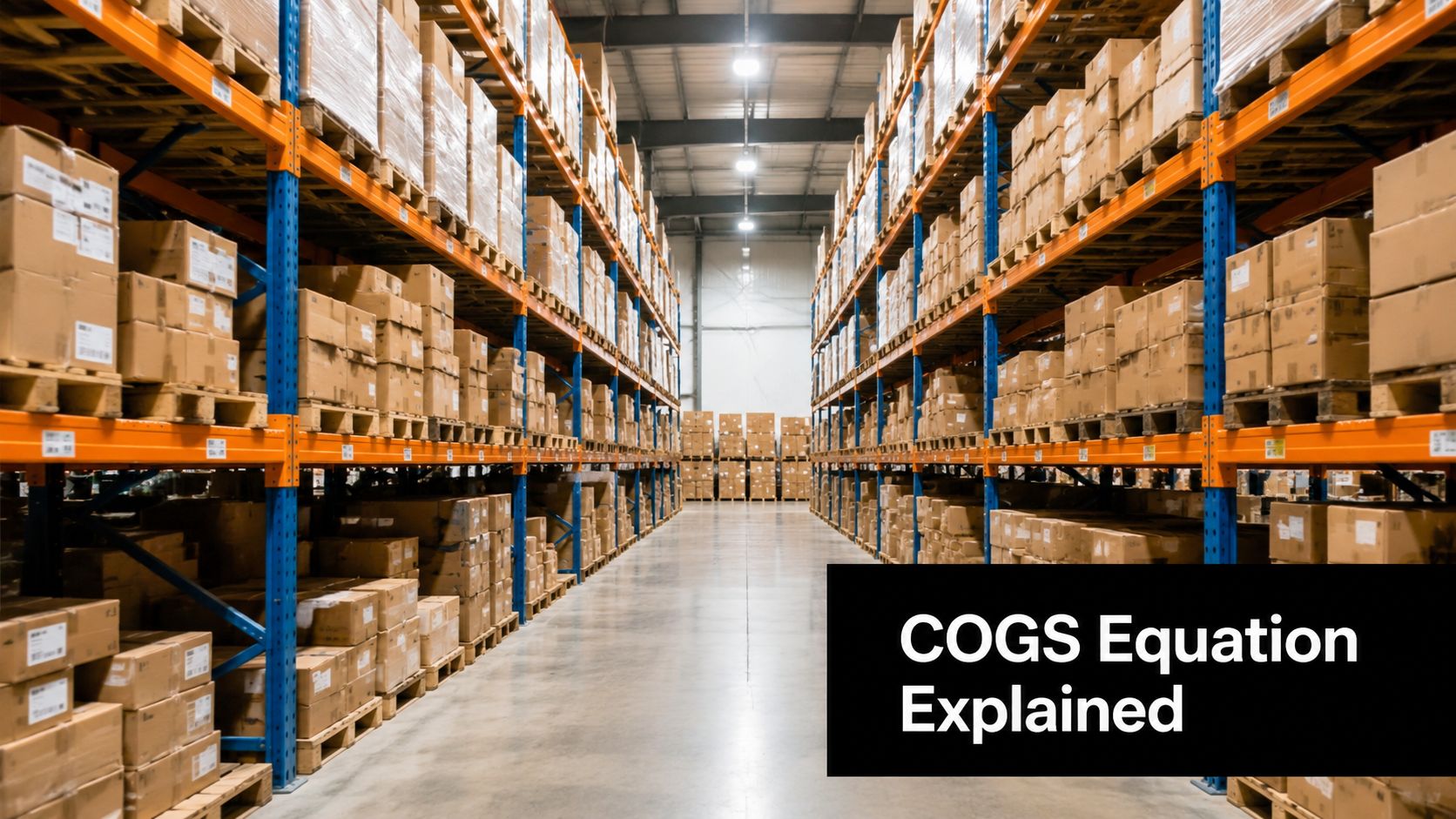
Think of inventory like a stockroom flow
A clean way to understand this is to picture your warehouse stockroom.
You start the month with goods already on the shelves. That is beginning inventory. During the month, you buy more goods and bring them into stock. That is purchases. At the end of the month, some goods remain unsold on the shelves. That is ending inventory.
What left the shelves and was sold becomes your COGS.
Breaking the formula into plain English
Here is what each element means in business terms:
- Beginning inventory is the value of the stock you had on day one of the accounting period.
- Purchases are the goods you bought for resale during the period. In practice, this may later need adjustment for landed cost, but the core formula starts here.
- Ending inventory is the value of the stock still unsold at period end.
Subtract what remains from what was available for sale. The difference is what your business consumed through sales.
If you want the commercial outcome from that calculation, this guide on how to compute gross profit is the next logical step, because gross profit depends directly on the quality of your COGS number.
The formula is simple. The discipline is not. Most costing errors happen because companies trust the formula but mishandle the inputs.
Where businesses usually slip
The common mistakes are operational, not mathematical:
- Wrong opening values because prior-period inventory wasn't closed properly
- Incomplete purchases because some stock receipts or supplier bills are missing
- Unreliable ending inventory because physical counts and system stock don't match
That's why I tell business owners not to admire the formula. Test the process feeding it. A perfect equation with poor inventory records still gives you a bad answer.
COGS Variations for Merchandising and Manufacturing Firms
Not every business should use the cost of goods sold equation in the same way. A trading company in Abu Dhabi and a factory in ICAD don't carry cost through the business the same way. If you force both into one simplistic model, your margins will be wrong.
Merchandising businesses
For a trading or distribution company, COGS usually starts with purchased inventory. The challenge is making sure the stock value reflects the acquisition cost, not just the supplier's base invoice.
A wholesaler importing electrical items into Jebel Ali may receive stock at one purchase price, then absorb freight, clearance, and related inbound costs before the goods are ready for sale. If those amounts are ignored or posted carelessly to overhead, the item cost becomes too low and gross margin becomes artificially high.
For merchandising firms, management should focus on:
- Stock receipt accuracy so purchased quantities and values hit inventory correctly
- Cost build-up discipline so procurement and finance agree on what belongs in stock cost
- Branch consistency because one warehouse using ad hoc adjustments will distort group reporting
Manufacturing firms
Manufacturers need another layer. They don't just buy finished goods for resale. They transform raw materials into finished products. That means COGS depends first on the cost of goods manufactured.
That manufacturing cost generally comes from three pillars:
- Direct materials, such as steel, chemicals, timber, packaging, or components
- Direct labour, including production staff whose work can be assigned to output
- Manufacturing overhead, such as factory-related indirect costs allocated to production
A factory manager using manufacturing resource planning tools should expect the system to capture material issues, labour booking, and production overhead in a structured way. If production is managed outside the accounting system, finished goods costs usually become estimates instead of controlled figures.
A manufacturer that costs only materials is not doing product costing. It's doing partial costing and calling it complete.
Side-by-side comparison
| Business type | Main cost source | Main risk |
|---|---|---|
| Trading company | Purchased inventory | Ignoring landed and inbound acquisition costs |
| Manufacturing company | Produced inventory | Missing labour or overhead in product cost |
| Mixed business | Both purchased and produced stock | Using one valuation rule for two different cost flows |
The practical point is straightforward. A reseller needs disciplined inventory acquisition cost. A factory needs disciplined production costing. Both need a system that posts cost in real time instead of waiting for manual adjustments at month-end.
Chat on WhatsApp +971506228024 Quotation – Demo RequestInventory Valuation Methods and IFRS Impact in the GCC
The cost of goods sold equation tells you the structure. Inventory valuation tells you the money value attached to that structure. That's where many GCC companies get uncomfortable, because stock isn't just counted by quantity. It must also be valued consistently.
FIFO and weighted average
Two common IFRS-aligned methods used in practice are FIFO and Weighted Average Cost.
FIFO assumes the earliest purchased items are sold first. In a rising cost environment, older and cheaper stock moves into COGS first, which often produces lower COGS and higher gross profit than weighted average.
Weighted Average Cost smooths price changes by spreading total available cost across total units. It usually produces a middle-ground cost figure and reduces volatility in item costing.
LIFO is not used under IFRS in this context, so UAE and GCC businesses need to configure their systems around acceptable methods and apply them consistently.
Why the GCC context matters
This is not just theory. In the GCC, IFRS adoption tied to the standard COGS formula has been associated with a 34% increase in transparent financial reporting, and in Qatar, 89% of trading companies adjusted their inventory valuation methods to align with the COGS equation, resulting in a 22% reduction in financial reporting errors. Those figures are noted in the verified source background, and they reinforce a simple point: inventory valuation policy affects reporting quality.
For multi-branch groups, this matters even more when preparing consolidated financial statements across entities and locations. One branch using FIFO and another using inconsistent manual averages creates reporting noise that finance then has to clean up.
Decision point: Choose one IFRS-compliant method that fits your stock behaviour, configure it correctly, and stop changing it casually to make margins look better.
Impact of inventory valuation on COGS
| Metric | FIFO Method | Weighted Average Method |
|---|---|---|
| Assumption | Oldest inventory is sold first | Average cost is applied across units |
| COGS in rising prices | Usually lower | Usually more moderate |
| Gross profit in rising prices | Usually higher | Usually more moderate |
| Stock value of closing inventory | Often reflects newer costs | Reflects blended cost |
| Management effect | Can make margins appear stronger in inflationary periods | Can make reporting smoother and more stable |
What management should do
A valuation method is not a finance-only setting. It affects pricing, purchasing review, and profitability analysis.
Use this checklist:
- Match method to stock reality if goods move in sequence and age matters, FIFO is often easier to explain
- Prioritise consistency because changing valuation methods without strong governance damages comparability
- Automate calculation because manual weighted average calculations across many SKUs are asking for errors
This is one area where a properly configured ERP earns its keep. Once valuation rules are embedded into stock, purchase, and sales transactions, finance gets cleaner gross profit without rebuilding everything in spreadsheets.
Practical Examples and Journal Entries
Theory is useful. Book entries close the month.
Let's use a straightforward example for a UAE trading company. I'll keep it numerical but simple enough to follow operationally.
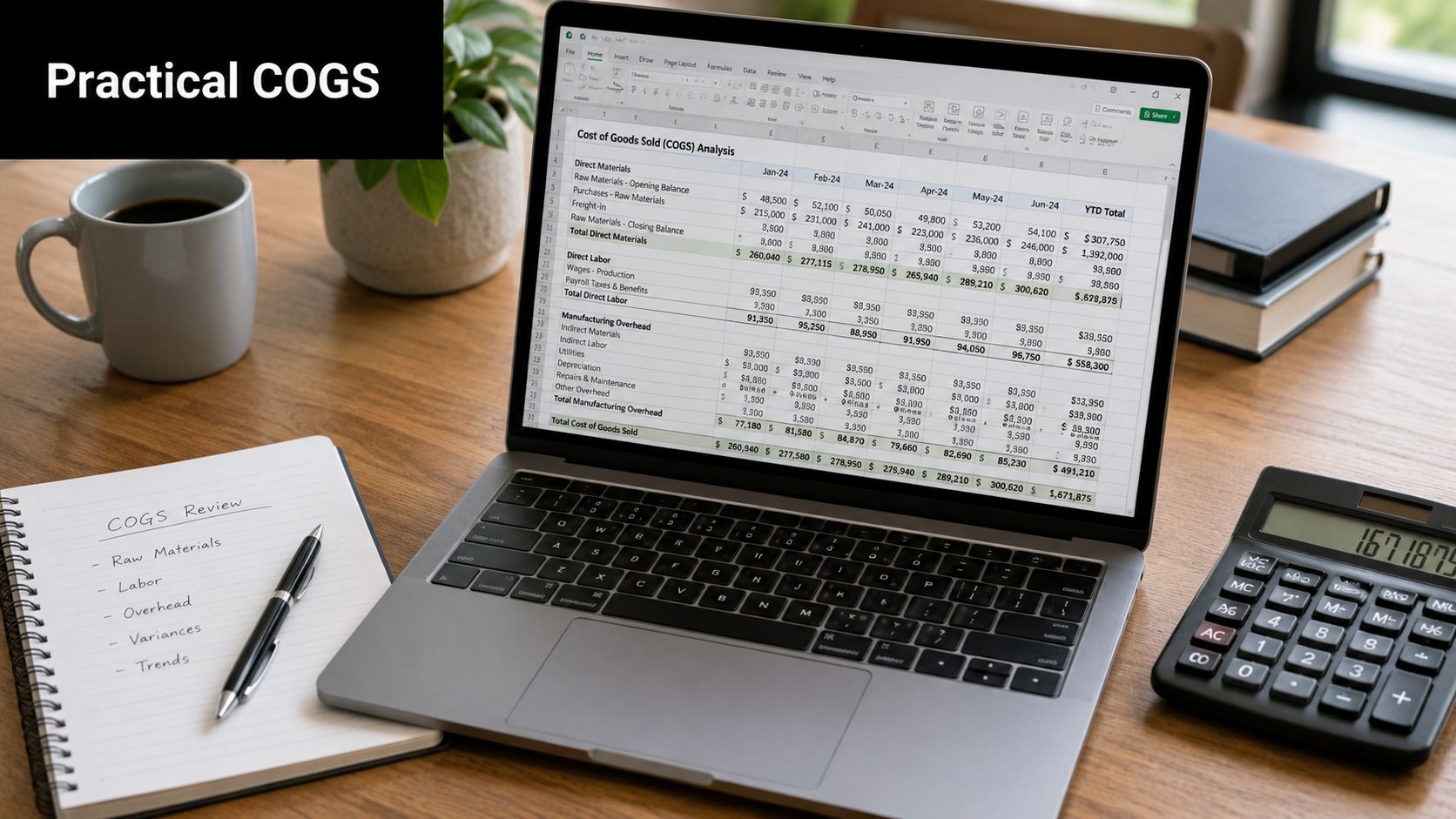
A clean worked example
Assume the business has:
- Beginning inventory of 100 units at AED 10 each
- Purchase 1 of 100 units at AED 12 each
- Purchase 2 of 100 units at AED 14 each
- Units sold during the period of 220 units
- Ending inventory of 80 units
First, calculate goods available for sale.
| Item | Units | Unit cost | Total cost |
|---|---|---|---|
| Beginning inventory | 100 | AED 10 | AED 1,000 |
| Purchase 1 | 100 | AED 12 | AED 1,200 |
| Purchase 2 | 100 | AED 14 | AED 1,400 |
| Goods available for sale | 300 | AED 3,600 |
FIFO result
Under FIFO, the first 220 units sold would be:
- 100 units from beginning inventory at AED 10
- 100 units from purchase 1 at AED 12
- 20 units from purchase 2 at AED 14
So FIFO COGS becomes AED 2,480.
Ending inventory under FIFO becomes the remaining 80 units from purchase 2, valued at AED 1,120.
Weighted average result
Average cost per unit is AED 3,600 divided by 300 units, which equals AED 12 per unit.
Under weighted average:
- COGS for 220 units sold = AED 2,640
- Ending inventory for 80 units = AED 960
That difference is exactly why valuation policy matters. Same stock movement. Different reported COGS. Different gross profit.
If your team wants to align these postings with UAE bookkeeping practice, this reference on journal entries in accounting for UAE businesses is useful.
Don't wait for auditors to discover that your inventory numbers make sense only in Excel. The ledger must reflect the same costing logic the warehouse follows.
Typical journal entries
When inventory is purchased:
| Transaction | Debit | Credit |
|---|---|---|
| Inventory purchase on credit | Inventory | Accounts Payable |
| Inventory purchase paid immediately | Inventory | Cash or Bank |
When recognising cost of goods sold at period end in a periodic system:
| Transaction | Debit | Credit |
|---|---|---|
| Recognise COGS | Cost of Goods Sold | Inventory |
In a perpetual inventory environment, the system posts cost automatically when goods are sold:
| Transaction | Debit | Credit |
|---|---|---|
| Record sale cost | Cost of Goods Sold | Inventory |
That's why serious inventory businesses should prefer perpetual, system-driven accounting over periodic guesswork.
Common Pitfalls and Advanced Considerations
The textbook version of the cost of goods sold equation is incomplete for many UAE businesses. It's too neat. Real operations are not neat.

Landed cost is where many importers fail
If your business imports stock into the UAE, the supplier invoice alone is not always the full inventory cost. A frequent challenge for import-heavy UAE businesses is accounting for landed costs. The basic COGS formula often omits whether freight, insurance, and import duties should be capitalised into inventory or expensed, and that distinction is critical for VAT and e-invoicing compliance.
Many finance teams make a damaging mistake. They post freight and duty to a general expense account because it's faster. That makes current-period profit look weaker in one month, item margin look stronger later, and stock value less reliable throughout.
Errors that distort profit and compliance
The most common problems I see are these:
- Freight treated inconsistently across shipments, suppliers, or branches
- Customs and duty handled outside stock cost even when directly attributable to inventory acquisition
- Physical counts ignored until year-end, leaving shrinkage or stock errors buried in margin
- Revenue matched to the wrong period while cost recognition lags behind
- Manual journal corrections used repeatedly because the source transaction flow is broken
If finance has to “fix” inventory every month with journal entries, operations is not integrated with accounting properly.
A stricter operating approach
Use a harder standard:
- Capture inbound stock through purchase and receipt controls.
- Assign directly attributable landed costs to inventory, not random expense accounts.
- Reconcile physical and system quantities routinely, not only at year-end.
- Make sure sales invoices, stock issue, and COGS posting happen in the same transaction flow.
This is the point where software configuration matters more than accounting theory. One practical option is Explorer Computer LLC – Hinawi Software ERP, which includes inventory, accounting, manufacturing, and cost-accounting functions in one flow so that purchases, stock movement, and ledger postings stay connected. That matters because disconnected systems create most of the errors management later tries to explain away.
Automating COGS with Hinawi ERP for Ultimate Control
Manual costing is risky. It's also slow, inconsistent, and expensive to supervise.
A proper ERP setup automates the full chain behind the cost of goods sold equation. Purchase orders feed receipts. Receipts update stock. Landed cost can be applied to inventory. Sales issue stock and post COGS. Manufacturing consumption updates product cost. The general ledger reflects all of it in real time.
That operating model gives management control in areas spreadsheets never handle well:
- Multi-warehouse inventory visibility across branches and locations
- FIFO or weighted average automation without manual recalculation
- Manufacturing cost roll-up through materials, labour, and overhead logic
- Real-time gross profit reporting by item, project, branch, or customer
- Cleaner VAT support because cost and stock records remain auditable
If your company imports, manufactures, distributes, or manages multiple branches, don't accept month-end costing drama as normal. It isn't. It's a system weakness.
Chat on WhatsApp +971506228024 Quotation – Demo RequestTake the Next Step with Hinawi ERP
For companies in the UAE and GCC, accurate COGS management isn't just good accounting practice. It's a control point for profitability, VAT compliance, inventory accuracy, and management reporting.
If you're still relying on spreadsheets, disconnected software, or month-end manual adjustments, you're exposing the business to avoidable errors. You're also making decision-making harder than it needs to be. Management should be reviewing margin by item, shipment, product line, or production batch from the system itself, not reconstructing cost after the fact.
Hinawi ERP is a fully integrated ERP software developed since 1998 in Abu Dhabi for businesses across the UAE and GCC. It supports Accounting, HR & Payroll, Real Estate Management, Fixed Assets, Manufacturing, Garage & Maintenance, School Management, CRM, and complete business automation.
It's particularly relevant for companies that need:
- VAT and e-Invoicing compliance
- UAE WPS payroll support
- Arabic and English bilingual operation
- Flexible company policy settings
- Real-time accounting integration across all modules
- Operational fit for factories, contracting firms, real estate businesses, schools, garages, trading companies, and manufacturers
If your current process makes stock cost hard to trust, modernise it. Reduce manual work. Improve financial accuracy. Give management live control over costing, accounting, and operations.
Visit Hinawi ERP or request a personalised demo to see how an integrated ERP can handle inventory, landed cost, manufacturing, payroll, fixed assets, and financial reporting in one environment.
A practical next move is to speak with Explorer Computer LLC – Hinawi Software ERP about your current inventory costing, VAT process, and reporting gaps. If your business operates in the UAE or GCC and needs tighter control over accounting, payroll, manufacturing, real estate, fixed assets, CRM, schools, garages, or broader business automation, their Abu Dhabi-based team can walk you through a personalised approach and live demo.