
Category: Accounting
A lot of finance teams in the UAE are still using a payment voucher template that was downloaded years ago, adjusted in Excel, printed when needed, and trusted far more than it should be. It works until someone asks for the full trail behind a payment. Then the problems show up quickly. The invoice is in one folder, the transfer advice is in email, the approval happened on WhatsApp, and the voucher itself contains only a date, an amount, and one signature.
That isn't just untidy. It weakens control.
A proper payment voucher template is not a stationery item. It is a control document that sits between request, approval, payment, accounting entry, and audit review. In UAE businesses, that distinction matters because finance teams are expected to maintain records that can support tax treatment, expense classification, and payment legitimacy. Generic templates rarely deal with that reality, especially in bilingual environments or companies moving toward structured digital workflows.
The gap usually appears when a business grows. A small team can tolerate informal handling for a while. A multi-branch business, a contractor, a real estate company, or a manufacturer can't. Once payments involve multiple approvers, VAT coding, supplier checks, and month-end reconciliation, a weak voucher format becomes a recurring source of error.
Systems matter here too. A template can impose discipline, but software determines whether that discipline survives at scale. In practice, finance teams often move from a manual template to an approval-driven accounting workflow inside ERP once duplicate effort and missing documentation start affecting close quality and audit readiness.
Chat on WhatsApp +971506228024 Quotation – Demo Request
From Manual Mess to Audit-Ready A Document of Control
The most common failure I see is not that teams lack a payment voucher template. It's that they use one with too little structure to prove anything later.
A typical example is easy to recognise. The accounts team pays a supplier by bank transfer. The supporting invoice is valid, the business expense is genuine, and the payment itself is real. Months later, someone reviews the transaction and asks four basic questions. Who approved it, what was paid, which invoice did it settle, and where is the evidence of release? If those answers sit across separate files and messages, the voucher hasn't done its job.
That's why the voucher should be treated as a document of control, not a mere payment note. It should bring the essential transaction facts into one governed record and connect them to the underlying evidence. Companies that align this with stronger governance principles usually find the process easier to defend during reviews, especially where finance leadership is also thinking about broader control environments such as Sarbanes-Oxley compliance practices.
A payment voucher is strongest when a reviewer can understand the transaction without hunting through five different places.
What an audit-ready voucher changes
A well-built voucher creates discipline in three places:
- Before payment: It forces someone to specify the payee, amount, purpose, and source document.
- At approval: It makes accountability visible by showing who prepared, checked, and authorised the payment.
- After posting: It gives accounting and audit teams one reference point for reconciliation.
This matters operationally as much as it matters for compliance. In month-end close, weak vouchers slow down AP verification. In internal review, they make exception testing harder. In external audit, they increase follow-up requests.
The result is simple. If a payment voucher template cannot prove the transaction path, it's only a partial record.
Core Components of a Compliant Payment Voucher
Most downloadable forms include the obvious fields. Date, voucher number, payee, amount, and signature. That's the bare minimum, but it isn't enough for a finance team that needs traceability.
The compliance gap is well described in a discussion of voucher formats at this payment voucher reference, which notes that common public templates usually stop at basic fields and don't explain how to align the form with approval evidence, attachment control, or audit-ready documentation. That's exactly where many UAE companies struggle.

Header fields that should never be optional
Start with the top of the form. This section should carry the identifying data that makes the voucher searchable, sequential, and reviewable.
| Field | Why it matters |
|---|---|
| Voucher number | Creates a unique transaction reference and supports filing discipline |
| Voucher date | Establishes the document date for review and period control |
| Payment date | Distinguishes preparation from actual release |
| Branch or entity | Helps in multi-location or multi-company environments |
| Ledger account code | Links the voucher to accounting classification |
A unique serial number is more important than many teams realise. Without it, duplicate detection, audit selection, and reconciliation all become harder.
Payment and payee fields that improve verification
The next group should identify exactly who received funds and how the payment moved.
Include these items clearly:
- Payee name: Use the legal or approved supplier name, not a casual short form.
- Payment method: Distinguish cheque, bank transfer, cash, or another authorised method.
- Reference detail: Record cheque number, bank reference, UTR, or other payment identifier when relevant.
- Amount: Show the amount clearly. Many companies also show it in words for control purposes.
- Currency: Essential where the business operates across borders or books in multiple currencies.
Narration and source linkage
This area is usually the weakest part of a manually built template. The description says things like “supplier payment” or “expenses”, which tells a reviewer almost nothing.
Write narration so that a finance controller can understand the transaction in one read. A better entry links the payment to the business purpose and source document. For example, the voucher should refer to the supplier invoice, purchase order, rent period, asset purchase, or service period as applicable.
Practical rule: If the narration can be copied onto ten unrelated transactions without changing the meaning, it's too vague.
Sign-off and attachment control
A compliant template needs room for more than one signature. It may require the issuer, approver, and recipient to sign, and it should be attached to related payment documentation. That is where a simple form becomes usable in a real accounts payable workflow.
Use a dedicated checklist or attachment box for items such as:
- Supplier invoice attached
- PO or contract attached
- Bank proof or cheque copy attached
- Receiving or service evidence attached where relevant
- Approval evidence complete
Chat on WhatsApp +971506228024 Quotation – Demo Request
A voucher that lacks attachment discipline might still look complete. It just won't stand up well when someone tests the transaction from end to end.
Designing for Bilingual and VAT Compliance in the UAE
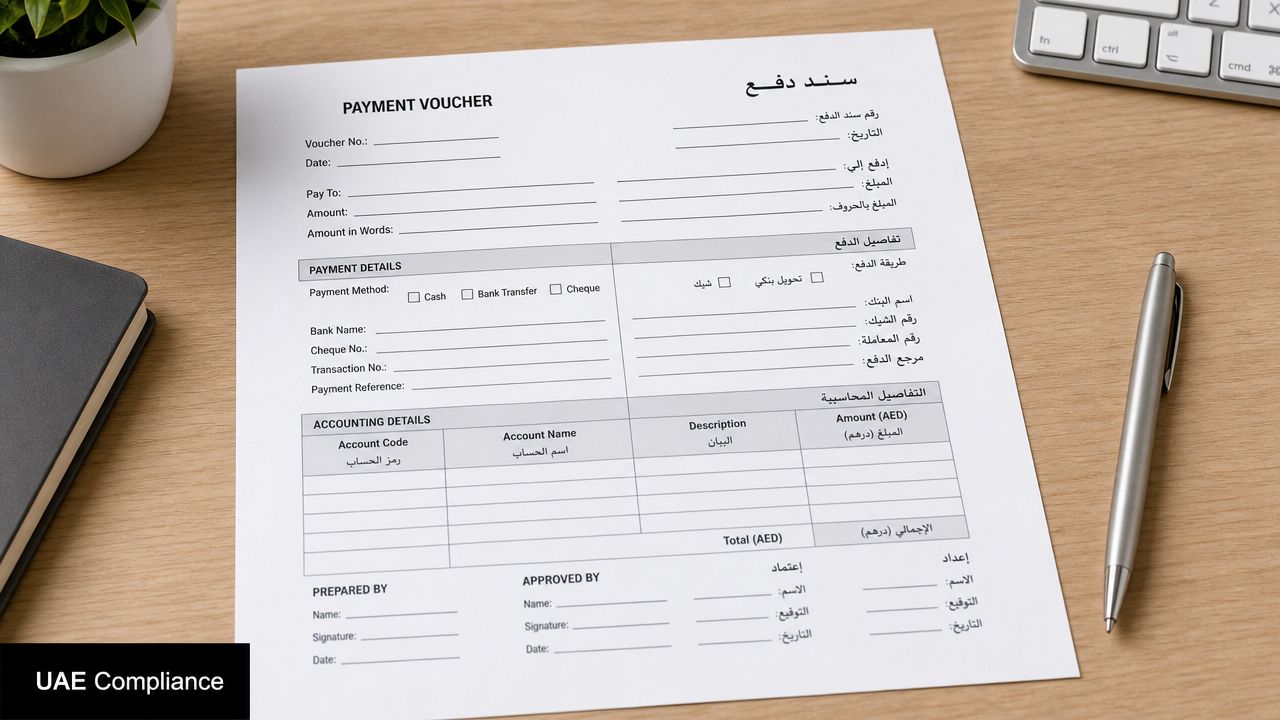
In the UAE, the voucher format must suit the business environment you operate in. That means bilingual usability and VAT awareness built into the design, not added later by hand.
According to Wafeq's UAE payment voucher guidance, businesses must retain accounting records and supporting documents for at least 5 years under VAT record-keeping rules, and the UAE VAT rate is 5%. The same guidance highlights the need for sufficient audit trail documentation to support input tax recovery and expense classification. That changes how a payment voucher template should be designed from the start.
Bilingual layout that stays readable
A bilingual voucher often fails because the designer tries to fit too much into one line. The result is cramped labels, inconsistent terminology, and confusion for the person entering or reviewing the document.
A better layout usually follows one of these patterns:
- Side-by-side bilingual labels: English and Arabic appear together for each field.
- Mirrored structure: One language appears on one side and the other on the opposite side, with identical field order.
- System-generated bilingual printout: Data is entered once, while labels print in both languages.
For businesses evaluating bilingual finance operations, this becomes easier when the document style matches the wider system design, including Arabic and English ERP workflows.
VAT fields that belong on the voucher
A UAE-ready payment voucher shouldn't rely on someone remembering tax details from the invoice file. The voucher should carry enough information to support review and posting.
At minimum, the form should accommodate:
| VAT-related item | Control purpose |
|---|---|
| Supplier identification | Confirms the payment belongs to the correct vendor record |
| Tax treatment field | Shows whether the expense includes VAT and how it is coded |
| VAT amount | Helps verify the tax component before posting |
| Gross amount | Supports reconciliation between invoice, voucher, and payment |
| Linked invoice reference | Connects the voucher to the source tax document |
Where businesses often go wrong is not in calculating VAT, but in losing the connection between the payment and the invoice carrying the tax evidence. That weakens the support for input tax recovery.
What weak VAT design looks like
A weak template usually has one “amount” box and one “purpose” line. That forces AP staff to keep the VAT logic in their heads or in another spreadsheet. During payment runs, that invites miscoding. During review, it slows everything down because the voucher itself doesn't explain the tax position.
The voucher should not replace the invoice. It should make the invoice traceable, the tax treatment visible, and the approval trail complete.
For SMEs and multi-branch companies, many generic templates stop being practical. They may be printable, but they aren't structured enough for tax-led review.
Structuring for Approval Workflows and Internal Controls
The strongest payment voucher template is the one that enforces behaviour before money leaves the bank. That is why structure matters as much as content.
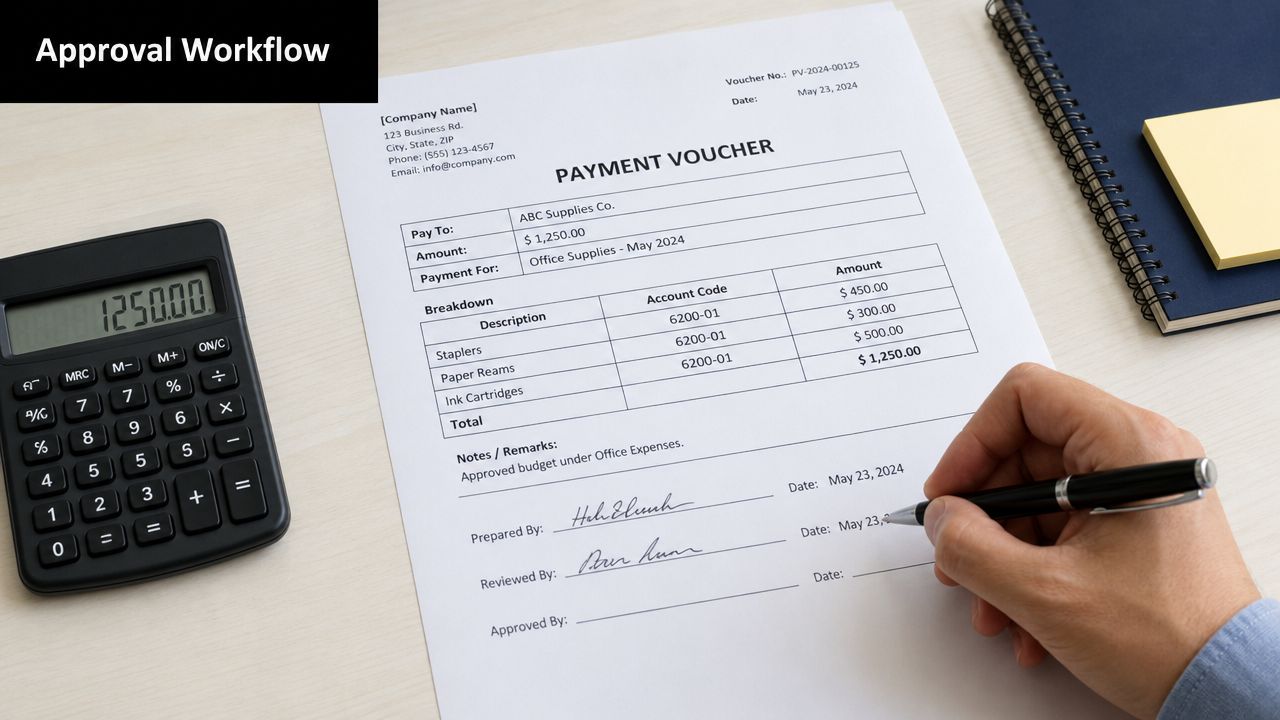
A practical reference from MyBillBook's payment voucher format guidance describes the most defensible design as a three-control audit chain made up of voucher header fields, linked source documents, and approval evidence. It also notes a common pitfall in manual templates: free-text or unlinked fields that break traceability and make reconciliation harder. That observation matches what finance teams deal with every month.
The three-control audit chain in practice
The model is straightforward:
- Voucher header fields identify the payment clearly.
- Linked source documents prove the payment relates to a genuine obligation.
- Approval evidence shows the business released funds through authorised review.
When one of those layers is missing, the control weakens. The most dangerous gap is usually the third one. Companies often have invoices and payment proofs, but the approval trail sits outside the voucher in chats, emails, or verbal instructions.
Approval boxes should reflect actual authority
A voucher with one line for “Authorised Signature” is too simple for most businesses beyond the smallest scale. The form should reflect separation of duties.
Use sign-off areas such as:
- Prepared by: The person who assembled the transaction and entered the voucher.
- Checked by: The reviewer who confirms coding, attachments, and support.
- Approved by: The manager or finance authority who authorises release.
- Received by: Relevant where cash or physical handover is involved.
This should also align with your vendor and invoice handling process, especially if approvals start before payment through workflows such as vendor invoice management.
Control warning: If the same person can create, approve, and release the voucher without visibility, the template isn't supporting control. It's only documenting activity.
A weak template versus a controlled template
The difference is usually obvious.
| Weak template | Controlled template |
|---|---|
| Free-text payee names | Payee tied to approved supplier identity |
| Vague purpose line | Narration linked to invoice or PO |
| One signature field | Distinct approval stages |
| No attachment record | Required supporting document list |
| Separate payment proof | Reference captured on the voucher |
Many finance leaders must take a firm stance. Staff often prefer flexible forms because they're quicker in the moment. But flexibility in payment documentation usually pushes the detailed work into audit, reconciliation, and exception handling later.
Chat on WhatsApp +971506228024 Quotation – Demo Request
Automating Vouchers with an ERP for E-Invoicing Readiness
A manual payment voucher template can improve discipline, but only up to a point. Once transaction volume rises, paper and spreadsheet controls begin to break. Serial numbering gets inconsistent, attachments go missing, versions change, and approval evidence sits outside the accounting record.
That problem becomes more pressing as digital compliance expectations increase. The UAE Ministry of Finance announced that the national e-invoicing framework will roll out in phases beginning in 2026, according to this e-invoicing reference. For finance teams, that means voucher processes will increasingly need digital approval trails, ERP accounting links, and structured document storage instead of isolated Word or PDF forms.
What changes when the voucher lives inside ERP
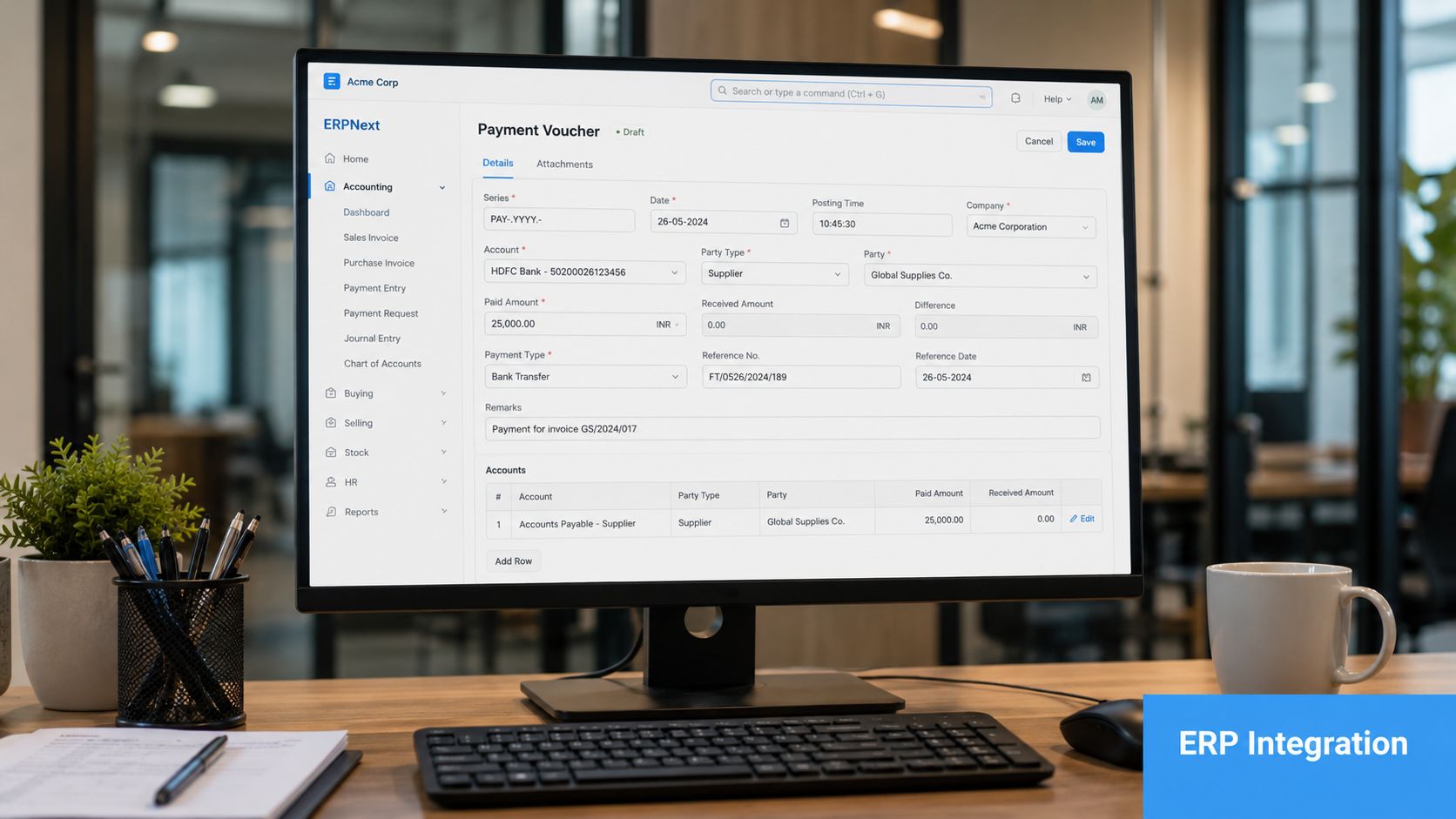
The biggest shift is that the voucher stops being a detached document and becomes part of a transaction flow.
A well-set system can do the following:
- Generate the voucher from source activity: For example, from a purchase invoice or approved payment request.
- Route approvals digitally: Based on amount, department, branch, or company policy.
- Post accounting entries after approval: Reducing re-entry and coding mistakes.
- Store the support set together: Invoice, proof of payment, and approval trail in one place.
Businesses preparing for structured digital finance processes often start by tightening their accounting and tax flow in areas such as UAE e-invoicing readiness.
The trade-off between template freedom and system control
Teams often resist ERP-driven vouchers at first because manual templates feel more flexible. They can add notes anywhere, change layouts, or bypass missing fields. That flexibility is exactly the problem.
An ERP-enforced voucher gives you less room to improvise and more confidence that each payment follows policy. In practice, that usually means better traceability, cleaner month-end support, and easier review across departments like procurement, finance, payroll, and fixed assets.
One example in the UAE market is Explorer Computer LLC's Hinawi ERP, which includes accounting workflows and printable payment voucher functions inside a broader integrated environment. Used properly, that kind of setup allows the voucher, invoice, approval path, and ledger posting to remain connected rather than managed as separate tasks.
Chat on WhatsApp +971506228024 Quotation – Demo Request
Where this matters most
This isn't just an AP concern. It becomes critical in businesses with:
- Payroll-related disbursements
- Fixed asset purchases
- Multi-entity or multi-branch approvals
- Project-based contractor payments
- Real estate and recurring supplier settlements
In those environments, the voucher needs to be controlled, searchable, and linked. A static template can start the process. It usually can't finish it well.
Take the Next Step with Hinawi ERP
A strong payment voucher template gives your business a cleaner document. A connected ERP gives you a controlled process.
That distinction matters if you're trying to reduce manual work, improve audit readiness, and maintain consistency across departments. Many UAE and GCC businesses still operate with fragmented payment handling. Accounting keeps the voucher. Procurement keeps the invoice trail. Management approvals sit in email. Payroll, fixed assets, projects, and real estate transactions follow their own routines. Over time, reporting suffers because the process itself is split.
Hinawi ERP addresses that problem as an integrated business platform developed in Abu Dhabi since 1998 through Hinawi ERP UAE. For companies in the UAE and GCC, that matters because payment vouchers rarely exist in isolation. They connect to accounting, supplier management, HR and payroll, fixed assets, real estate activity, manufacturing operations, garage and maintenance processes, CRM, and broader business automation.
Why this matters for decision-makers
Business owners and finance leaders usually want the same outcomes:
- Fewer manual dependencies: So finance staff don't spend time chasing attachments and approvals.
- Better financial accuracy: So each payment reaches the right account, supplier, and reporting period.
- Clear compliance handling: Especially around VAT treatment and e-invoicing readiness.
- Operational visibility: So management can review payments across branches, projects, or entities without relying on spreadsheets.
Hinawi ERP supports VAT and e-Invoicing compliance, UAE WPS payroll, Arabic and English bilingual operation, flexible company policy settings, and real-time accounting integration across all modules. That combination is particularly useful for factories, contracting companies, real estate businesses, schools, garages, trading companies, and manufacturers that need one workflow instead of several disconnected ones.
A practical next step
If your current payment voucher template still depends on manual numbering, uncontrolled edits, or separate filing of approvals and support documents, the process is already telling you it needs redesign.
Start by reviewing three areas:
- Document design. Does the voucher prove the transaction clearly?
- Approval structure. Does the process enforce authority before payment release?
- System integration. Does the voucher connect to accounting, reporting, and storage?
If the answer is weak in any of those areas, this is the right time to modernise. Companies across Abu Dhabi, the UAE, Saudi Arabia, and the GCC are under pressure to tighten controls while also reducing routine finance effort. A connected ERP is usually the point where those goals stop conflicting.
Chat on WhatsApp +971506228024 Quotation – Demo Request
For companies that want to move beyond static forms and build a more reliable payment control environment, the practical next step is to speak with the Hinawi ERP team, review your current workflow, and see how an integrated system can support accounting accuracy, approval discipline, and day-to-day operational control.
Explorer Computer LLC – Hinawi Software ERP supports companies in the UAE and GCC that want stronger financial control, less manual work, and better visibility across accounting, HR & Payroll, Real Estate Management, Fixed Assets, Manufacturing, Garage & Maintenance, School Management, CRM, and complete business automation. Visit www.hinawierp.com to learn more or request a personalised demo.