
Category: Accounting
Your stockroom may look full, but your cash position can still feel tight. That's a common problem for trading, distribution, and manufacturing businesses across the UAE and GCC. Goods sit on shelves, capital gets trapped, warehouse space disappears, and management keeps asking the same question: if we have so much inventory, why does cash still feel under pressure?
That's where the inventory turnover ratio stops being an accounting formula and starts becoming a management tool. It tells you how effectively you convert inventory into sales over a period. Used properly, it helps you judge whether stock is moving at the right pace for your business model, whether you're tying up too much working capital, and whether your warehouse is supporting profit or undermining it.
Most businesses don't have a calculation problem. They have a visibility problem. When purchasing sits in one spreadsheet, warehouse balances in another, and finance closes numbers later, you don't get a usable turnover signal. You get delayed hindsight. If you want to manage inventory turnover ratio properly, you need integrated operational and accounting visibility, not manual guesswork.
If you also want a clearer view of profit impact, review how gross profit and stock decisions connect to business performance.
Chat on WhatsApp +971506228024 Quotation – Demo Request
The Hidden Costs of Inefficient Inventory
A business owner in Abu Dhabi imports fast-moving items, keeps extra stock to avoid delays, and rents additional warehouse space because the main facility is already packed. Sales are happening, but the finance team still slows vendor payments, watches cash carefully, and keeps postponing other investments. The problem isn't always poor revenue. Often, it's inventory sitting too long.
Inventory is recorded as an asset. In real operations, it can behave like a liability when control is weak. Every slow-moving pallet consumes cash, space, attention, and storage effort. It also creates hidden pressure on forecasting, replenishment, and reporting.
Why stock can hurt before it helps
When turnover is poor, the business usually absorbs several costs at once:
- Working capital pressure: Money stays locked in goods instead of funding payroll, supplier settlements, maintenance, or expansion.
- Warehouse congestion: Teams spend more time locating, moving, counting, and managing stock that should have been sold already.
- Decision fog: Managers can't easily distinguish healthy buffer stock from dead stock.
- Margin erosion: Old stock often ends up discounted, bundled, or written down just to clear space.
Practical rule: If inventory keeps rising faster than management confidence, you don't have a storage issue. You have a control issue.
In the GCC, this gets worse when stock is spread across branches, warehouses, or free zone locations. One site may be overstocked while another faces shortages. On paper, the company looks covered. In practice, customer service suffers and cash gets trapped in the wrong place.
What owners should watch
Don't treat inventory turnover ratio as a number only for accountants. Use it to challenge purchasing, warehousing, and sales decisions. If the ratio weakens, ask which SKUs are slowing down, which locations are holding excess stock, and whether procurement is reacting to fear instead of demand.
That's the shift that matters. Good operators don't ask only, “How much stock do we have?” They ask, “How fast is it moving, why is it moving at that pace, and what is it doing to cash?”
Calculating the Inventory Turnover Ratio
The formula is straightforward. The discipline is in using the right figures and reading them in the right period.
Inventory turnover ratio = Cost of Goods Sold ÷ Average Inventory
That means you compare the cost of what you sold during a period against the average value of inventory you held during that same period. For a UAE trading company, distributor, or manufacturer, this gives a practical measure of stock velocity.
Start with Cost of Goods Sold
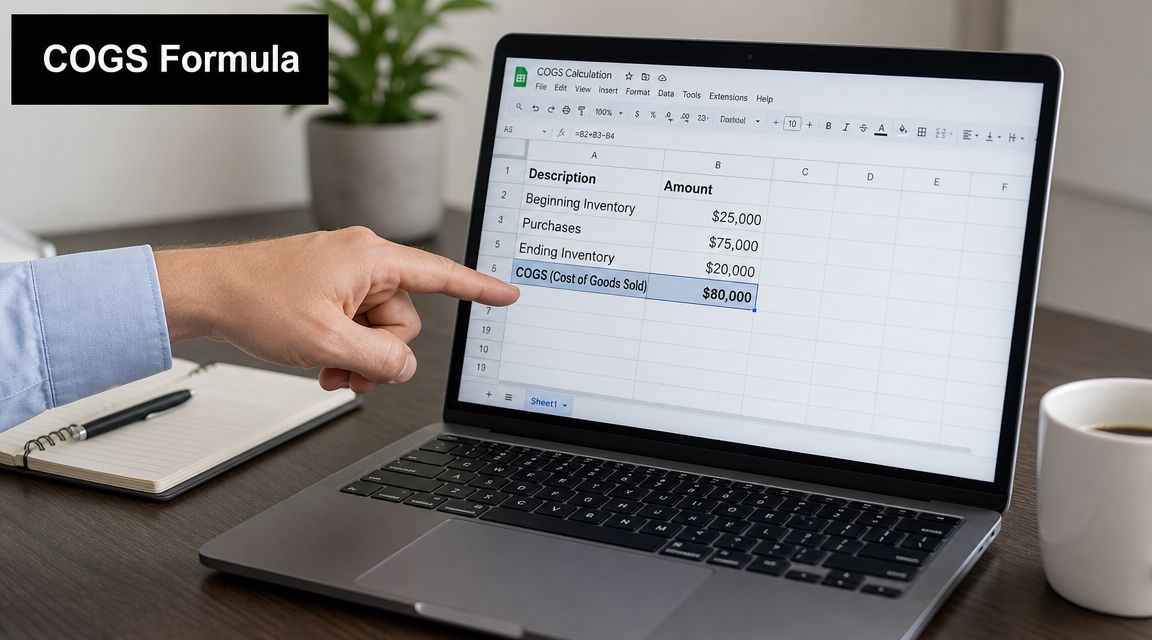
Cost of Goods Sold, or COGS, comes from your income statement. It reflects the direct cost of the items sold during the selected period. If you're a distributor, that usually means purchase-related item costs. If you manufacture, it includes the direct production cost assigned to finished goods sold.
Don't use sales revenue in this formula. That distorts the result. Use COGS because the ratio is meant to compare stock value with the actual cost movement through the business.
If your team needs a clearer accounting foundation first, review how gross profit is computed in practical business terms. It helps separate revenue thinking from cost thinking, which is essential when reading turnover correctly.
Then calculate Average Inventory
Average inventory is usually calculated as:
(Beginning Inventory + Ending Inventory) ÷ 2
A single closing balance can mislead you. If you imported a large shipment near month-end, your inventory snapshot may look unusually high. If you cleared stock just before reporting, it may look unusually low. Using an average gives a more realistic picture.
Here's the basic process:
- Choose one period: Month, quarter, or year. Stay consistent.
- Take beginning inventory value: Use the value at the start of that period.
- Take ending inventory value: Use the value at the close of that period.
- Calculate the average: Add both values and divide by two.
- Divide COGS by average inventory: That result is your inventory turnover ratio.
Why the period matters
A business handling seasonal demand can't rely on one isolated month. A business importing in bulk can't read turnover without considering shipment timing. That's why disciplined companies compare similar periods and track trends, not isolated snapshots.
When the formula is simple, the temptation is to oversimplify the conclusion. Resist that.
A ratio only becomes useful when finance, procurement, warehouse, and sales all trust the underlying data. If those functions don't reconcile inventory movements properly, your result may be mathematically correct and operationally useless.
Chat on WhatsApp +971506228024 Quotation – Demo Request
What a Good Inventory Turnover Ratio Looks Like
Most articles give broad ranges and stop there. That advice is too generic to help a UAE or GCC operator make real decisions.

A widely observed gap in market guidance is that most guides offer broad inventory turnover ranges like 5-10, but this is too simplistic for the UAE market. A distributor with long import lead times or a business managing seasonal demand across multiple warehouses can't target the same ratio as a standard retailer. The more useful view is to analyse turnover in the context of working capital pressure and regional logistics, because a higher ratio can sometimes indicate stockouts and lost sales, not just efficiency, as noted in this discussion of inventory turnover limits in operational contexts.
High isn't automatically healthy
A high inventory turnover ratio can mean your stock is moving efficiently. It can also mean you're operating too lean. If replenishment is delayed by import cycles, supplier inconsistency, customs timing, or inter-warehouse transfer delays, a high ratio may hide missed orders.
That's why I don't advise owners to chase an abstract “good” ratio. I advise them to chase the right ratio for their operating model.
| Business situation | Likely interpretation of turnover |
|---|---|
| Fast-moving local distribution | Lower turnover may indicate overstocking or weak stock discipline |
| Imported goods with long lead times | Moderate turnover may be sensible if service levels remain stable |
| Seasonal business with branch transfers | Short-term swings may reflect timing, not true efficiency |
| High-value slow-moving items | Lower turnover may still be commercially acceptable |
The right benchmark is internal first
Your first benchmark should be your own business. Compare current turnover against historical performance by:
- Location: One warehouse may be dragging the whole business.
- Product group: Some categories move fast while others tie up cash.
- Season: Ramadan, year-end procurement cycles, project-based demand, and school schedules can distort simplistic comparisons.
- Business model: A local manufacturer, a wholesaler, and a project supplier should not be judged by the same target.
A useful turnover ratio is one that supports cash flow without damaging availability.
What management should ask instead
Stop asking, “Is our ratio good?” Ask sharper questions:
- Are we improving or worsening over time?
- Which SKUs are consuming space without contributing enough movement?
- Are we carrying stock because demand requires it, or because planning is weak?
- Is a stronger ratio coming from better selling, or from understocking?
That's the correct interpretation. The inventory turnover ratio only becomes meaningful when you connect it to service levels, lead times, and cash discipline.
Uncovering the Causes of Poor Inventory Turnover
Poor turnover rarely starts in the warehouse. It usually starts in planning, purchasing, sales execution, or weak data discipline.
When I review businesses with bloated stock in the GCC, the same pattern appears again and again. Management blames demand first. The causes are usually operational.
Forecasting that reacts instead of planning
Many companies buy based on urgency, habit, or supplier pressure. They don't forecast with enough discipline by item, season, branch, or customer segment. That creates over-ordering in some lines and shortages in others.
Seasonality makes this worse. A company that ignores Ramadan demand shifts, project cycles, school re-opening periods, or regional holidays usually ends up holding the wrong stock at the wrong time.
Common warning signs include:
- Purchasing by memory: Buyers reorder based on experience alone.
- No SKU segmentation: Fast and slow items are treated the same way.
- Late demand visibility: Sales trends appear only after stock has already piled up.
Supply chain habits that force excess stock
Some businesses carry too much stock because they don't trust their supply chain. That's understandable, but it's still expensive. Long import lead times, uncertain shipment timing, and uneven supplier performance often push teams to build large buffers.
The problem is that buffer stock tends to become permanent. What started as a precaution becomes standard operating behaviour.
If your supplier problem is forcing you to overstock every month, the answer isn't more stock. It's a better replenishment model.
Slow-moving and obsolete items nobody wants to confront
Many businesses incur subtle financial losses. Items stop moving, but nobody flags them clearly. They remain on reports, occupy bins, and distort purchasing plans because the system still counts them as available inventory.
A disciplined review should separate inventory into three groups:
- Healthy movers that support routine sales.
- Slow movers that need tighter monitoring.
- Obsolete or irrelevant stock that should be cleared, repurposed, or stopped entirely.
Sales weakness disguised as an inventory issue
Sometimes the stock isn't the core problem. The offer is. Pricing may be off. Product mix may be outdated. Sales teams may be pushing the wrong items. Marketing may be weak in categories that need stronger visibility.
That's why turnover diagnosis should never sit with finance alone. Bring in procurement, warehouse, sales, and management together. Otherwise, one department will optimise its own target while the business keeps carrying bad stock.
Chat on WhatsApp +971506228024 Quotation – Demo Request
Actionable Strategies to Improve Inventory Turnover
If turnover is weak, don't start with a random stock clearance. Fix the operating model that created the problem.
Tighten forecasting with actual business drivers
Forecasting should reflect how your business really sells. Look at historical sales by SKU, branch, customer type, and season. Separate normal demand from one-off project demand. If you mix both together, purchasing decisions will stay distorted.
For manufacturers and production-led businesses, a more structured planning approach matters. If your operation depends on raw materials, work orders, and production schedules, review how manufacturing resource planning supports better material and stock control.
Manage inventory by priority, not by volume
Not all stock deserves the same attention. A practical ABC approach helps management focus effort where it matters most.
- A items: High-value or operationally critical stock. Review frequently and control tightly.
- B items: Moderate importance. Monitor regularly, but don't over-engineer them.
- C items: Lower-value stock. Keep rules simple and avoid wasting management time.
This sounds basic, but many companies still treat all SKUs equally. That's a mistake. Your best controls should sit on the items that affect cash flow and service most.
Rebuild reorder points with reality, not habit
Many reorder points are old assumptions that nobody reviewed after supplier changes, freight issues, or demand shifts. Recalculate them using actual lead times, demand patterns, and desired service levels.
A sensible reorder policy should answer three things:
| Question | Management focus |
|---|---|
| When should we reorder | Trigger level based on realistic consumption |
| How much should we reorder | Quantity aligned to lead time and cash discipline |
| Where should stock sit | Correct warehouse or branch, not just total company level |
Clear dead stock aggressively
Old stock doesn't become useful because it remains on the balance sheet. If an item isn't moving, act. Use bundles, promotions, substitutions, internal transfers, or controlled liquidation. The objective is to release cash and space, not defend a past purchasing mistake.
Management advice: Protecting obsolete stock from write-downs usually costs more than recognising the problem early.
Improve supplier conversations
Procurement often focuses too heavily on unit price. That's incomplete. A slightly better purchase price can become expensive if it forces larger orders, longer holding periods, or poor replenishment flexibility.
Push for terms that improve flow:
- Smaller and more frequent deliveries
- Better visibility on shipment timing
- Faster replenishment for high-priority items
- Clear communication on substitutions and delays
Make turnover part of routine management
Don't review the inventory turnover ratio only at year-end. Put it into monthly management review by category and location. Link it to purchasing behaviour, aged stock review, and warehouse space usage.
That's how you turn a formula into a control system. When turnover improves for the right reasons, cash pressure eases, warehouse operations become cleaner, and management decisions get sharper.
Using ERP Systems for Advanced Inventory Control
Manual inventory reporting fails for one reason above all others. It arrives too late to guide action.
A spreadsheet can calculate an inventory turnover ratio, but it can't reliably capture the full movement of purchasing, transfers, receipts, issues, returns, cost updates, and accounting impact across multiple locations. Once a business operates with branches, warehouses, import cycles, approvals, and finance controls, disconnected files become a liability.

Why turnover alone can mislead management
The inventory turnover ratio alone can be misleading. For UAE operators, the more practical question is whether cash conversion improved after accounting for freight delays and VAT compliance buffers. A more useful system combines turnover with Days Inventory Outstanding (DIO) and related operational measures, giving management a clearer view of cash flow and service levels instead of treating turnover as a standalone efficiency score, as discussed in this analysis of inventory turnover and broader decision context.
That distinction matters. A ratio may improve while cash remains constrained because stock is still sitting in the wrong warehouse, inbound shipments are delayed, or compliance-related buffers remain high.
What a proper ERP changes
An integrated ERP gives you one operational chain:
- Purchase order created
- Goods received into stock
- Inventory updated by warehouse
- Cost reflected accurately
- Sales issue or delivery posted
- Accounting updated in real time
When that chain is connected, management can review turnover by item, category, warehouse, or branch without waiting for manual reconciliation. That's the value. Not automation for its own sake, but visibility you can act on.
If your business is managing multiple stock locations, purchasing flows, and warehouse movements, a connected supply chain management software approach is far more reliable than spreadsheet-based control.
Metrics that should sit beside turnover
A serious dashboard should include more than one number. At minimum, management should view turnover alongside:
- DIO: To understand how long stock stays in the business.
- Aged inventory: To identify slow and obsolete lines.
- Stock by location: To find imbalances across warehouses or branches.
- Service-level indicators: To see whether leaner stock is damaging availability.
- Cash impact: To connect inventory decisions back to finance.
A business doesn't improve inventory by measuring one ratio better. It improves by aligning stock, service, and cash in the same system.
That's why ERP matters. It turns inventory turnover ratio from a backward-looking report into a live management signal.
Chat on WhatsApp +971506228024 Quotation – Demo Request
Take the Next Step with Hinawi ERP
If your business is still managing inventory through disconnected sheets, delayed reports, and manual stock checks, the inventory turnover ratio won't give you enough control. You need a system that connects purchasing, warehousing, sales, costing, and finance in real time.
Hinawi ERP is a fully integrated ERP software developed since 1998 in Abu Dhabi. It supports Accounting, HR & Payroll, Real Estate Management, Fixed Assets, Manufacturing, Garage & Maintenance, School Management, CRM, and complete business automation for companies across the UAE and GCC.
For regional businesses, the fit is practical. Hinawi ERP supports VAT and e-Invoicing compliance, UAE WPS payroll, Arabic and English bilingual operation, flexible company policy settings, and real-time accounting integration across all modules. It's suitable for factories, contracting companies, real estate businesses, schools, garages, trading companies, and manufacturers that need tighter control with less manual work.
If you want to modernise operations, reduce spreadsheet dependency, improve financial accuracy, and gain better management visibility, this is the right time to act. Visit request a personalised Hinawi ERP quotation or demo for a direct discussion about your workflow, or go to www.hinawierp.com to explore the system in more detail.
Talk to the Hinawi ERP team if you want to manage inventory turnover ratio as a strategic control, not just an accounting figure.
A CTA for Explorer Computer LLC – Hinawi Software ERP.