
Category: HR & Payroll
Payroll is late again. Leave balances don't match what line managers approved. HR has one spreadsheet, finance has another, and the owner is asking a simple question nobody can answer quickly: are we fully compliant with WPS, and can we prove it if someone asks?
That's where most UAE and GCC businesses realise they don't have an HR process problem. They have a systems problem. Manual HR administration breaks first in payroll, then in reporting, then in compliance. Once your business has multiple departments, branches, projects, or visa-heavy hiring, spreadsheets stop being cheap and start becoming risky.
This is why HR software has become standard infrastructure. In the UAE, 85% of organisations already use HR technology, rising to 90% among mid-sized companies according to HiBob's HR tech statistics. That tells you the market has already moved. If you're still relying on disconnected files and approvals over email, you're behind operationally, not just technologically.
A practical benchmark is an ERP environment that connects HR, payroll, and finance instead of treating them as separate islands. In the GCC, that matters more than glossy employee apps or trendy dashboards. It's about control, auditability, and getting salary, leave, and accounting entries right the first time.
Modernizing Your Business with Strategic HR Software
A growing business in Abu Dhabi or Dubai usually reaches the same breaking point in stages. First, payroll takes longer than it should. Then attendance disputes begin. After that, finance starts questioning HR numbers because leave accruals, salary allocations, and final settlement figures don't line up.
That's when HR software stops being an admin purchase and becomes a management decision. You're not buying a prettier employee database. You're putting a control layer over salaries, records, approvals, onboarding, and reporting.
What changes when the system is right
With the right HR software, your team stops rebuilding the same information in multiple places. Employee master data stays consistent. Salary changes follow approval rules. Leave transactions affect payroll properly. Managers get visibility without calling HR for every small query.
Practical rule: If your payroll team must manually re-enter attendance, allowances, deductions, or bank transfer details every month, your HR setup is already too fragile.
This matters even more in the UAE because businesses operate across branches, projects, legal entities, and multilingual workforces. The software must support real operational control, not just tick boxes on a sales brochure.
What owners should expect
Business owners should expect three outcomes from HR software:
- Cleaner payroll operations: Salaries, deductions, and final settlements should follow defined rules.
- Better management visibility: Headcount, leave exposure, and labour cost should be visible without manual compilation.
- Defensible compliance: You should be able to trace payroll from employee record to payment output to accounting impact.
That's the standard serious companies should demand. If a system can't support that, it's not a business platform. It's an electronic form cabinet.
Chat on WhatsApp +971506228024 Quotation – Demo Request
Core Features of HR Software for UAE Businesses
Most buyers ask the wrong question. They ask, “What features are included?” The better question is, “Which functions protect payroll accuracy, branch control, and compliance in our business?”
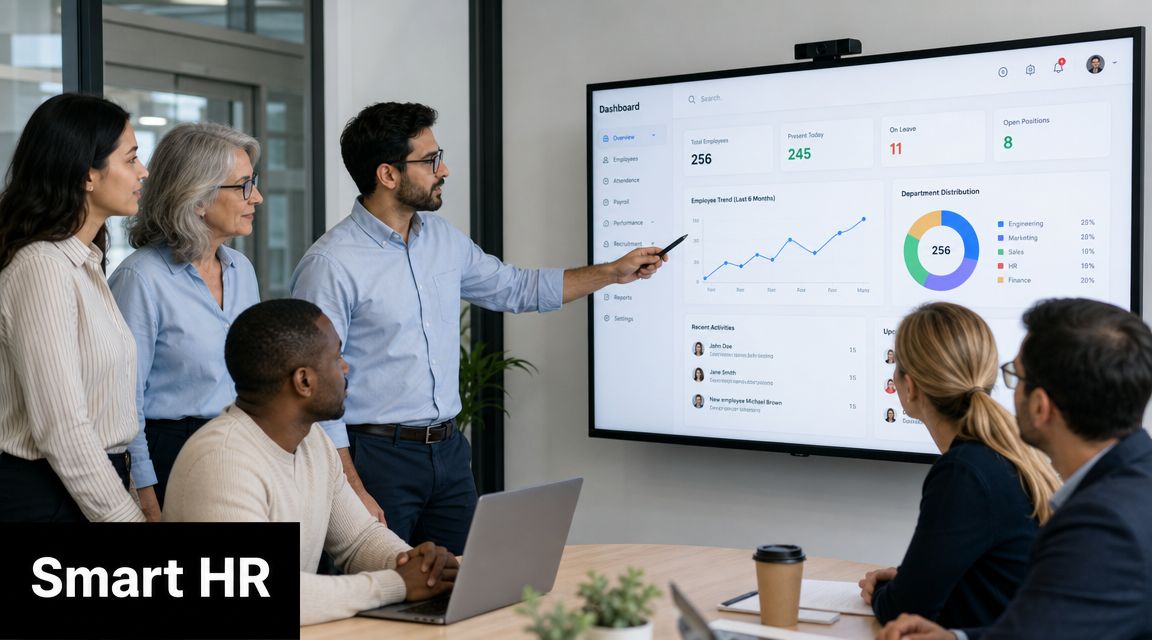
Payroll and WPS management
For UAE businesses, this is the first filter. If the system doesn't handle compliant payroll output properly, stop the evaluation.
WPS support is a fundamental requirement. The software must generate the required electronic wage data recognised by approved banks and exchanges so salaries are paid correctly and on time. That requirement is explained in this UAE-focused HR software guidance on WPS payroll. It isn't a cosmetic payroll feature. It is a compliance requirement tied to salary transfer workflow.
A useful starting point is understanding how payroll works in practical business terms, then checking whether the software handles your actual payroll structure, not just basic salary and deductions.
Look for:
- Salary rule control: Basic pay, allowances, deductions, overtime, loans, and final settlement logic must be configurable.
- Payroll exceptions: The system should handle new joiners, resignations, unpaid leave, and partial periods without manual workarounds.
- Batch reconciliation: HR and finance must be able to verify what was processed, what was paid, and what remains unresolved.
Time, attendance, and leave
Attendance is where payroll errors often start. If your business runs shifts, overtime, site work, or multiple locations, weak attendance control creates salary disputes every month.
A proper setup should connect attendance, leave, and payroll so the payroll team isn't calculating adjustments by hand. That includes late marks, approved leave, unpaid absence, shift rules, and public holiday treatment based on your company policy.
If your attendance data sits in one system and payroll sits in another, expect recurring salary corrections.
Recruitment, onboarding, and employee records
Recruitment tools are useful, but don't overvalue them. Hiring workflows matter, yet your long-term risk sits in employee master data quality. Passport details, contract terms, salary history, leave policy assignment, bank details, and document tracking must be maintained accurately from day one.
For UAE and GCC firms with diverse workforces, onboarding should also support document collection and policy-based assignment of entitlements. When a new employee is added, the record should be ready for payroll and reporting, not waiting for HR to patch missing fields later.
Performance and reporting
Performance management matters, especially for larger organisations, but reporting matters more if you're still building management discipline. The system should give HR and finance reliable reports on headcount, leave balances, payroll elements, and organisational structure.
You also need reports that managers can use. That means role-based access, clean output, and business-ready summaries rather than technical exports that require manual formatting every month.
Chat on WhatsApp +971506228024 Quotation – Demo Request
The Power of Integrating HR with Your ERP System
Standalone HR software is often enough for small, simple businesses. It becomes a liability once finance, payroll, attendance, project costing, and management reporting need to agree with each other.
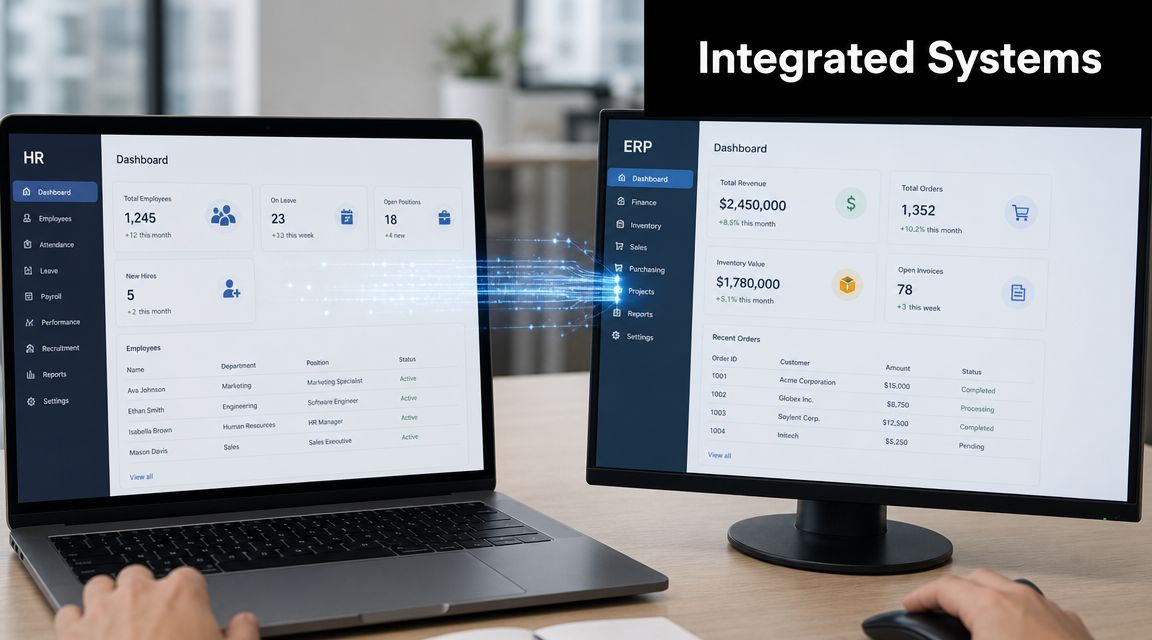
Why integration matters more than feature count
An isolated HR module can track employees. An integrated ERP setup can control the business effect of employee activity.
That distinction matters in contracting, manufacturing, real estate, trading, and service businesses. When HR and accounting work separately, teams spend their time reconciling differences. When they work together, one approved dataset drives payroll, provisions, allocations, and reporting.
According to this guide on modern HR systems and data normalisation, modern HR systems centralise employee data for payroll, benefits, attendance, and reporting. For multi-branch firms in the UAE, the practical advantage is that one employee record can drive leave balances, cost-centre posting, and bilingual Arabic-English reporting.
What integrated HR looks like in practice
Consider a contracting business with head office staff, site supervisors, drivers, and labour across multiple locations. In a disconnected setup:
- HR updates the employee file.
- Attendance comes from another tool.
- Payroll is processed in a payroll package.
- Finance posts salary journals manually.
- Management receives reports after several rounds of correction.
That model doesn't scale well.
In an integrated environment such as an HRMS and accounting-connected ERP workflow, approved employee records, attendance inputs, leave transactions, payroll processing, and accounting entries move through one controlled chain. Labour costs can be posted by branch, project, or department without repeated manual intervention.
Integration isn't about convenience. It's about whether management can trust the numbers.
The operational payoff
The biggest gain is not speed alone. It's consistency.
You reduce duplicate entry. You reduce disagreements between departments. You improve visibility over labour cost, accrued liabilities, and branch performance. For GCC companies running Arabic and English reporting across several entities, this structure is far more valuable than adding another standalone HR app.
I'd use Hinawi ERP as a benchmark example. Not because every company should buy the same product, but because a region-focused ERP should already understand that HR, payroll, accounting, and compliance can't be treated as separate systems in a UAE operating environment.
Chat on WhatsApp +971506228024 Quotation – Demo Request
Ensuring Compliance with UAE and GCC Regulations
Most HR software demos are misleading because they focus on employee portals, approval screens, and charts. Those things are useful, but they don't answer the question owners and finance managers eventually face: can we prove our payroll process is compliant and traceable?
Compliance starts with system architecture
In the UAE, the issue is rarely whether a payroll screen exists. The issue is whether payroll, WPS output, and finance records are connected well enough to stand up to scrutiny.
That's why the more useful concept is compliance-grade integration. As noted in this analysis of the compliance gap between HR and finance systems, many businesses struggle to prove compliance when payroll, WPS, and VAT-linked accounting sit in different systems. The answer is tighter integration that reduces manual reconciliation and audit risk.
The three controls I advise clients to insist on
WPS-ready payroll controls
The system must support compliant payroll processing from approved employee data through salary output and payment traceability. If the team still edits payroll outside the system before bank submission, control is weak.VAT-linked accounting visibility
HR software itself doesn't “do VAT” in isolation, but payroll-related accounting entries, expense allocations, reimbursements, and department cost flows must land correctly in finance. Otherwise, your audit trail is fragmented.End-of-service calculation discipline
Final settlement and gratuity-related records must follow defined rules and stay reviewable. A practical reference point is how end-of-service calculation support should be structured in a payroll system, especially when service periods, leave balances, deductions, and settlement timing all interact.
Where businesses usually fail
The weak point is rarely the software alone. It's the handoff between departments. HR changes salary or leave data, payroll processes a batch, finance books a journal, and nobody owns the full chain. When records don't match, everyone starts checking spreadsheets.
A compliant process is one you can trace from employee file to payroll result to payment output to accounting entry.
That's the standard. If your team can't do that without exporting multiple files and manually cross-checking them, your control environment needs work.
Chat on WhatsApp +971506228024 Quotation – Demo Request
A Practical Checklist for Selecting Your HR Software
Most bad software decisions happen because the buyer evaluates screens instead of operational fit. The selection process should be blunt. If the vendor can't answer region-specific, finance-linked questions clearly, remove them from the shortlist.
Use this checklist before you approve any purchase
| Evaluation Criterion | Why It Matters | What to Ask the Vendor |
|---|---|---|
| Full WPS compliance | UAE payroll cannot rely on manual file manipulation after payroll close | Can your system generate compliant wage transfer output directly from payroll and keep a traceable audit trail? |
| Real-time accounting integration | Separate payroll and finance systems create reconciliation problems | How do payroll journals, provisions, and staff-related costs post into accounting? Is it real time or export based? |
| VAT-linked financial visibility | Staff costs and reimbursements affect finance reporting and control | How are employee-related transactions reflected in the accounting side for review and audit? |
| Arabic and English operation | GCC businesses often require bilingual screens, records, and reports | Which reports, masters, and documents support Arabic and English natively? |
| Multi-branch capability | Branches, sites, and entities create approval and reporting complexity | Can we assign employees, payroll, attendance, and reporting by branch, company, project, or cost centre? |
| Flexible policy setup | Every company handles leave, overtime, and benefits differently | Can you configure our leave policy, shift rules, loans, deductions, and approval chains without custom coding? |
| Employee master-data control | Weak employee records create payroll and compliance failures | How do you manage contracts, salary history, bank details, and document validity in one record? |
| Final settlement support | Resignations and terminations are where errors become expensive | How does the system handle service periods, leave encashment, deductions, and final payroll closure? |
| Reporting depth | Management needs operational and financial visibility, not raw data dumps | Show us actual HR and payroll reports used by finance, HR, and management. |
| Local implementation support | Regional compliance and policy setup require practical guidance | Who will configure the system, train our team, and support us after go-live? |
| Industry fit | Contracting, real estate, manufacturing, and schools have different workflows | Which parts of your system are already used for businesses like ours? |
| Total cost of ownership | Cheap software becomes expensive when integration and support are missing | What is included in implementation, training, migration, support, and future changes? |
What I would reject immediately
I'd remove any vendor that gives vague answers to these points:
- “We can customise that later.” That usually means the requirement isn't standard and may become costly or unstable.
- “You can export to Excel.” Exporting isn't integration. It's a manual workaround.
- “Our payroll is global.” That doesn't prove UAE fit. You need region-specific payroll control.
- “The system is easy to use.” Ease of use matters, but compliance and accounting linkage matter more.
What a strong vendor demo should show
Ask the vendor to demonstrate a full process, not isolated screens:
- Employee creation: Add a new employee with salary structure and policy assignment.
- Attendance impact: Show approved attendance or leave affecting payroll.
- Payroll run: Process the payroll batch with deductions or adjustments.
- WPS output: Demonstrate the payment-ready output path.
- Accounting entry: Show the payroll result reflected in finance.
- Management reporting: Produce branch or department-level summaries.
Don't buy HR software based on design polish. Buy it based on whether it survives your month-end reality.
A serious evaluation feels less like software shopping and more like process inspection. That's exactly how it should be.
Best Practices for Implementation and Data Migration
A good HR system can still fail badly during rollout. The reason is simple. Companies treat implementation like software installation when it's really a business control project.
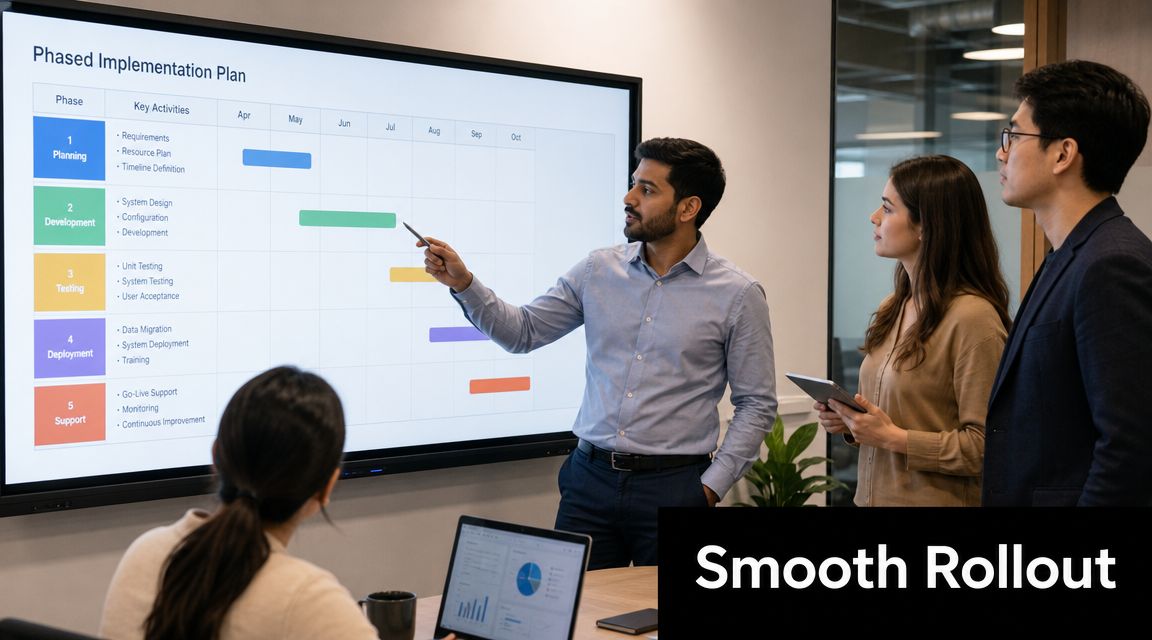
Start with policy decisions, not screens
Before migration begins, define how your business wants to operate. That includes leave rules, overtime treatment, loan deductions, approval responsibilities, branch structure, and payroll cut-off dates.
If these decisions are left unclear, the implementation team will fill the gaps with assumptions. Then you'll discover the mismatch during the first live payroll.
A practical implementation roadmap is to start with a structured work plan for using the software rather than jumping straight into data entry.
Clean data before you migrate it
Bad data migrates faster than good data. That's the problem.
Review employee records carefully before import. Standardise names, codes, salary elements, bank details, join dates, leave balances, and department assignments. Remove duplicates. Correct incomplete records. Confirm which historical data you need inside the new system and which data can remain archived.
Use a short validation list:
- Employee identity fields: Names, codes, branch, department, and status must be consistent.
- Payroll elements: Salary structure, deductions, loans, and entitlements must be verified.
- Leave data: Opening balances and policy assignments must be approved before go-live.
- Documents and dates: Contracts, IDs, expiry dates, and bank details must be complete.
Train users by role
Don't train everyone in one room with the same script. HR staff, payroll users, line managers, and finance reviewers all need different training.
HR needs employee lifecycle control. Payroll needs exception handling and review discipline. Managers need approvals and visibility. Finance needs confidence in entries, accruals, and payroll-linked reporting.
The fastest way to damage a new system is to go live with untrained managers and then blame the software for bad approvals.
Think ahead on AI capability
AI isn't the first criterion for selecting HR software, but it should be on your future-fit checklist. According to Select Software Reviews' HR statistics, 45% of companies are already using AI in HR, with 43% using it in recruiting and 25% in learning, and 65% of users report significant gains in productivity and efficiency. That doesn't mean you should buy flashy AI features for their own sake. It means you should avoid a platform that has no path toward smarter automation, especially in recruitment and employee support.
Roll out in phases where possible. Get employee records right first. Then attendance and leave. Then payroll. Then wider reporting and manager self-service. That sequence reduces risk and gives your team time to stabilise.
Measuring ROI and Avoiding Common Pitfalls
The return on HR software isn't just lower admin effort. It's better control.
A sound ROI review should look at whether payroll closes with fewer corrections, whether HR and finance spend less time reconciling data, whether management gets faster visibility into labour cost, and whether compliance evidence is easier to produce. Those outcomes matter more than vendor claims about generic efficiency.
What to measure after go-live
Use practical indicators such as:
- Payroll accuracy: Fewer corrections after payroll processing.
- Processing effort: Less manual work in attendance consolidation, payroll prep, and reporting.
- Control quality: Clearer audit trails from HR transactions into finance.
- Management visibility: Faster access to staffing and payroll reports through HRMS reporting workflows.
The mistakes that keep repeating
The most common failures are familiar:
- Choosing software without UAE fit: If local payroll and WPS handling are weak, the system will cause recurring risk.
- Ignoring integration: Separate HR and finance platforms create ongoing reconciliation work.
- Underestimating implementation: Poor data, weak training, and unclear policies damage the rollout.
- Buying for appearance: A modern interface won't fix broken payroll control.
If you want a reliable outcome, judge HR software the same way you'd judge accounting software. By accuracy, traceability, and operational fit.
Chat on WhatsApp +971506228024 Quotation – Demo Request
Take the Next Step with Hinawi ERP
If your business is still managing HR, payroll, accounting, and reporting in separate systems, this is the right time to fix it properly. Companies in the UAE and GCC need more than a basic HR tool. They need an integrated business platform that supports payroll control, finance visibility, and compliance-ready operations.
Hinawi ERP is a fully integrated ERP software developed since 1998 in Abu Dhabi. It supports Accounting, HR & Payroll, Real Estate Management, Fixed Assets, Manufacturing, Garage & Maintenance, School Management, CRM, and complete business automation. For regional businesses, that matters because HR doesn't work in isolation. Salary processing affects accounting, cost centres, reporting, compliance, and management decisions across the company.
The practical benefits are clear: VAT and e-Invoicing compliance, UAE WPS payroll support, Arabic and English bilingual operation, flexible company policy settings, and real-time accounting integration across all modules. It suits factories, contracting companies, real estate businesses, schools, garages, trading companies, and manufacturers that need stronger control over operations and reporting.
If you want to reduce manual work, improve financial accuracy, and modernise management control, visit the Hinawi ERP website or request a personalised demo from the team.
A practical next move for UAE and GCC companies is to speak directly with Explorer Computer LLC – Hinawi Software ERP about your HR, payroll, accounting, and compliance workflow. If your business needs integrated control across WPS payroll, VAT-aware accounting, bilingual operations, and broader automation for real estate, manufacturing, fixed assets, garages, schools, CRM, and finance, Hinawi ERP offers a region-focused path built in Abu Dhabi since 1998. Visit the website or request a personalised demo to review your current process and see how an integrated ERP can reduce manual work, tighten payroll accuracy, and improve management visibility.