
Category: Accounting
A finance director in Dubai often meets Sarbanes-Oxley for the first time at the worst possible moment. A U.S. investor asks for tighter reporting. A parent company wants quarterly certifications. External auditors start asking who approved a journal, who changed a vendor record, and where the evidence sits. Suddenly, what looked like a U.S. legal issue becomes an operational issue inside your ERP, your finance team, and your monthly close.
That's why sarbanes oxley compliance matters in the UAE and GCC. If your company is listed in the U.S., preparing for that route, or operating as a U.S.-reporting subsidiary, SOX isn't a side topic. It changes how finance, IT, operations, and management work together. It also affects ambitious regional companies that want stronger governance long before a listing or cross-border transaction forces the issue.
SOX was enacted on July 30, 2002 in response to scandals at Enron, WorldCom, Tyco International, and Adelphia, with the aim of restoring investor confidence and strengthening internal controls over financial reporting, as outlined by the Sarbanes-Oxley Act reference guide. The law is American. The discipline it created is global.
Introduction Why SOX Matters for Businesses in the UAE and GCC
A finance director in Dubai closes the month, reviews the consolidation pack, and gets a call from a U.S. parent or investor. They want quarterly certifications, cleaner evidence, and clear answers to basic control questions. Who approved the journal entry. Who changed the supplier bank details. Where is the audit trail. At that point, sarbanes oxley compliance stops being a U.S. legal topic and becomes a daily operating standard for your finance function.
That is why SOX matters in the UAE and GCC. Regional groups often run multi-entity structures, shared service teams, bilingual documentation, VAT reporting, and branch accounting across more than one jurisdiction. If those activities sit across emails, spreadsheets, and loosely controlled ERP workflows, your reporting risk is already too high.
For a GCC business, SOX usually arrives through one of three routes. A U.S.-listed parent imposes group controls. An investor demands stronger reporting discipline before a transaction. Management decides the company needs board-grade financial integrity before expansion. In each case, the underlying issue is the same. Can your organisation prove that financial reporting is accurate, approved, complete, and supported by evidence inside the system?
That question gets practical very quickly. A UAE group with entities in Dubai, Abu Dhabi, and Saudi Arabia needs controlled close procedures, consistent chart-of-accounts discipline, and documented approvals that survive auditor testing. It also needs control design that reflects local operating reality, including VAT treatment, intercompany activity, Arabic and English support, and different branch cutoffs. Even basic calendar discipline matters. If reporting periods are unclear or adjusted informally, start by tightening your understanding of the fiscal year structure used for accounting and planning.
Here is the rule I give finance leaders. If your CFO cannot sign with confidence because support sits in scattered files or depends on verbal confirmation, your control environment is weak.
An integrated ERP matters because SOX is evidenced through transactions, approvals, logs, reconciliations, and user access records. Policy documents alone do not satisfy that standard. Finance teams in the UAE and GCC need a system that can handle multi-branch operations, role-based approvals, audit trails, and period control without creating extra manual work. That is how you handle SOX efficiently and turn it into better financial discipline, not just another compliance exercise.
Understanding Core SOX Requirements Sections 302 and 404

A finance director in Dubai closes the month for five entities, one branch posts late adjustments in Arabic, another uses offline Excel reconciliations, and group reporting still has to support executive certification. That is not a US compliance story. It is a GCC operating reality, and Sections 302 and 404 sit directly inside it.
Section 302 deals with executive certification. Section 404 deals with internal control over financial reporting. Together, they answer two hard questions. Can management stand behind the numbers, and can the business prove why that confidence is justified?
What Section 302 means in practice
Section 302 requires the CEO and CFO to certify that periodic financial reports are accurate and complete in all material respects. For a UAE or GCC group, that certification depends on disciplined close routines across entities, branches, currencies, and reporting teams.
Weak finance habits get exposed swiftly under these conditions.
If executive sign-off relies on summary packs assembled from email attachments, unsupported journals, or branch-level spreadsheets, the problem is not presentation. The problem is that management does not control the reporting process well enough to certify it with confidence.
A workable 302 process needs clear ownership for account balances, documented review of significant estimates, controlled consolidation, and evidence that exceptions were identified and resolved before sign-off. It also needs consistency in the underlying accounting structure. A poorly designed chart of accounts makes review harder, reconciliations slower, and certification riskier. That is why finance teams should standardise their general ledger structure and account hierarchy before they worry about audit wording.
What Section 404 requires from operations
Section 404 is more demanding because it asks management to assess whether internal controls over financial reporting are effective. For many companies, this is the point where policy language collides with day-to-day operations.
In the GCC, those operations are rarely simple. One group may run retail outlets, warehouses, and service branches across multiple jurisdictions. Another may combine contracting, fixed assets, payroll, procurement, and intercompany recharges inside the same reporting perimeter. Add VAT treatment, multi-branch accounting, bilingual users, and different local approval habits, and control gaps appear quickly.
Section 404 forces management to deal with those gaps directly. Auditors will not accept a policy manual as evidence that controls operate. They will ask what happens in the system, who approved the transaction, whether access was restricted, whether the period was locked, and whether the audit trail is complete.
The controls that matter most are straightforward:
- Segregation of duties so one user cannot create, approve, and pay the same transaction path
- Approval controls for journals, vendor changes, payments, and sensitive master data
- Audit logs that show who changed what, when, and under whose authority
- Reconciliations that can be traced from source transaction to final balance without guesswork
- Period-end controls that stop late or informal postings after review is complete
These are not abstract audit concepts. They are daily operating disciplines. If a branch accountant can change supplier bank details without review, if VAT adjustments are posted outside a controlled workflow, or if intercompany balances are cleared with manual top-side entries, your Section 404 exposure is already visible.
Why these sections matter to GCC management teams
Sections 302 and 404 create personal accountability for executives and operational accountability for finance. That is exactly why they matter. They force management to replace informal trust with evidence.
For UAE and GCC businesses, the practical issue is not whether SOX applies only in the United States. The practical issue is whether your finance environment would survive the same level of scrutiny. Investors, boards, lenders, and external auditors increasingly expect that standard anyway.
The right response is not more spreadsheets or longer checklists. It is tighter process design inside the ERP. Multi-entity close, bilingual workflows, branch controls, VAT-sensitive postings, and documented approvals should all sit in one controlled system. If they do not, Sections 302 and 404 become expensive, manual, and fragile. If they do, compliance becomes far more manageable and financial reporting gets stronger at the same time.
The COSO Framework and Internal Control Mapping
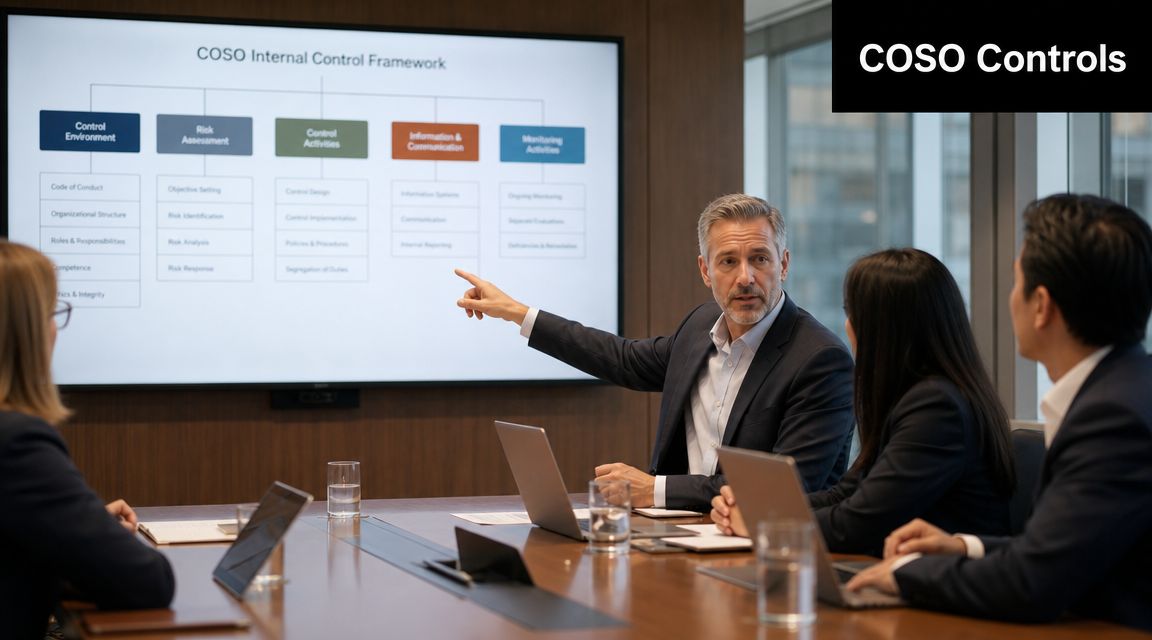
SOX tells you to maintain effective internal controls. It doesn't hand you a finished control map. That's why most serious organisations use the COSO framework as the working model.
Think of COSO as the architecture behind your controls. Without it, companies pile up approvals and reports without understanding whether those actions reduce risk.
Five control areas that matter in practice
Control environment starts at the top. If executives bypass approval rules, the rest of the company will do the same. In a contracting group, this means management can't demand clean reporting while tolerating off-system commitments and manual corrections after month-end.
Risk assessment asks a simple question. Where could a material misstatement happen? In a real estate business, lease revenue recognition, deposit handling, and manual adjustment entries deserve immediate attention.
Control activities are the actual checks. This could be approval workflows, locked posting periods, bank reconciliation reviews, or system-based invoice matching. A clean general ledger structure in accounting is part of this because weak account design creates weak reporting.
Information and communication means people receive the right data at the right time. If branch managers keep local records outside the finance system, the reporting chain breaks before consolidation even begins.
Monitoring means controls are reviewed, exceptions are investigated, and weaknesses are remediated. If nobody reviews access rights, override logs, or unreconciled items, you don't have monitored controls. You have assumptions.
How to map COSO without overcomplicating it
Use a transaction journey. Follow one material process from start to finish and ask what could go wrong, who could do it, and what evidence proves the control worked.
A manufacturer in the GCC can map procure-to-pay like this:
- Vendor creation risk. Unauthorised or duplicate supplier setup.
- Purchase approval risk. Orders raised without budget or management review.
- Receipt and invoice risk. Quantity or price mismatch.
- Payment risk. Payment released without proper authorisation.
- Reporting risk. Accrual or expense posted to the wrong period.
Strong control mapping is simple enough for finance owners to operate and strong enough for auditors to test.
COSO becomes useful when it's tied to live processes. It becomes useless when it lives in a PowerPoint that nobody follows.
Building Your SOX Compliance Program Step by Step
A finance director in the GCC usually sees the fundamental SOX problem during close week. One branch is posting late adjustments in Arabic-labeled spreadsheets. Another entity is clearing intercompany balances outside the ERP. Group finance is trying to certify numbers that also need to stand up to VAT treatment, audit testing, and management review. That is not a policy problem. It is a program design problem.
Build the program in a strict sequence. Start with reporting risk, assign ownership, then define evidence. Companies that reverse that order create thick documentation and weak control execution.
Step 1 Risk assessment
Begin with significant accounts, material disclosures, and the processes that feed them. For UAE and GCC groups, that usually means revenue, receivables, payables, cash, payroll, inventory, fixed assets, tax and VAT postings, and intercompany activity across branches or legal entities.
Scope around financial reporting risk, not around the org chart. A branch accountant may sit in operations, but if that person can post inventory adjustments that affect margin, the process belongs in scope.
Be specific. Multi-entity businesses should identify where exchange rates, cross-branch settlements, manual accruals, and local workarounds can distort consolidated reporting.
Step 2 Control design and implementation
Design controls that fit how the business runs. If a control depends on email approval, local files, or verbal sign-off, expect failure during testing.
Use a mix of preventive and detective controls:
- Vendor master control. Separate supplier creation, supplier amendment, and payment approval.
- Journal entry control. Require review of unusual, manual, or late journals before close.
- Period-end control. Lock prior periods and restrict reopening to authorised finance leaders.
- Variance review control. Compare actuals against approved budgets and investigate unexplained movements through a structured budgeting and forecasting process.
- Intercompany control. Reconcile balances by entity pair, not only at group total level.
- VAT control. Review tax codes, exception reports, and adjustments that can affect both statutory filings and financial statements.
Explorer Computer LLC – Hinawi Software ERP is relevant here for a practical reason. An integrated ERP helps UAE and GCC companies keep approvals, postings, operational triggers, and audit trails inside one system instead of scattering them across branches and spreadsheets. That makes control ownership clearer and evidence easier to produce.
Step 3 Control testing
Testing answers one question. Did the control operate as designed, for the full period, with evidence an auditor can inspect?
Ask for proof that is native to the process. Approved transactions, system logs, review notes, exception reports, reconciliations, access change records, and dated sign-offs are stronger than screenshots saved after the fact.
Regional groups often underestimate language and entity complexity here. If one branch stores support in Arabic, another in English, and a third outside the ERP, testing slows down and exceptions rise. Standardise naming, retention, and reviewer sign-off before external audit asks for samples.
Step 4 Remediation
Every serious SOX program finds gaps. Good management fixes them fast, assigns a deadline, and keeps the remediation record clean.
Typical remediation work includes tightening user roles, replacing spreadsheet reconciliations with system-based reports, correcting approval hierarchies, and adding review points before consolidation. If one weakness appears in more than one entity, treat it as a group issue. Do not let each branch invent its own fix.
A deficiency becomes expensive when management leaves it open through another reporting cycle.
Step 5 Reporting and certification
Management certification should not depend on a last-minute status chase. By the time executives review controls, they should see a clear record of what was tested, what failed, what was remediated, and which issues remain open by entity and process owner.
Poor preparation drives extra cost, extra audit effort, and unnecessary pressure on finance teams. As noted earlier, manual SOX programs consume more time than companies expect. The answer is simple. Reduce manual approvals, reduce off-system evidence, and reduce branch-level exceptions before certification starts.
For GCC companies, that discipline matters beyond SOX. The same control structure supports cleaner consolidation, stronger VAT governance, and more reliable board reporting.
The Role of ERP in Automating SOX Compliance

A manual SOX environment always looks the same. Finance closes the month. Audit asks for support. Branch teams send files with different naming styles. Someone exports data from one system, checks it in Excel, emails comments, then uploads a revised version. Nobody is fully sure which file is final. Everyone is tired.
That model collapses under pressure in multi-entity GCC businesses.
What an ERP should do for SOX
For regional companies, the issue isn't understanding the law. It's operationalising controls in a multilingual, multi-entity environment where VAT, e-invoicing, operational data, and financial reporting all feed the same statements. The SEC-focused background in the SEC archival discussion relevant to foreign issuers and control evaluation highlights the importance of reliable periodic control evaluation and documented remediation. That's exactly where ERP design matters.
An ERP should handle four control needs well:
- Evidence capture so every posting, approval, and change leaves a trace.
- Segregation of duties so conflicting actions are restricted by role.
- Automated reconciliation so balances are matched within a controlled process.
- Standardised reporting so each entity reports through the same logic.
For cloud and remote finance teams, controlled access also matters. A system designed for online ERP access across locations helps management maintain process continuity without losing visibility over who did what.
A GCC operating example
Consider a contracting group with operations in Saudi Arabia and the UAE. Site purchases happen daily. Payroll entries affect project costing. Advance payments, retention balances, subcontractor bills, and equipment expenses all hit the books. If local teams use side spreadsheets for approvals or adjustment tracking, group finance loses control of the close.
Now compare that with an integrated ERP environment:
| ERP capability | SOX impact |
|---|---|
| Audit trail on journal edits and approvals | Supports re-performance and review |
| Role-based user permissions | Reduces conflicting duties |
| Intercompany reconciliation workflow | Improves consolidation discipline |
| Standard chart and reporting structure | Produces consistent group statements |
That's the difference between gathering evidence after the fact and generating it during daily operations.
Auditors don't want stories. They want a system trail they can follow.
For UAE and GCC companies, bilingual workflows matter too. If one branch works in Arabic, another in English, and group reporting sits above both, your ERP must preserve consistency without forcing teams into local workarounds. That's a practical issue, not a cosmetic one.
Common Pitfalls and Your Audit Readiness Checklist
The audit request arrives on a Sunday evening. By Monday morning, your finance team is chasing journal support from one branch, IT access logs from another, and approval evidence buried in email threads in both Arabic and English. That is how SOX problems show up in the UAE and GCC. Not because management ignored compliance, but because control evidence was never built into daily operations.
The fastest way to fail SOX is to treat it as an annual documentation exercise. The second fastest is to assume finance can carry it alone. For regional groups running multiple entities, VAT reporting, project accounting, intercompany activity, and branch-level approvals, weak coordination between finance, IT, and operations creates audit gaps quickly.
Pitfalls that create avoidable problems
- Running controls only near audit season. A control performed only for testing usually breaks under real scrutiny. Build it into the monthly close.
- Letting spreadsheets override ERP workflows. Side files hide approvals, weaken version control, and create disputes over which number is final.
- Ignoring IT general controls. User access, password discipline, system changes, event logs, and backup records affect the reliability of financial reporting. Auditors will ask for them.
- Skipping formal access reviews. If users keep old permissions after role changes, segregation of duties collapses.
- Allowing system changes without financial impact review. A small configuration update can change posting logic, approval routing, or report output.
- Treating documentation as optional. If the control happened but no one can produce evidence quickly, expect an audit finding.
- Leaving journal entry governance loose. Manual postings, bulk uploads, and late adjustments need clear approval rules. Even routine processes such as importing journal entries with approval and traceability controls should sit inside a defined review process.
- Forgetting regional operational realities. Multi-branch businesses often miss controls around VAT adjustments, bilingual supporting documents, and local branch approvals that feed group reporting.
SOX Audit Readiness Checklist
Use this checklist as a working review with finance, IT, internal audit, and operations. If any item gets a vague answer, fix it before the auditors ask the same question.
| Control Area | What audit-ready looks like |
|---|---|
| Governance | Assign named owners for close, journals, reconciliations, access reviews, and remediation. Ownership by department is too vague. |
| Financial close | Document the close calendar, approval points, review steps, and escalation rules for every reporting cycle. |
| Journal entries | Require independent review for manual journals, unusual entries, and late adjustments. Keep support attached in the ERP or a controlled repository. |
| Access control | Review ERP user rights on a schedule, remove obsolete access immediately, and document business-owner approval. |
| Segregation of duties | Identify conflicting roles such as vendor creation, payment approval, and posting authority. Restrict or monitor them formally. |
| Reconciliations | Complete bank, receivable, payable, inventory, fixed asset, and intercompany reconciliations on schedule, with reviewer sign-off. |
| Master data | Log and approve changes to vendors, customers, tax settings, chart elements, and banking details. |
| IT controls | Keep backup records, change logs, incident logs, and system access history available for testing. |
| VAT and statutory reporting | Tie VAT submissions back to the ledger, review adjustment entries, and retain support for exceptions and reclassifications. |
| Multi-entity reporting | Standardise account mapping, branch submission deadlines, and consolidation review across all entities. |
| Documentation | Store evidence in a way auditors can retrieve quickly without depending on personal inboxes or local desktop files. |
| Remediation | Track control gaps to closure with an owner, due date, root cause, and proof of retesting. |
Run this review before year-end. Run it again before any interim testing. Regional groups with several entities or branches should also test whether evidence can be pulled consistently across Arabic and English workflows, because translation gaps and local naming differences slow audits down fast.
A finance director should be able to answer three questions without hesitation. Who owns the control? Where is the evidence? What stops the same issue from recurring? If your team cannot answer those cleanly, the problem is not the audit. The problem is the control environment.
Conclusion Moving Beyond Compliance to Better Business
The companies that handle SOX well don't treat it as an imported burden from the United States. They use it as a framework to clean up weak processes, tighten accountability, and build trust in their numbers.
That matters in the UAE and GCC because ambitious businesses rarely stay simple. They add branches, entities, warehouses, projects, assets, payroll complexity, VAT obligations, and cross-border reporting requirements. Each new layer creates more opportunities for error if the control model stays manual.
SOX forces management to answer uncomfortable but necessary questions. Can the CFO defend every material number? Can auditors trace approvals without chasing people? Can IT prove access, change, and backup discipline? If the answer is uncertain, growth is already carrying hidden risk.
The practical answer isn't more paperwork. It's better system design, stronger ownership, and integrated workflows that produce evidence as work happens. That's why ERP matters so much in sarbanes oxley compliance. A well-implemented ERP supports approvals, audit trails, reconciliations, reporting consistency, and operational visibility across the whole business.
For many regional companies, that's the bigger win. Better compliance usually produces better management reporting, cleaner closes, fewer surprises, and stronger investor confidence. That's not just audit readiness. That's a better business.
Take the Next Step with Explorer Computer LLC – Hinawi Software ERP. If your company in the UAE or GCC wants stronger financial control, less manual work, and cleaner reporting across multiple departments, Hinawi ERP is built for that reality. Developed since 1998 in Abu Dhabi, Hinawi ERP is a fully integrated business platform covering Accounting, HR & Payroll, Real Estate Management, Fixed Assets, Manufacturing, Garage & Maintenance, School Management, CRM, and complete business automation. It supports VAT and e-Invoicing compliance, UAE WPS payroll, Arabic and English bilingual operation, flexible company policy settings, and real-time accounting integration across all modules. It suits factories, contracting companies, real estate businesses, schools, garages, trading companies, and manufacturers across the UAE and GCC. If you want to modernise operations, reduce manual errors, improve financial accuracy, and gain stronger management control, visit www.hinawierp.com or request a personalised demo from the Hinawi ERP team.