
Category: Accounting
If you're running a group with a property company in Abu Dhabi, a factory in Jebel Ali, and a trading entity selling into Saudi Arabia, your finance team already knows the pain. Month-end turns into a spreadsheet chase. One subsidiary closes late, another uses different account codes, and somebody always asks whether the intercompany loan was eliminated properly.
That's exactly where consolidated financial statements stop being an accounting exercise and start becoming a management necessity. They give owners, finance directors, lenders, auditors, and regulators one reliable view of the group. In the GCC, that matters even more because IFRS compliance, VAT handling, bilingual reporting, and multi-entity governance all collide in the same reporting cycle.
A modern ERP such as Hinawi ERP changes the conversation. Instead of rebuilding the group picture manually every period, you standardise the data structure, automate eliminations, and produce reports from a controlled system rather than from disconnected files.
Chat on WhatsApp +971506228024 Quotation – Demo RequestThe Challenge of Unifying a Diversified Business Group
A diversified GCC group rarely fails because it lacks transactions. It fails because it lacks a unified financial version of the truth.

Take a familiar situation. The parent company sits in Dubai. One subsidiary manages leases and service charges in Abu Dhabi. Another entity manufactures products and moves stock internally. A third buys and sells across borders. Each business unit may be profitable on paper, but if the group can't combine the numbers cleanly, management decisions are being made on partial information.
Why the group view matters
Consolidated financial statements combine the parent and its subsidiaries into one reporting set so the group is presented as a single economic entity. That's the only view that really helps with board reporting, external financing, investor communication, and serious governance.
In the UAE, the rules are not new. IFRS, including IFRS 10 on Consolidated Financial Statements, became mandatory for all companies listed on DFM and ADX from January 1, 2007, and VAT introduced in 2017 reinforced the need for stronger multi-entity reporting discipline according to the UAE consolidation overview.
That changed the practical standard for finance teams. Group reporting can't rely on loosely aligned ledgers anymore.
Practical rule: If each subsidiary can close its own books but nobody can trust the combined result, your reporting model is broken.
Where manual groups get stuck
The usual problem isn't accounting knowledge. It's structure.
- Different account coding: One entity records rental income one way, another uses a different ledger structure. A group-level review becomes slow and subjective. A shared chart of accounts design approach fixes that at the source.
- Duplicate internal activity: Sales, loans, management fees, and expense recharges between entities inflate the raw numbers before elimination.
- Late adjustments: Finance teams often wait until the end of the month or year to repair inconsistencies that should have been controlled during daily operations.
For GCC groups, that's dangerous. Auditors will ask for support. Tax teams will ask how VAT-related entries flow through the group. Owners will ask which division is really generating external profit.
Hinawi ERP is useful in this context because it supports standardised multi-company operations instead of forcing the finance department to reconstruct everything after the fact. That's the right approach. Consolidation works best when the operating system is organised before the reporting deadline arrives.
Chat on WhatsApp +971506228024 Quotation – Demo RequestChoosing the Right Consolidation Method
The first mistake many groups make is technical but costly. They start combining numbers before deciding how the investment should be treated. That decision drives everything that follows.
Control decides the method
The method depends on influence and control, not just ownership percentage in isolation. In practice, finance teams usually evaluate three broad treatments.
| Method | Ownership Level (Guideline) | Level of Influence | Financial Statement Treatment |
|---|---|---|---|
| Full Consolidation | Typically more than 50% | Control | Combine assets, liabilities, income, and expenses line by line, then recognise any non-controlling interest |
| Equity Method | Typically 20% to 50% | Significant influence | Record the investment as a single line item and recognise the investor's share of results |
| Proportionate Consolidation | Limited application in certain joint arrangements | Shared control in specific structures | Recognise the relevant share based on the arrangement where applicable |
Full consolidation is the method most GCC groups deal with. If the parent controls the subsidiary, the parent does not report an investment account alone. It reports the underlying business as part of the group and then separates any minority holding through non-controlling interest.
The equity method is different. If you can influence strategy but don't control operations, you should not pull the entire balance sheet and profit and loss into the group. That creates a false picture of size and financial strength.
The wrong method creates the wrong story
A holding company can look stronger or weaker than it really is if the method is wrong. That affects debt discussions, dividend planning, internal performance reviews, and audit scrutiny.
Use this rule set:
- Ask who controls decisions. Voting rights matter, but contractual rights and governance arrangements matter too.
- Review substance, not labels. A company called an “associate” may still be controlled in practice.
- Align management reports with statutory logic. If your board pack tells one story and the audited financials tell another, expect confusion.
A clean profit and loss statement structure helps decision-makers see the impact of the selected method quickly. That matters when group leadership wants to compare operating units fairly.
Don't let ownership percentages make the decision on their own. Control, influence, and rights determine the accounting result.
Hinawi ERP is particularly helpful when groups have layered ownership structures because the system can be configured around company relationships and standardised reporting logic. That reduces the risk of finance teams applying one method in management reporting and another at year-end.
Chat on WhatsApp +971506228024 Quotation – Demo RequestThe Consolidation Workflow A Practical Walkthrough
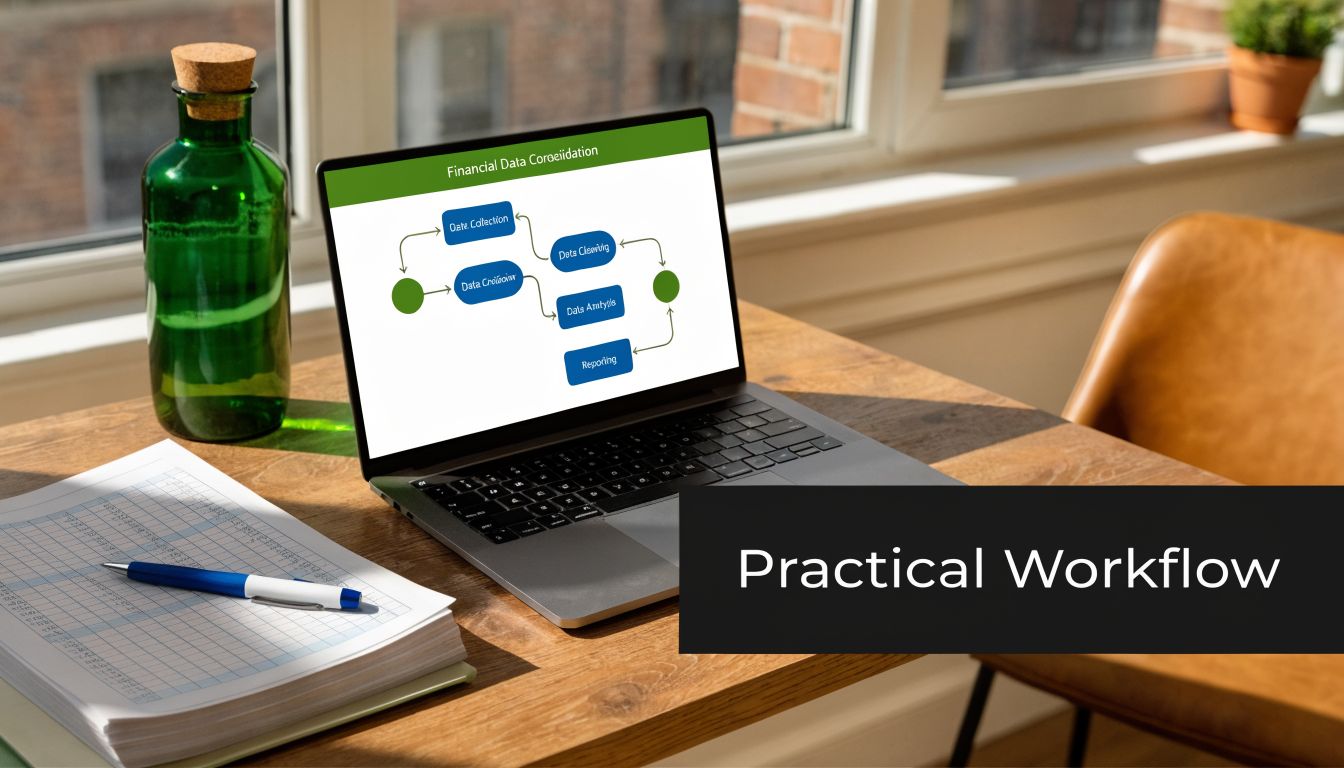
Once the method is set, the quality of the workflow determines whether your close is controlled or chaotic.
Start with clean trial balances
Pull trial balances for every reporting entity on the same cut-off date. If one company closes on different assumptions, your consolidation is already compromised.
Before aggregation, check these items:
- Account mapping: Every company must roll into the same group structure.
- Cut-off consistency: Revenue, expenses, receivables, payables, and accruals must reflect the same reporting date.
- Supporting schedules: Fixed assets, inventory, loans, payroll accruals, and tax-related balances must reconcile to the ledger.
If your team is still importing adjustment data manually from disconnected files, you need tighter control over journal entry imports and accounting movement handling.
Eliminate intra-group activity properly
This is the step that breaks many consolidations. Intercompany transactions must be eliminated so revenue, expenses, assets, and liabilities are not counted twice. The risk is not theoretical. Failure to eliminate these transactions properly can distort profitability metrics by 15 to 40 percent depending on group complexity, as noted in this explanation of consolidation reporting requirements.
Here's the core logic:
- Parent records a sale to subsidiary.
- Subsidiary records a purchase from parent.
- Group financial statements remove both sides.
- Only external customer activity remains.
A similar rule applies to intercompany loans, advances, management charges, and internal rent.
If a transaction never left the group, it should not survive unchanged in the consolidated financial statements.
Handle acquisition accounting and minority interests
When a parent acquires a subsidiary, consolidation doesn't end with balance aggregation. You also need to identify acquisition-date values, goodwill where relevant, and any non-controlling interest.
Spreadsheet-led groups lose visibility at this stage. One workbook may contain the purchase price allocation, another may contain post-acquisition reserves, and a third may track minority ownership changes. That's not a system. It's a risk.
Standardise policies before combining data
A group cannot produce reliable consolidated financial statements if one subsidiary depreciates fixed assets differently, another recognises revenue on different principles, and a third applies different accrual timing for staff costs.
That's why strong groups standardise policies before they standardise reports. In practice, that means the parent defines the accounting framework, the chart structure, the approval logic, and the treatment rules for common transactions.
Hinawi ERP helps here because the operating model is integrated. Accounting, fixed assets, inventory, payroll, and operational modules feed a central financial structure. That's much more effective than trying to repair inconsistency during year-end consolidation.
Chat on WhatsApp +971506228024 Quotation – Demo RequestNavigating UAE and GCC Reporting Requirements
Regional consolidation work gets difficult when companies assume one accounting policy can be applied loosely across several jurisdictions. It can't.

Policy harmonisation is not optional
A group operating in the UAE, Saudi Arabia, and Egypt often discovers that subsidiaries have adopted different practical treatments for depreciation, revenue recognition, lease handling, or employee accruals. That creates reporting friction long before the final consolidation file is prepared.
Manual policy alignment can consume 20 to 30 percent of the consolidation timeline, according to this discussion of consolidated financial statement harmonisation. That's not a minor inefficiency. It's a sign that the group's finance architecture is too fragmented.
A practical fix starts with one rulebook. The parent should define the fiscal calendar, approval deadlines, group chart structure, and shared policy settings. Even basic clarity around fiscal year setup and reporting periods removes avoidable confusion.
VAT and bilingual reporting raise the standard
In the UAE, VAT changed what finance teams need from group reporting. It isn't enough to produce a year-end pack. Businesses need traceable, defensible transaction flows across related entities, especially where intercompany charges, stock transfers, service allocations, and property-related invoicing are involved.
A contracting group in Abu Dhabi with a support entity in Riyadh faces exactly this problem. The UAE side may need one reporting treatment for local compliance, while management still expects a consolidated regional view. If the company runs separate systems with no common coding and no bilingual output, finance staff spend their time translating and reclassifying instead of controlling the numbers.
Regional groups don't struggle with consolidation because the rules are unclear. They struggle because their systems don't enforce those rules consistently.
Hinawi ERP fits this regional reality well because it supports Arabic and English operations, real-time accounting integration, and multi-company process control inside one environment. For GCC businesses, that's not a convenience feature. It's the baseline for sustainable reporting.
Common Pitfalls and Audit Red Flags to Avoid
Auditors rarely get concerned by complexity alone. They get concerned when management can't explain the logic behind the numbers.
The mistakes that trigger scrutiny
The most common red flags are predictable:
- Wrong investment classification: If control exists but the investment is treated too lightly, the financial statements understate the group position.
- Incomplete profit elimination: Inventory or fixed assets transferred internally may still contain unrealised profit that must be removed at group level.
- Weak goodwill follow-up: Acquisition balances are often calculated once and then ignored.
- Inconsistent accounting policies: Similar transactions across subsidiaries are treated differently, which makes comparability unreliable.
- No audit trail for adjustments: Consolidation journals appear in the final file, but nobody can trace who posted them, why, or on what support.
These are controllable failures. They happen when finance teams work around the system instead of through it.
Why ERP discipline matters to auditors
A reliable ERP environment doesn't just speed up reporting. It leaves evidence. That matters during audit reviews because every elimination, reclassification, and policy adjustment should be traceable.
There's strong support for that approach. A 2022 PwC Middle East survey of 150 GCC firms found that 78% of UAE-based conglomerates using ERP systems reported a 40% reduction in consolidation errors post-IFRS adoption, with non-controlling interests accurately reflected in 92% of audited statements. This finding appears in the earlier UAE consolidation reference already cited.
Auditors trust controlled processes more than clever spreadsheets.
My recommendation is simple. Build a monthly consolidation discipline, not just an annual one. If intercompany balances, minority interests, and policy differences are reviewed every month, the year-end audit becomes a validation exercise rather than a rescue mission.
Automating Your Group Consolidation with ERP
Manual consolidation is expensive even when nobody invoices you directly for it. It costs management time, delays decisions, and increases compliance exposure.
What automation should actually do
A proper ERP-led consolidation process should give you:
- One data structure across entities: Shared coding, shared reporting logic, and controlled permissions.
- Intercompany visibility: The system should identify matching balances and flag exceptions early.
- Integrated subledgers: Fixed assets, inventory, payroll, property management, and service operations should feed accounting automatically.
- Bilingual reporting: GCC businesses need output that works operationally and regulatorily.
- Real-time management visibility: Group leaders shouldn't wait until quarter-end to understand the financial position.
Hinawi ERP provides a practical fit for regional businesses by supporting multi-company operations, VAT and e-invoicing compliance, UAE WPS payroll support, and real-time accounting integration across modules. For factories, contracting firms, real estate operators, schools, garages, trading businesses, and manufacturers, that integration removes a lot of the manual reconciliation that makes consolidation painful.
A finance team should not be spending its best hours retyping data, reconciling internal transfers by hand, or rebuilding reports in Excel because operating systems don't talk to each other. The right ERP eliminates that waste.
Chat on WhatsApp +971506228024 Quotation – Demo RequestTake the Next Step with Hinawi ERP
If your group is still producing consolidated financial statements through spreadsheets, disconnected ledgers, and manual eliminations, you're accepting unnecessary risk. That approach may survive for a while, but it won't give you the control, speed, or audit readiness that a growing GCC business needs.
Hinawi ERP is a fully integrated ERP software developed since 1998 in Abu Dhabi. It supports Accounting, HR & Payroll, Real Estate Management, Fixed Assets, Manufacturing, Garage & Maintenance, School Management, CRM, and complete business automation. For companies operating across the UAE and GCC, that matters because consolidation depends on operational consistency, not just year-end accounting effort.
The platform is designed for regional requirements. It supports VAT and e-Invoicing compliance, UAE WPS payroll, Arabic and English bilingual operation, flexible company policy settings, and real-time accounting integration across all modules. It's suitable for factories, contracting companies, real estate businesses, schools, garages, trading companies, and manufacturers that need stronger control across multiple entities.
If you want to modernise operations, reduce manual work, improve financial accuracy, and gain better control over management reporting, start with a proper system review. Visit Hinawi ERP or request a personalised demo. If you want a quick look first, you can also review Hinawi ERP demo information.
Speak with the Hinawi ERP team for practical advice on how to structure group reporting, automate eliminations, and build a consolidation process that works in the UAE and GCC environment.
A CTA for Explorer Computer LLC – Hinawi Software ERP.