
Category: Accounting
If you're still calculating VAT in Excel, checking formulas line by line, and then copying totals into invoices or accounting entries, you're carrying more risk than you need to. I see this often with trading companies, contractors, real estate offices, and growing manufacturers in Abu Dhabi and Dubai. The maths itself isn't hard. The issue is that manual VAT work spreads across quotations, invoices, purchases, returns, journals, and reports. That's where errors start.
A proper vat calculator uae approach should do more than tell you the tax on one amount. It should help you price correctly, issue compliant invoices, separate input and output tax properly, and prepare clean records for review. For many businesses, an online calculator is useful for a quick check. It isn't enough to run the business.
That gap is exactly why more UAE companies move from one-off calculations to integrated accounting and ERP workflows. If your sales team prices one way, your accountant records another way, and your operations team keeps separate spreadsheets, VAT becomes a control issue, not just a tax issue.
Take the Next Step with Hinawi ERP
If your business is growing in the UAE or GCC, don't stop at manual tax calculations. Hinawi ERP helps companies connect VAT calculation to actual operations, including accounting, inventory, HR & Payroll, real estate management, fixed assets, manufacturing, garage & maintenance, school management, CRM, and wider business automation. Developed in Abu Dhabi since 1998, it supports Arabic and English operation, UAE WPS payroll, real-time accounting integration, flexible company policies, and VAT and e-Invoicing compliance.
For companies that want fewer manual entries, better reporting, and tighter operational control, visit www.hinawierp.com or request a personalised demo.
Chat on WhatsApp +971506228024 Quotation – Demo RequestWhy Accurate VAT Calculation is Critical for Your UAE Business
A business owner closes the month and sees three different VAT figures. One from the sales spreadsheet, one from the purchase summary, and one from the accounting system. Then the accountant starts checking whether prices were entered as inclusive or exclusive, whether returns were adjusted properly, and whether any exempt or zero-rated items were mixed into standard-rated sales. That isn't a tax problem alone. It's an operational weakness.
Since VAT became part of UAE business life, accurate calculation hasn't been optional. It affects pricing, invoicing, cash flow, and compliance. If your team calculates VAT inconsistently, you don't just risk filing errors. You also create avoidable disputes with customers, confusion in margins, and weak audit trails.
A practical starting point is understanding how UAE tax rules apply in day-to-day transactions. This overview of the new tax in UAE is useful if your team still treats VAT as an end-of-quarter exercise instead of a daily accounting requirement.
Where businesses usually get it wrong
The common errors are rarely dramatic. They're routine.
- Sales staff quote wrongly: They treat a listed amount as net when it was meant to be gross.
- Purchase teams miss recoverable tax: They record supplier bills without proper VAT treatment.
- Branch teams use different logic: One branch enters VAT inclusive prices, another uses exclusive pricing.
- Manual adjustments break consistency: Credit notes, returns, and partial payments don't match the original tax treatment.
Practical rule: If your VAT process depends on one person remembering the correct formula every time, the process is weak.
Why a calculator matters, and why it isn't the finish line
A VAT calculator helps because it forces a clean answer. You enter an amount, define whether it's inclusive or exclusive, and get the right split. That's useful. It reduces guesswork.
But if that calculator sits outside your invoicing, purchasing, stock, fixed assets, or payroll-related accounting flow, your team still has to re-enter data somewhere else. That's where control is lost. Businesses that want reliable reporting need one source of truth. The calculator is the first discipline. System automation is the effective fix.
Take the Next Step with Hinawi ERP
Many UAE and GCC companies start by looking for a vat calculator uae tool, then realise the underlying issue is fragmented operations. Hinawi ERP addresses that bigger problem by linking accounting, HR & Payroll, fixed assets, real estate, manufacturing, schools, garages, CRM, and operational workflows into one system. It supports VAT and e-Invoicing compliance, UAE WPS payroll, bilingual Arabic and English use, flexible company policy settings, and real-time accounting across modules.
If you're ready to reduce manual work and tighten control across departments, visit www.hinawierp.com or request a personalised demo.
Chat on WhatsApp +971506228024 Quotation – Demo RequestUnderstanding UAE VAT Fundamentals for Businesses
The core rules are straightforward if you separate them properly. VAT was introduced in the UAE on January 1, 2018, with a standard rate of 5%, and businesses with annual taxable supplies above AED 375,000 must register, while voluntary registration is available from AED 187,500 to AED 375,000 according to this explanation of the UAE VAT framework and registration thresholds.
That means every business owner needs clarity on two questions. Are you required to register, and what type of supplies are you making?
Know the three supply categories
Not every transaction is treated the same way.
- Standard-rated supplies: These carry VAT at 5%.
- Zero-rated supplies: These are taxed at 0%, which isn't the same as exempt.
- Exempt supplies: No VAT is charged, and the treatment differs from zero-rated items in practice.
This distinction matters because your pricing, invoicing, and input tax recovery all depend on it. A business that mixes taxable, zero-rated, and exempt activities needs clean classification from the start. If you don't separate them properly, your VAT reporting becomes unreliable.
Zero-rated and exempt aren't interchangeable. Many finance teams treat them casually, then struggle when reconciling recoverable tax.
Output VAT and Input VAT
Business owners should keep this simple.
Output VAT is the tax you collect on sales.
Input VAT is the tax you pay on business purchases.
Your VAT position comes from the difference between the two. If your records are inaccurate, your return won't reflect the accurate position of the business. That's why ledger structure matters as much as invoice totals. If your finance team wants tighter posting discipline, this guide to the ledger in accounting is worth reviewing.
The registration decision
Use this checklist:
- Review taxable supplies over the relevant period.
- Include taxable imports where applicable.
- Separate exempt activity from taxable activity clearly.
- Don't delay registration once the threshold applies.
A lot of SMEs wait too long because they watch cash receipts instead of taxable supplies. That's a mistake. VAT compliance starts with classification and registration discipline, not with filing day.
How to Manually Calculate VAT with Practical Examples
Manual calculation still matters. Even if you use software, you should know when the number is right and when it isn't. Most VAT mistakes happen because staff confuse a VAT-exclusive amount with a VAT-inclusive amount.
For VAT-exclusive prices, the formula is Total = Net Price × 1.05. For VAT-inclusive prices, the extraction formula is VAT = Gross Price × (5/105). Miscalculating inclusive prices can lead to customer disputes and FTA non-compliance fines up to AED 20,000 per invoice according to this explanation of VAT-inclusive and VAT-exclusive calculation rules in the UAE.
When the amount is VAT exclusive
This is the easier scenario. You have a net selling price, and VAT must be added.
Example:
- Net amount = AED 1,000
- VAT = AED 50
- Total invoice = AED 1,050
The same logic applies whether you're billing for trading stock, a service call, a maintenance job, or a project milestone.
When the amount is VAT inclusive
Businesses often miscalculate. If the total already includes VAT, you don't take 5% of the gross amount as if it were net. You must extract the VAT portion correctly.
Example:
- Gross amount = AED 1,050
- VAT = AED 1,050 × (5/105) = AED 50
- Net amount = AED 1,000
If your quotation or retail price is advertised as inclusive, this is the formula you need. The same principle applies when checking supplier invoices.
If your team can't instantly tell whether a price is inclusive or exclusive, fix that before you fix anything else.
VAT Calculation Methods Compared
| Scenario | Formula | Example (AED 1,000 Base) | Result |
|---|---|---|---|
| Add VAT to exclusive price | Total = Net Price × 1.05 | AED 1,000 × 1.05 | AED 1,050 total |
| Extract VAT from inclusive price | VAT = Gross Price × (5/105) | AED 1,050 × (5/105) | AED 50 VAT |
| Extract net from inclusive price | Net = Gross / 1.05 | AED 1,050 / 1.05 | AED 1,000 net |
Practical checks before issuing the invoice
Use a short control routine:
- Check price basis: Is the quoted amount net or gross?
- Check document flow: Does the proforma, sales order, and final invoice use the same basis?
- Check returns logic: If goods are returned, VAT must be adjusted consistently.
- Check customer clarity: Retail and B2B invoices often require different pricing presentation habits.
If your sales process begins with quotations or advance billing, keep the tax logic consistent from the start. This matters even on a simple proforma invoice sample, because bad tax treatment at quotation stage usually carries into the final invoice and accounting entry.
Take the Next Step with Hinawi ERP
If your accountants and sales staff are still manually checking whether each amount is VAT inclusive or exclusive, you're wasting time and inviting errors. Hinawi ERP helps businesses in the UAE and GCC standardise tax treatment across accounting, inventory, payroll, fixed assets, contracting, real estate, and operational workflows. It supports VAT and e-Invoicing compliance, UAE WPS payroll, bilingual use, real-time accounting integration, and flexible policy settings for different company structures.
To modernise operations and reduce repetitive manual checks, visit www.hinawierp.com or request a personalised demo.
Chat on WhatsApp +971506228024 Quotation – Demo RequestUsing an Online VAT Calculator Tool
An online calculator is useful when you need a quick answer. You enter the amount, choose whether it is VAT inclusive or exclusive, and the tool returns the net amount, VAT amount, and gross total. For a finance manager checking a supplier bill or a sales executive confirming invoice pricing, that's practical.
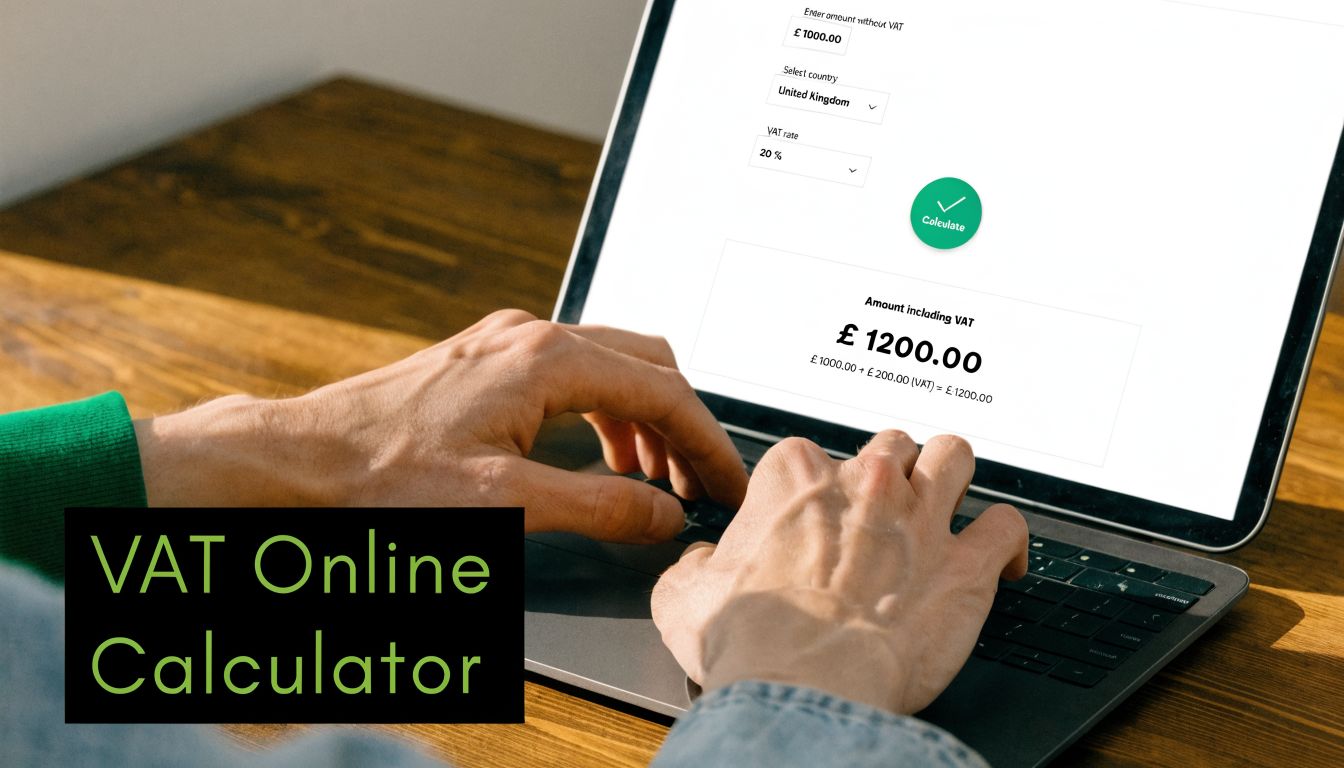
Online VAT calculators simplify compliance by applying standard formulas, but complex cases such as the Reverse Charge Mechanism (RCM) for imports or partial exemptions require more advanced tools. The same source notes projected demand for precise integrated solutions, with over 500,000 registered entities by 2026 in the UAE ecosystem according to this overview of online VAT calculation in the UAE.
Where a standalone calculator helps
It works well for one-off decisions:
- Checking a selling price: Useful before issuing a quotation.
- Verifying a supplier invoice: Good for quick finance review.
- Training junior staff: It reinforces the difference between inclusive and exclusive pricing.
Where it stops being enough
A calculator doesn't post entries. It doesn't generate an audit trail. It doesn't know whether the transaction relates to stock, services, imports, assets, or returns. It also won't resolve VAT implications at the point of sale, which is exactly why the tax setup in your point of sale process matters.
A standalone calculator answers one question at a time. A business needs the whole transaction history tied together.
If your business has multiple branches, warehouses, projects, lease contracts, or approval layers, separate calculators quickly become another manual step. They don't remove work. They shift it.
Beyond Calculators Automating VAT with Hinawi ERP
A major improvement comes when VAT is built into the transaction itself. Sales invoices, purchase bills, credit notes, stock movements, fixed asset acquisitions, and branch-level reporting should all feed the same accounting engine. That's how you stop reconciling VAT after the fact.
In asset-intensive businesses, an ERP must correctly calculate recoverable Input VAT on purchases against Output VAT on sales. If the business fails to separate taxable supplies from zero-rated or exempt ones, input tax can become irrecoverable, which can inflate costs by 5% and increase penalty risk according to this article on ERP VAT calculation and input tax treatment.
Why ERP-level control matters
Consider a manufacturing company buying machinery, raw materials, and services. VAT touches purchasing, stock, cost accounting, fixed assets, and final sales. If each team works in a separate file, the finance department spends its time repairing records instead of reviewing them.
Now consider a real estate business handling lease contracts, property expenses, maintenance charges, and owner statements. VAT treatment must stay consistent across contract billing, vendor payments, and accounting. Manual calculators won't control that flow.
What integrated automation changes
One option businesses evaluate is VAT handling in Hinawi and QuickBooks, especially when they want VAT logic tied directly to accounting and operational entries rather than managed in side spreadsheets. That approach is stronger because the system can apply tax rules when the transaction is created, not after someone notices a mismatch.
A well-configured ERP should help you:
- Generate consistent invoices: Tax treatment follows the transaction type.
- Protect input VAT recovery: Purchases and assets are recorded with proper tax coding.
- Support e-invoicing readiness: Compliance becomes part of workflow, not a last-minute exercise.
- Improve audit readiness: The records show how the VAT figure was produced.
Clean VAT reporting is usually the result of clean operations. It rarely comes from heroic correction work at quarter-end.
For business owners, that's the key decision. Keep using calculators as separate tools, or move VAT into a controlled process that runs across sales, purchasing, assets, payroll-related accounting, and reporting.
Take the Next Step with Hinawi ERP
Companies in the UAE and GCC don't need more disconnected tools. They need one system that connects finance, operations, and compliance. Hinawi ERP, developed in Abu Dhabi since 1998, gives businesses a fully integrated platform covering Accounting, HR & Payroll, Real Estate Management, Fixed Assets, Manufacturing, Garage & Maintenance, School Management, CRM, and full business automation. It supports VAT and e-Invoicing compliance, UAE WPS payroll, Arabic and English bilingual operation, flexible policy settings, and real-time accounting integration across all modules.
If your business operates in contracting, trading, real estate, manufacturing, education, maintenance, or multi-branch services, this is the right time to replace manual work with structured automation. Visit www.hinawierp.com or request a personalised demo.
Chat on WhatsApp +971506228024 Quotation – Demo RequestTake the Next Step with Hinawi ERP
If you're serious about VAT compliance, stop treating the vat calculator uae search as the end of the job. It should be the start of fixing your workflow. Manual calculations are acceptable for quick checks. They are not a solid operating model for a growing business.
Hinawi ERP is a fully integrated ERP software suite developed in Abu Dhabi since 1998. It supports Accounting, HR & Payroll, Real Estate Management, Fixed Assets, Manufacturing, Garage & Maintenance, School Management, CRM, and complete business automation. For companies across the UAE and GCC, that matters because VAT doesn't sit in one department. It affects sales, procurement, assets, payroll accounting, reporting, and management control.
The practical advantages are clear:
- VAT and e-Invoicing compliance: Better control over tax treatment and invoice workflows.
- UAE WPS payroll support: Important for businesses managing finance and HR together.
- Arabic and English bilingual operation: Easier adoption across mixed teams.
- Flexible company policy settings: Useful for multi-branch and multi-process businesses.
- Real-time accounting integration: Transactions flow into finance without repeated manual entry.
- Industry fit across sectors: Suitable for factories, contracting companies, real estate firms, schools, garages, trading companies, and manufacturers.
If you're still moving data between spreadsheets, disconnected software, and manual approvals, you're slowing the business down. Modernise the operation. Reduce manual work. Improve financial accuracy. Give management a clearer view of what is happening across the company.
Visit www.hinawierp.com or request a personalised demo and speak with the Hinawi ERP team about the right setup for your business.
Explorer Computer LLC – Hinawi Software ERP helps companies in the UAE and GCC connect VAT compliance with real operational control. If you want a system built in Abu Dhabi with local business understanding, integrated accounting, HR & Payroll, real estate, manufacturing, fixed assets, school, garage, and automation capabilities, speak with the team and request a personalised consultation or demo.