
Category: HR & Payroll
A resignation lands on your desk at 3:40 pm. The employee’s final settlement is already being processed. Operations wants the laptop returned today. Finance wants payroll closed. The employee wants an employee experience certificate immediately because visa cancellation and a new job offer are waiting.
Weak offboarding processes are exposed.
In many UAE businesses, the certificate is still treated like a simple HR letter. Someone opens an old Word file, copies a previous format, checks a joining date from one system, confirms the designation from another, walks the paper for signature, and hopes nothing is wrong. That approach is risky. One wrong date, one mismatch with the employee’s Emirates ID-linked name, or one delayed issue can create a compliance problem, a payroll dispute, and an unnecessary argument at the worst point in the employee lifecycle.
The smarter view is simple. The employee experience certificate is not clerical output. It is a regulated offboarding document tied to labour compliance, payroll records, and in many cases the practical movement of the employee from one employer to another. If your HR and payroll records are not integrated, your certificate process will eventually fail under pressure.
That’s why companies in the UAE and wider GCC should treat certificate issuance as part of a controlled ERP workflow, not an ad hoc admin task. A proper system such as Hinawi ERP can pull verified HR and payroll data, apply a bilingual template, route approvals, and produce an auditable record without the last-minute scramble that most HR teams know too well.
If your company still handles this manually, fix it before your next resignation, not after.
Need to modernise HR offboarding and document control across your business? Visit www.hinawierp.com or request a personalised demo.
Chat on WhatsApp +971506228024 Quotation – Demo RequestIntroduction The Critical Role of Employee Certificates in the UAE
An HR manager in Abu Dhabi usually doesn’t struggle with the concept of an employee experience certificate. The struggle is timing. The request nearly always comes during final settlement, handover, visa cancellation, leave encashment review, or a dispute about dates and entitlement. That’s why weak process design around this document causes disproportionate damage.
In practice, the certificate sits at the intersection of three departments. HR owns employment records. Payroll owns settlement logic. Management owns authorisation. If those functions don’t work from the same live data, the certificate becomes a bottleneck. You see rework, repeated calls from former employees, and pressure from new employers who need a clean document to proceed.
Why this document becomes urgent
The urgency is operational, not theoretical. A former employee may need the certificate to support a visa transition, a work permit process, a final settlement discussion, or a professional background check. The business may need it to close the file cleanly and avoid a dispute that drags into payroll reconciliation.
A good offboarding process doesn’t end when the employee leaves the premises. It ends when every required record, payment, and certificate has been issued correctly and can be defended under audit.
Where companies usually get it wrong
The biggest errors are predictable:
- Using outdated templates that don’t match current legal or bilingual expectations.
- Pulling dates manually from spreadsheets, emails, or disconnected systems.
- Ignoring payroll linkage even though end-of-service calculations and WPS records often sit behind later disputes.
- Delaying approvals because signatures depend on physical paper or one unavailable manager.
This is why ERP automation matters. When the certificate is generated from a controlled HR and payroll workflow, accuracy improves and the business gains traceability. That matters to HR, finance, auditors, and management.
Defining the Employee Experience Certificate in a UAE Context

An employee experience certificate is a formal document issued by an employer confirming that a person worked for the company in a stated role for a stated period. In the UAE, that simple definition is not enough. The document carries legal and administrative weight.
Core definition: An employee experience certificate is an official employment record issued at the end of service or upon request, confirming the employee’s tenure, designation, and related employment particulars for use in labour, immigration, and career transition processes.
That makes it very different from a recommendation letter. A recommendation is optional and subjective. An experience certificate is expected to be factual, controlled, and consistent with the employer’s official records. It is also different from a salary certificate, which is generally used to confirm compensation for banking, housing, or other financial purposes.
What the certificate is meant to prove
The document should confirm verifiable employment history. In the UAE context, that usually means the business is certifying that the person named in the document worked for the company from the joining date to the last working day, in the recorded position, under the company’s records.
For HR teams managing digital personnel files through systems like employee management software, this should never depend on memory, an old file cabinet, or a manually edited template. The data should already exist in the employee master record and final settlement workflow.
What it should never become
An employee experience certificate should not turn into any of the following:
- A negotiation tool where one side delays issuance to pressure the other.
- A narrative performance review filled with unnecessary opinions.
- A substitute for payroll records when finance hasn’t closed the employee account properly.
- A free-form document created differently by each HR executive.
That last point matters. If every HR officer writes certificates differently, your business creates inconsistency and legal exposure. You also make audit review harder than it needs to be.
Why precision matters more than tone
In the UAE and GCC, accuracy beats eloquence. A polished letter with incorrect tenure or wrong name formatting is worse than a plain certificate that aligns perfectly with labour, payroll, and identity records.
Keep the wording restrained. The document’s value comes from consistency with official records, not from impressive language.
Navigating Mandatory Legal Requirements in the UAE and GCC
An employee resigns, finance closes payroll on one date, HR records a different last working day, and the experience certificate goes out with a mismatch. That single inconsistency can disrupt visa cancellation, delay a new work permit, and trigger a dispute you could have prevented.
In the UAE, the employee experience certificate is part of compliant offboarding. Treat it as a controlled HR document tied to labour records, payroll closure, and final settlement. Under Federal Decree-Law No. 33 of 2021 on labour relations, employers are expected to issue proof of service based on accurate employment records. In practice, that means the certificate must match the employee file, WPS-linked payroll history, and end-of-service calculations.
The compliance risk is rarely the wording. It is the mismatch.
If the name on the certificate does not match the Emirates ID and labour file, or the service period does not match payroll and gratuity records, your company creates avoidable exposure. The same applies across the GCC. The legal framework differs by country and zone, but the operating rule stays the same. Service certificates must be consistent with official employment, payroll, and exit records.
Required checks before issuance
HR should verify these points before any certificate is released:
- Full legal name exactly as recorded in the employee’s official identity and HR file
- Joining date and last working day exactly as used for final settlement and service history
- Final designation from the approved employee record, not from email trails or old contracts
- Legal entity name that matches the employing company, especially in groups with multiple licences
- Authorised signatory and controlled format approved by HR and management
- Conduct statement, only if your policy allows it and the wording is standardised
Weak offboarding controls become quickly apparent. If HR has to ask payroll for dates, ask operations for the title, and ask admin for the signatory file, the process is already broken.
Why payroll linkage matters in the UAE
The certificate should never sit outside payroll closeout. In the UAE, salary records, WPS submissions, leave balance payout, and gratuity calculations all affect the employee’s final service record. If those records are not aligned, the certificate becomes a liability.
A proper offboarding workflow pulls approved fields from one source of truth. That includes the employee master record, payroll close, and final settlement approval. If your team still prepares certificates from Word files and separate spreadsheets, fix the process at the system level. Start with a clear understanding of how an integrated payroll process supports compliant HR records.
What a strong control setup looks like
Use a workflow that starts the certificate automatically once resignation or termination is approved. Pull the name, tenure, designation, and entity from locked HR records. Link the release of the certificate to payroll clearance and end-of-service settlement approval. Store the issued document in the employee file with timestamped approvals.
Hinawi ERP is built for exactly this kind of control. HR does not need to rewrite service details manually. The system can generate the certificate from approved records, route it for digital sign-off, and keep the audit trail attached to the offboarding file. That is the standard UAE employers should aim for, especially where WPS discipline and final settlement accuracy already matter every month.
Practical rule: If your experience certificate can be issued without checking payroll closure and final settlement data, your offboarding process is too loose.
Companies across the UAE and GCC are replacing manual HR paperwork with integrated ERP workflows. Visit www.hinawierp.com if you want to review how this can work in your organisation.
Chat on WhatsApp +971506228024 Quotation – Demo RequestCrafting Compliant Certificate Templates for Arabic and English
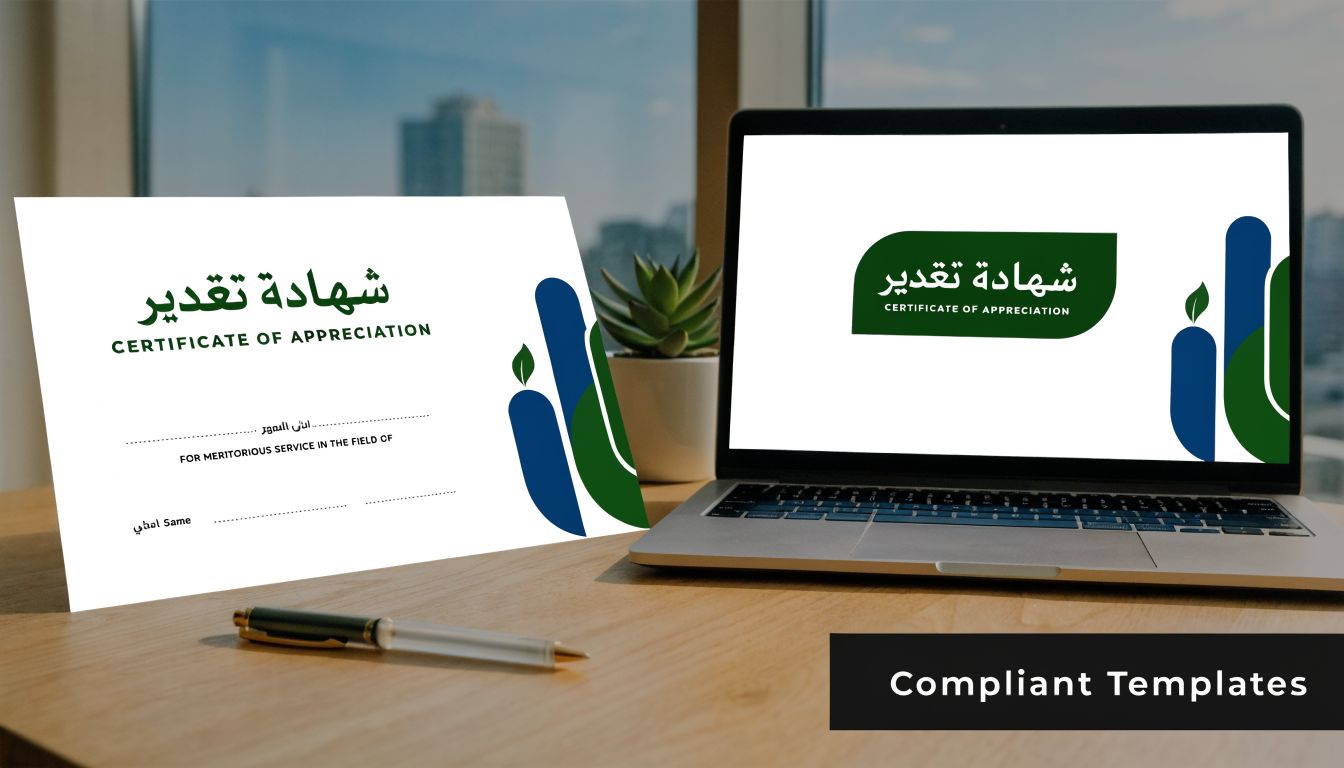
An employee finishes clearance, payroll closes the file, and HR still pulls an old Word template from a desktop folder. That is how avoidable certificate errors get issued. In the UAE, a certificate is not just a courtesy letter. It must match the employee record, the final employment dates, and the settlement position already reflected in your payroll and WPS-controlled process.
Internet templates are weak for this job. They are usually drafted for another jurisdiction, written in one language, and disconnected from the records your company will rely on if the employee questions dates, title, or final service status. Use a controlled bilingual template inside your HRMS instead. Companies that configure document rules through HRMS setup and policy controls should treat the certificate as a system document, not a free-text memo.
What a compliant bilingual template should contain
Build one approved Arabic-English format for each legal entity and keep the wording standard. Your template should pull approved fields directly from the employee master and final HR record, including:
- Legal entity name and contact details exactly as used by the employer issuing the certificate
- Certificate title in Arabic and English
- Employee full name as recorded in the official personnel file
- Employee ID or reference number if your organisation uses it for internal verification
- Joining date and last working date taken from approved records
- Final job title based on the last approved designation
- Neutral statement of service confirming employment history without adding subjective comments
- Authorised signatory details with company stamp or approved digital sign-off
Keep the language formal and restrained. Experience certificates in the UAE should confirm facts. They should not include performance claims, salary details, disciplinary commentary, or custom wording inserted to please one employee or one manager.
Link the template to WPS and end-of-service records
This is the part many HR teams still get wrong. The certificate must line up with the same dates used for payroll closure and end-of-service calculations. If the relieving date on the certificate does not match the date used in final settlement, you create a dispute point with no benefit to the employer.
The risk is practical, not theoretical. An employee can use the certificate to challenge service period, role history, or separation status. If HR, payroll, and finance hold different versions of the same employment record, your internal controls are already failing.
For that reason, the template should only populate from approved data fields. Do not let staff type over joining dates, edit designations manually, or issue separate Arabic and English versions with mismatched content. One source record should generate both languages.
A workable template standard
Use this review table to tighten your current format:
| Template element | Why it matters |
|---|---|
| Full employee name from system record | Reduces mismatch with identity and personnel records |
| Exact joining and last working dates | Supports final settlement consistency and external verification |
| Arabic and English text in one controlled format | Reduces translation inconsistency and rework |
| Final approved designation | Prevents disputes caused by informal title changes |
| Signatory, issue date, and approval log | Creates traceability if the document is questioned later |
A good template is hard to alter and easy to verify.
Stop rewriting certificates case by case
HR teams often create risk by trying to be flexible. One employee asks for a better title. Another asks to remove the reason for leaving. A manager asks for a special version in English only. That approach weakens control and guarantees inconsistency over time.
Set one approved format. Create limited system-based variants only where there is a real business need, such as entity-level branding or free zone-specific signatory rules. Everything else should stay locked.
If your HR team still prepares certificates from disconnected files, now is the time to standardise. Visit www.hinawierp.com or request a personalised demo to see how bilingual document automation fits into a full ERP.
Chat on WhatsApp +971506228024 Quotation – Demo RequestA Step-by-Step Workflow for Issuing Certificates Efficiently

Most companies don’t have a document problem. They have a workflow problem.
The certificate itself is short. The delay comes from chasing data, checking dates, confirming approvals, and correcting inconsistencies discovered too late. That’s why the best improvement is not writing a prettier certificate. It is redesigning the offboarding process so the certificate is produced as a controlled output of final settlement.
The risky manual workflow
A typical manual process looks like this:
- HR receives a request by email or phone.
- An officer checks the personal file for joining date and designation.
- Payroll is contacted separately to confirm last working day or final status.
- A template is edited manually in Word.
- A manager is asked to sign physically.
- The file is saved on a shared folder with no proper naming standard.
- The employee later asks for a correction because one field is wrong.
This process is familiar because it is common. It is also weak. There is no single source of truth, no approval log worth relying on, and no protection against accidental editing.
The controlled ERP workflow
A better workflow starts earlier. Once resignation or termination is approved, the system should trigger the next actions automatically through the employee lifecycle controls. Teams using structured employee help and management workflows can standardise the sequence instead of handling every exit as an exception.
A strong process usually follows this pattern:
- Exit initiation begins from the approved employee record.
- Service dates and designation are pulled from the live HR database.
- Payroll and settlement status are checked before certificate release.
- Template selection is automatic based on entity, language, and policy.
- Approval routing moves digitally to the authorised signatory.
- Final PDF output is stored in the employee record with time-stamped history.
When certificate issuance is tied to final settlement, HR stops reacting to urgent requests and starts controlling the process.
Before and after in practical terms
| Process area | Manual method | ERP-driven method |
|---|---|---|
| Data source | Multiple files and emails | Single employee master record |
| Date validation | Manual checking | System-pulled approved dates |
| Template control | Different versions in circulation | Approved standard templates |
| Approval | Paper or email chase | Routed digital approval |
| Audit trail | Weak or missing | Stored record with issue history |
What to fix first
Don’t try to automate everything at once if your records are already messy. Start with the controls that remove the biggest failure points:
- Clean employee master data before automating outputs.
- Link HR and payroll records so settlement-related documents align.
- Restrict template editing rights to authorised administrators.
- Define issue ownership so HR, payroll, and management know who approves what.
The result is not just speed. It is fewer disputes, fewer corrections, and a cleaner exit experience for everyone involved.
Navigating Regional Nuances for Mainland vs Free Zones
A common failure point appears the moment a group company offboards staff from both a mainland entity and a free zone entity using the same certificate template. HR issues the document quickly, the employee submits it for visa, banking, licensing, or overseas attestation, and the certificate comes back for correction because the issuing entity details, signatory authority, or validation path do not match the jurisdiction.
That delay is avoidable.
Mainland and free zone employers should treat certificate issuance as an entity-level compliance task, not an admin shortcut. The certificate may look similar on the surface, but the legal entity behind it determines which records must match, who is authorised to sign, and what external party is likely to question the document.
For UAE employers, the practical risk is bigger than wording. If the certificate dates do not align with the employee’s approved last working day, payroll close, WPS record, and end-of-service settlement, the document becomes harder to defend. In a dispute, inconsistency across those records weakens the employer’s position fast.
Where the difference actually shows up
The biggest mistake is assuming mainland and free zone variation is only about branding or letterhead. It is usually about control points.
| Requirement | Mainland (MOHRE-linked entities) | Free Zones (for example DMCC, DIFC, ADGM and others) |
|---|---|---|
| Issuing basis | Employment records tied to mainland labour administration and company policy | Employment records tied to free zone authority rules and entity policy |
| Signatory control | Must match authorised signatory structure for the mainland entity | Must match the authorised signatory structure registered for that free zone entity |
| Supporting record checks | Last working day, payroll close, WPS alignment, final settlement status | Last working day, payroll close, free zone record alignment, final settlement status |
| External acceptance questions | Often checked against company records and labour documentation | Often checked more closely when used outside the originating free zone or abroad |
| HR process risk | Wrong entity template or outdated signatory | Wrong authority wording, wrong entity name, or missing jurisdiction-specific validation |
What multi-entity employers should standardise
Use one policy framework, but configure separate rules by legal entity. That is the right model.
HR should not decide manually which version to issue. The system should pull the employing entity, approved employment dates, and authorised template automatically. If your organisation runs mainland and free zone entities in parallel, Hinawi should generate the correct certificate based on the employee master record and entity mapping, then hold release until payroll and final settlement checks are complete.
That matters for compliance because certificate dates must agree with the records already used for offboarding. If WPS shows salary processed through a certain date, or end-of-service is calculated from a confirmed termination date, the certificate cannot show something different without creating a dispute risk.
What to set up in practice
Start with four controls:
- Separate certificate templates by legal entity, not just by brand
- Separate approval routes by authorised signatory and jurisdiction
- A required check against payroll, WPS-related records, and end-of-service dates before issue
- A flag for certificates likely to be used outside the issuing jurisdiction, so HR can prepare the employee for added verification steps
Many HR teams lose time when an employee asks for a certificate after exit. HR issues a generic version, payroll spots a date mismatch, then the document gets reissued twice. That is poor offboarding control.
A better approach is simple. Configure entity-specific templates in Hinawi, lock editing rights, and make certificate release dependent on approved offboarding data. One legal entity should have one controlled certificate logic. Groups with multiple entities need multiple controlled variants, each tied to the right records and approval path.
Frequently Asked Questions
Is the employer required to issue an employee experience certificate
In the UAE context, yes, the issue is not something employers should treat casually. Once employment ends or the employee requests the document within the applicable framework, the employer should issue it accurately and on time. Refusal or delay creates unnecessary legal exposure and often turns a simple offboarding step into a formal dispute.
Can the certificate include negative comments about the employee
That is usually a bad idea. The certificate should remain factual and restrained. Confirm service details, designation, and approved wording only. If your company has a conduct statement in its standard template, keep it consistent with policy and legal review. Don’t allow individual managers to add personal remarks.
Are digitally signed certificates valid
They can be operationally valid if your company uses a controlled approval process and the document is generated from an authorised system. What matters is that the certificate comes from approved company records, follows policy, and can be authenticated if challenged. Random PDF signatures without process control are not the same thing as a governed digital workflow.
How long should the company keep certificate records
Keep them according to your document retention and audit requirements, and align them with employment, payroll, and legal record policies. In practice, the final issued certificate should sit in the employee file together with settlement records, approval history, and any reissued versions.
What is the safest way to avoid disputes
Use one system of record. HR, payroll, and management should work from the same approved data. Most disputes start when the certificate says one thing, payroll says another, and no one can prove which record was final.
Want to see how integrated HR, payroll, and document workflows work in a real ERP environment? Visit www.hinawierp.com and speak to the team about a personalised walkthrough.
Chat on WhatsApp +971506228024 Quotation – Demo RequestTake the Next Step with Hinawi ERP
If your business still handles employee experience certificates through Word files, email approvals, and manual payroll checks, you are carrying unnecessary risk. The certificate should be generated from the same system that manages your employee records, payroll, settlement logic, and approvals.
Hinawi ERP is a fully integrated ERP software developed since 1998 in Abu Dhabi. It supports Accounting, HR & Payroll, Real Estate Management, Fixed Assets, Manufacturing, Garage & Maintenance, School Management, CRM, and complete business automation. For UAE and GCC companies, that matters because offboarding does not happen in isolation. HR records affect payroll. Payroll affects accounting. Accounting affects audit readiness.
Hinawi ERP helps businesses modernise operations with:
- VAT and e-Invoicing compliance for stronger financial control
- UAE WPS payroll support linked to HR and payroll processes
- Arabic and English bilingual operation for practical regional use
- Flexible company policy settings for different entities and workflows
- Real-time accounting integration across all modules
- Suitability for factories, contracting firms, real estate businesses, schools, garages, trading companies, and manufacturers
If you want cleaner offboarding, less manual work, more accurate records, and better management control, speak with the Hinawi ERP team. You can also explore their platform through the Hinawi ERP demo and consultation page.
For companies in the UAE and GCC, Explorer Computer LLC – Hinawi Software ERP offers a practical path to modernise HR, payroll, accounting, and business automation with local expertise, bilingual capability, and integrated control.