
Category: Accounting
Quarter-end in the UAE often looks the same. The finance team is chasing missing invoices, someone is reconciling imports at the last minute, and the business owner wants to know one thing: is the VAT return ready, accurate, and safe to submit?
That pressure is exactly why vat filing uae can't be treated as a simple form-filling exercise. For many businesses, the actual risk isn't the EmaraTax portal itself. It's the weak process behind it. Manual spreadsheets, branch-level inconsistencies, late document collection, and poorly classified transactions create problems long before anyone clicks Submit.
In practice, the businesses that file smoothly do three things well. They keep transaction data organised daily, they reconcile before the filing window closes, and they use accounting or ERP workflows that reduce manual touchpoints. In complex sectors such as trading, contracting, manufacturing, real estate, school operations, and garage maintenance, that's where a properly configured ERP becomes less of a convenience and more of a control mechanism. Hinawi ERP is often relevant in these environments because VAT sits inside wider operations such as inventory, payroll, fixed assets, and project costing rather than in isolation.
Take the Next Step with Hinawi ERP
If your finance team is still preparing VAT returns from spreadsheets, disconnected ledgers, or branch-wise manual summaries, this is the right time to modernise the process. Hinawi ERP helps UAE and GCC businesses automate VAT reporting, connect sales, purchases, inventory, payroll, and fixed assets in real time, and maintain cleaner records for audit readiness. You can explore the system at Hinawi ERP official website or request a personalised discussion with the team.
Chat on WhatsApp +971506228024 Quotation – Demo RequestThe Critical Path to UAE VAT Compliance
VAT has been part of normal business operations in the UAE since 1st January 2018, when it was introduced at a 5% standard rate under the federal tax system, with mandatory registration for businesses exceeding AED 375,000 in annual taxable turnover and voluntary registration from AED 187,500, as outlined by the UAE Ministry of Finance VAT framework. That same framework also notes that by 2019, 296,000 businesses had registered for VAT and 3.2 million electronic tax refund applications had been processed by year-end, which tells you how quickly VAT became part of day-to-day business administration.
The operational lesson is straightforward. VAT compliance isn't occasional admin. It's a recurring reporting cycle that affects invoicing, purchasing, imports, credit notes, reconciliations, and management reporting.
What the deadline pressure usually reveals
When I review VAT processes for UAE companies, the filing issue is rarely “we don't know the rate”. The problem is usually one of these:
- Sales were posted late and the VAT period doesn't reflect actual supplies.
- Purchase invoices are incomplete so recoverable input VAT is questionable.
- Imports were recorded inconsistently between customs, accounts, and stock.
- Branches followed different coding rules for similar transactions.
- The return is being built manually from multiple reports that don't fully agree.
A clean VAT return starts much earlier than the filing date. It starts with transaction discipline across the whole quarter or month.
Practical rule: If your team is still “preparing the books” during the VAT filing week, the problem is process design, not just workload.
The compliance path that actually works
A reliable filing cycle usually follows this order:
Close operational entries early
Sales, purchase invoices, credit notes, debit notes, and import records should be posted before the VAT review begins.Reconcile the ledger
VAT accounts, supplier balances, customer balances, and bank movements need to agree with source documents.Review classifications
Standard-rated, zero-rated, exempt, import-related, and reverse charge items must be separated correctly.Prepare the VAT summary
The return should come from a controlled report, not from ad hoc spreadsheet combinations.Submit and archive support
The return, acknowledgement, and supporting records should stay linked for future review.
This is also why finance leaders should pay attention to accounting period discipline and year-end structure. A useful reference for that is this practical note on fiscal year meaning, because VAT problems often begin with weak period control rather than tax knowledge.
Take the Next Step with Hinawi ERP
If VAT preparation still depends on manual summaries from accounting, inventory, payroll, and branch staff, your business is carrying unnecessary compliance risk. Hinawi ERP gives companies in the UAE and GCC a practical way to centralise entries, automate VAT treatment, and keep supporting records connected to each transaction. Visit Hinawi ERP official website or request a personalised demo to see how a real ERP workflow can support your filing process.
Chat on WhatsApp +971506228024 Quotation – Demo RequestPreparing Your Data for a Flawless VAT Return
On the week a VAT return is due, the same pattern shows up again and again. Sales says all invoices were issued. Purchasing says a few supplier tax invoices are still pending. Warehouse records do not fully match landed cost postings. The bank reconciliation is behind. Finance can still submit a return in that situation, but it cannot defend every figure with confidence if the FTA asks questions later.
That is why data preparation decides the quality of the return before anyone logs into EmaraTax. For UAE businesses with multiple branches, imports, fixed assets, free zone activity, or mixed taxable supplies, VAT filing is not a document-gathering exercise. It is a structured reconciliation process.
What finance should have ready before the return is drafted
The filing pack should tie each VAT figure back to transaction-level support. If a number appears in the VAT 201, finance should be able to trace it to the source document, the accounting entry, and the period in which it belongs.
| Document Type | Purpose & Key Details |
|---|---|
| Sales tax invoices | Support output VAT on standard-rated sales and validate customer-facing tax amounts |
| Sales credit notes | Reduce taxable value and output VAT where returns, corrections, or discounts apply |
| Purchase tax invoices | Support input VAT recovery on eligible business expenses |
| Supplier credit notes | Adjust previously claimed input VAT where purchase values changed |
| Customs and import documents | Support import VAT treatment and comparison with portal auto-populated values |
| Bank statements | Help reconcile payment timing, supplier authenticity, and completeness of records |
| Debit and credit notes | Support adjustments and explain period-based corrections |
| Export documentation | Support zero-rated treatment where applicable |
| Branch-wise transaction reports | Separate activities by location where the business operates across multiple sites |
| General ledger and VAT summary | Provide the accounting basis for the VAT 201 return figures |
A complete filing pack matters most where the business model is operationally messy. A construction group may have advance receipts, retention, inter-branch charges, and asset purchases in the same quarter. A distributor may have import VAT, stock transfers, rebates, and supplier credit notes crossing periods. In both cases, the return goes wrong because records are incomplete, late, or posted to the wrong VAT box.
The review process that catches errors early
Good VAT preparation starts with reconciliation, not with the return form.
Use a pre-filing review sequence that forces each team to prove completeness:
- Match sales invoices to ledger postings so taxable supplies are recorded in the correct period and under the correct VAT treatment.
- Compare purchase entries with supplier statements to identify missing invoices before input VAT is claimed.
- Check customs documents against import postings because auto-populated import values still need internal validation.
- Review credit notes and manual journals to confirm they relate to the current filing period and are supported.
- Reconcile branch activity where separate sites raise invoices, receive goods, or post expenses independently.
- Review fixed asset purchases separately because capital items often require different attention than routine operating expenses.
- Check zero-rated and exempt transactions line by line because classification errors often survive basic arithmetic checks.
I usually ask one direct question before signing off a client’s draft return. Can the finance team explain every adjustment without reopening old emails and WhatsApp messages? If the answer is no, the process is too manual.
Why manual preparation creates avoidable VAT risk
Spreadsheets are still common, especially in owner-managed businesses. They are acceptable for a very small company with limited transaction volume and no operational complexity. They become risky once the business adds warehouses, multiple legal locations, project billing, imports, fixed assets, or separate approval chains.
The problem is control. Spreadsheets summarise data after the fact. They do not control how transactions were entered, whether VAT codes were applied consistently, or whether supporting documents were attached at source.
That is why I often start with the posting structure and audit trail, not with the VAT report itself. Businesses that want reliable filing need disciplined accounts, clear tax codes, and a chart of accounts that supports reporting. This practical guide to the ledger structure used in accounting records is a useful reference because VAT accuracy depends heavily on how transactions reach the books.
What a stronger workflow looks like in practice
For complex UAE businesses, the better operating model is system-led and exception-based.
Operational teams create transactions in the live system. Finance reviews VAT coding during the month, not only at quarter end. Exceptions are flagged before the filing deadline. The VAT summary is generated from reconciled books rather than rebuilt manually from disconnected files.
An ERP setup makes a measurable difference in day-to-day compliance. In Hinawi ERP, for example, finance can review sales, purchases, inventory movements, fixed asset entries, and branch postings in one environment, then compare VAT summaries against the underlying documents before filing. That is far more dependable than asking staff to merge branch spreadsheets, warehouse reports, customs schedules, and bank records at the last minute.
For a free zone business, the benefit is not speed alone. It is classification control. For an asset-intensive company, the benefit is not a cleaner dashboard. It is being able to trace capital expenditure and supporting tax invoices without hunting through separate folders. For a multi-branch trading business, the benefit is seeing whether one branch is consistently miscoding purchases or delaying invoice posting.
Clean VAT returns come from controlled transaction flow, timely reconciliation, and records that can stand up to review. That standard is difficult to maintain with manual files. It is realistic with a properly configured ERP and a finance team that closes each period with discipline.
Calculating Your Net VAT Position
A return can look balanced on a spreadsheet and still fail under review. I see this often with businesses that have decent bookkeeping but weak VAT mapping across branches, imports, fixed assets, and intercompany activity. The net VAT position is only reliable when the totals can be traced back to the tax treatment of each transaction type.
The formula is straightforward. Output VAT less recoverable input VAT gives the amount payable or recoverable for the period. The hard part is deciding what belongs in each box of the return, in the right period, with support that will stand up if the FTA asks questions later.
The three numbers that matter most
By the time finance signs off the return, three figures should be clear and defensible.
Output VAT
This is the VAT charged on taxable supplies, adjusted for credit notes and other output-side corrections where applicable.
The review should answer practical questions such as:
- Were all sales invoices posted in the correct tax period?
- Were credit notes linked to the original supplies and reflected correctly?
- Were zero-rated sales separated from standard-rated supplies?
- Were exempt transactions excluded from output tax where relevant?
- Were branch-level sales totals rolled up correctly into the consolidated return?
Recoverable input VAT
This is the input tax the business is allowed to claim on purchases, expenses, and qualifying capital items, subject to documentation and recovery rules.
This area creates more filing errors than many owners expect. A purchase can be genuine, approved, and fully paid, but the VAT claim may still be wrong if the tax invoice is incomplete, the expense is blocked or partly restricted, or the entry was posted in the wrong period. Asset-heavy businesses need extra care here because high-value capital expenditure attracts attention and often needs separate review before filing.
Net VAT due or recoverable
This is the result after combining output VAT and recoverable input VAT. If output VAT is higher, tax is payable. If recoverable input VAT is higher, the return shows a recoverable balance, subject to the normal treatment on the portal and the strength of the supporting records.
Working test: If finance cannot trace the net VAT figure from the summary report back to invoice-level entries, customs support, and adjustment journals, the calculation is not ready for submission.
A practical calculation example
Consider a UAE trading company that sells locally, exports part of its stock, imports goods for resale, buys services from overseas vendors, and operates more than one branch. That mix is common, and it is also where manual VAT work starts to break down.
The quarter-end calculation usually has to separate:
- local standard-rated sales
- zero-rated exports with supporting documents
- import VAT linked to customs data
- reverse charge entries on overseas service purchases
- customer credit notes
- supplier credit notes
- prior-period corrections
- fixed asset purchases that need separate review
The arithmetic is not the issue. Classification is. If imports are sitting in the purchase ledger without proper tax codes, or if overseas services are booked as ordinary local expenses, the VAT summary may still produce a number, but not a reliable one.
Reverse charge needs a controlled workflow
Reverse charge is one of the areas where teams hesitate, especially when procurement, accounts payable, and finance each see only part of the transaction. The overseas supplier may issue an invoice with no UAE VAT, but the UAE business may still have to account for tax on the purchase and assess whether the related input tax is recoverable.
This highlights why chart of accounts design and tax code configuration matter. The correct treatment has to start at transaction entry. If the tax logic is applied later through manual journals or spreadsheet adjustments, the risk of omission or duplication rises quickly.
In Hinawi ERP, the stronger approach is to set the transaction rules in advance and review exceptions. Supplier location, item type, expense category, branch, and document type can all affect VAT treatment. For multi-branch businesses, that matters because one branch may code imported services correctly while another books the same cost to a generic expense account with no reverse charge treatment at all. A system-led review makes that inconsistency visible before filing.
What works in practice
A spreadsheet-based method can work for a small company with low transaction volume, one location, and stable transaction types. It becomes harder to control once the business has regular imports, multiple warehouses, free zone activity, capital projects, or branch-level purchasing.
A rules-based ERP setup is more dependable because the VAT treatment is built into the transaction flow. Explorer Computer LLC – Hinawi Software ERP is often used in this way by businesses that need VAT-aware accounting connected to inventory, fixed assets, payroll, and operations, rather than a tax summary prepared after the books are closed. The value is not only speed. It is consistency, traceability, and fewer quarter-end adjustments.
Review points before finalising the calculation
Before approving the net VAT figure, test it from several angles:
- Sales by Emirate should agree with invoice registers and ledger postings where the return requires that breakdown.
- Imports and customs-linked VAT should be checked against source documents and accounting entries.
- Credit notes should reflect genuine commercial adjustments and the correct period.
- Exempt and zero-rated transactions should have the right classification and supporting evidence.
- Fixed asset purchases should be reviewed separately because values are often larger and coding errors have a bigger effect.
- Branch totals should reconcile to the consolidated ledger, especially where branches use different users or approval flows.
- Manual journals affecting VAT should be reviewed line by line.
A short internal control table helps keep that review disciplined:
| Review Area | What to confirm |
|---|---|
| Sales totals | Match invoice registers and ledger postings |
| Purchase totals | Include only documented and eligible input claims |
| Imports | Agree with customs support and accounting entries |
| Adjustments | Reflect actual notes and corrections |
| Reverse charge | Posted consistently and reviewed with support |
| Final net position | Traceable from summary back to source transactions |
The trade-off is straightforward. Spreadsheets give flexibility, but they also leave more room for late interpretation, inconsistent branch practices, and missed adjustments. System logic takes more work to configure upfront, but it gives finance a cleaner close, a clearer audit trail, and a calculation process that holds together as the business grows.
For vat filing uae, the safest position is reached before filing week. By that point, finance should be validating exceptions and evidence, not deciding the VAT treatment of routine transactions for the first time.
Filing Your Return on the EmaraTax Portal
Once the numbers are reconciled, the task becomes procedural. The EmaraTax process for Form VAT 201 involves around 19 steps, and one of the most common filing mistakes is failing to verify auto-populated data for imports and reverse charges. The same filing guidance also notes that ERP-supported auto-population can lift filing success rates to over 95%, compared with around 70% for manual filing, according to the EmaraTax VAT filing process guide.
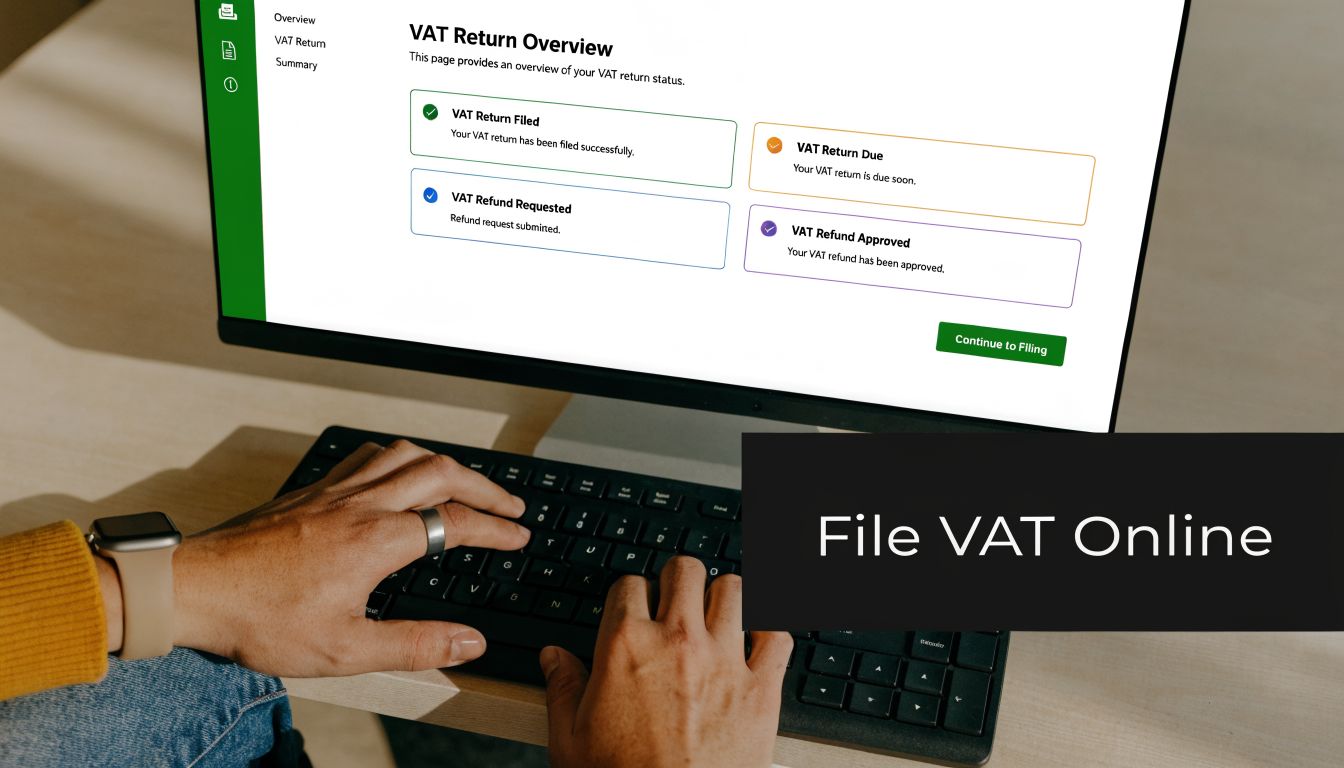
The practical point isn't memorising all portal steps. It's entering the portal with final, reviewed figures.
How the portal process usually flows
The VAT 201 workflow broadly follows this path:
- Log in to EmaraTax
- Open VAT filings and select the correct period
- Confirm the instructions and begin
- Review the filing period details
- Use the Excel template if needed
- Enter output tax details
- Enter input tax details
- Review imports, adjustments, and reverse charge areas
- Confirm the net VAT position
- Save, review, declare, and submit
- Download the acknowledgement
- Arrange payment if tax is due
That sounds manageable, and it is. The strain appears when the figures were assembled manually and the user starts second-guessing the source data inside the portal.
The fields that deserve extra care
Not every VAT return field carries the same risk. In practice, these areas deserve closer checking:
- Imports because portal data may be auto-populated and still require reconciliation
- Reverse charge lines because businesses often post these inconsistently
- Adjustments because prior period fixes can be applied incorrectly
- Zero-rated and exempt values because category errors affect both output and recovery logic
- Net VAT due because all earlier mistakes converge at this point
Don't treat portal auto-fill as confirmation. Treat it as data that still needs review.
A better submission habit
Finance teams filing manually often type values from several sheets into EmaraTax. That creates avoidable risk. A better method is to work from one final VAT report that mirrors the return structure, then cross-check each box against a reviewed summary.
This shifts the user’s role from data assembler to reviewer. That change matters. It reduces transposition errors, duplicate entries, and filing-day confusion.
A good internal submission routine looks like this:
| Filing Stage | Manual habit | Better habit |
|---|---|---|
| Return prep | Build totals from fresh spreadsheets | Use a locked, reviewed VAT summary |
| Import review | Accept portal values quickly | Compare with customs and ledger support |
| Box completion | Key numbers one by one from mixed sources | Cross-check against a structured report |
| Final review | Focus on whether the form submits | Focus on whether every figure is defensible |
Why ERP-backed filing is more dependable
The EmaraTax portal is the submission platform. It isn't your reconciliation engine. That distinction matters for any business with stock, projects, branches, service imports, or fixed assets.
When the accounting system can produce a VAT report aligned to the filing structure, the process becomes far more controlled. Hinawi ERP, for example, is typically used in this context to generate VAT-aware summaries from live transactions across accounting, inventory, fixed assets, and operational modules. The advantage isn't only speed. It's consistency between underlying entries and reported values.
Before clicking submit
I advise businesses to pause for one final control review before declaration:
- Does the filing period match the intended tax period?
- Do all major totals tie back to the ledger?
- Were auto-populated import figures checked manually?
- Are unusual adjustments explained and documented?
- Has someone independent reviewed the draft if the business is complex?
- Is the payment process ready if VAT is due?
The biggest filing mistakes don't usually happen because staff can't use the portal. They happen because the return is still being validated while it is being entered.
Advanced VAT Filings for Complex Businesses
Standard VAT filing guidance is fine for a single-location business with straightforward sales and purchases. It becomes inadequate once the company operates across branches, warehouses, free zones, projects, or asset-heavy environments. In those cases, vat filing uae is less about completing a form and more about controlling transaction architecture.
The weak point is usually not intent. It's fragmentation. One branch may classify a transaction one way, another branch may use a different code, and the head office only discovers the inconsistency during consolidation.
Guidance focused on complex businesses notes that multi-branch organisations and businesses operating in or transacting with free zones face special VAT considerations that are often poorly managed, and that asset-intensive companies must handle difficult year-end VAT adjustments tied to inventory valuation and fixed asset input VAT recovery, as discussed in this practical review of accurate VAT filing in the UAE.
Multi-branch and free zone realities
A business with mainland operations and free zone activity can't rely on broad summaries alone. It needs visibility into where the transaction happened, which entity or branch handled it, what documents exist, and how goods or services moved.
Common pressure points include:
- Inter-branch reconciliation where invoice flow and stock movement don't align
- Mainland versus free zone treatment where teams assume the same rules apply everywhere
- Warehouse transactions that are recorded operationally but not reviewed from a VAT perspective
- Project-based billing where timing and documentation create period mismatches
For retailers and trading businesses, the point-of-sale environment also matters because invoice generation and tax coding begin at transaction level. That's why process owners should think beyond accounting and include operational systems such as point of sale workflows in the control design.
In complex businesses, VAT errors often begin in operations and only become visible in finance.
Asset-intensive companies need a different review lens
Manufacturers, contractors, garages, and fixed-asset-heavy businesses deal with another layer of difficulty. Large machinery purchases, long project cycles, spare parts, job cards, production issues, and inventory adjustments all affect how VAT appears in the books.
The finance team should separate these reviews from routine purchase testing:
- Fixed assets should be traced from acquisition documents to asset records and VAT treatment.
- Inventory adjustments should be examined at period-end because valuation and stock corrections can affect reporting logic.
- Job costing and project expenses should be checked for timing, coding, and support.
- Mixed-use or mixed-activity environments need careful review where recoverability is not straightforward.
What works in practice
For a growing UAE or GCC business, the right answer is usually not “train staff harder to use spreadsheets”. The better answer is to standardise tax codes, centralise transaction capture, and make branch, warehouse, project, and asset records part of the same reporting framework.
That is where integrated ERP adds real control. A system that links inventory, BOQ, fixed assets, accounting, procurement, and branch reporting allows finance to review a single transaction trail instead of rebuilding one from separate records.
Post-Filing Compliance, Deadlines, and Penalties
A common failure point looks like this. The VAT return was submitted on time, finance assumes the period is closed, and two months later someone asks for the support behind an adjustment, an import document, or a branch-level sales breakdown. The numbers may be filed, but the business is still exposed if it cannot produce the trail quickly and cleanly.
Post-filing compliance in the UAE is an operational discipline. Submission is only one step. Payment, record retention, exception tracking, correction handling, and audit support all sit after the return goes in.
VAT returns are generally due within 28 days after the end of the tax period. Filing late, paying late, or missing supporting records creates avoidable risk. In practice, I advise clients to treat the filing date as an internal checkpoint, not the finish line.
What a proper post-filing close should include
Strong finance teams run a documented post-filing routine on the same day or within a few days of submission. That routine should cover:
- Saving the final return, acknowledgement, and payment reference
- Locking the VAT working papers used for the filed period
- Documenting manual adjustments and who approved them
- Listing open exceptions that may require correction or follow-up
- Reconciling the filed VAT position to the ledger and bank payment
- Preserving the supporting documents by period, branch, and transaction type
This matters more in complex businesses. A multi-branch trading group may need to retrieve tax evidence by outlet. A contractor may need to support project-stage costs months later. An asset-intensive company may need to show how a capital purchase moved from invoice to fixed asset record to VAT treatment. If those records sit across email threads, shared folders, and spreadsheets, retrieval becomes slow and unreliable.
Error correction needs speed and judgement
Errors discovered after filing should be assessed immediately. Do not wait for the next period and hope the difference disappears in volume. Review the cause, quantify the impact, identify the affected period, and decide whether the issue can be corrected in the next return or needs a formal disclosure under the applicable rules.
The trade-off is straightforward. A rushed correction can create a second mistake. A delayed correction can increase penalty exposure and make the business look careless. The right approach is controlled, documented, and fast.
Audit readiness depends on retrieval, not memory
During a review, the Federal Tax Authority is not testing whether the finance team remembers why an entry was posted. It is testing whether the business can produce consistent records that support the filed position.
That is why post-filing control should be system-led. The filed return should tie back to the transaction source, attached documents, approval history, tax code logic, and period-end reconciliation. In Hinawi ERP environments, that means finance can trace exceptions across branches, assets, inventory movements, and accounting entries without rebuilding the story manually after the fact.
Teams that manage several reporting obligations should also maintain a single compliance calendar, not separate reminders by department. A practical reference point is this guide on income tax return filing deadlines and compliance dates, especially for businesses aligning VAT, corporate tax, and year-end close procedures.
A return filed on time still needs to be defensible later. That is the standard that matters.
Take the Next Step with Hinawi ERP
Manual VAT filing creates more than clerical pressure. It creates management risk. When tax data sits across disconnected spreadsheets, branch systems, warehouse files, purchase approvals, and fixed asset registers, finance spends too much time rebuilding numbers that should already be available.
Hinawi ERP addresses that problem by connecting VAT treatment to the transactions that create it. Developed since 1998 in Abu Dhabi, Hinawi ERP is a fully integrated business software platform for companies in the UAE and GCC. It supports Accounting, HR & Payroll, Real Estate Management, Fixed Assets, Manufacturing, Garage & Maintenance, School Management, CRM, and complete business automation.
For decision-makers, the practical benefits are clear:
- VAT and e-Invoicing compliance through structured accounting and tax-aware reporting
- UAE WPS payroll support for payroll accuracy and regulatory alignment
- Arabic and English bilingual operation across departments
- Flexible company policy settings that match internal approval and workflow rules
- Real-time accounting integration across all modules
- Industry fit for factories, contracting companies, real estate businesses, schools, garages, trading companies, and manufacturers
If you want to reduce manual work, improve financial accuracy, and bring VAT filing into a controlled operational process, a personalised review is the right next step. You can also see how Hinawi works alongside accounting workflows in this overview of VAT in Hinawi and QuickBooks.
Visit Hinawi ERP official website or request a personalised demo to discuss your business structure, filing challenges, and reporting requirements with the Abu Dhabi-based team.
Chat on WhatsApp +971506228024 Quotation – Demo RequestExplorer Computer LLC – Hinawi Software ERP supports businesses across the UAE and GCC with practical ERP implementation, VAT-ready accounting, payroll, fixed assets, real estate, manufacturing, garage management, school systems, CRM, and business automation. If your company wants stronger compliance, cleaner reporting, and less manual effort, speak with the team at Explorer Computer LLC – Hinawi Software ERP for consultation or a personalised demo.