
Category: Fixed Assets
If you're running a construction company in the UAE and your team still depends on Excel for costing, WhatsApp for site updates, and a separate accounting package for finance, you don't have a system. You have a delay machine.
The pattern is always the same. A project manager updates quantities in one file. Procurement buys materials from another list. Payroll runs from attendance sheets that don't match site allocation. Finance closes the month with missing job costs, unreconciled supplier balances, and a growing fear that the next VAT review will expose weak records. By the time management sees the true position of a project, the margin has already moved.
That’s why erp software for construction industry is no longer a nice-to-have for UAE contractors. It’s the operating layer that connects projects, costs, payroll, procurement, inventory, fixed assets, and reporting in one controlled environment. For firms dealing with BOQs, subcontractors, heavy equipment, and compliance, basic accounting software isn’t enough.
This matters even more in the Gulf. The UAE construction ERP market context sits inside a sector where the global construction ERP market was valued at USD 3.7 billion in 2024 and is projected to reach USD 7.6 billion by 2034, while the UAE construction industry contributes 8-10% to GDP and has over 500 major projects valued at AED 1.9 trillion (USD 517 billion) in the pipeline as of 2024.
The Hidden Costs of Disconnected Construction Management
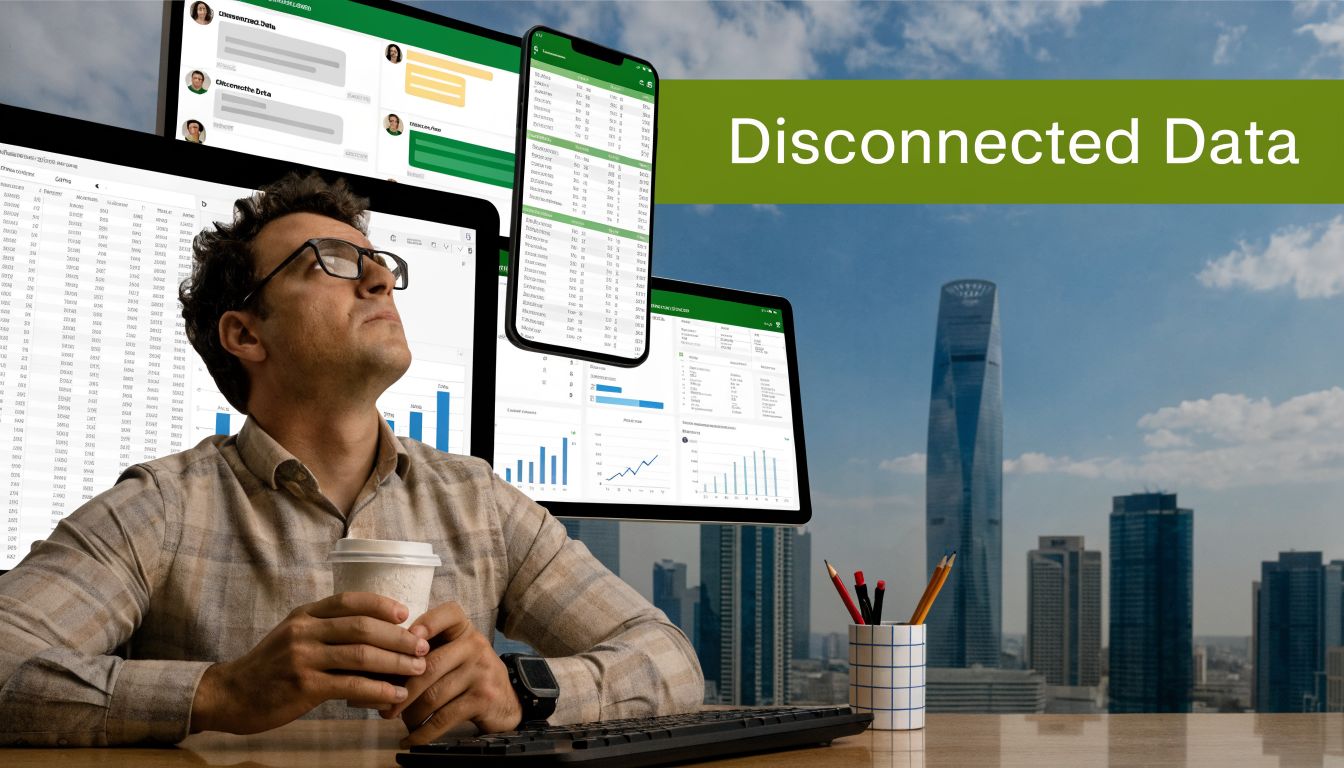
At 6:30 p.m., your project manager says a job is on budget. At 7:00 p.m., procurement reports urgent material purchases outside the approved plan. The next morning, finance finds supplier invoices that were never tied to the right cost code, and payroll is still waiting for site attendance to confirm labour allocation. That is how margin disappears in a construction company. Not through one big mistake, but through daily gaps between departments.
Where the damage happens
Owners usually blame delay, weak follow-up, or staff discipline. The underlying problem is fragmented control.
In many UAE construction firms, site records sit in spreadsheets, store issues stay in manual logs, payroll depends on late timesheets, and finance closes the month from partial documents. Every team is working, but each team is working with different numbers. By the time management sees the full cost picture, the decision window has already closed.
The losses show up in three places:
- Project costing slips out of control: committed cost, actual cost, and remaining budget stop matching in real time.
- Compliance becomes risky: WPS support, VAT records, supplier documents, and approval trails are harder to verify when they sit across separate files and systems.
- Assets stop reporting clearly: equipment usage, maintenance cost, fuel, and depreciation do not flow cleanly back to the project that consumed them.
This is not only an efficiency issue. It is a control issue.
Practical rule: If one project-cost question requires calls to site, stores, HR, and finance, your business is being run by follow-up, not by system control.
The problem is sharper in the Gulf because global ERP products often miss local operating requirements. A contractor in the UAE does not only need project accounting. You need payroll processes that support WPS, reporting that stands up to VAT review, growing pressure to prepare for e-invoicing, and genuine bilingual operation across Arabic and English. If your software handles construction logic but fails local compliance and daily language use, your team goes back to spreadsheets around the system.
Growth makes all of this worse. One branch can hide these gaps for a while. Multiple projects, shared equipment, subcontractor claims, retention tracking, inter-branch stock movement, and staged billing expose every weak handoff.
An ERP built on connected modules across projects, procurement, payroll, assets, and finance fixes the handoff problem at the source. Material purchases hit project cost codes. Labour flows from attendance into payroll and job costing. Asset charges reach the right project ledger. Finance stops rebuilding the story after month end because the story is already recorded correctly inside the system.
What is a Construction ERP Beyond Standard Accounting Software
A UAE contractor usually feels the limit of standard accounting software at the worst moment. Payroll is due, a project manager is disputing job costs, procurement says materials were approved, and finance still cannot see a complete financial picture of the job without checking three spreadsheets and two inboxes.
That is the difference.
Standard accounting software records transactions after the work happens. A construction ERP runs the business while the work is happening. It connects estimating, project execution, procurement, stores, subcontracting, payroll, equipment, billing, retention, and final accounts inside one operating system.
For a construction firm, that distinction is operational, not technical. If your software only tells you what was posted to the ledger, it is already late. You need to know which project is slipping, which package is over budget, which subcontractor claim is still unapproved, and which labour cost has not been charged back correctly before month end closes.
From posted accounts to controlled operations
Basic finance software is built to answer accounting questions. Construction ERP is built to answer management questions.
Can site raise a material request against an approved job budget? Can procurement see committed cost before issuing a purchase order? Can labour attendance flow into payroll and then into project costing without re-entry? Can retention, progress billing, and variations be tracked against the contract instead of on separate sheets?
If the answer is no, your team will build workarounds around the system. That is exactly how contractors end up with one version of cost in finance, another with the project manager, and a third in the owner's review meeting.
A proper contracting ERP software for UAE construction companies gives every department the same record, tied to the same project structure. Data is entered once, approved in sequence, and used across costing, billing, inventory, payroll, and reporting.
What standard accounting software misses in the Gulf
Many global products understand accounting. Fewer understand Gulf contracting.
A UAE construction ERP must handle local payroll practice, support WPS-ready payroll processes, work cleanly in Arabic and English, and help finance stay prepared for VAT review and the shift toward e-invoicing requirements. If those needs sit outside the core system, staff go back to spreadsheets, side calculations, and manual corrections. The software stays in place, but control disappears.
This is why owners should be careful with generic ERP claims. A product can look strong in demos and still fail in daily GCC operations if bilingual use is weak or compliance tasks depend on manual work outside the system.
What a real construction ERP should deliver
Your ERP should give each function a clear role inside one workflow:
- Project teams track budget, actual cost, committed cost, and progress against the job structure
- Procurement buys against approved demand and sees the project impact before costs hit finance
- Stores and equipment teams issue materials and usage to the right project and cost code
- HR and payroll allocate labour cost correctly, including site-level charging
- Finance receives direct postings with audit trails instead of month-end reconstruction
- Management sees project margin early enough to act, not after the damage is booked
That is the definitive step beyond accounting software. You stop using finance to reconstruct operations after the fact. You use ERP to control operations while they are happening.
Core Modules for the Modern UAE Construction Firm
Construction companies in the UAE don’t need more software. They need fewer disconnected tools and better control. The right ERP should reflect how a contractor operates, not how a generic office business posts invoices.
Project accounting and job costing
This is the core. Every cost needs a home, and in construction that home is the project, the package, the BOQ item, or the cost code.
If labour, material, equipment, subcontract, and overhead costs aren’t tied to jobs properly, margin reporting becomes guesswork. The owner sees revenue. The project manager sees progress. Finance sees expenses. Nobody sees the full picture at the same time.
A good construction ERP posts transactions directly against project structures so management can review budget, committed cost, actual cost, and expected outcome without waiting for month-end clean-up.
BOQ management and variation control
BOQ discipline is what separates controlled projects from expensive confusion.
A specialised ERP should let your team manage quantities, rates, revisions, and work progress in a structured way. That’s especially important when variation orders start piling up and project staff begin maintaining offline sheets to track “temporary” adjustments that later become permanent dependencies.
The UAE-specific value is clear in construction ERP features for BOQ and accounting. A specialised construction ERP integrates Bill of Quantities tracking with VAT-compliant accounting, enables automated depreciation per IAS 16, and implementations in the UAE show this can reduce audit discrepancies by up to 30% through bilingual reporting and e-invoicing, with job costing linked directly to fixed assets.
Fixed assets and depreciation
Many contractors under-manage fixed assets. That’s a mistake.
In an asset-intensive company, cranes, vehicles, heavy equipment, generators, tools, and plant aren’t just balance sheet items. They shape project cost and operational readiness. If equipment is idle, shared across sites, or poorly assigned, the accounting impact and the project impact both get distorted.
ERP software for construction industry should handle:
- Asset registers: Every asset should be uniquely tracked with location, condition, cost, and status.
- Depreciation methods: The system should support accounting treatment aligned with company policy and standards.
- Job linkage: Work orders and usage should connect to assets so costing reflects reality.
HR payroll and WPS control
Payroll in UAE construction is not only an HR process. It’s a compliance process, a project-cost process, and a risk process.
Contractors need labour hours, project allocation, overtime control, leave records, final settlement, and Wages Protection System handling to work together. If payroll sits outside ERP, labour cost allocation usually breaks first. Compliance issues follow after.
Procurement inventory and site issues
Procurement delays destroy project rhythm. So does poor stock visibility.
The right ERP should connect purchase requests, approvals, purchase orders, goods receipt, supplier invoices, and issue-to-site records in one chain. That lets you trace why material was ordered, where it was received, which project used it, and what it cost.
For UAE contractors with central stores and multiple sites, this is one of the fastest operational wins. Material leakage often hides inside manual issue notes and late posting.
Consultant’s advice: Don’t evaluate inventory as a warehouse module only. Evaluate it as a project profitability control.
VAT e-invoicing and bilingual reporting
Many global systems become expensive in these situations.
A construction business in the Gulf needs finance and compliance tools that match local practice. VAT treatment, invoice structure, retention, subcontractor billing support, Arabic-English reporting, and document traceability aren’t optional extras. They’re daily operating requirements.
A system with integrated software modules for UAE businesses should support these natively, not through a patchwork of workarounds.
Standard ERP vs Construction ERP features
| Module | Standard ERP Capability | Construction ERP Essential Feature |
|---|---|---|
| Finance | General ledger, AP, AR, bank reconciliation | Project accounting, retention, progress billing, cost code reporting |
| Inventory | Basic stock control | Site issues, project-wise material consumption, multi-location construction stores |
| Payroll | Salary processing | Labour allocation to projects, WPS handling, site attendance impact |
| Fixed Assets | Asset register and depreciation | Equipment-to-job linkage, usage visibility, depreciation tied to operational context |
| Procurement | Purchase cycle management | Material requests from site, BOQ-linked purchasing, subcontract support |
| Reporting | Standard financial reports | Project margin, WIP, cost-to-complete, bilingual operational reporting |
Selecting the Right ERP A Guide for GCC Contracting Companies
You approve payroll, sign off supplier payments, and review project status from five different spreadsheets. Finance says one number. Site says another. Then the vendor demo looks polished, promises “localisation later,” and your team assumes the gaps can be fixed after purchase. That is how GCC contractors buy the wrong ERP.
If you run a construction business in the UAE or wider GCC, select for operational fit first. Brand recognition means very little if the system struggles with WPS, Arabic and English reporting, VAT treatment, retention, or the e-invoicing rules your business will need to handle properly.

Compliance and language fit should decide your shortlist
Many international ERP products look strong in finance and procurement, then fall apart in day-to-day Gulf operations. The weakness usually appears in four places. WPS payroll processing, bilingual transactions and printouts, construction billing with retention, and local tax and invoicing requirements.
That gap matters more than feature count.
A contractor in the UAE does not need another system that can be customised in theory. You need one that already handles how your company pays labour, bills clients, records subcontract work, and produces documents your team and local stakeholders can use. This is why locally developed construction ERPs stand out. Systems such as Hinawi ERP are built around GCC operating reality, not retrofitted for it after the sale.
What owners should ask in every ERP demo
Use the demo to test real work, not marketing slides. Ask the vendor to show these tasks live:
- Run a full WPS payroll cycle: Use a construction workforce example with allowances, deductions, and bank file output.
- Switch between Arabic and English during actual transactions: Do not accept bilingual marketing screens if reports, invoices, or master data break in practice.
- Create a progress invoice with retention: Then show the accounting impact without manual spreadsheet support.
- Issue materials to a project and track cost by job: This shows whether job costing is built in or only patched into finance.
- Process subcontract billing and approvals: Many systems handle purchasing but struggle with construction subcontract flows.
- Show local post-go-live support: Ask who will train users, migrate data, and fix operational issues after go-live.
If the vendor avoids live answers and shifts every GCC-specific requirement into “phase two,” remove them from the shortlist.
Buy product fit, not customisation debt
Heavy customisation creates long-term cost, slow support, and reporting problems every time rules change. That is a poor trade for a contractor already dealing with tight project margins.
Choose software backed by ERP implementation and support services for GCC construction companies from a team that understands local payroll, project billing, VAT records, Arabic documentation, and site-driven operations. That is the difference between an ERP you can run the business on and one your staff work around by reopening Excel.
Implementation and Data Migration A Practical Checklist
Implementation doesn’t fail because ERP is complicated. It fails because companies bring bad habits, messy data, and unclear decisions into a new system.
Treat implementation like a construction project. Define scope, assign responsibility, clean the site, and don’t pour concrete on weak foundations.
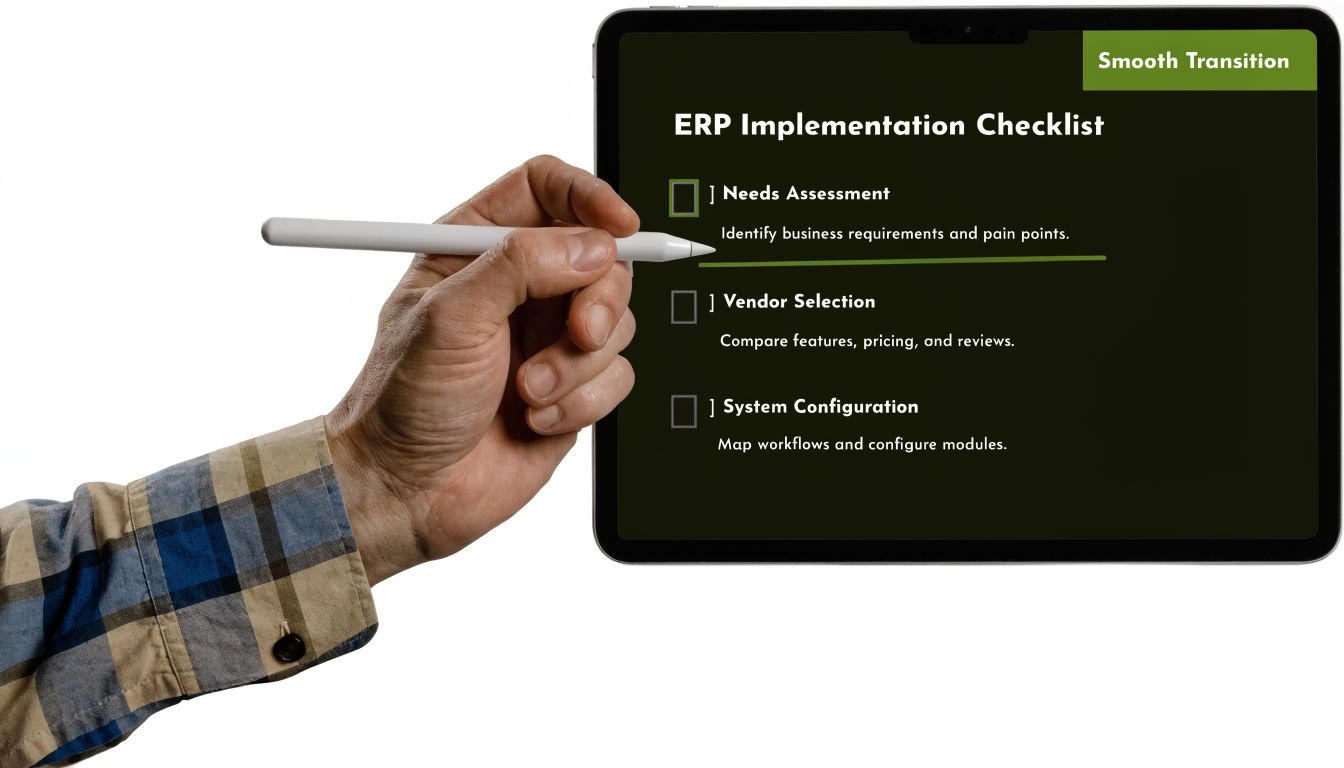
Start with process ownership
Don’t leave ERP selection and implementation to IT alone. Construction ERP is an operational system.
Your core team should include:
- Finance leadership: They define controls, reporting, tax structure, and closing needs.
- Project operations: They define job costing, BOQ use, approvals, and site processes.
- HR and payroll: They define attendance, labour allocation, payroll rules, and compliance handling.
- Procurement and stores: They define purchasing flow, inventory movement, and material issue controls.
Clean your data before migration
Most spreadsheet-driven companies want to “move everything” into ERP. That’s the wrong instinct.
First remove duplicates. Standardise customer, supplier, employee, item, and asset masters. Review chart of accounts. Close dead projects where possible. Fix opening balances. If your old data is inconsistent, ERP will expose the inconsistency faster, not solve it.
Migrate controlled data, not historical chaos.
This is also the stage to review data security, user roles, backup discipline, and ERP data protection practices. Construction companies often focus on functionality and ignore access control until after problems appear.
Choose rollout logic carefully
There isn’t one correct launch model. There is only the right model for your operational maturity.
A phased rollout usually works better for mid-sized contractors:
- Phase one: Financials, purchasing, inventory, HR, and payroll
- Phase two: Project costing, BOQ, subcontract management, and advanced reporting
- Phase three: Mobile field entry, dashboards, and deeper management analytics
Some firms prefer a full go-live. That can work if the data is clean, leadership is engaged, and the process discipline is already strong. If not, phased deployment is safer.
Train for decisions, not just screens
User training often goes wrong because it focuses on clicks rather than accountability.
Train people on what the transaction means, why timing matters, and how one department’s entry affects another department’s output. A store issue affects project cost. Payroll posting affects labour reporting. Asset assignment affects profitability analysis.
That’s how adoption sticks. People use ERP properly when they understand the operational consequence of bad data.
Measuring ROI and Long-Term Value in Construction
It is the end of the month. Your commercial manager has one margin figure, finance has another, and the project team is still waiting for timesheets, supplier invoices, and store issues to be posted. At that point, ROI is no longer a software question. It is a control question.
Construction ERP pays back when it helps you act before profit leaks out of a job. The value comes from faster cost visibility, cleaner billing support, tighter labour allocation, and fewer manual reconciliations between departments. For UAE contractors, there is another layer. A system that handles WPS payroll properly, supports Arabic and English in daily use, and is ready for regional e-invoicing requirements reduces compliance risk as well as admin effort. Global ERPs often need heavy custom work to reach that standard. Systems built for the GCC start there.
Tangible returns you can measure
Start with the areas where money is already slipping:
- Project margin control: Cost overruns show up earlier when payroll, material issues, subcontract bills, and variations hit the same system instead of separate files.
- Faster billing readiness: When WIP, project progress, and approved cost data are aligned, your team can certify and invoice with less delay.
- Lower payroll rework: WPS-linked payroll with correct project allocation cuts correction cycles and reduces disputes over labour costing.
- Better procurement timing: Purchase requests, approvals, deliveries, and stock movements become visible in one flow, which reduces site delays and emergency buying.
- Stronger cash flow planning: Finance can see committed cost, certified revenue, and payment exposure earlier, not after month-end cleanup.
A useful ROI review does not stop at software cost versus headcount savings. Measure how many decisions were improved because management saw the issue in time.
Long-term value shows up in control
Some returns will never sit neatly in one ledger line, but they matter more than a small admin saving.
You see them when finance closes faster, project reports stop being challenged in every meeting, auditors get traceable records without panic, and site teams stop running parallel spreadsheets to compensate for system gaps. You also see them when the ERP fits UAE operations properly. If your system cannot handle bilingual documentation cleanly, support WPS payroll without workarounds, or adapt to GCC tax and e-invoicing rules, the hidden cost continues even after go-live.
That is why owners should judge long-term value on fit, not branding. A famous global product with weak regional alignment can cost more over five years than a well-designed local construction ERP.
KPIs worth tracking inside ERP
Do not track everything. Track the numbers that force action.
| KPI | Why it matters |
|---|---|
| Project margin variance | Shows whether actual profitability is drifting from estimate |
| Budget versus actual by cost code | Shows which cost category is causing the overrun |
| WIP position | Supports billing discipline and cash flow control |
| Resource utilisation rate | Highlights idle labour or equipment |
| Procurement cycle time | Shows where approvals or supply delays are slowing projects |
| Payroll allocation accuracy | Confirms labour cost is posted to the correct projects |
| Variation order recovery | Shows whether approved changes are being converted into billable value |
| Compliance exception count | Flags payroll, tax, or documentation issues before they become penalties |
If you want one practical benchmark, use this. A good ERP should shorten decision time, reduce reconciliation work, and improve confidence in project profitability. If it does not, you bought accounting software with extra screens, not a construction management system.
Conclusion Take Control of Your Construction Business
A UAE construction business can’t stay on spreadsheets forever. The complexity is too high, the compliance burden is too serious, and the cost of delayed information is too expensive.
If your teams still re-enter data across finance, stores, payroll, and projects, you don’t have visibility. You have lag. That lag is what causes weak costing, payroll issues, poor material control, and arguments over which report is correct.
The right erp software for construction industry gives you something more important than automation. It gives you control. Control over project margins, BOQ tracking, labour cost, fixed assets, compliance records, and reporting discipline.
For GCC contractors, the standard buying advice from global ERP content isn’t enough. You need a system that fits how regional firms operate. That means strong project accounting, proper BOQ handling, native WPS payroll support, VAT and e-invoicing readiness, and genuine Arabic-English capability.
This is not a technology upgrade. It’s a management decision.
Companies that move early usually end up with cleaner reporting, stronger compliance, better operational discipline, and more confidence when they bid, execute, and scale.
Take the Next Step with Hinawi ERP
If your construction company is still juggling disconnected accounting, payroll, BOQ tracking, inventory records, and fixed asset schedules, it’s time to replace patchwork processes with one integrated system.
Hinawi ERP is a fully integrated ERP software developed since 1998 in Abu Dhabi by Explorer Computer LLC. It supports Accounting, HR & Payroll, Real Estate Management, Fixed Assets, Manufacturing, Garage & Maintenance, School Management, CRM, and complete business automation for companies across the UAE and GCC.
For construction and contracting firms, that matters because the business doesn’t run in isolated departments. It runs through connected transactions. Hinawi ERP supports VAT and e-Invoicing compliance, UAE WPS payroll, Arabic and English bilingual operation, flexible company policy settings, and real-time accounting integration across all modules.
It’s suitable for factories, contracting companies, real estate businesses, schools, garages, trading companies, and manufacturers that want to reduce manual work, improve financial accuracy, and gain tighter control over operations and management reporting.
If you're serious about modernising your business, don’t wait for another year of spreadsheet fixes and month-end surprises. Visit Hinawi ERP for UAE and GCC businesses or request a personalised demo to see how the system can fit your workflow.
Chat on WhatsApp +971506228024 Quotation – Demo RequestFor companies ready to improve control across accounting, payroll, projects, inventory, real estate, fixed assets, manufacturing, garages, schools, and CRM, speak with Explorer Computer LLC – Hinawi Software ERP for consultation or a personalised demo.