
Category: Manufacturing
Your production manager knows the problem. Orders come in from sales, purchasing chases suppliers on calls and WhatsApp, costing sits in spreadsheets, and the finance team sees the full picture after the month has gone wrong.
That setup may have worked when the factory was smaller. It stops working when you need tighter delivery control, cleaner costing, stronger payroll discipline, and audit-ready VAT records at the same time.
This is why Manufacturing ERP UAE is no longer an IT discussion. It is a management control decision. In the UAE, manufacturers need better production planning. They need systems that can handle local compliance, imported material costing, bilingual users, and multi-branch visibility without forcing teams back into manual work.
The wider market confirms that this shift is underway. The UAE ERP software market was valued at approximately USD 2.1 billion recently, and is projected to grow at a CAGR of 8.38% from 2024 to 2028, potentially reaching USD 3.45 billion by 2028, with over 60% of companies planning ERP implementations to reduce costs and improve productivity, according to Ken Research’s UAE ERP market analysis.
A practical local example is Hinawi ERP, developed in Abu Dhabi and built around integrated accounting, HR, payroll, fixed assets, manufacturing, and business automation for UAE and GCC operations.
Want to see this process inside an ERP? Use these quick links:
Chat on WhatsApp +971506228024 Quotation – Demo RequestThe Modern UAE Factory's Dilemma in 2026
A factory in Jebel Ali does not fail because demand disappears. It struggles because information arrives late, costs are unclear, and departments operate with different versions of the truth.
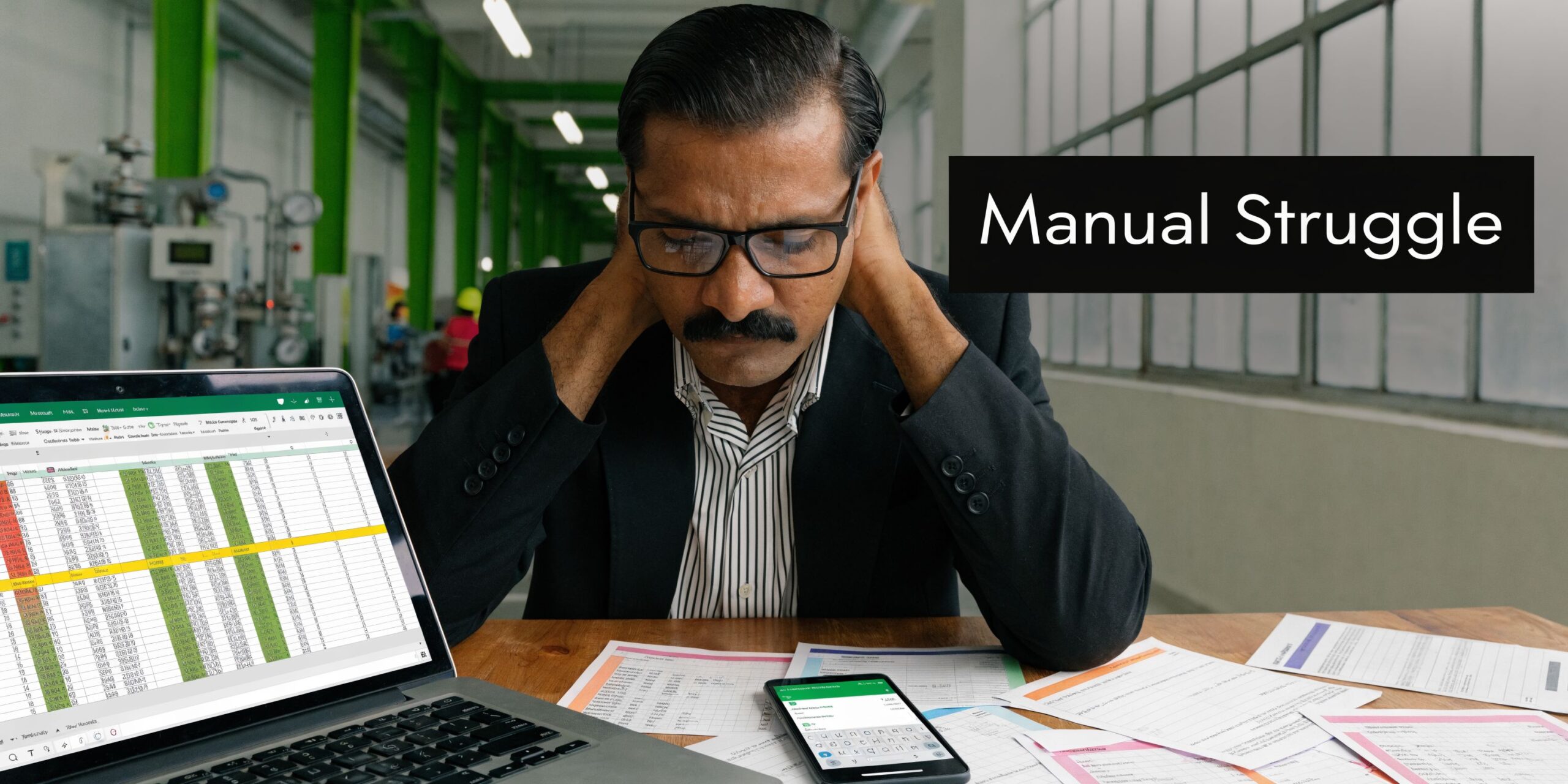
The common warning signs are obvious to any CEO who spends time on the floor. Production supervisors rely on handwritten job cards. Purchase teams reorder material based on memory. Stores staff update stock after the fact. Finance receives incomplete paperwork and then spends days correcting entries that should never have been wrong in the first place.
Where significant damage occurs
The cost of disconnected systems is not clerical inconvenience. It hits four areas directly:
- Scheduling control: Production dates slip because material availability, machine load, and labour allocation sit in separate files.
- Cost accuracy: The company thinks it knows product margin, but actual labour, overhead, and import charges are not captured properly.
- Compliance risk: Payroll teams run WPS processes from one system while finance handles VAT and invoices elsewhere.
- Management visibility: Owners get reports after problems have affected delivery, cash flow, and customer trust.
For UAE manufacturers, this becomes serious because imported inputs, multi-warehouse operations, and local compliance rules all need to work together. Generic software is seldom designed around that circumstance.
What a CEO should conclude
If your operation still depends on Excel to bridge production, finance, HR, and procurement, you do not have a controlled manufacturing business. You have a collection of manual workarounds.
Consultant’s view: The right ERP does not digitise paper. It replaces fragmented decisions with one operating model.
A proper Manufacturing ERP UAE platform acts as the control layer across the factory and back office. It ties sales orders to production planning, material demand to purchasing, labour to payroll, and every transaction to accounting. That is the point. One system. One audit trail. One set of numbers.
Core Manufacturing ERP Modules Explained for the UAE Context
Most manufacturers buy ERP ineffectively. They ask for features. They should be asking how the system controls production, stock, costing, finance, and people as one connected process.
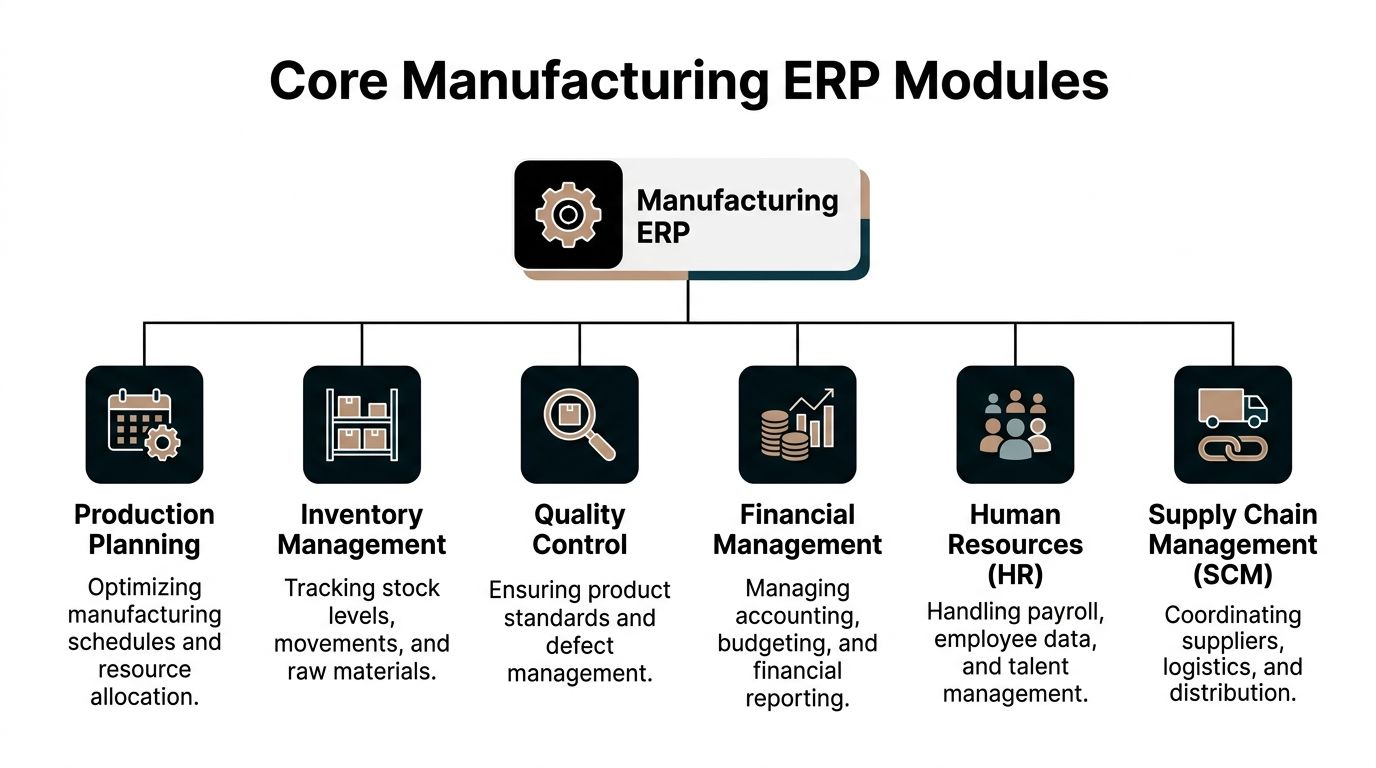
Production planning and job control
Production planning is where the manufacturing discipline starts. If your ERP cannot translate demand into work orders, machine allocation, material issue, and stage tracking, it is not a manufacturing system. It is an accounting package with extra screens.
In practical UAE factory terms, you need the system to handle:
- Work orders and job cards: Creation, approval, modification, and cancellation without paper chasing
- Bill of materials and formulas: Clear material structure so production consumption is not guessed
- Routing and stage tracking: Visibility into which order is waiting, running, delayed, or completed
- Variance awareness: The ability to compare planned usage with actual usage before margin erosion becomes normal
A strong example of this approach is manufacturing resource planning functionality, where production, material movement, and costing are managed inside one process instead of across separate tools.
Inventory and warehouse discipline
Many UAE factories say they have stock problems. Most have transaction discipline problems.
If raw materials, semi-finished goods, and finished products are not updated in real time, purchasing will overbuy, production will stop unexpectedly, and finance will keep arguing with stores over balances. ERP fixes this only when inventory is closely connected to production and purchasing.
What matters most:
- Raw material issue and return
- Warehouse transfers
- Batch or lot visibility where needed
- Real-time stock positions by location
- WIP tracking during production
This matters more in businesses with imported materials, where delays and substitution decisions affect both delivery and costing.
Quality control that links to operations
Quality is not a separate department. It is a manufacturing event with financial consequences.
The ERP should record inspections, rejections, and rework in a way that affects production reporting and cost visibility. If rejected material never touches the cost trail, your product profitability report is fiction.
A sound setup allows supervisors and management to answer basic but critical questions swiftly:
| Control question | Why it matters |
|---|---|
| Which batch failed inspection? | Prevents repeat usage and customer complaints |
| Which job had rework? | Exposes hidden production waste |
| Which supplier material caused issues? | Improves vendor decisions |
| Which finished item has repeat defects? | Protects margin and reputation |
Financial management inside manufacturing
Many ERP projects go wrong when vendors show production screens and ignore the general ledger impact. A manufacturer cannot afford that mistake.
Every production movement should hit accounting correctly. Material issues, labour allocations, subcontracting, landed costs, overhead absorption, asset depreciation, and finished goods valuation must flow into finance without manual journal reconstruction.
That is why I advise CEOs to challenge every ERP vendor with one blunt question: When a production order closes, what happens in accounting automatically?
If the answer is vague, walk away.
HR and payroll for factory reality
Manufacturing is labour-heavy, shift-sensitive, and compliance-heavy. Payroll cannot sit outside the ERP if you want clean labour costing and operational control.
Your system should support:
- Employee records tied to departments or production units
- Payroll processing aligned with UAE WPS requirements
- Attendance or labour input that can support costing
- Leave and overtime controls that finance can audit
The benefit is not merely HR efficiency. It is cost clarity. When labour sits outside the ERP, product costing becomes approximate.
Supply chain management for UAE operations
Procurement, supplier lead times, inbound logistics, and warehouse receipt all need to feed production planning. UAE manufacturers depend on imported inputs, so delays and landed charges cannot be treated as separate accounting issues.
A capable ERP connects supplier purchasing with stock arrival, costing, and production demand. It stops the old pattern where procurement buys reactively and finance discovers the cost impact later.
Key takeaway: In a factory, every module matters. But value comes from integration, not from ticking off a module list.
Want to see this process inside an ERP? Use these quick links:
Chat on WhatsApp +971506228024 Quotation – Demo RequestAchieving Financial and HR Compliance in the UAE
Compliance failures in a manufacturing business seldom begin with fraud. They begin with disconnected processes, weak document control, and manual adjustments made under pressure.
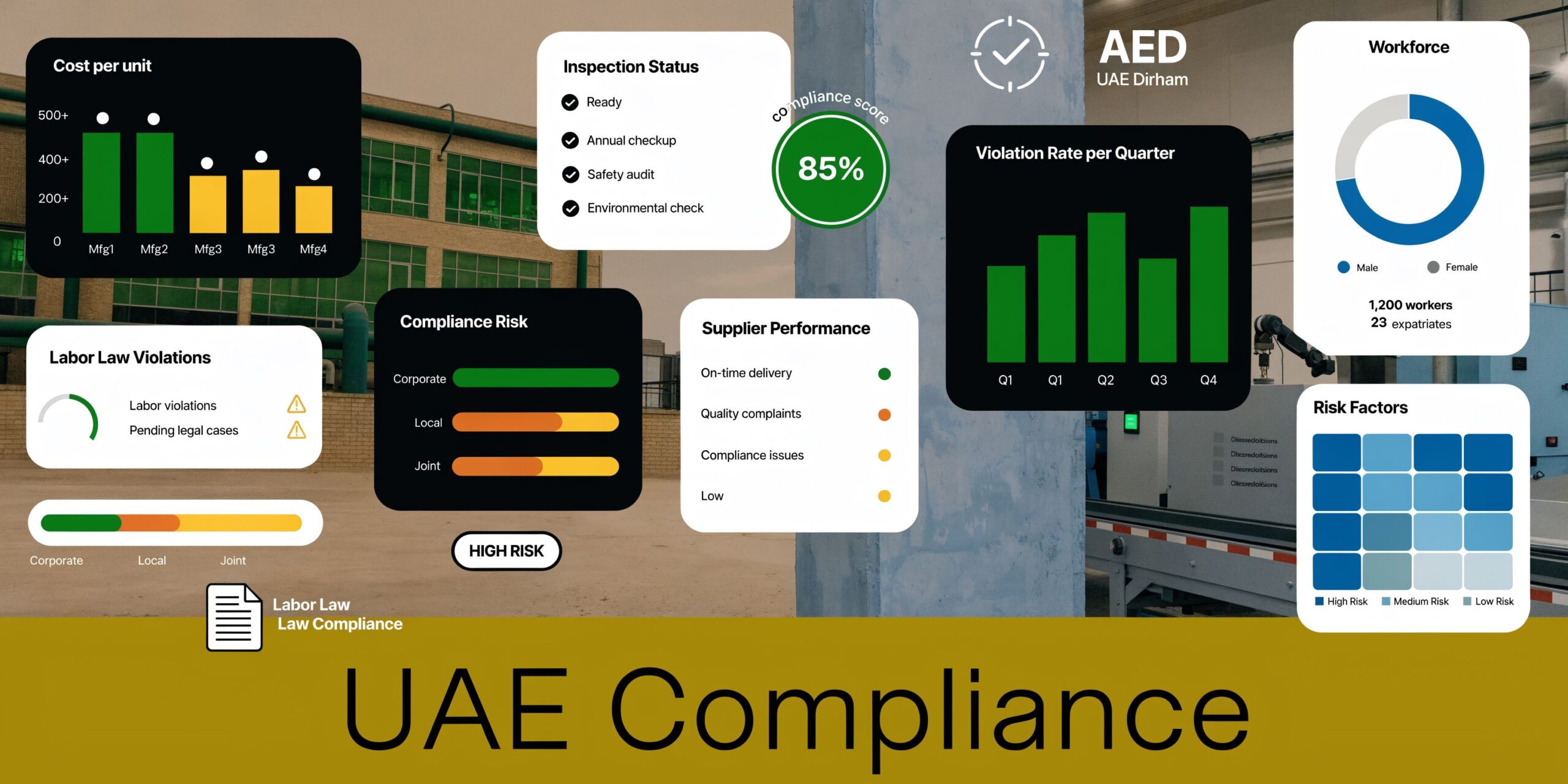
A UAE factory must treat VAT, e-invoicing readiness, landed cost accuracy, payroll processing, and WPS alignment as system requirements, not admin tasks. If these sit outside the ERP, errors will multiply.
VAT and e-invoicing need clean source data
Finance teams often focus on output reports. That is too late. VAT compliance depends on how purchases, inventory movements, sales invoices, and cost allocations enter the system in the first place.
A localised ERP should support the operating circumstances of UAE finance teams, including tax handling that fits local reporting requirements. Manufacturers reviewing tax-readiness should look closely at how their system supports VAT processes in the UAE, particularly where production, purchasing, and invoicing intersect.
Landed cost is not optional in an import-heavy market
If you import raw materials, your product cost is wrong until freight, customs, and insurance are reflected correctly. Too many manufacturers still treat these charges as after-the-fact finance adjustments.
That is poor management.
According to BrainsphereIT’s UAE manufacturing ERP discussion, UAE-specific manufacturing ERPs with automatic landed cost calculation can cut costing errors by 25% and support VAT compliance. The same source notes that unaccounted import variances previously inflated COGS by 10 to 15% in regional factories.
That is not a small bookkeeping issue. It affects pricing, margin reporting, and management decisions.
WPS payroll belongs inside the wider ERP
Factory payroll is seldom simple. You may have shift patterns, overtime, allowances, deductions, and multilingual staff records. Running payroll outside the ERP creates two immediate problems.
First, finance loses a reliable link between labour cost and actual operations. Second, compliance checks become harder because HR, payroll, and accounting records do not reconcile clearly.
A better structure includes:
- Payroll calculation within the integrated system
- WPS-ready processing
- Employee records maintained in Arabic and English where required
- Labour data connected to department or production cost centres
- Real-time accounting entries from payroll to finance
Practical advice: Ask your vendor to show one complete flow from employee record to payroll posting to final accounting entry. If they need exports and re-entry, the design is weak.
Audit readiness is the actual compliance test
The core question is simple. Can your team explain any payroll, inventory, purchase, or invoice transaction swiftly and with documents?
If the answer depends on checking email trails, spreadsheets, and manual approvals, your compliance process is fragile. Manufacturing ERP UAE should reduce that fragility by creating a full audit trail inside one environment.
Operational Excellence Beyond the Production Line
A UAE factory can run production well and still bleed margin every day. The losses show up in late purchasing, stock sitting in the wrong branch, container costs posted badly, and managers making decisions from reports that arrive too late to correct anything.
That is why ERP scope must extend beyond production planning. If the system stops at the shop floor, you still do not control the business.
Closed-loop MRP should control buying, not just suggest it
MRP earns its value when it drives purchasing discipline. In an import-dependent manufacturing business, every early order ties up cash and every late order risks idle machines, missed delivery dates, and expensive rescheduling.
A proper setup links sales demand, production orders, current stock, supplier lead times, and goods in transit. It should also reflect landed cost logic. UAE manufacturers that import raw materials need purchase planning tied to freight, duty, clearing, and final warehouse receipt, otherwise material availability looks better on screen than it is in reality.
The test is simple. Ask the vendor to show one material requirement flow from customer order to purchase recommendation to goods receipt to production issue. If planners still rely on memory, phone calls, or side spreadsheets, the ERP design is incomplete.
Warehousing must feed production with clean, shared data
Warehouse control is an operating issue, not a storage issue. If batch status, reserved quantities, inter-branch transfers, and available stock are unclear, production planning becomes guesswork.
For multi-branch manufacturers, the ERP should show stock by location, movement history, allocations, transfer approval status, and pending receipts in one view. A Dubai warehouse, Sharjah factory, and Abu Dhabi sales team must be working from the same transaction logic. Anything less creates recurring errors in dispatch, replenishment, and costing.
Integrated supply chain management ERP capabilities matter here. Procurement, stock movement, and fulfilment must run as one operating chain.
Hinawi ERP is well suited to this model because UAE manufacturers often need more than a generic warehouse screen. They need branch transfers, landed cost allocation, approval flows, and stock visibility that finance and operations both trust.
Reporting must help management intervene this week, not explain failure next month
Many manufacturers still receive operational reports after the useful decision window has closed. By then, the consequences are already visible. Overtime rises, shipments slip, invoicing gets delayed, and customer confidence drops.
Management reporting should answer immediate questions:
- Which work orders are at risk today
- Which materials are short, in transit, or stuck in approval
- What purchase commitments are due this week
- Where actual production cost is drifting from standard or expected cost
- Which branch is carrying slow-moving or excess inventory
- How dispatch delays are affecting billing and cash collection
The objective is control. A dashboard only matters if a plant manager, procurement head, and finance lead can act on it without waiting for manual reconciliation.
Multi-branch operations need one process model
A common UAE setup is simple on paper and messy in practice. Production runs in one emirate, warehousing sits in another, procurement is centralised, and directors review performance from a head office or group finance function. If each location keeps its own files, approval habits, and stock rules, the company does not gain flexibility. It loses control.
Use the ERP to standardise how transactions are created, approved, moved, and reported.
| Area | Weak setup | Controlled setup |
|---|---|---|
| Procurement | Buyers rely on calls, memory, and supplier chats | System-generated demand with approval rules |
| Warehouse | Branches maintain separate stock records | Shared stock visibility across all locations |
| Transfers | Materials move before paperwork catches up | Transfer requests, dispatch, receipt, and variance tracked in one flow |
| Reporting | Finance rebuilds reports manually at month-end | Real-time operational and financial visibility from live transactions |
| Delivery planning | Sales and production dispute order status | Shared order, production, and fulfilment status |
Want to see this process inside an ERP? Use these quick links:
Chat on WhatsApp +971506228024 Quotation – Demo RequestManagement lesson: If two branches give you different answers for the same stock, order, or cost question, the problem is system design. Fix that first.
The Strategic Advantage of Customization and Source Code
Many ERP projects experience unnoticed failure. The software goes live, users keep working around it, and management accepts compromise as normal.
That happens when the system is rigid and the business is not.
Standard software often breaks at the edges
A UAE manufacturer may also run contracting jobs, service operations, project-based costing, fixed asset tracking, or branch-specific approval rules. Standard ERP packages tend to handle the centre well and fail at the edges.
The edges are where businesses live.
The integration problem is particularly serious when older accounting tools, HR systems, or local workflows already exist. According to DynamicsSmartz on ERP implementation in the UAE, over 70% of Industry 4.0 pilots fail to scale globally due to siloed implementations. For UAE manufacturers with legacy systems, that makes flexibility a strategic requirement, not a technical preference.
Why customization matters for long-term control
Customization is useful when it solves business-specific operational logic, such as:
- Approval paths that match your governance model
- Job costing methods that reflect your production process
- BOQ or project links for mixed manufacturing and contracting businesses
- Documents and reports customized for local management needs
- Integration with legacy tools during a phased migration
The wrong customization is cosmetic. The right customization protects process integrity.
A direct comparison of Hinawi ERP versus other ERPs is relevant here because manufacturers need to assess not merely modules, but how adaptable the platform is when operations become more complex.
Source code ownership is a strategic issue
Most CEOs do not ask about source code early. They should.
If your ERP cannot be adapted without waiting on a distant vendor roadmap, you are renting your future operating model. That is risky for companies with sector-specific processes, local compliance requirements, or cross-border GCC operations.
Source code availability can matter when:
- you need a regional report format not present in the standard package
- you must integrate with an old payroll or machine data source during transition
- your approval logic changes as the company scales
- your business model expands beyond pure manufacturing
My recommendation: Choose an ERP you can shape over time. Do not force your factory to imitate software designed for someone else’s business.
Your Roadmap for ERP Selection and Implementation
ERP projects go wrong before the contract is signed. Companies buy software first and define requirements later.
Reverse that order.
Start with operating pain, not vendor demos
A CEO should begin with five blunt internal questions:
- Where do production delays originate?
- Which costs are still estimated rather than captured?
- Where do compliance risks depend on manual intervention?
- Which departments re-enter the same data?
- Which reports arrive late to manage by?
If your team cannot answer those clearly, you are not ready to evaluate ERP vendors.
Use a proper selection checklist
Below is a practical shortlist tool for Manufacturing ERP UAE decisions.
| Evaluation Criteria | Importance | Questions to Ask |
|---|---|---|
| Manufacturing fit | Critical | Can the system manage work orders, job cards, BOMs, costing, and production stages natively? |
| UAE compliance | Critical | How does it support VAT, e-invoicing readiness, payroll processing, and WPS-related needs? |
| Accounting integration | High | Does every production and payroll transaction post to finance automatically? |
| Import costing | High | Can it calculate landed cost for freight, customs, and insurance within inventory valuation? |
| Multi-branch control | High | Can management view warehouses, factories, and finance across entities or locations in one system? |
| Customization flexibility | High | Can workflows, reports, approvals, and forms be adapted to our process? |
| Implementation capability | Critical | Who will map our processes, migrate data, train users, and support go-live in the UAE? |
| Long-term support | Critical | What happens after go-live when we need changes, training, or additional modules? |
Implement in phases, but with one blueprint
A phased rollout is prudent. A fragmented rollout is not.
I advise manufacturers to implement in a controlled sequence:
- Phase one: Finance, inventory, purchasing, and core master data
- Phase two: Production planning, work orders, job costing, and warehouse discipline
- Phase three: HR, payroll, approvals, and management reporting
- Phase four: Advanced branch coordination, fixed assets, and process refinement
The blueprint must be unified from day one. Otherwise, teams create new silos under a modern label.
A practical reference for readiness and rollout planning is this ERP work plan for starting software implementation.
Measure ROI with operational metrics that matter
UAE manufacturers implementing full-cycle Manufacturing ERP typically achieve full ROI within 18 to 24 months, with 35% reduction in production lead times, 40% decrease in scheduling conflicts, and 10 to 15% annual operational cost savings, according to Codex IT’s UAE manufacturing ERP analysis.
That is useful, but your board should measure ROI through your own operation.
Track:
- Reduction in lead time
- Fewer manual journal corrections
- Lower excess stock
- Faster invoice generation
- Better on-time production and delivery control
- Cleaner month-end closing
Want to see this process inside an ERP? Use these quick links:
Chat on WhatsApp +971506228024 Quotation – Demo RequestImplementation rule: Do not call the project successful because the software is live. Call it successful when the business stops depending on spreadsheets to run core decisions.
Take the Next Step with Hinawi ERP
If you run a factory in the UAE or wider GCC, your ERP decision should solve three problems at once. It should improve operational control, strengthen compliance, and give management reliable financial visibility.
Hinawi ERP fits that requirement because it was developed in Abu Dhabi since 1998 for the challenges regional businesses face. It is a fully integrated ERP software covering Accounting, HR & Payroll, Real Estate Management, Fixed Assets, Manufacturing, Garage & Maintenance, School Management, CRM, and full business automation.
For manufacturers, that matters because production does not operate in isolation. Material planning affects purchasing. Labour affects payroll. Finished goods affect invoicing. Asset usage affects depreciation. Every one of those activities should flow into real-time accounting without manual reconstruction.
Hinawi ERP also supports the requirements decision-makers in the UAE and GCC keep coming back to:
- VAT and e-Invoicing compliance
- UAE WPS payroll support
- Arabic and English bilingual operation
- Flexible company policy settings
- Real-time accounting integration across modules
- Suitability for factories, contracting companies, schools, garages, real estate firms, trading companies, and manufacturers
If your current systems depend on manual files, delayed reports, and disconnected departments, the solution is not to hire more staff to manage the mess. The solution is to modernise the operating model.
Visit www.hinawierp.com or request a personalised demo. If you want practical advice on how to structure selection, migration, compliance setup, and rollout, speak with the Hinawi ERP team.
Explorer Computer LLC – Hinawi Software ERP helps companies across the UAE and GCC modernise operations with a fully integrated ERP platform developed in Abu Dhabi since 1998. If your business needs stronger manufacturing control, better VAT and e-invoicing compliance, UAE WPS payroll support, bilingual Arabic and English workflows, and real-time accounting across all departments, visit Explorer Computer LLC – Hinawi Software ERP and request a personalised consultation or demo.