In the fast-paced UAE property market, if you're still managing your leads with spreadsheets and sticky notes, you're not just falling behind—you're actively leaving money on the table. For decision-makers in Abu Dhabi, Dubai, and across the GCC, a dedicated Real Estate Customer Relationship Management (CRM) system isn't a luxury anymore; it's the core engine for growth. This software becomes your central command center, organizing every client interaction, tracking every lead, and automating communication so no opportunity gets lost in the shuffle. A well-implemented system, like the CRM module within Hinawi ERP, provides the operational control and visibility needed to thrive.
A modern CRM streamlines operations, but its true power is unlocked when integrated into a full ERP. This allows for seamless data flow between sales, accounting, and HR, eliminating manual errors and providing real-time financial insights—critical for making informed business decisions.
Chat on WhatsApp +971506228024 Quotation – Demo Request Chat with Hinawi AIWhy a Real Estate CRM is a Must-Have in the UAE

Let's be realistic. The real estate game in hubs like Dubai and Abu Dhabi moves at a dizzying speed. Your phone is buzzing with enquiries from Property Finder, Bayut, social media ads, your own website, and even walk-ins. Trying to juggle all of that manually is a recipe for operational chaos. Leads get forgotten, crucial follow-ups are missed, and client details end up scattered across half a dozen different places. This disorganization isn't just messy; it costs you deals and damages your professional reputation.
The Scale of the Challenge
The numbers alone tell the story. Dubai's property market is booming, hitting record-breaking transaction values. In this supercharged environment, a telling statistic has emerged: agents using a proper CRM are closing 25-35% more deals than those who aren't.
With a surge in the primary market and a staggering jump in off-plan sales values, the competition is fierce. You can get more insights on this trend from SmartLeads.expert. A real estate CRM gives you the structure to cut through the noise. It helps you:
- Catch every lead: Automatically pull in enquiries from every source into one clean, organised database.
- Stay top-of-mind: Set up automated follow-ups through email, SMS, or WhatsApp so you're always engaging with prospects.
- Know your client: Easily segment your contacts by their budget, what they're looking for, and where they are in their buying journey.
- Focus your day: Give your agents a crystal-clear dashboard of their daily tasks, calls, and priorities.
Thinking Beyond a Standalone CRM
While any CRM is a huge leap from a spreadsheet, the real power comes from integration. Think bigger. A complete solution like Hinawi ERP doesn't just stop at real estate customer relationship management. It weaves your sales activity directly into the financial backbone of your business—your accounting, HR, and payroll.
Imagine this scenario for a real estate firm in Abu Dhabi: the moment a deal is marked 'closed' in your CRM, the system automatically kicks off the invoicing process in the accounting module, ensuring VAT compliance, and flags the commission calculation in the HR module for the next WPS-compliant payroll. That’s the power of having one unified platform for your entire operation, where sales and administration flow together perfectly.
Unpacking the Core Features of a Real Estate CRM
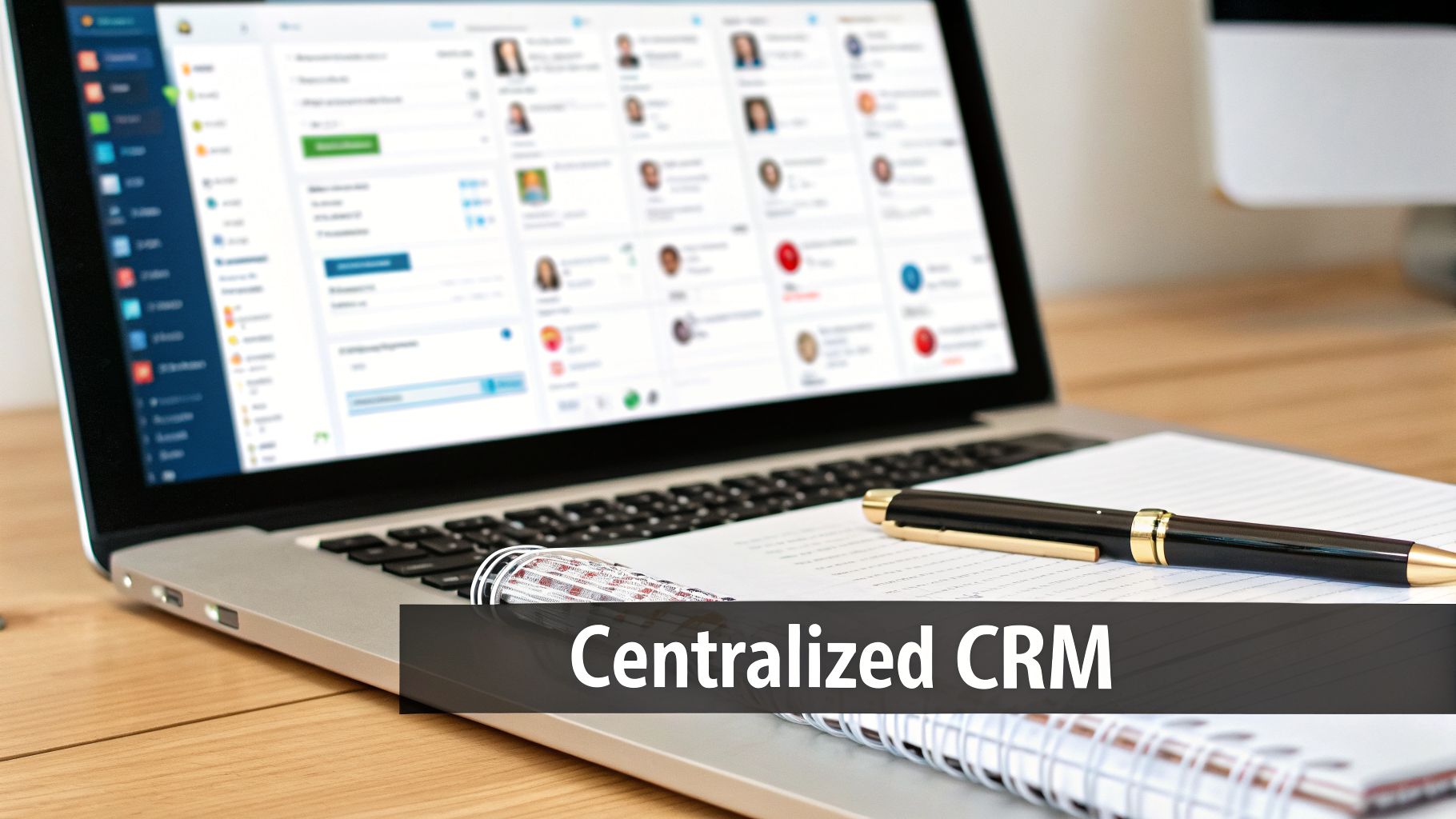
So, what does a real estate customer relationship management system really do on the ground? Forget the jargon for a moment. Think of it as your agency's central nervous system—a single digital hub that never forgets a client’s preference, a follow-up date, or a single lead.
It’s designed to solve a problem every busy agency faces: crucial information scattered across personal notepads, random spreadsheets, and individual agents' phones. A CRM brings all of that chaos into one organised, accessible place.
Lead Capture and Management
Everything starts with how you handle new enquiries. A proper CRM automates this entire process, integrating directly with your website, social media, and local property portals like Bayut and Property Finder.
- Automatic Lead Entry: When a prospect enquires about a listing online, their details are instantly captured and organised in the CRM as a new lead.
- Smart Lead Assignment: The system can then automatically assign that lead to the right agent based on rules you set, like property expertise, location, or even just who's next in line.
- Zero Dropped Leads: This process is seamless. It ensures no enquiry falls through the cracks and your team can respond immediately—a massive advantage in the fast-moving GCC property market.
Ultimately, this automation means every single opportunity gets the attention it deserves right from the start.
The Power of Automation: CRM vs. Spreadsheets
For many growing agencies, the move from manual tracking to a dedicated CRM is a game-changer. Spreadsheets and notepads might feel sufficient at first, but they can't scale and often lead to missed opportunities and inefficiencies. The difference becomes clear when you compare the two side-by-side.
| Functionality | Manual Method (Spreadsheets/Notepads) | Dedicated CRM Solution (e.g., Hinawi ERP) |
|---|---|---|
| Lead Capture | Manual data entry from emails, calls, portals; prone to errors and delays. | Automatic import from website, portals (Bayut, etc.), and social media. |
| Follow-ups | Relies on individual agent memory or calendar reminders; inconsistent. | Automated reminders, task assignments, and email/WhatsApp sequences. |
| Client History | Scattered notes across different files; no single view of interactions. | 360-degree client view with all calls, emails, and viewings logged. |
| Reporting | Time-consuming manual compilation; difficult to get real-time insights. | Instant, customisable dashboards on agent performance, leads, and sales. |
| Team Access | Difficult to share; risk of duplicate data or outdated information. | Centralised, real-time data accessible to the entire team from anywhere. |
A dedicated CRM doesn't just store data; it puts that data to work, freeing up your agents to focus on what they do best: building relationships and closing deals.
Chat on WhatsApp +971506228024 Quotation – Demo Request Chat with Hinawi AIIntelligent Nurturing and Communication
Once a lead is in the system, the CRM acts as your communication engine. Instead of manually tracking who to call and when, agents can build intelligent nurturing workflows.
For instance, a new lead for a villa in Arabian Ranches could get an automatic welcome email. Two days later, the system sends a curated list of similar properties. A week later, it creates a task for the agent to make a follow-up call. This keeps your agency top-of-mind and ensures consistent, professional communication without burning out your team. Integrating tools like Real Estate Live Chat can further boost this by providing instant answers to client questions.
A centralised database eliminates duplicate efforts and guarantees every lead gets the attention it deserves. This directly impacts your bottom line and helps build the long-term relationships essential in the GCC property market.
Centralised Contact and Activity Management
Finally, a CRM gives you a complete, 360-degree view of every contact. Any agent can pull up a client's profile and instantly see the entire history of their relationship with your agency—every call made, email sent, property viewed, and offer submitted.
This is incredibly powerful. It means that when a client calls back after six months, you don't have to scramble for information. Any agent can provide personalised, informed service on the spot. This unified view, a core benefit of platforms offering comprehensive CRM solutions, translates directly into happier clients and a more efficient team that closes more deals.
The Strategic Advantage of an Integrated ERP System
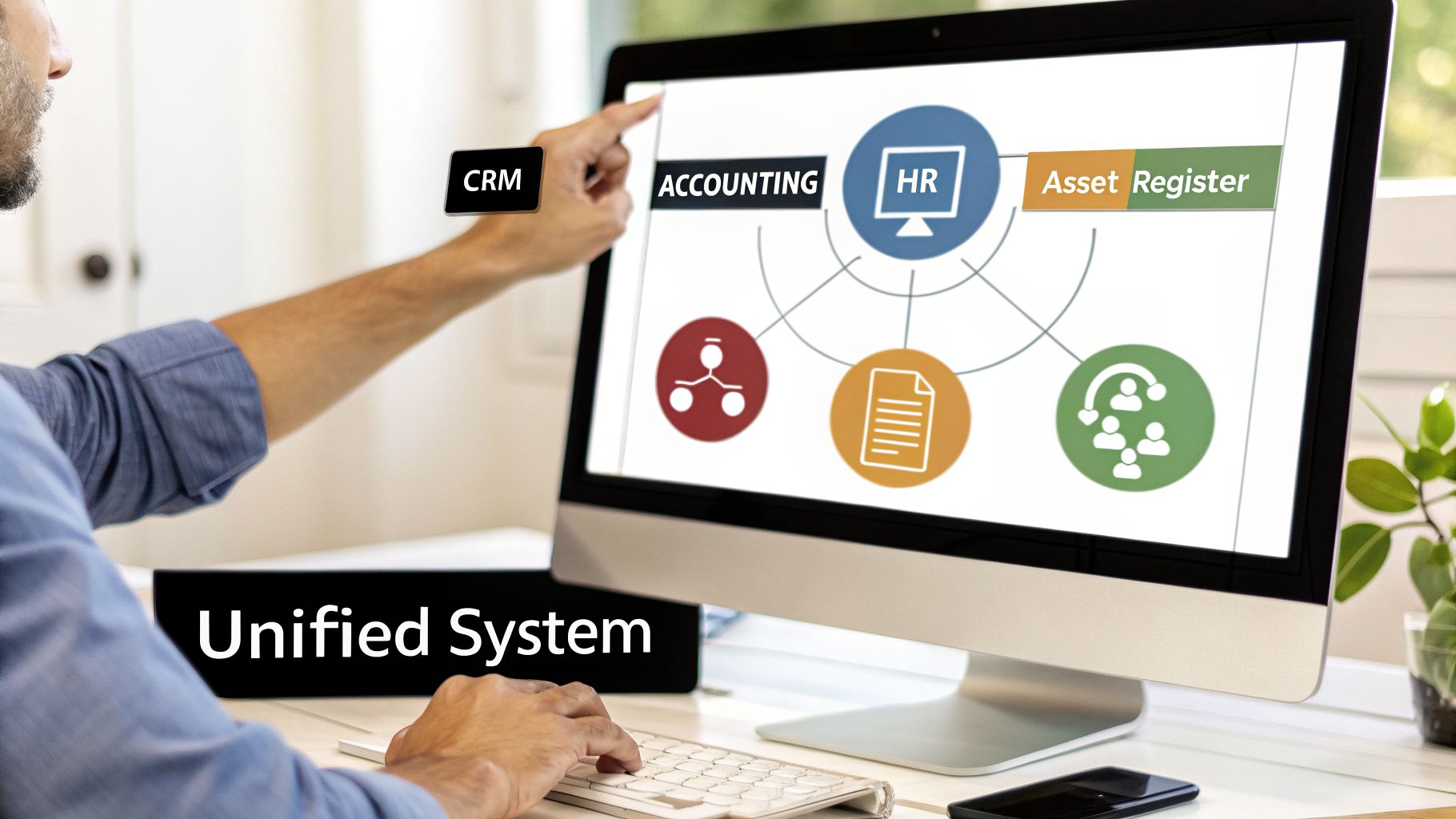
A standalone real estate CRM is a fantastic starting point for organising leads and managing client conversations. But its true power is only revealed when it stops being a lonely island of data and connects to the rest of your business. When integrated with an Enterprise Resource Planning (ERP) system, your real estate customer relationship management software goes from a simple sales tool to the very heart of your operations.
For real estate agencies across the UAE and the wider GCC, this kind of integration is a complete game-changer. Instead of juggling separate, disjointed systems for sales (your CRM), finance (accounting), and staff (payroll), a unified ERP brings everything under one digital roof. This creates a smooth, automatic flow of information that cuts out tedious manual work, slashes the risk of human error, and gives you a real-time, 360-degree picture of your business's health.
From Deal to Debits and Credits
Think about a typical day at a busy Abu Dhabi brokerage. An agent closes a major deal on an off-plan property. In a disconnected business, this one event sets off a chain reaction of manual tasks. The agent has to tell the accounts team, who then have to manually create an invoice, figure out the VAT, and chase the payment. At the same time, someone needs to tell HR to calculate and process the agent's commission. Every single one of these handovers is a chance for something to go wrong, leading to payment delays and VAT compliance risks.
Now, imagine that same scenario with an integrated system like Hinawi ERP.
The moment the agent marks the deal as 'Closed' in the CRM, the system automatically springs into action. It instantly generates a VAT-compliant invoice in the accounting module, ready for the UAE's e-invoicing standards. At the same time, it calculates the agent's commission based on preset rules and adds it to the HR module for the next WPS-compliant payroll run.
This isn't just about making life easier; it's about building a more professional and efficient operation. It guarantees financial accuracy, keeps you compliant with UAE regulations, and frees up your talented team to focus on closing more deals instead of pushing paper.
The Power of a Single Source of Truth
This kind of deep integration is no longer a luxury—it's becoming essential for survival and growth. The UAE's real estate technology market, which includes CRM solutions, is projected to hit USD 717.0 million in 2025 and is forecast to grow at an incredible 17.6% CAGR through 2032. As the market heats up, businesses with connected, efficient systems will pull far ahead of the competition. You can read more about this market growth in a report from P&S Intelligence.
A unified ERP gives everyone in your company a single, reliable source of truth. Management can pull up dashboards that directly link sales performance to actual revenue, profit, and cash flow. Having this clear visibility is vital for making smart strategic decisions, allocating your resources wisely, and delivering the kind of high-end, seamless service that clients in this region expect. To see this in action, you can learn more about a Hinawi Web ERP Online Business Management System.
Ultimately, the smooth, automated flow of data between your real estate CRM, accounting, and HR is the foundation for building a business that is scalable, efficient, and ready for the future.
Chat on WhatsApp +971506228024 Quotation – Demo Request Chat with Hinawi AIBuilding Actionable Workflows for UAE Real Estate
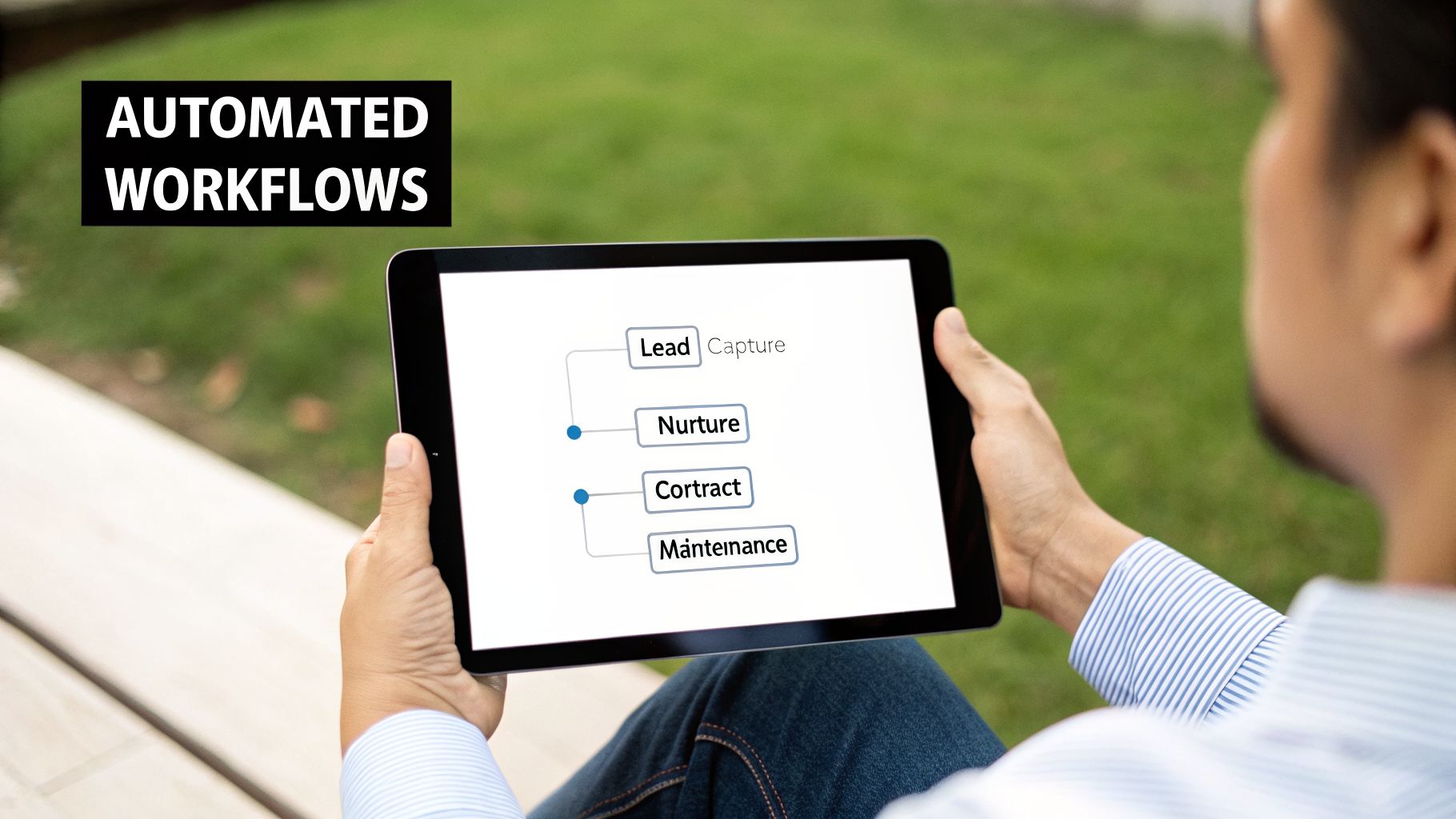
A real estate customer relationship management system is just a fancy digital address book until you teach it what to do. The real magic happens when you build workflows that mirror the day-to-day hustle of your agency. These automated processes turn your CRM from a passive database into the true engine room of your business.
For anyone working in the UAE market, this means designing automation that understands local needs. We're talking about everything from instantly grabbing off-plan leads to managing the entire, complex lifecycle of a tenancy contract. Let's get practical and map out exactly how an integrated system lifts the administrative weight, freeing up your agents to do what they do best: build relationships and close deals.
Off-Plan Lead Nurturing Workflow
The UAE's off-plan market is a race against the clock. Leads from social media ads or property portals have a short attention span. A fast, structured response isn't just nice to have; it's essential.
Here’s a classic example of how an automated workflow can give you the edge:
- Step 1 – Instant Capture: A potential buyer sees your Instagram ad for a new Emaar development and fills out the contact form. Your CRM immediately creates a new lead record with their name, number, and email. No manual data entry, no delays.
- Step 2 – Smart Assignment: The system instantly assigns that lead to the agent on your team who specialises in that specific community's off-plan properties.
- Step 3 – Immediate First Contact: Within seconds, the workflow fires off a pre-written WhatsApp message and an email. The buyer gets a thank you and a digital brochure while their interest is still at its peak.
- Step 4 – Nurturing on Autopilot: The lead is automatically enrolled in a 90-day communication plan. This "drip campaign" sends a carefully timed mix of content—construction updates, community guides, market reports—via SMS and email, keeping your agency top-of-mind without an agent lifting a finger.
This whole process ensures that no lead ever goes cold. It makes your agency look professional, organised, and persistent from the very first click.
The Complete Tenant Lifecycle Workflow
For property managers, the paperwork never seems to end. An integrated CRM, especially one connected to an ERP like Hinawi, automates the entire tenant journey. This is a game-changer for firms in Dubai or Abu Dhabi managing large portfolios.
When your real estate customer relationship management platform is tied directly to your accounting, every step in the tenant’s journey can trigger the right financial or admin action automatically. You can see how a dedicated Real Estate Module brings all these functions under one roof.
Let's walk through how this workflow unfolds in the real world:
- Enquiry to Viewing: A potential tenant finds your listing on Bayut and sends an enquiry. The CRM captures the lead, and your agent can schedule a viewing directly in the system, which then syncs with their calendar.
- Contract Generation: The viewing went well, and the tenant is interested. The agent changes the status to ‘Interested,’ and with a single click, the system generates a Tawtheeq-ready tenancy contract, automatically filled with all the property and tenant details.
- Rent and PDC Management: Once the contract is signed, the system schedules automated reminders to be sent via SMS before each rent payment is due. If you've collected Post-Dated Cheques (PDCs), their details are logged, and the system sets up alerts for upcoming deposit dates.
- Maintenance Handling: Six months later, the tenant uses a tenant portal to report a faulty A/C unit. This automatically creates a maintenance ticket in the CRM, assigns it to your go-to maintenance team, and tracks its status all the way to completion.
- Seamless Renewals: Ninety days before the lease expires, the system gets to work again. It automatically sends a renewal offer to the tenant and creates a follow-up task for the property manager, ensuring you never miss a renewal opportunity.
Choosing the Right CRM: A Consultant's Checklist for the UAE Market
Picking the right real estate CRM is a huge decision, one that will echo through your business for years. It’s not just a software subscription; it’s about choosing a central nervous system for your entire operation. For property managers and brokers here in the UAE and across the GCC, this choice is even more critical. A generic, off-the-shelf system from overseas can quickly turn into an expensive headache.
You need a platform that understands the rhythm of our local market, acting less like a tool and more like a trusted partner. Forget the flashy sales pitches for a moment. Let's cut through the noise and focus on what truly matters for your agency day in and day out.
Does It Speak Our Language? Localisation and Compliance
I can't stress this enough: if a CRM doesn't get the local landscape, it's a non-starter. This is the first and most important hurdle any system must clear.
- Truly Bilingual: The entire platform—from the agent dashboard to the contracts you send clients—must work flawlessly in both Arabic and English. This isn't just about a translated interface; it's about full operational capability in both languages.
- Built for Local Rules: Does the software handle VAT and e-invoicing according to the Federal Tax Authority (FTA) standards? Is it compliant with the UAE’s Wages Protection System (WPS) for payroll? You should ask vendors directly how they keep the system updated when these regulations inevitably change.
- Understands Local Business: Here’s a classic example: post-dated cheques (PDCs). They are a fundamental part of the rental market in the UAE. Many international CRMs have no concept of how to manage or track them, making them practically useless from day one.
Can It Connect to Everything Else? Integration
A CRM that operates in a bubble is a data silo waiting to happen, creating more work and confusion. The goal is to have one seamless flow of information from the first client call to the final financial report. This is where integration with an ERP like Hinawi ERP really shines, connecting your CRM directly to your accounting, HR, and asset management modules.
Think about it. When your agent finalises a lease in the CRM, the system should instantly talk to your accounting software to generate the invoice and then cue the payroll module to calculate commissions. That’s the power of true integration—no more manual data entry, no more delays, just real-time visibility across your business. You can see how this works by exploring third-party integration within a complete ERP ecosystem.
Chat on WhatsApp +971506228024 Quotation – Demo Request Chat with Hinawi AIChoosing a vendor is a complex process, but a structured approach can make it much clearer. The checklist below is designed to help you ask the right questions and focus on what really counts for a business operating in the UAE.
Vendor Selection Checklist for a Real Estate CRM in the UAE
| Evaluation Criteria | Key Questions to Ask | Why It Matters for a UAE Business |
|---|---|---|
| Localisation & Compliance | Is the interface fully bilingual (Arabic/English)? Does it handle PDC management, VAT, and WPS? | Non-negotiable. A system that doesn't meet local legal and business norms is a liability. |
| Integration with ERP | Can it integrate with my existing accounting/HR software? Do you offer an all-in-one ERP solution? | Prevents data silos, automates workflows (e.g., invoicing from deals), and provides a single source of truth. |
| Industry-Specific Features | Does it manage property listings, tenant portals, maintenance requests, and commission calculations? | A generic CRM won't have the specialised tools needed for property management and brokerage. |
| Scalability | Can the system support multiple branches, currencies, and a growing number of users and properties? | Your software must be able to grow with your business, not hold it back. |
| Local Support & Training | Do you have a support team based in the UAE? What are your support hours and channels? | When issues arise, you need fast, local support that understands your context, not a call centre in another time zone. |
| User Experience (UX) | Is the interface intuitive for agents and admins? Can we get a live demo with our own data? | If your team finds it hard to use, they won't use it. Adoption is key to ROI. |
| Total Cost of Ownership | What is the full cost, including setup, training, support, and potential customisation fees? | Look beyond the subscription price to understand the true long-term investment. |
This checklist will guide you toward a partner, not just a product—a system that will genuinely support your growth in the region.
Will It Grow With You? Scalability and Support
Your ambitions are big, so your CRM needs to be ready to scale right alongside you. Ask potential vendors how their platform handles multi-branch operations, a growing team of agents, and an ever-expanding portfolio of properties. The last thing you want is for performance to drop just as your business is taking off.
Just as important is who you call when things go wrong. Having a local support team is a massive advantage. When you face a critical issue during rent collection week, you need an expert in your time zone who understands your business, not a chatbot or an overseas helpdesk. A vendor with a physical presence, like Hinawi ERP's team in Abu Dhabi, provides that peace of mind.
The goal is to empower owners to make a confident, informed choice and avoid the common pitfall of selecting a generic international CRM that fails to meet local needs. To ensure you make an informed decision for your business, consult a comprehensive guide on the Best CRM for Real Estate Agents.
Take the Next Step with Hinawi ERP
We've walked through why a proper real estate customer relationship management system is so critical, from capturing every lead to automating your most tedious tasks. The truth is, the gap between a growing agency and one just treading water often comes down to the tools they use. Moving past scattered spreadsheets and generic software isn't just a good idea anymore—it’s essential for staying competitive in the fast-paced UAE and GCC property markets.
If you are a business owner or manager in the UAE or GCC, it is time to modernize your operations, reduce manual work, improve financial accuracy, and gain better control over your management.
Your Partner in Business Modernisation
This is where Hinawi ERP comes in. Developed right here in Abu Dhabi since 1998, it’s not just another piece of software. It’s a complete, fully integrated business management system built to unite your Accounting, HR & Payroll, Real Estate Management, Fixed Assets, Manufacturing, Garage & Maintenance, School Management, and CRM into one seamless platform. For companies in the UAE, Saudi Arabia, and across the GCC, this means finally having a single, reliable source of truth for your entire operation.
Think about it: a system where a deal closed in the CRM automatically generates a VAT-compliant invoice, calculates the agent’s commission, and updates your financial ledgers in real-time. That's the power of true integration.
Built for the Realities of the GCC Market
We built Hinawi ERP from the ground up because we understand the specific challenges and rules of doing business in this region. Our system is designed to give you an edge with features that address local needs head-on:
- Compliance Made Simple: We’ve built in full support for VAT and e-Invoicing regulations across the GCC, so your financials are always clean and audit-ready.
- Worry-Free Payroll: The system is fully compliant with the UAE WPS payroll system, which automates salaries and complex commission payouts correctly and on schedule.
- Bilingual Operations: Switch seamlessly between Arabic and English across the entire platform to support your diverse team and clientele.
- Unmatched Flexibility: You can configure highly specific company policies for things like agent commissions, leasing terms, and other unique business rules.
- Real-Time Integration: Every module, whether for real estate, manufacturing, or contracting, feeds directly into the accounting system for instant financial clarity.
Hinawi ERP is suitable for factories, contracting companies, real estate businesses, schools, garages, trading companies, and manufacturers. Stop letting administrative headaches dictate your company's growth. It’s time to give your team a system that works as hard as they do, providing the clarity and control you need to make smarter, faster decisions.
Ready to see how Hinawi ERP can transform your business? Visit www.hinawierp.com or request a personalized demo with our consultants.
Chat on WhatsApp +971506228024 Quotation – Demo Request Chat with Hinawi AIFrequently Asked Questions
When property managers and brokers start looking into a real estate CRM, a few key questions always come up. Let's tackle the most common ones head-on to give you the clarity you need.
How Long Does It Take to Implement a Real Estate CRM?
This is a big one, and the good news is, it’s not as long as you might think. For a modern, cloud-based system like Hinawi ERP, you're realistically looking at a matter of weeks, not months.
The process is structured to get you up and running without derailing your business. It involves moving your existing contacts and property data over, training your team so they're comfortable from day one, and fine-tuning the workflows to match how you actually work. A good implementation partner makes this a smooth transition, not a major disruption.
Is a Specialised Real Estate CRM Better Than a Generic One?
Without a doubt, yes. A CRM built specifically for real estate comes with the right tools straight out of the box. Think property listing management, full tenant lifecycle tracking, and even integrations with local property portals—features that generic systems just don't have.
Trying to force a generic CRM to work for real estate is often a frustrating and expensive exercise in customisation. It will likely stumble on critical UAE-specific tasks like managing post-dated cheques (PDC) or calculating complex agent commission structures. A specialised solution is simply the smarter, more effective path.
Can a CRM Integrate with My Existing Accounting Software?
While some CRMs can "talk" to other accounting software, these integrations are often clunky and can easily break, leading to data sync headaches. A much better approach is an all-in-one ERP system like Hinawi ERP.
With a fully integrated ERP, your CRM and accounting modules are two sides of the same coin. Data flows between them instantly and seamlessly. This means no more double data entry, 100% financial accuracy, and a single, live picture of your business—from the first lead to the final profit and loss statement.
How Does a CRM Help with UAE-Specific Compliance?
A system designed for the region has local compliance built into its DNA. For instance, when your team closes a deal in the CRM, it can automatically generate a VAT-compliant invoice. If it's part of a complete ERP, the payroll module can ensure all commission payouts are fully compliant with the Wage Protection System (WPS).
Solutions developed right here, like Hinawi ERP which was created in Abu Dhabi, are always kept up-to-date with the latest rules from the Federal Tax Authority (FTA) and UAE labour laws. This takes a huge weight off your shoulders, dramatically cutting down your compliance risk and administrative workload.