
A credit note form is the official document you, as a seller, send to a buyer when you need to cancel or change an invoice you've already sent. It’s your way of officially recording a reduction in what your customer owes, whether for a partial amount or the entire invoice. In the UAE and across the GCC, getting these forms right is non-negotiable for clean accounting and staying on the right side of VAT laws. For decision-makers in Abu Dhabi, Dubai, and beyond, mastering this process is a cornerstone of sound financial management, especially with ERP systems like Hinawi ERP that automate these critical workflows.
Chat on WhatsApp +971506228024 Quotation – Demo RequestWhat Is a Credit Note and Why Is It Critical for UAE Businesses?
It’s easy to think of a credit note as just a correction slip, but it's much more than that from a professional consulting standpoint. Think of it as the official "undo" button for a sales invoice. The main purpose of a credit note form is to create a formal record when you reduce the amount a customer needs to pay after you've issued the original bill. This gives both you and your customer a clear, auditable paper trail.

Common Triggers for Issuing a Credit Note
In the real world of GCC business operations, things don't always go according to the initial invoice. You'll find yourself needing to issue a credit note in several common situations:
- Goods Returned: A customer in Dubai returns a shipment of electronics because they were damaged in transit. You'll issue a credit note to cancel out the original sale. This is a frequent scenario for trading and manufacturing companies.
- Pricing Errors: It happens. Maybe you accidentally billed at the old price instead of the new one. A credit note corrects the customer's balance and ensures financial accuracy.
- Service Adjustments: A project's scope changes midway through. A construction firm in Abu Dhabi might issue a credit note for services that were billed but are no longer required, a common occurrence in the contracting sector.
- Promotional Discounts: You decide to offer a loyal customer a discount after you’ve already sent the invoice. The credit note applies that discount officially.
Mastering the credit note process is absolutely essential, especially with the UAE's strict VAT rules and the upcoming 2026 e-invoicing mandate. A small mistake on a credit note can throw off your VAT return, potentially leading to fines from the Federal Tax Authority (FTA).
From a consulting perspective, a credit note isn't just about good customer service; it's a legal requirement for adjusting your VAT liability. When you issue a credit, you are effectively reducing the output tax you owe to the government, and the document must meet strict FTA standards to be valid during an audit.
This is exactly where relying on a modern ERP system pays for itself. Trying to track invoices, credit reasons, and VAT adjustments manually is a recipe for errors. An integrated system like Hinawi ERP handles this whole process automatically. It links the credit note straight back to the original invoice, updates your inventory, and adjusts the books in real-time, giving you a perfect audit trail and protecting your business from costly compliance headaches.
What Goes Into a Proper, VAT-Compliant Credit Note?
Think of issuing a credit note that isn't up to the UAE's Federal Tax Authority (FTA) standards like sending an invoice without your bank details. It just causes headaches, delays, and can land you in some serious compliance trouble later on. To keep your financial records clean and audit-proof, you have to understand that a credit note form is a serious legal document, not just a quick memo to your customer.
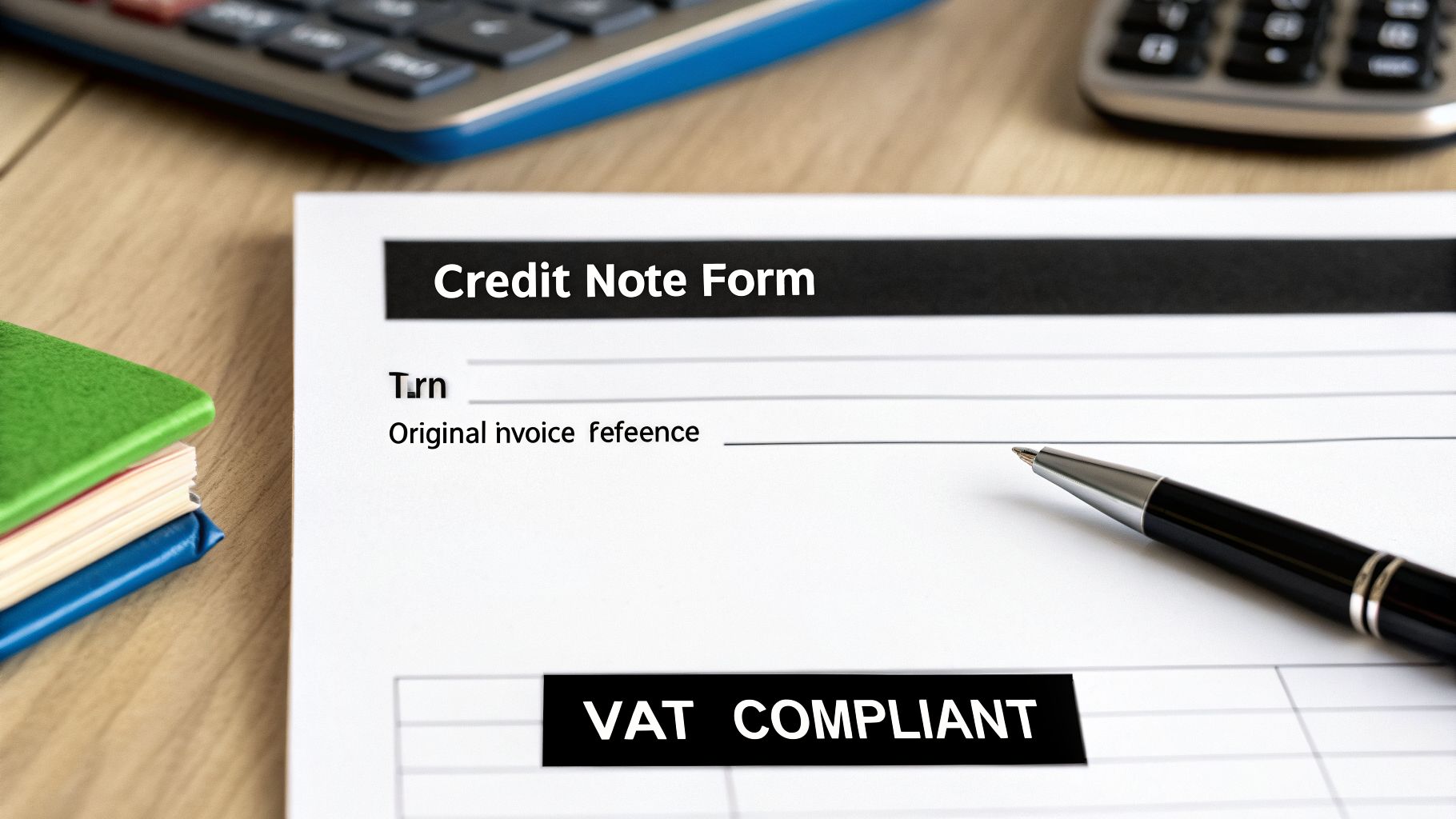
Every field on that form is a piece of a puzzle. When you put them all together correctly, you create a perfectly clear picture of the transaction adjustment. For anyone doing business in Abu Dhabi, Dubai, or anywhere in the GCC, getting this right is non-negotiable if you want to avoid penalties.
Checklist of Mandatory Fields on a UAE Credit Note
To ensure full compliance, every credit note you issue must contain specific information. The table below breaks down exactly what the FTA expects to see. Think of this as your pre-flight checklist before sending any credit note out the door.
| Field Name | Purpose and Explanation | FTA Compliance Note |
|---|---|---|
| Title | The document must be clearly labelled as a "Credit Note" or "Tax Credit Note". | This is the first thing an auditor looks for. Ambiguity is a red flag. |
| Unique Sequential Number | A unique ID for each credit note, just like an invoice number. | This is essential for your audit trail and prevents any duplicate entries or confusion. |
| Date of Issue | The date the credit note was created. | This date determines which tax period the VAT adjustment will fall into. |
| Original Invoice Reference | The number of the original tax invoice that this credit note is correcting. | This creates an unbreakable link between the sale and the adjustment, a core FTA requirement. |
| Supplier Details | Your company's full legal name, registered address, and Tax Registration Number (TRN). | Your TRN is the most critical piece of information here. Without it, the document is invalid for VAT purposes. |
| Recipient (Customer) Details | The customer’s full legal name, registered address, and TRN (if they are registered for VAT). | Forgetting the customer's TRN is a common oversight that can cause issues for both parties. |
| Reason for Issuance | A short, clear explanation of why the credit is being issued (e.g., "Return of 5 damaged units," "Price error correction"). | Vague reasons like "Credit" are not sufficient. Be specific. |
| Description of Goods/Services | A clear description of the specific goods or services being credited. | This should match the description on the original invoice for easy reconciliation. |
| Financial Breakdown | The total value from the original invoice, the value of the adjustment (credit), and the new net amount. | Shows the full financial story of the adjustment before tax. |
| VAT Calculation | The corrected VAT amount. You must clearly state the value of the tax being credited back. | This must be explicitly shown. The VAT amount must be recalculated based on the credited value. |
Having this checklist handy ensures you never miss a critical detail, making your credit notes completely compliant and audit-ready.
Breaking Down the Key Sections
Let's dive a little deeper into what these fields really mean in practice.
Core Identification Details
First up, you need to make sure the document is instantly recognisable by both you and your customer. These aren't just suggestions; they're non-negotiable for the FTA.
- It must be clearly titled "Credit Note" or "Tax Credit Note" right at the top. No room for confusion.
- Give it a unique sequential number. This is your primary tool for tracking and is fundamental to a clean audit trail.
- The date of issue is crucial for slotting the adjustment into the correct tax period.
- You absolutely must reference the original invoice number. This connects the dots and justifies the VAT adjustment.
Trying to manage sequential numbers and link documents manually is a recipe for disaster. It's so easy for things to get missed. This is exactly where an integrated system like Hinawi ERP shines, as it automates the numbering and linking for you, ensuring every document is perfectly in its place.
Chat on WhatsApp +971506228024 Quotation – Demo RequestWho's Who: Supplier and Recipient Information
Next, you need to clearly state who is involved. This confirms the legitimacy of the entire transaction and is essential for VAT reconciliation on both sides.
Your credit note has to include your company’s full legal name, address, and Tax Registration Number (TRN). It also needs the customer's full legal name, address, and their TRN. I've seen countless businesses trip up by forgetting the TRN of either party—a simple mistake that can make the document useless for VAT purposes.
The Numbers: Financial and VAT Adjustments
This is the real substance of the credit note, where you detail the financial correction. You have to be precise here.
A frequent source of errors in VAT audits stems from the incorrect calculation and display of adjusted VAT on credit notes. The document must not only show the value of the credit but also precisely break down the corresponding reduction in the VAT amount.
Here’s what that looks like in practice:
- Reason for Issuance: Give a brief but clear explanation. "Return of damaged goods" or "Price adjustment on order #123" works perfectly.
- Description of Goods/Services: List the actual items or services being credited.
- Financial Breakdown: Show the total from the original invoice, the amount you're crediting, and the difference.
- VAT Calculation: This is the big one. You have to explicitly show the VAT amount you're crediting back, which is calculated on the value of the adjustment itself.
Nailing these financial details makes sure your accounting records, like the ones we talk about in our guide to journal entries in the UAE, are accurate and completely defensible. When you get this right, the credit note becomes more than just a form—it's your proof of compliance and financial integrity.
Common Scenarios for Issuing a Credit Note in the UAE
In the real world of business in Dubai, Abu Dhabi, and across the GCC, a credit note form is much more than just a piece of paperwork. It’s a vital tool for keeping customer relationships healthy and staying on the right side of tax laws. So, when do you actually need to issue one? Let's move past the textbook definitions and look at real-life situations that call for a credit note.

Here are a few common examples you’re likely to encounter, no matter your industry.
Damaged or Incorrect Goods in Trading and Manufacturing
One of the most frequent reasons for a credit note is when a customer returns goods. Picture a trading company in Sharjah that orders a large shipment of electronics. When the boxes arrive, they find that 15% of the units are broken from the journey.
Naturally, the company will reject the damaged goods. The supplier then needs to issue a credit note for the value of those returned items, making sure to reverse the corresponding VAT. This simple document officially lowers the amount the trading company owes and, just as importantly, corrects the supplier's sales and VAT records.
The same logic applies in manufacturing. A factory in a Jebel Ali free zone might have to reject a batch of raw materials because it doesn't pass their quality checks. The supplier sends a credit note, creating a clear paper trail for the return and ensuring the factory's books accurately reflect its true inventory value and what it owes.
Often, these issues are caught by solid accounting practices like 3-way matching in accounting, which compares the purchase order, goods receipt, and invoice. If there's a mismatch because of damaged goods, the credit note is the formal way to set things straight.
Invoice Errors and Post-Sale Discounts
Let's be honest, mistakes happen. Maybe your accounts team accidentally bills a client twice for the same service, or an old price is used on a new invoice. A credit note is the clean, professional, and legally sound way to fix it. It effectively cancels the wrong amount and shows the client exactly what they actually owe.
Think about a contracting company in Saudi Arabia that decides to give a client a volume discount, but only after the invoice has been sent.
- Original Invoice: AED 100,000 + 5% VAT (AED 5,000) = Total AED 105,000.
- Agreed Discount: A 10% discount is given after the fact.
- Credit Note: A credit for AED 10,000 + 5% VAT (AED 500) is issued.
The credit note spells out the AED 10,500 reduction perfectly. The customer knows the correct final payment, and the contractor's VAT return is accurate because it reflects the lower sale amount.
Service-Based Adjustments in Real Estate and Maintenance
Credit notes aren't just for businesses selling physical products. Service industries across the GCC use them all the time to handle billing changes.
In a business world built on relationships, a credit note can be a fantastic customer retention tool. It shows you’re fair and flexible, turning a potential complaint into a chance to build more trust.
For example, a real estate firm in Abu Dhabi might agree to waive a lease termination penalty for a great long-term corporate tenant. If that penalty was automatically added to the final invoice, a credit note is needed to reverse that specific charge. This scenario is common and highlights the need for flexible billing within real estate management software.
Or consider a garage workshop. A customer is mistakenly billed for a repair that should have been covered by their warranty. By issuing a credit note for the full incorrect charge, the garage fixes the problem professionally and keeps the customer happy.
In every one of these situations, having a connected system like Hinawi ERP is a game-changer. It links your sales, inventory, and accounting together, so you can create a credit note straight from the original invoice. This one step can automatically update stock levels, reverse the accounting entries, and fix your VAT records—all while creating a perfect, traceable audit trail for every transaction.
How 2026 Tax Reforms Impact Your Credit Note Strategy
A major shift in UAE tax law is coming, and your company’s approach to the credit note form is right at the centre of it. The 2026 tax reforms will fundamentally change how businesses manage VAT credits, moving from a flexible system to one with a strict deadline. This isn't just a minor tweak to the rules; it's a strategic change that will directly affect your cash flow.
For years, businesses in the UAE have been able to carry forward VAT credits indefinitely. That’s all about to change. The new reforms introduce a five-year time limit on claiming these credits.
The New Reality: A Ticking Clock on VAT Credits
This change elevates credit note management from a routine bookkeeping task to a critical part of your financial strategy. Every VAT credit you generate—whether from a customer return, a price adjustment, or an invoice correction—now has an expiry date.
Let's look at a real-world example. Imagine a trading company in Dubai that accepted a large return of goods back in 2021. They issued a credit note, which created a significant input VAT credit on their books. Under the old rules, that credit could sit there for years, ready to be offset against a future VAT bill whenever it was convenient.
With the new rules, that's no longer possible. That VAT credit from 2021 now has a countdown timer attached to it.
Under the upcoming tax reforms, failing to act on the VAT credits your business holds will mean a direct and permanent financial loss. Procrastination is no longer an option—you need a proactive, system-driven approach, and you need it now.
Understanding the Transitional Measures and the Hard Deadline
To help businesses adapt, the government has put transitional measures in place for legacy credits. In the UAE's evolving VAT landscape, your credit notes are key to correcting invoices and managing input VAT. This is especially true with the new five-year limitation period kicking in from January 1, 2026.
For example, a construction firm holding an AED 500,000 credit balance from equipment bought in 2019 gets transitional relief. They can file a refund claim, but they must do it by the non-extendable deadline of December 31, 2026. If they miss that date, the money is gone for good. You can find more insights on new VAT procedures and compliance on Tax Adepts.
This hard deadline puts immense pressure on finance teams. You have to find, verify, and claim every single outstanding VAT credit that originated before the new rules came into force.
For a deeper dive into how these changes will affect your business, you might be interested in our guide on the new tax landscape in the UAE.
The Urgent Need for a Proactive System
The takeaway is clear: you can no longer afford to be passive about credit management. Every credit note represents a potential VAT credit that you must track and use within the five-year window. Trying to do this manually with spreadsheets is not only slow but also dangerously prone to errors that can cost you real money.
This is exactly where a modern ERP system proves its worth. A system like Hinawi ERP gives you the visibility and control you need. It doesn't just generate a compliant credit note form; it tracks the associated VAT credit from the moment it’s created until it’s fully utilised, even flagging credits that are nearing their expiry date. This automated oversight ensures you never lose cash to a simple administrative slip-up.
Chat on WhatsApp +971506228024 Quotation – Demo RequestNailing the Credit Note Process: Best Practices
Managing credit notes isn't just about paperwork; it's a core financial discipline. When you get it right, you protect your revenue, keep your customers happy, and stay ready for any audit. It's the difference between a reactive headache and a proactive strategy for maintaining financial health.
Think of these practices as the quality control system for your accounts receivable. They should be non-negotiable parts of how your business operates.
The Ground Rules for Credit Note Management
To build a solid process, every business in the UAE and wider GCC needs to get these fundamentals right:
- Act Fast: Don't let credit requests linger. Issue the credit note as soon as you've confirmed the reason, whether it’s a returned product or a price adjustment. Quick action looks professional and keeps customer relationships strong.
- Keep It in Order: Use a strict, sequential numbering system for all your credit notes. This is absolutely essential for a clean audit trail and avoids gaps that the Federal Tax Authority (FTA) will definitely question.
- Link Back to the Original: Every single credit note must clearly reference the original tax invoice it's adjusting. This isn't just good practice; it's a firm requirement for VAT compliance.
How to Build an Unshakeable Audit Trail
When an auditor comes knocking, your credit note records need to tell a clear and complete story. This means documenting absolutely everything.
First, always state a clear reason for the credit. Vague notes like "Credit" or "Adjustment" won't cut it. Be specific. Something like, "Credit for 5 units of product XYZ returned damaged" or "Discount for early project completion" leaves no room for doubt.
Next, you have to back it up with proof. Attach all the relevant documents, which could include:
- Signed goods return notes (GRNs)
- Email conversations confirming the price adjustment
- Photos showing the damaged goods
- Internal memos approving the credit
This bundle of evidence gives an auditor the full picture, proving that every adjustment you made was legitimate.
Using Internal Controls and Software to Lock It Down
Just as important as accurate records is preventing mistakes or fraud. A simple but powerful step is to implement an internal approval workflow. For example, any credit note over a certain value might require a manager's sign-off before it's issued.
This is where trying to manage everything manually starts to fall apart. People make mistakes. That's why modern ERP systems are so valuable. A platform like Hinawi ERP builds these best practices right into its DNA. It can be set to require managerial approval, automatically enforce sequential numbering, and make sure every credit note is linked to its original invoice. This creates a bulletproof digital record for the FTA. If your team handles a high volume of transactions, you can learn how to importing cash and credit invoices to make the process even smoother.
Chat on WhatsApp +971506228024 Quotation – Demo RequestThe stakes are getting higher. With the 2026 tax reforms on the horizon, UAE businesses have a critical deadline for handling credits from sales returns or discounts. Unclaimed VAT credits could simply expire, hitting your bottom line hard. A recent survey showed that 65% of audited SMEs in Sharjah and Ajman had major credit note discrepancies. Worse, 15% faced penalties up to 200% of the owed tax. It's a stark reminder that flawless record-keeping is non-negotiable. You can read more about what’s coming in the UAE tax revolution on NRDoshi.ae.
Automating Credit Notes with an Integrated ERP System
Think about the manual process of issuing a credit note. It's a chain of tedious, error-prone steps that can easily drain your team's time. This isn’t just an administrative headache; for any business in the UAE, it's a real financial risk. Now, what if you could condense all that work into a single, confident click?
That's precisely what an integrated Enterprise Resource Planning (ERP) system brings to the table. When you have a system like Hinawi ERP at the core of your operations, the old way of doing things—manually creating documents, digging up old invoices, and then making separate journal entries—becomes obsolete. The entire workflow is connected and automated.

From Manual Errors to Automated Accuracy
The real power of an integrated system is having a single source of truth for your business. When you need to issue a credit note, you can generate it directly from the original sales invoice. This one simple action sets off a chain of perfectly coordinated events in the background:
- Data Auto-population: The system instantly pulls all the key details from the original invoice. Customer name, TRN, product lines, and pricing appear on the credit note form without anyone needing to type a single character, virtually eliminating data entry mistakes.
- Document Linking: Your new credit note is automatically and permanently linked to the original sales invoice. This creates a crystal-clear audit trail that’s easy for anyone—including auditors—to follow.
- Real-time Ledger Updates: The moment you finalise the credit note, your books are updated instantly. The general ledger reflects the change, adjusting sales revenue, accounts receivable, and VAT liability on the spot. No more waiting, and no more manual reconciliation at the end of the month.
This kind of automation is becoming critical, especially with the upcoming 2026 UAE tax changes introducing strict expiry rules for VAT credits. In fact, a recent PwC analysis highlighted that 40% of GCC multi-branch operations risk significant losses if they don't have robust reconciliation systems in place by 2026.
A Practical Look Inside Hinawi ERP
With Hinawi ERP, creating a credit note is a straightforward and guided process. The system is designed to ensure every FTA-mandated field is correctly filled out, taking the guesswork out of compliance.
This is a perfect example of how an integrated ERP can simplify even complex tasks like PDF document extraction by pulling data directly from various document formats, which further cuts down on manual effort.
For a deeper dive into these compliance features, you can explore how Hinawi ERP handles VAT compliance to see these principles in action. The goal is to make the correct way of doing things the easiest way.
This degree of automation is no longer a luxury; it’s a necessity for sound financial control. It builds a transparent, unchangeable audit trail for every transaction, safeguarding your business from compliance penalties and financial loss in the fast-paced UAE market.
Take the Next Step with Hinawi ERP
For companies in the UAE and GCC, managing credit notes, VAT compliance, and day-to-day operations with manual processes or disconnected software is no longer a sustainable strategy. The risk of error, compliance penalties, and operational inefficiency is too high. Modernizing your operations is essential for growth and stability.
Hinawi ERP, developed in Abu Dhabi since 1998, offers a fully integrated, bilingual (Arabic and English) solution designed for the specific needs of the regional market. We provide a single platform that unifies Accounting, HR & Payroll, Real Estate Management, Fixed Assets, Manufacturing, Garage & Maintenance, and School Management.
By adopting Hinawi ERP, you can:
- Ensure VAT and e-Invoicing Compliance: Automate financial reporting and stay ahead of regulatory changes.
- Streamline Payroll: Benefit from full UAE WPS support and flexible company policy settings.
- Gain Real-time Visibility: Integrated accounting across all modules means your financial data is always accurate and up-to-date.
- Reduce Manual Work: Automate repetitive tasks, improve financial accuracy, and gain better control over your management.
Our solution is trusted by a diverse range of businesses, including factories, contracting companies, real estate firms, schools, garages, trading companies, and manufacturers across the GCC. We invite you to speak with our consultants to explore how Hinawi ERP can address your specific challenges.
Chat on WhatsApp +971506228024 Quotation – Demo RequestVisit us at www.hinawierp.com or request a personalized demo to see how we can help you modernize your business.
Frequently Asked Questions About Credit Notes in the UAE
Let's clear up some of the most common questions we hear about handling credit notes in the UAE. Getting these details right is crucial for staying compliant and keeping your accounts in perfect order.
What is the main difference between a credit note and a debit note?
Think of it from the seller's perspective. A credit note is what a seller sends to a buyer to say, "I'm reducing the amount you owe me." This usually happens after a product return or to fix a pricing error, and it directly lowers the seller's accounts receivable.
A debit note, on the other hand, is more like a formal request. It's often sent by the buyer to the seller to signal that there’s a problem (like damaged goods) and that they expect a credit. It's the buyer's way of officially starting the conversation before the seller issues the actual credit note.
How long must I keep credit note records for the FTA?
The Federal Tax Authority (FTA) is very clear on this. You need to hold onto all your business records, which absolutely includes credit notes and the invoices they relate to, for at least five years after the tax period they fall into.
And if you're in the real estate sector, the requirement is even stricter—you'll need to keep those records for 15 years.
Can I issue one credit note for multiple invoices?
Technically, you could, but we strongly advise against it. It's much cleaner and safer to issue a separate credit note for every single tax invoice.
Why? Because it creates a perfect one-to-one link. This simple practice makes reconciling your accounts a breeze and gives both you and the FTA a crystal-clear audit trail. Mixing multiple invoices into one credit note just opens the door for confusion down the line.
What happens if I make a mistake on a credit note?
It happens. The key is how you fix it. If you've already sent the credit note, you can't just go back and change it. That would break the sequence and integrity of your financial documents.
The correct procedure is to formally cancel the incorrect credit note. Then, you issue a brand new one with its own unique sequential number, making sure it clearly references the original invoice. This ensures everything stays transparent and properly documented.