The UAE’s prime location has always made it a crossroads for global trade, but today, that position is fuelling a massive need for modern warehousing in UAE. For business owners and operational leaders in the region, mastering this market isn't just good practice—it's fundamental to achieving scalable, competitive growth. The challenge is no longer just finding space, but integrating that space into a streamlined, data-driven operation. For many companies in Abu Dhabi and across the UAE, this means moving beyond spreadsheets and manual processes to a unified system like an ERP.
For instance, a trading company struggling with inaccurate inventory counts across multiple branches often faces lost sales and delayed financial reports. An integrated solution, such as Hinawi ERP, provides real-time visibility, connecting warehouse stock levels directly to the accounting ledger, ensuring accuracy and enabling confident decision-making.
Chat on WhatsApp +971506228024 Quotation – Demo Request Chat with Hinawi AIThe Rising Demand for Warehousing in UAE
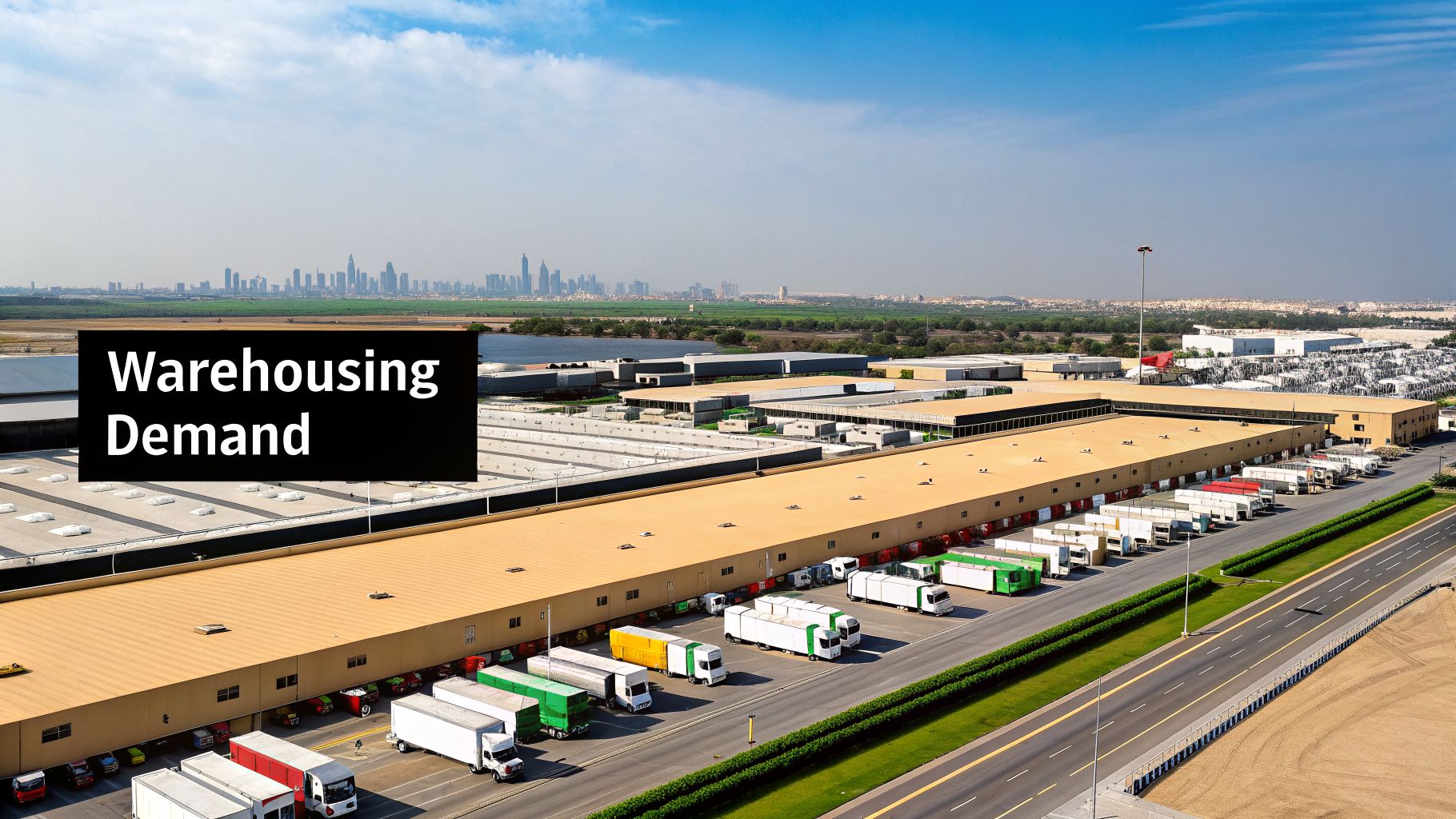
Logistics in the UAE is undergoing a rapid transformation. A confluence of economic drivers is compelling companies to adopt more intelligent approaches to inventory storage and movement. A warehouse is no longer a passive storage facility; it is the dynamic nerve centre of a supply chain, crucial for meeting modern customer expectations.
A few key factors are behind this boom:
The E-commerce Explosion: As online shopping becomes the norm, there's a huge demand for fulfilment centres. These aren't just warehouses; they're high-tech operations designed to pick, pack, and ship a high volume of small, individual orders with incredible speed and precision.
Massive Infrastructure Projects: Major government-led projects are seriously upgrading the country’s logistics backbone. Think of the ambitious Etihad Rail network and the constant expansion of world-class ports, which make the UAE an even better distribution hub for the entire region.
Economic Diversification: The nation's push to grow beyond oil means new industries are flourishing. Sectors like manufacturing, pharmaceuticals, and high-tech electronics each have very specific needs, from climate-controlled environments for sensitive goods to just-in-time storage for raw materials.
Navigating this new reality requires more than just four walls and a roof; it calls for intelligent oversight. This is precisely where an integrated Enterprise Resource Planning (ERP) system becomes a strategic asset. For a trading business in Abu Dhabi, it means having a live, accurate view of stock levels across every single branch. For a manufacturer, it’s about seamlessly connecting raw material inventory with production schedules and finished goods. A powerful ERP acts as the central brain, unifying inventory control, financials, purchasing, and sales. By automating routine tasks and delivering real-time data, it empowers better decisions, reduces costly errors, and boosts overall efficiency.
Want to see this process inside a real ERP? Use these quick links:
Chat on WhatsApp +971506228024 Quotation – Demo Request Chat with Hinawi AIA Look Inside the UAE Warehousing Market for 2026
If you're planning your business's next move in the UAE, you can't afford to ignore what's happening in the warehousing sector. It’s not just a story of steady growth; it’s a market in the middle of a massive transformation. Think of it less like renting a simple storage unit and more like trying to secure prime real estate in a booming city—you need to be quick, smart, and forward-thinking.
The numbers alone are staggering. The UAE's logistics and warehousing market hit a valuation of USD 54.65 billion in 2025. But it’s not stopping there. Projections show it rocketing towards USD 87.45 billion by 2032, expanding at a compound annual growth rate (CAGR) of 8.15%. This explosive growth is fuelled by huge government investments in infrastructure like Khalifa Port and the Etihad Rail network, not to mention the constant expansion of the country's free zones. For a deeper dive into the data, you can check out the full report on the UAE logistics market.
For any business on the ground, this fierce demand translates directly into a race for space and a real impact on the bottom line.
To make sense of these figures, here’s a quick snapshot of the most critical market statistics and what they mean for your business planning.
UAE Warehousing Market Key Metrics at a Glance (2025-2026)
| Metric | Value / Growth Rate | Key Takeaway for Businesses |
|---|---|---|
| Market Value (2025) | USD 54.65 Billion | The market is already massive, indicating a mature but highly competitive logistics ecosystem. |
| Projected CAGR (2026-2032) | 8.15% | Expect costs and competition to keep rising. Budget for rental increases and plan your warehousing needs well in advance. |
| Prime Occupancy Rates | Up to 98% | Finding quality, ready-to-move-in space is incredibly difficult. Don't wait until the last minute to start your search. |
| Grade A Rental Growth (Dubai) | 18% Year-on-Year | Rental inflation is significant. Lock in long-term leases where possible to stabilise your operational costs. |
| Grade A Rental Growth (Abu Dhabi) | 13% Year-on-Year | While slightly lower than Dubai, the upward trend is clear across the Emirates. Factor this into your financial forecasting. |
These numbers paint a clear picture: the market is hot, and securing the right facility at the right price requires a proactive strategy.
The Scramble for Grade A Facilities
One of the defining trends right now is the near-insatiable demand for Grade A warehousing. We’re not talking about your average lock-up. These are state-of-the-art facilities with high ceilings, advanced fire safety systems, efficient loading docks, and the solid infrastructure needed for modern logistics.
This clamour for quality has pushed occupancy rates through the roof. In prime industrial hubs like Dubai South and Abu Dhabi's KEZAD, occupancy is hovering around 98%. When supply is this tight, you know what happens next: prices climb.
Over the last year alone, we've seen rents for top-tier facilities jump by 18% in Dubai and 13% in Abu Dhabi. Some hotspots, like Dubai Industrial City, have seen an incredible 32% year-on-year rental hike.
This isn't just a statistic; it's a critical budget line item for any company. If you hesitate, you could find yourself paying significantly more or settling for a subpar location that hurts your operational efficiency. Understanding how these local trends fit into the bigger picture is key, which is why many businesses consult broader analyses of global logistics and fulfillment strategies.
New Supply Can't Keep Up with Demand
Developers are racing to meet this demand, with over 7 million square feet of new warehouse space currently under construction in Dubai areas like Al Warsan and National Industries Park. But here's the catch: much of this new supply is already spoken for before the concrete even dries.
A huge portion of these new builds are being pre-leased, with companies signing contracts months or even years before the facility is ready. This tells you just how urgent the situation is. Businesses with a clear, long-term plan are securing the best spots, while those who wait are left scrambling.
This is where having a tight grip on your own operations becomes a major competitive advantage. For instance, a UAE trading company juggling inventory across multiple locations needs to know exactly what it has and where. An integrated system like Hinawi ERP gives you that real-time visibility. It helps you optimise stock levels, which in turn allows you to make sharp, data-backed decisions about how much space you’ll need next year, ensuring you can plan ahead in a market this tight.
Choosing Your Location: Free Zone vs Mainland Warehousing
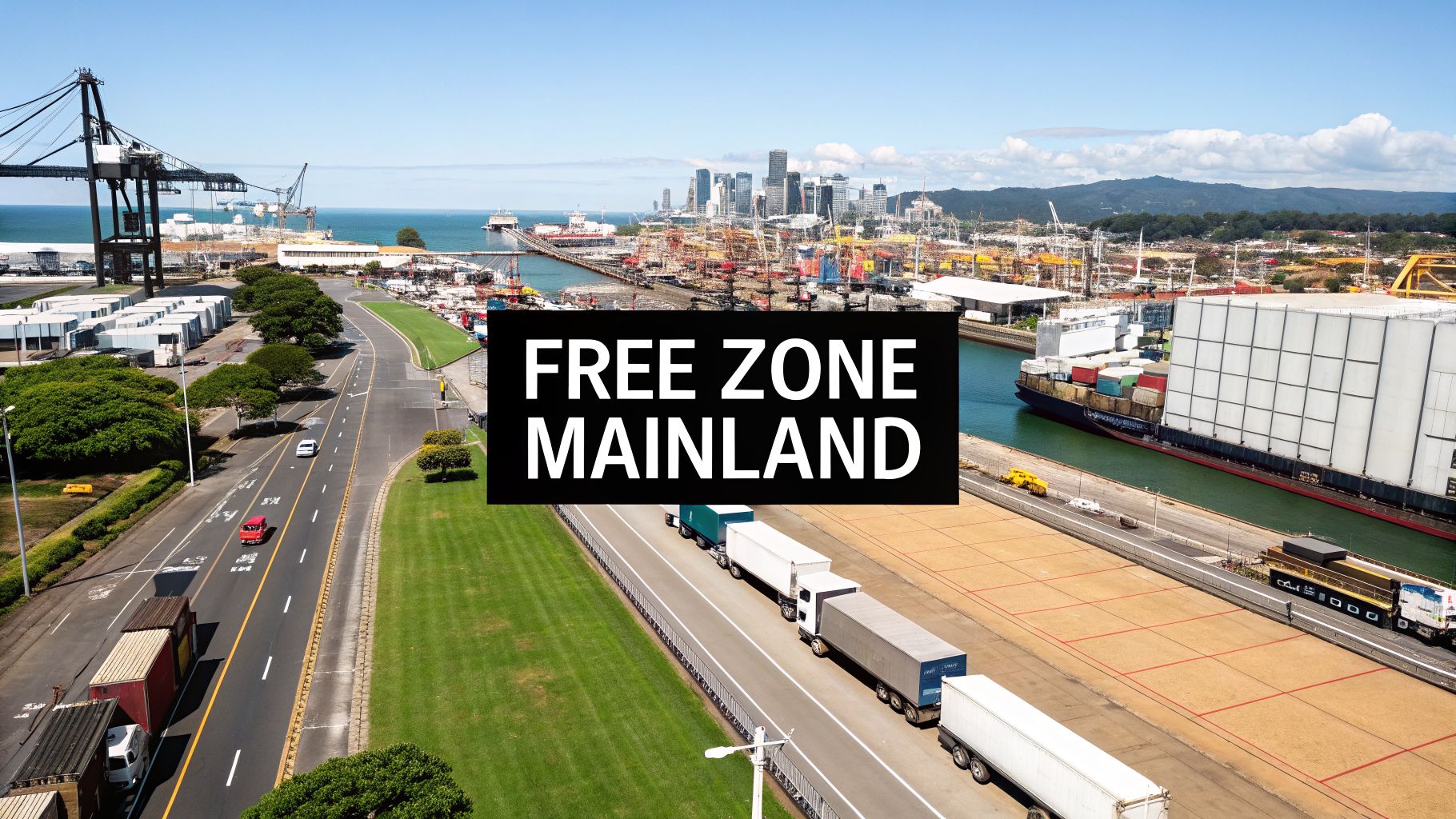
When you're setting up a business with a warehousing in UAE component, one of the first and most important questions you'll face is where to base your operations. This isn't just about picking a spot on a map. Choosing between a free zone and the mainland is a decision that will ripple through your entire business, affecting your costs, customer access, and daily operations.
Here’s a simple way to think about it: a free zone is like having an international passport for your goods. It’s designed for seamless global trade. A mainland licence, on the other hand, is your all-access pass to the local UAE market. The best choice for you comes down to one core question: who are you selling to?
For example, a trading company based in Jebel Ali Free Zone (Jafza) can import products, store them, and ship them out to another country without ever paying customs duties. This makes it an incredibly efficient hub for international distribution.
But if your main goal is selling directly to customers and businesses right here in the UAE, a mainland location makes more sense. It gives you the freedom to trade across all seven emirates without needing a middleman or local agent, which simplifies your logistics and sales right from the start.
Key Factors for Comparison
So, how do you make the call? You need to weigh the pros and cons of each against your specific business goals. Getting this right can supercharge your growth; getting it wrong can lead to logistical headaches and unnecessary costs.
Let's break down the main differences:
Foreign Ownership: Free zones have always been the go-to for 100% foreign ownership, which is a huge plus for international entrepreneurs. While the mainland has opened up to allow 100% ownership for many business activities, the free zone framework is often seen as more straightforward and established for this purpose.
Customs and Duties: This is a big one. Goods sitting in a free zone warehouse are technically considered outside the UAE for customs. That means no customs duties on anything you import and later re-export. With a mainland setup, you’ll be paying the standard 5% customs duty on goods you bring into the country.
Market Access: This is the trade-off. Mainland companies can sell to anyone, anywhere in the UAE, without restriction. Free zone companies, however, generally need to go through a local distributor to get their products onto the mainland market, at which point customs duties typically apply.
VAT Regulations: The standard 5% VAT is a reality everywhere, but how it’s applied can differ. In certain "designated" free zones, transactions between businesses can be treated as outside the scope of VAT, which can be a real advantage for traders. It's one of many financial details, like understanding tenancy contract calculations, that can make a big difference to your bottom line.
Aligning Location with Your Business Model
At the end of the day, your business model is your guide. An e-commerce business shipping to customers across the GCC would likely thrive in a free zone, using it as a central point for regional distribution. In contrast, a local manufacturing firm or a contracting company would be far better off on the mainland to directly serve its home market.
No matter which path you choose, staying on top of your inventory, finances, and compliance is non-negotiable. An ERP system is no longer a luxury but a necessity. For instance, a system like Hinawi ERP is built to handle the complexities of both setups. It can track inventory across multiple warehouses—whether they're in a free zone or on the mainland—and automatically manage the different VAT rules, keeping your financial data accurate and perfectly integrated. This ensures your back office runs smoothly, letting you focus on what really matters: growing your business.
Selecting Your Operational Model: 3PL vs Self-Operated
Alright, so you’ve scouted the perfect location for your facility. Now for the next big question on your warehousing in UAE journey: do you handle it all yourself, or do you bring in the experts? This is a crucial fork in the road, deciding whether you’ll partner with a Third-Party Logistics (3PL) provider or build and run your own in-house operation.
Think of it this way: are you buying a house that you need to furnish, staff, and maintain yourself, or are you moving into a fully serviced apartment where the specialists handle the details? Each approach has massive implications for your costs, your control, and how quickly you can adapt to market changes.
The 3PL (Outsourced) Model
Going the 3PL route means you’re essentially handing the keys to your warehousing and order fulfilment to a specialised partner. It's an incredibly popular choice, especially for fast-scaling e-commerce businesses or international companies just planting their flag in the UAE. The biggest win here is converting a massive, upfront capital expense (CapEx) into a predictable, monthly operating expense (OpEx).
Here’s why so many businesses choose to outsource:
- Flexibility on Demand: A great 3PL lets you scale your space and services up or down almost instantly. Got a huge seasonal rush? They can handle it. A quieter quarter? You’re not paying for empty racks.
- Instant Expertise: You immediately tap into a well-oiled machine. These companies live and breathe logistics, so you get access to seasoned professionals and proven processes for picking, packing, and shipping right out of the gate.
- Economies of Scale: 3PLs serve multiple clients, which means they can negotiate better rates for shipping and share the costs of labour, technology, and warehouse space. It’s a level of cost-efficiency that's tough for a single business to achieve on its own.
Of course, the trade-off is giving up some direct control. You're entrusting a huge part of your customer's experience to a partner, so building a relationship based on clear communication and trust is absolutely non-negotiable.
The Self-Operated (In-House) Model
Running your own warehouse, on the other hand, puts you in the driver's seat. You have absolute, granular control over every single detail—from how your inventory is organised on the shelf to the training your team receives. This path is often taken by larger manufacturers, established distributors with complex product ranges, or any business where warehousing is deeply tied to specialised services or production.
The main reasons to keep operations in-house include:
- Total Control: Every process can be tailored to perfectly match your brand's standards and the promises you make to your customers. There are no compromises.
- Seamless Integration: Your warehouse can be woven directly into your other business units, like manufacturing or quality control, creating an incredibly smooth and efficient workflow.
- A Long-Term Asset: The physical building, the racking, and the equipment are all assets on your balance sheet that can appreciate over time.
The obvious catch is the hefty upfront investment. You're on the hook for the property, equipment, technology, and a full team to run it all, not to mention the ongoing management headache.
No matter which path you take, visibility is everything. Whether your stock is sitting in your own facility or in a partner's warehouse across the city, you need a single, reliable source of truth. This is where a powerful ERP system becomes the backbone of successful supply chain management.
An integrated system like Hinawi ERP acts as your central command centre. It gives you a live, unified dashboard to track inventory levels across every single location—including stock managed by your 3PL. This ensures your sales, finance, and operations teams are all looking at the exact same real-time data. It’s what stops stockouts before they happen and keeps your financial reporting accurate, regardless of the operational model you choose.
How Technology Is Changing the Game in UAE Warehousing
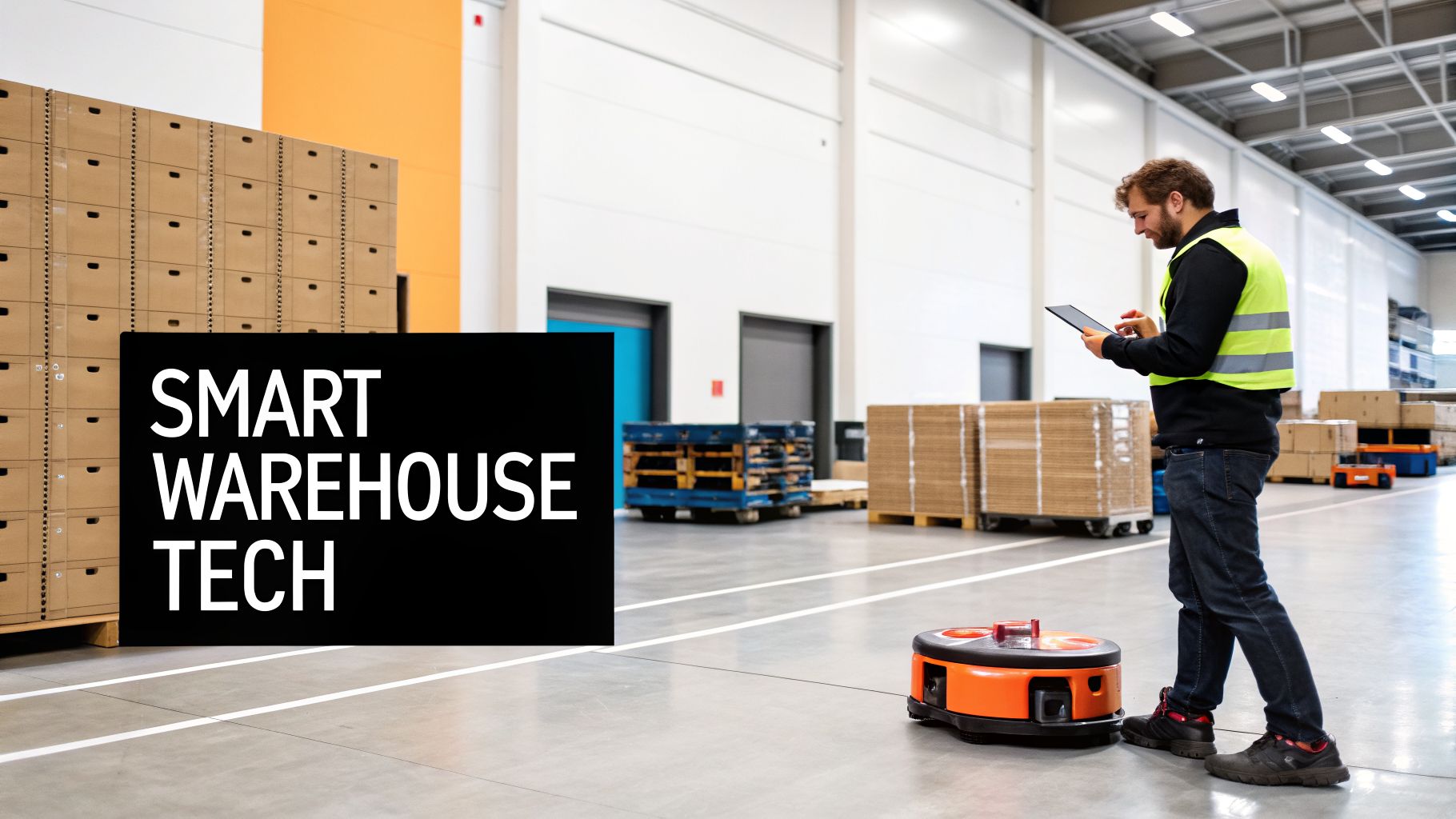
If you still picture a warehouse as just rows of dusty shelves and staff with clipboards, it’s time for a rethink. That old-school image is fading fast here in the UAE. Today’s warehouses are buzzing hubs of technology, where speed and accuracy aren't just goals—they're expectations driven by the intense demands of modern commerce.
Think about a facility where robots glide through aisles to pick orders, drones buzz overhead counting stock at night, and tiny sensors constantly check the temperature of sensitive goods. This isn’t a futuristic dream; it’s happening right now in advanced facilities for warehousing in the UAE. This shift is essential for any business managing physical goods, whether it’s a factory juggling job cards or a maintenance company that needs to track every last spare part.
The Rise of Automation and Smart Warehousing
This move towards tech-driven operations is happening quickly. The UAE's warehouse automation market is projected to grow at a compound annual growth rate (CAGR) of 13.4% through 2026. That’s a clear signal that businesses are investing heavily in robotics, the Internet of Things (IoT), and artificial intelligence to build smarter, more responsive supply chains.
You can see it across the Emirates as major logistics players launch highly automated centres. These facilities use robotics to slash e-commerce processing times and improve order accuracy, setting a new benchmark for the entire industry. It's a direct response to the need for total efficiency and control in a market that’s booming.
So, what are the key pieces of tech making a real impact?
- Autonomous Mobile Robots (AMRs): These are the smart carts that navigate the warehouse floor on their own, moving goods from storage to packing stations. They do the heavy lifting and endless walking, freeing up your team for more complex tasks.
- Automated Storage and Retrieval Systems (ASRS): Imagine a giant, intelligent vending machine for pallets. ASRS uses cranes and shuttles to automatically store and retrieve items in a high-density grid, making the most of every square metre of vertical space.
- Internet of Things (IoT) Sensors: These small but mighty devices are the nervous system of the smart warehouse. They monitor everything from the temperature and humidity for pharmaceuticals to the health of a forklift's engine.
- Drones for Inventory Management: Instead of shutting down aisles for manual cycle counts, you can deploy drones. They fly through the warehouse, scanning barcodes and updating inventory records with incredible speed and accuracy.
Of course, as warehouses become more technologically advanced, they also become more valuable targets. Investing in modern professional warehouse security services is no longer optional; it’s a critical step to protect these high-tech assets and the sensitive data they generate.
The ERP as the Central Command Centre
All this incredible hardware—the robots, sensors, and drones—is only one part of the puzzle. For it all to work together seamlessly, you need a powerful software brain to conduct the orchestra. That's the role of a fully integrated Enterprise Resource Planning (ERP) system. When a Warehouse Management System (WMS) is properly connected to an ERP, you get a single, unified view of your entire business. It bridges the gap between what's physically happening on the warehouse floor and what's happening in your accounting and sales departments.
Think about it from the perspective of a UAE trading company. An order is picked by a robot. Instantly, the ERP updates the stock count, the accounting module generates a VAT-compliant e-invoice, and the C-suite dashboard reflects the sale. It all happens automatically, with zero manual data entry.
This is exactly the kind of powerful integration that systems like Hinawi ERP provide, offering robust options for third-party integration. The result is a unified ecosystem where picking data, real-time inventory, and financial records are always in sync, giving managers the visibility they need to run a truly modern operation.
Ready to see how an ERP can centralize your warehouse operations?
Chat on WhatsApp +971506228024 Quotation – Demo Request Chat with Hinawi AIHow an Integrated ERP Ties Your Warehouse Operations Together
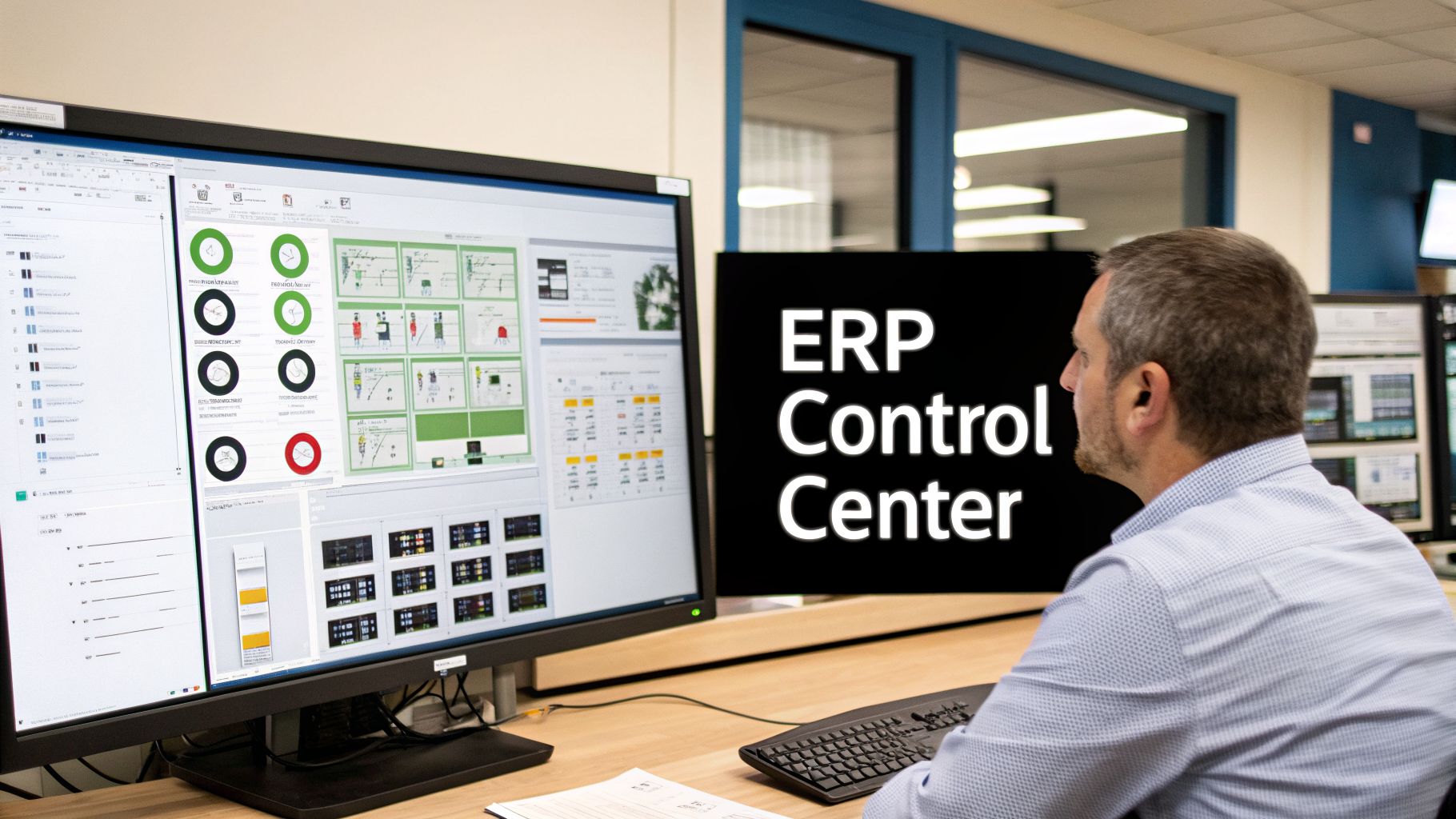
You can have the best warehouse layout and the most efficient team, but if your systems don't talk to each other, you're constantly fighting fires. This is where a proper Enterprise Resource Planning (ERP) system comes in. Think of it as the brain of your entire operation, connecting everything from your warehouse floor to your finance department in a single, unified platform. It’s what turns a collection of separate tasks into a smooth, intelligent business process.
I see this all the time with trading companies here in the UAE. A business in Abu Dhabi, for example, might be juggling stock across several warehouses. They're dealing with inaccurate inventory counts, which leads to lost sales and expensive last-minute orders. At the same time, their accounts team is manually calculating VAT and landed costs on international shipments, a process filled with human error and serious compliance risks. These everyday headaches are what hold a good business back from becoming a great one.
An ERP in Action: A Practical Look
This is where the right technology steps in. For that Abu Dhabi trader, implementing an ERP like Hinawi ERP gives them a single source of truth. Suddenly, they have real-time stock levels across every single branch. When an item is sold, the central inventory is updated instantly. No more guesswork. The system even sends automated alerts when stock drops below a certain point, so reordering becomes proactive, not reactive.
It gets even better when you look at the financials. The system automatically calculates the true landed cost of imported goods by pulling in all the related expenses—shipping, insurance, customs duties, and more. This data flows right into the accounting module, where VAT is handled correctly without anyone touching a calculator. This kind of automation explains why so many businesses are looking for ways to manage their stock across different locations. For a deeper dive, our guide on multi-warehouse inventory management is a great resource.
The fast-paced UAE market makes this control non-negotiable. Mid-sized warehouses (10,000-50,000 sq ft) now make up 58.1% of market demand as companies prioritise flexibility. With top-tier Grade A warehouse occupancy hitting 95% and leasing rates in prime spots like Abu Dhabi’s KEZAD soaring by 35%, you simply can't afford inefficiency. You can discover more insights about these market trends to see just how competitive it's getting.
An integrated ERP isn't just about tracking boxes. It's about connecting every part of your business so that your warehouse directly contributes to your financial stability and growth goals.
Beyond Inventory: A Complete Business Picture
This integration goes far beyond just inventory management. An ERP connects departments that often work in silos, creating a seamless flow of information that solves many common operational challenges.
To illustrate, here's a quick look at some typical warehousing problems and how a system like Hinawi ERP addresses them head-on.
Core Warehousing Challenges Solved by Hinawi ERP
| Operational Challenge | Hinawi ERP Module/Feature | Business Benefit |
|---|---|---|
| Inaccurate stock counts across multiple locations | Centralised Inventory & Multi-Store Management | Real-time visibility prevents stockouts, automates reordering, and improves sales forecasting. |
| Complex landed cost & VAT calculations | Landed Cost & Financials Module | Automates calculation of duties, shipping, and VAT for accurate profit margins and compliance. |
| Payroll errors and WPS compliance issues | Integrated HR & Payroll | Ensures WPS-compliant payroll is processed accurately and on time, linked directly to operational data. |
| Difficulty tracking raw material usage | Job Costing & Manufacturing Module | Links raw material consumption to specific production orders for precise cost control and planning. |
| Managing and depreciating warehouse assets | Fixed Assets Management | Tracks equipment like forklifts and racking, automating depreciation calculations for accurate books. |
By unifying these functions, an ERP gives you a clear, accurate, and live view of your entire business. It eliminates the manual work and guesswork, allowing you to make decisions with confidence. In a demanding market like warehousing in UAE, this is what enables a company to scale without chaos.
Want to see how this could work for your business? Let's connect.
Chat on WhatsApp +971506228024 Quotation – Demo Request Chat with Hinawi AITake the Next Step with Hinawi ERP
Throughout this guide, a clear theme emerges: managing a modern warehouse in the UAE with outdated, disconnected systems is no longer a viable strategy. The path to competitiveness requires a single, unified platform that connects inventory, finance, and operations. This is where an ERP transitions from a software tool to a strategic business asset.
For companies across the UAE and GCC, Hinawi ERP provides this integrated backbone. Developed in Abu Dhabi since 1998, it is a fully integrated ERP software designed specifically for the needs of the regional market. It serves as a central nervous system for your entire business.
Hinawi ERP offers a comprehensive suite of modules to address your key operational challenges:
- VAT and e-Invoicing compliance: Stay ahead of regulatory requirements with automated financial management.
- UAE WPS payroll support: Ensure accurate, timely, and compliant payroll processing.
- Bilingual Operation: Seamlessly switch between Arabic and English interfaces.
- Flexible Policy Settings: Adapt the system to your unique company policies and workflows.
- Real-time Accounting Integration: All modules, from manufacturing to real estate, post directly to the general ledger for a single source of financial truth.
Our solution is ideally suited for a wide range of industries including factories, contracting companies, real estate businesses, schools, garages, trading companies, and manufacturers. We encourage decision-makers to modernize their operations, reduce manual work, improve financial accuracy, and gain better control over their management with Hinawi ERP.
Let our team of consultants show you how to achieve operational excellence.
Chat on WhatsApp +971506228024 Quotation – Demo Request Chat with Hinawi AI