
In the dynamic business landscape of the UAE, managing cash flow and client relationships effectively often comes down to clear communication. A professional statement of account template is one of your most important tools for this. It’s not just another invoice; it’s a complete snapshot of all the financial activity between you and a client over a set period. For businesses in Abu Dhabi, Dubai, and across the GCC, transitioning from manual templates to an automated system like Hinawi ERP is a critical step toward achieving financial clarity and operational efficiency.
Chat on WhatsApp +971506228024 Quotation – Demo RequestWhy A Statement of Account Is Crucial For UAE Businesses

Here in dynamic markets like Dubai and Abu Dhabi, financial clarity is non-negotiable. From a consulting perspective, companies consistently face operational challenges that a well-managed statement of account process can resolve.
Consider these common scenarios for businesses in the UAE and Saudi Arabia:
- Chasing Overdue Payments: A clear, itemised statement acts as a professional, non-confrontational reminder. It presents the full transaction history, encouraging clients to settle outstanding balances without requiring awkward phone calls.
- Handling Invoice Disputes: When a client questions a charge—a frequent issue in contracting or real estate—a statement provides the definitive record. It chronologically lists every invoice and payment, resolving discrepancies and preventing disputes from escalating.
- Ensuring Tax Compliance: With VAT regulations and the UAE Corporate Tax, your financial records must be audit-proof. A statement offers a clean, period-specific trail of transactions, simplifying compliance and reducing stress during audits by the Federal Tax Authority (FTA).
- Building Professional Trust: Consistently delivering an accurate, easy-to-read statement demonstrates organizational competence. This small touch significantly enhances client trust and reinforces your reputation as a reliable business partner.
From Manual Templates to Automated Efficiency
A downloadable statement of account template is a practical starting point. However, as your business scales, the manual process of creating these documents becomes a significant operational bottleneck—consuming valuable time in data extraction, error-checking, and individual distribution.
This is where the strategic value of an Enterprise Resource Planning (ERP) system becomes clear. An integrated solution like Hinawi ERP automates this entire workflow. It links directly to your accounting and sales modules to generate and dispatch accurate statements on a pre-defined schedule. This transition from manual work to automation is a fundamental step toward gaining real-time control over your company's finances. A critical aspect of this is defining your reporting periods; for a detailed explanation, you can learn more about the fiscal year and its meaning in our detailed guide.
Chat on WhatsApp +971506228024 Quotation – Demo RequestWhat Goes into a UAE-Compliant Statement of Account?
A statement of account is more than a list of numbers; it’s a narrative of the financial relationship with your client. When executed correctly, it provides total clarity, prevents disputes, and ensures your records are audit-ready for authorities like the UAE's Federal Tax Authority (FTA). Let’s dissect the essential components of a professional, compliant statement.

The foundation of any effective statement is clear identification. Begin with your full company name, address, and contact information. For any business operating in the UAE, your Tax Registration Number (TRN) must be prominently displayed. Equally important is the client's full legal name and address to prevent payment delays caused by ambiguity.
To provide absolute clarity, here is a breakdown of what every professional statement of account must contain.
Key Components Of A Professional Statement Of Account
| Component | Purpose | Best Practice For UAE Businesses |
|---|---|---|
| Your Company Details | Identifies you as the sender. | Include your legal name, address, phone, and TRN. The TRN is non-negotiable for VAT compliance. |
| Client's Company Details | Clearly identifies the recipient. | Use the client’s full legal name and registered address to avoid any confusion or payment disputes. |
| Statement Date & Period | Defines the timeframe covered. | Always specify the start and end dates (e.g., "1st October to 31st October 2024"). |
| Opening Balance | Shows the amount due from the last statement. | This must perfectly match the previous period's closing balance to ensure financial continuity and trust. |
| Transaction List | Details all financial activity in the period. | Itemise every invoice, payment, credit note, etc., with its date, reference number, and value. |
| Running Balance | Tracks the account total after each transaction. | This column provides an easy-to-follow narrative of how the final balance was calculated. |
| Closing Balance | The final amount owed as of the end date. | This is the most critical number for your client and your accounts receivable team. Make it bold and clear. |
Adhering to these details is not just about good bookkeeping; it's about building institutional trust and ensuring timely payment.
The Transactional Story at a Glance
The main body of the statement is where you provide the transactional narrative. This is not a jumble of figures but a chronological log that justifies the final balance.
It begins with two key figures: the Statement Period (e.g., "For the period of 1st October to 31st October 2024") and the Opening Balance. The opening balance is your anchor—it must be identical to the closing balance from the previous statement. Any discrepancy will immediately cause confusion and undermine credibility.
From there, list every transaction that occurred within the period. For each line item, include:
- Date: When the transaction was posted.
- Transaction Type: Be specific—Invoice, Payment, Credit Note, or Debit Note.
- Reference Number: The unique identifier for the invoice or payment receipt, vital for cross-referencing.
- Amount: The specific value of that transaction.
- Running Balance: An advisory best practice. A column showing the cumulative total after each entry helps clients follow the account's progression easily.
A well-structured statement is essentially a client-facing snapshot of your internal records. It offers a transparent window into your shared financial history. To really grasp how these transactions are formally logged, our guide on the role of the ledger in accounting is a great place to start.
Finalising the Statement and Adding Context
Finally, you arrive at the Closing Balance—the total amount the client owes as of the statement's end date. This figure must be prominent, as it's the primary focus for both the client and your accounts team.
For businesses in the UAE, particularly in sectors like contracting or real estate, generic statements often fail. A real estate firm in Abu Dhabi, for example, might struggle with tracking dues for hundreds of rental units. Manually adding property identifiers to each statement is prone to error. With a system like Hinawi ERP, you can configure custom fields (like project codes or property unit numbers) to populate automatically. This ensures every statement is perfectly tailored to the client's context, providing both parties with complete confidence in the numbers without manual effort.
Automating this process is key to scaling operations efficiently. See how you can achieve this with a modern ERP system.
Chat on WhatsApp +971506228024 Quotation – Demo RequestHow To Customise Your Free Statement Template
Think of a free template as a foundation. To derive real business value, you must adapt it to your specific operational context in the UAE. This goes beyond adding a logo; it's about transforming a generic document into a clear, professional tool that accelerates payment.
What works for a trading company in Dubai will not be a perfect fit for a manufacturing firm in Saudi Arabia. Contractors can add custom fields for project codes to help clients track costs against specific jobs. A real estate management firm might add a property unit number field to give landlords and tenants instant clarity on charges.
Tailoring Wording For Different Scenarios
The language you use directly impacts cash flow and client relationships. A one-size-fits-all message is ineffective. You must adapt your tone based on the account's status.
Standard Monthly Summary: For a client in good standing, keep it simple and polite. "Here is your account summary for October 2024. We appreciate your continued partnership." is sufficient.
Gentle Overdue Reminder: When an account is slightly past due, be firm yet courteous. "This is a reminder that your balance of AED 5,000 is now past due. Please advise on the expected payment date."
Final Notice: For seriously overdue accounts, the language must become direct and clearly state the consequences. "FINAL NOTICE: Your outstanding balance of AED 12,500 requires immediate attention. If payment is not received within 7 days, the account will be forwarded to our collections partner."
These minor adjustments turn a static report into an active component of your accounts receivable strategy. For consistency across all financial documents, our guide on creating a proforma invoice sample is an excellent resource.
Automation With Client Profiles
Manually adjusting the wording for every client is not scalable. This is where the benefits of a robust ERP system become undeniable.
With a well-configured ERP like Hinawi, you can automate this entire customisation. You can establish rules based on aging debt, and the system automatically applies the correct messaging and adds industry-specific fields to each statement.
This ensures every statement is not only accurate but also contextually appropriate, achieving a level of professionalism that is difficult to maintain manually, all without adding to your finance team's workload.
Moving Beyond Templates With ERP Automation
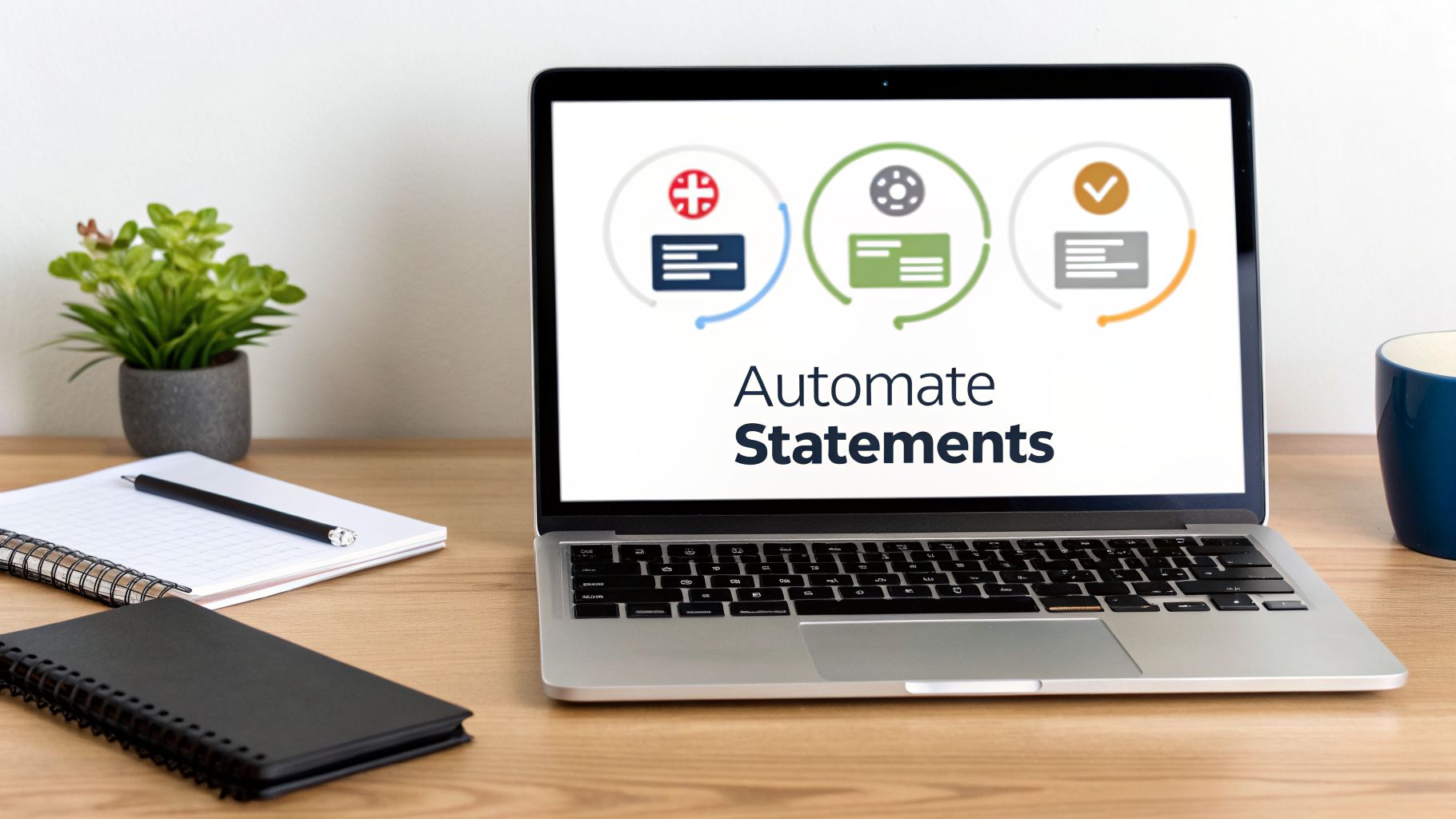
While a statement of account template is a fine starting point, it has limitations. As your company grows, a task that once took hours can expand into a multi-day process fraught with the risk of human error. This is the pivotal moment when forward-thinking businesses in the UAE transition to automation through an Enterprise Resource Planning (ERP) system.
The monthly grind of pulling transactions, formatting statements, and individual distribution can be completely transformed into a smooth, error-free, automated process. The true power lies in achieving pinpoint accuracy, guaranteed on-time delivery, and a real-time, 360-degree view of your accounts receivable.
This is not a niche concept; it's a major shift across the region. The UAE ERP market was valued at USD 2.14 billion in 2023 and is projected to reach USD 3.45 billion by 2028. This trend accelerated after VAT introduction, with 75% of retail and distribution firms adopting ERPs, resulting in 20-30% faster invoice cycles and a 25% reduction in overdue payments.
How ERP Delivers Superior Automation
An integrated system like Hinawi ERP provides a practical example of this efficiency leap. Its accounting module serves as the central nervous system, automatically consolidating every invoice, payment, and credit note from all business functions.
Because all data is synchronized in real time, creating a statement of account is no longer a manual data-gathering exercise. With a few clicks, the system can generate statements for a single client or dispatch them in bulk to your entire customer base.
For businesses operating in the GCC, this delivers game-changing advantages:
- Bilingual Operation: Automatically generate and send statements in both Arabic and English, a crucial feature for clear communication in the region.
- Multi-Currency Support: Effortlessly handle transactions from clients across the GCC and internationally, eliminating manual currency conversions and exchange rate errors.
- Scheduled Delivery: Configure the system to email statements on a specific day each month, enhancing professionalism and accelerating payment cycles.
Advanced automation offers even more dramatic time savings. For instance, AI-driven automation is helping some companies achieve incredible results, like cutting accounts receivable costs by 67%.
By centralising all your financial data, an ERP does more than just automate statements. It unlocks deeper insights into your cash flow, tracks client payment behaviours, and gives you a true pulse on the company's financial health.
Ultimately, automation frees your finance team to focus on strategic analysis and business growth rather than repetitive data entry. To see these features in action, explore the full range of our ERP services in Hinawi software.
Keeping Your Statements Compliant in the UAE and GCC
When conducting business in the UAE or anywhere in the GCC, regulatory details are paramount. Your statement of account template is not just a client courtesy; it's a financial document that must meet strict local regulations. It needs to be clear, accurate, and ready for inspection.
Addressing this from the outset prevents significant future complications. Let's review the key compliance points.
VAT, E-Invoicing, and Your TRN
First, VAT compliance is non-negotiable. If your statement references any transactions that include Value Added Tax, it must display your Tax Registration Number (TRN). Omitting it is a compliance failure that can cause problems for both you and your client during audits.
Furthermore, the entire region is moving toward mandatory e-invoicing. Your statement of account is part of this digital audit trail. While not an invoice itself, it summarizes them. A smooth transition to e-invoicing requires clean, structured accounting data ready for digital systems.
Corporate Tax and Keeping Good Records
The introduction of the UAE Corporate Tax has elevated the importance of financial transparency. Statements of account are a critical part of the audit trail that substantiates your financial reports.
Under federal law, businesses are required to maintain financial records for a minimum of five years. These statements form a core part of that mandatory history. For a deeper analysis, review our guide on the new tax law in the UAE.
This is part of a broader government-led digitization initiative across the Middle East. The regional ERP software market is consequently expected to reach USD 3,199.51 million by 2030. This growth is driven by the need for solutions like Hinawi ERP that can manage evolving compliance demands. You can read more about this growing market trend.
If your business engages with international partners, you may also need to provide documents in multiple languages. Utilizing professional financial document translation services is essential to ensure accuracy across jurisdictions.
Let our consultants show you how to ensure your financial documents are fully compliant.
Chat on WhatsApp +971506228024 Quotation – Demo RequestTake the Next Step with Hinawi ERP
If you find that manual templates for statements of account are becoming a bottleneck, it is time to consider a fully integrated system. For companies across the UAE and GCC, Hinawi ERP provides a unified solution, developed in Abu Dhabi since 1998. Our philosophy is to bring all core business functions—Accounting, HR & Payroll, Real Estate Management, Manufacturing, and more—under a single, powerful platform.

Hinawi ERP is engineered for the unique demands of the GCC market, helping you modernize operations, reduce manual work, and gain superior control over your management processes. We serve a diverse range of industries, including factories, contracting companies, real estate businesses, schools, garages, and trading companies.
Our system delivers tangible benefits:
- Full Compliance: Stay aligned with local VAT and e-invoicing regulations.
- Bilingual Operation: Seamlessly operate and generate reports in both Arabic and English.
- WPS Payroll Support: Ensure full compliance with the UAE's Wage Protection System.
- Flexible Policy Settings: Configure the system to match your company's specific operational rules.
- Real-Time Integration: Benefit from live accounting data that connects every module, from HR to Fixed Assets.
By automating tasks like generating a statement of account, you not only save time but also drastically improve financial accuracy, empowering your management team to make informed, data-driven decisions. The UAE's ERP software market reached USD 465.9 million in 2024, reflecting a strong regional demand for reliable, on-premise solutions that offer direct control—a core strength of Hinawi ERP. You can see more details about this growing market on Grand View Research.
It's time to move beyond spreadsheets and outdated processes. Let the Hinawi ERP team provide a consultation or a personalized demo to show you how our solution can become a strategic partner in your company’s growth. Visit us at www.hinawierp.com to learn more.
Chat on WhatsApp +971506228024 Quotation – Demo RequestA Few Common Questions We Hear
Let's address some common questions that arise when businesses refine their statement of account process. Optimizing these details can significantly impact your cash flow and client relationships.
How Often Should I Send A Statement Of Account?
While monthly statements are a solid industry benchmark, the optimal frequency depends on your business model and client agreements. Consider your credit terms and payment cycles.
For example, a contracting company in Dubai with clients on 60-day terms might send statements monthly. However, if a client has consistently overdue balances, increasing the frequency to bi-weekly can serve as a polite but firm reminder to get payments back on track without constant follow-up calls.
What Is The Difference Between A Statement And An Invoice?
This is a common point of confusion. An invoice is a bill for a specific product or service rendered. Its sole purpose is to request payment for that single transaction.
A statement of account, in contrast, provides a comprehensive summary of a client's account over a defined period. It lists all invoices issued, payments received, credit notes, and adjustments, showing the balance from the beginning to the end of the period. It tells the complete financial story.
Can Hinawi ERP Handle Statements For Multiple Currencies?
Yes, and this is a critical feature for any business operating in the UAE and the wider GCC. Managing transactions in different currencies (e.g., SAR, USD, EUR) is a common operational challenge that can lead to manual errors in conversion and reconciliation.
A robust ERP system like Hinawi is designed for this reality. It automates all multi-currency conversions and reporting, removing the risk of manual error and ensuring your financial records are always accurate. This simplifies reconciliation for your accounting team and provides clarity for international clients.