
When we talk about warehouse logistics, we're talking about the complete journey a product takes within your four walls. It’s the entire process, from the moment a shipment arrives at your receiving dock to the second it’s dispatched to a customer. Think of it as the central nervous system of your fulfilment operation, ensuring that every item moves smoothly, accurately, and right on schedule.
For any business operating in the fiercely competitive UAE and wider GCC markets, getting this right isn’t just a nice-to-have. It's a fundamental pillar of profitability and customer satisfaction. An integrated ERP system, such as Hinawi ERP, which has been developed in Abu Dhabi since 1998, provides the data-driven backbone necessary for this level of precision, connecting warehouse activities directly to your core financial and operational systems.
Chat on WhatsApp +971506228024 Quotation – Demo Request Chat with Hinawi AIWhy Your Warehouse Is More Than Just Storage
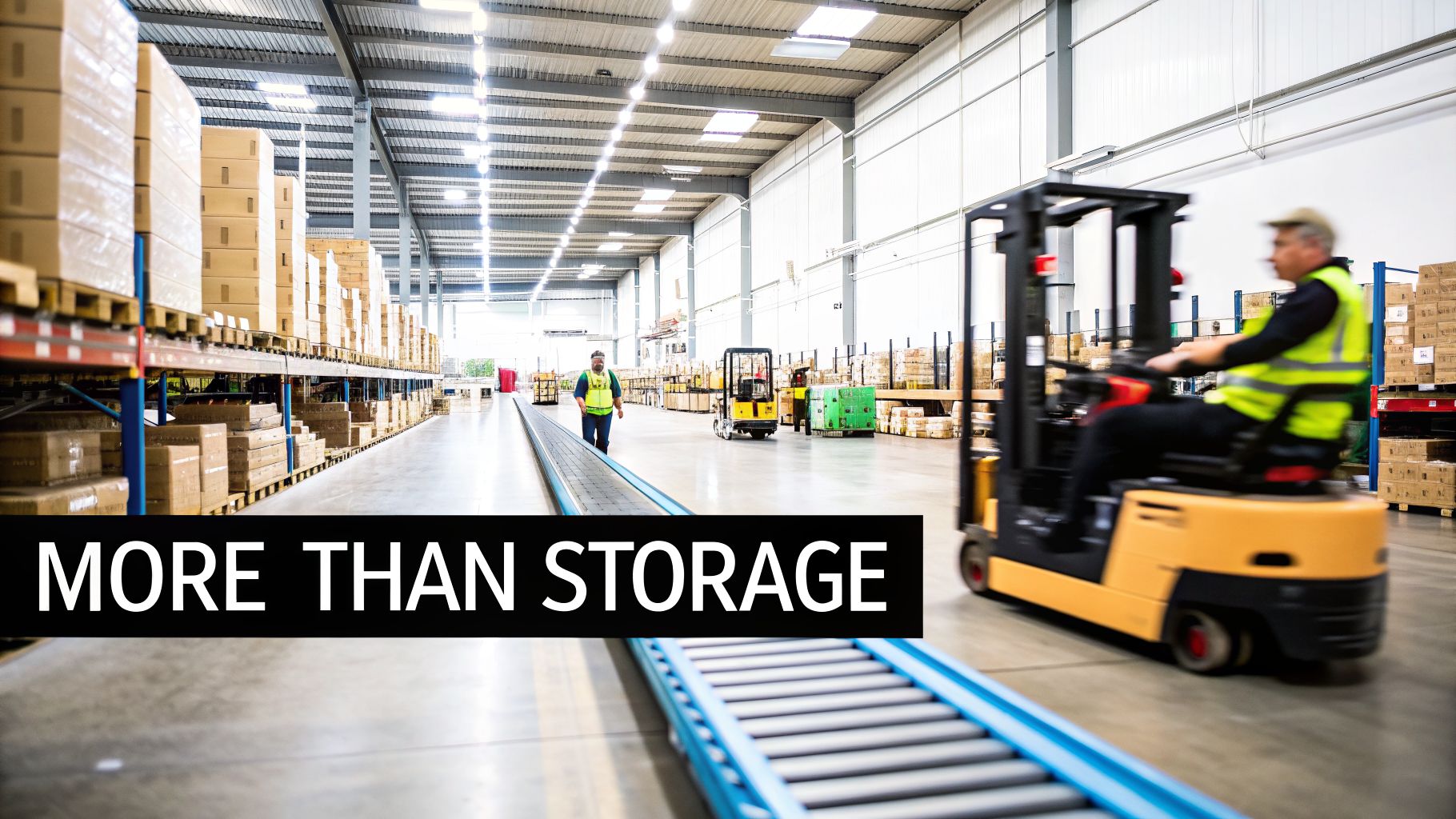
It’s time to stop thinking of your warehouse as a passive, four-walled box for holding inventory. That old-school view treats it as a cost centre—a necessary expense. The reality is that a modern warehouse is a living, breathing hub of activity that directly impacts your bottom line. Every single process, from receiving and put-away to picking and shipping, is a critical link in your supply chain. If one link is weak, it can create expensive chaos. But if every link is strong, you build a formidable competitive advantage.
This is especially true in fast-moving commercial centres like Dubai and Abu Dhabi, where customers expect orders to be fast and flawless. In this environment, a delay, a wrong item, or damaged goods aren't minor hiccups. They are major blows to your reputation, customer loyalty, and ultimately, your profitability.
Shifting from Cost Centre to Profit Driver
The secret to unlocking your warehouse's full potential is to start treating it like the strategic asset it is. To get there, you need to dive into the world of modern ecommerce warehouse management. This approach isn't about simply storing goods; it's about optimising every single function to push more orders out the door, slash operational costs, and achieve near-perfect accuracy.
Making this mental shift is vital for several reasons:
- Boosts Customer Satisfaction: When orders arrive quickly and correctly, you create happy, loyal customers who come back for more.
- Cuts Operational Costs: Efficient workflows mean less wasted time, labour, and materials, which directly improves your profit margins.
- Creates a Market Advantage: A well-oiled warehouse machine allows you to adapt to market shifts and scale up your operations without missing a beat.
For businesses in the UAE, modernising warehouse operations is no longer a choice. For many, this journey begins with integrating the right software. An ERP system acts as the brain of your operation, turning warehouse chaos into a streamlined, data-driven process by connecting your inventory with accounting and sales data. This gives you the complete visibility you need to make smart, strategic decisions. For more on this, our guide on multi-warehouse inventory management offers deeper insights.
Chat on WhatsApp +971506228024 Quotation – Demo Request Chat with Hinawi AIThe Lifecycle of Inventory in Your Warehouse
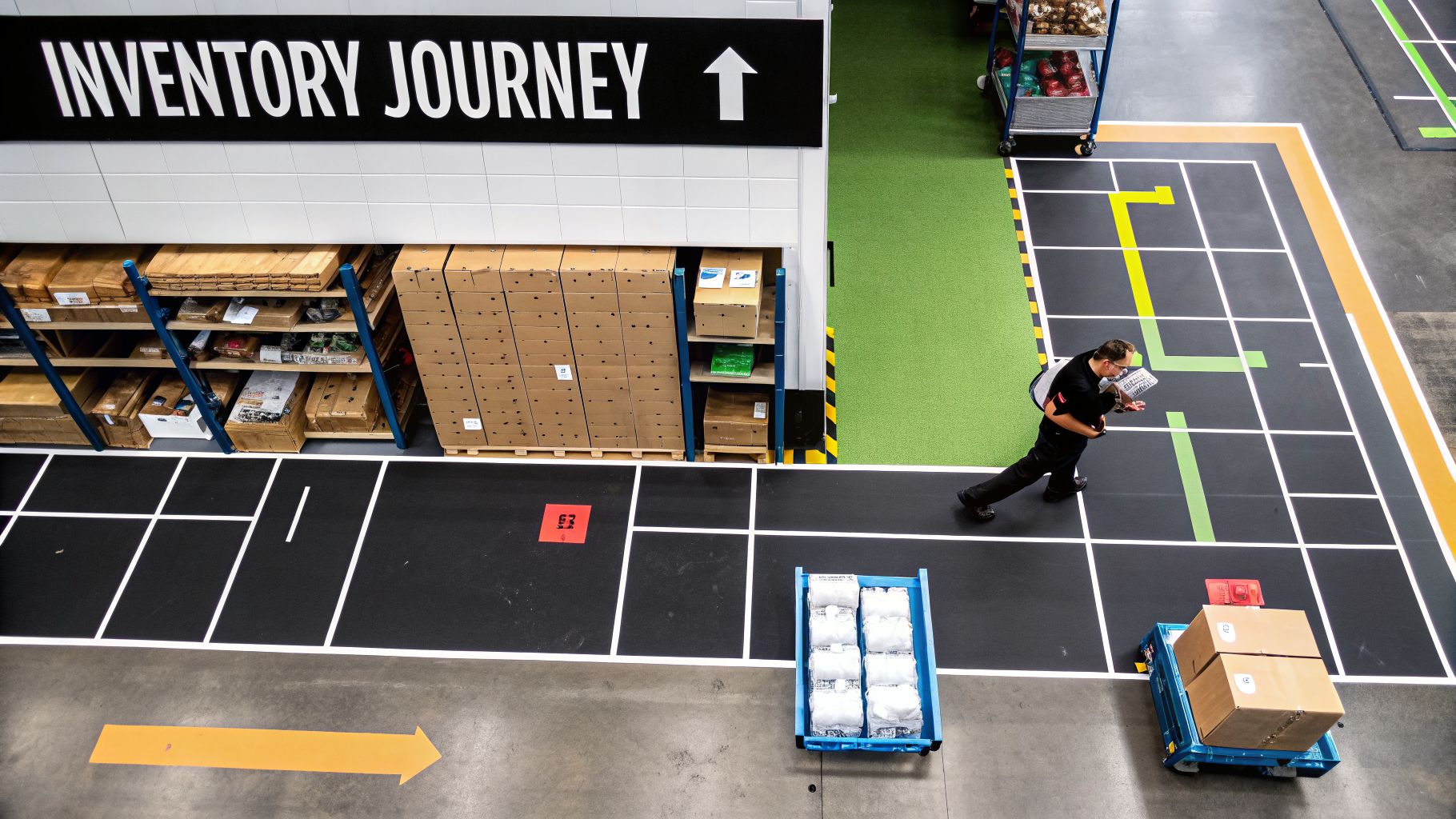
Think of your warehouse not as a static box, but as a living system where every product has a life story. Understanding that journey—from the moment a delivery truck arrives to the second a package leaves for a customer—is the key to unlocking real efficiency in your logistics in warehouse operations. Each stage is a handover where you can either create value or lose money.
For many businesses across the UAE, especially those juggling manual ledgers and disconnected spreadsheets, this journey is often a mystery. The result? Lost stock, frustratingly inaccurate counts, and costly shipping errors that eat away at your profits.
The Journey Begins: Inbound Logistics
It all starts the moment a supplier’s truck backs up to your receiving dock. This inbound logistics phase is far more than just unloading boxes; it's your first and best chance to ensure quality and data accuracy from the very beginning.
- Receiving: Your team physically unloads the goods from the delivery vehicle.
- Inspection: They immediately check for damage, verify quantities against the purchase order, and make sure the correct items have arrived.
- Recording: This is where the magic (or the trouble) happens. Every item must be logged into your inventory system.
A classic mistake we see with trading companies in Dubai and Abu Dhabi is a mismatch between the purchase order and the physical goods received. If your systems aren't connected, this discrepancy might not be caught for weeks, leading to payment disputes with suppliers and phantom stock on your books.
Finding a Home: Put-Away and Storage
Once goods are received and checked, they need a home. The put-away process is the strategic act of moving inventory from the receiving bay to its designated storage location. This isn't about finding the nearest empty shelf; it’s a calculated decision.
Smart put-away logic ensures your fastest-selling items are placed where they are easiest to grab, while slower-moving stock can be stored further away. For manufacturers, this ties directly into Manufacturing Resource Planning, ensuring raw materials are stored for optimal flow to the production line.
Expert Insight: The whole point of organised put-away is to slash the travel time for your pickers. Simply placing your hottest products closer to the packing stations can cut labour costs by over 50% in high-volume operations. It's one of the simplest, most effective changes you can make.
Mission Accomplished: Order Fulfilment
This is where your team goes into action mode, turning customer orders into shipped packages with speed and accuracy.
- Order Picking: A "pick list" acts as a treasure map, guiding staff to the right locations to retrieve items. This is consistently the most labour-intensive part of the entire process.
- Packing and Staging: Picked items are brought to a packing station. Here, they're checked one last time, packaged securely, and labelled for their journey to the customer.
- Outbound Logistics (Shipping): The finished package moves to the dispatch area, where it's sorted by courier or delivery route and loaded onto the correct truck.
Each step flows into the next. A delay in picking creates an instant bottleneck at the packing station, which can cause you to miss a courier's daily cut-off. This is why Mastering Inventory Management and Stock Control is not just a concept, but a core discipline for a healthy supply chain.
The Full Circle: Returns Management
The product lifecycle doesn’t always end when a package ships out. Reverse logistics—the process of handling customer returns—is a crucial, and often messy, part of the business. A smooth returns process means efficiently inspecting the product, deciding if it can be resold, refurbished, or written off, and instantly updating your stock levels and financial records.
To help you visualise how these stages connect, here’s a breakdown of the core processes and what you should aim to achieve at each step.
Core Warehouse Logistics Processes and Key Objectives
| Process Stage | Primary Function | Key Objective |
|---|---|---|
| Receiving | Unloading and inspecting incoming shipments from suppliers. | Verify accuracy and quality of goods against purchase orders. |
| Put-Away | Moving received items to their designated storage locations. | Minimise travel time for future picking and optimise space. |
| Storage | Holding inventory in an organised and secure manner. | Maintain inventory integrity and ensure easy accessibility. |
| Picking | Retrieving items from storage to fulfil customer orders. | Maximise speed and accuracy while minimising labour cost. |
| Packing | Preparing picked items for shipment with proper packaging. | Ensure order accuracy and protect goods from damage in transit. |
| Shipping | Loading packed orders onto vehicles for dispatch to customers. | Meet carrier deadlines and provide accurate tracking information. |
| Returns | Managing items sent back by customers (reverse logistics). | Recover value from returned stock and maintain customer satisfaction. |
In every one of these stages, the flow of information is just as critical as the physical movement of goods. When an item is picked, a truly integrated system ensures your inventory count, sales order, and accounting ledgers are all updated in real-time, without any manual entry.
Chat on WhatsApp +971506228024 Quotation – Demo Request Chat with Hinawi AINavigating the UAE's High-Stakes Logistics Market
The logistics market across the UAE and the wider GCC isn't just competitive—it's a pressure cooker. For any business in trading, manufacturing, or distribution, physical space has become a premium, and incredibly expensive, commodity. It’s no longer enough to simply have a warehouse; the real challenge is squeezing every last dirham of value out of every single square metre you lease or own.
What's driving this pressure? It's a classic case of demand outstripping supply. In Abu Dhabi, top-tier logistics zones like KEZAD are reporting 98% occupancy, fuelled by a 35% jump in warehouse leasing. This isn't just a local blip. Across the entire UAE, Grade A industrial facilities are hovering around 95% occupancy.
Naturally, this has sent rental costs soaring. Dubai has seen a 19% year-over-year hike in industrial rents, while Abu Dhabi has faced rent growth of over 50% in the last two years alone. For any company trying to manage a supply chain, those numbers are a direct threat to the bottom line.
The Strategic Response to Market Pressure
In this kind of environment, you can't afford to treat your warehouse as an operational afterthought. The climbing rents and fierce competition for space demand a smart, data-led approach to financial control. Flying blind and making huge real estate decisions based on gut feelings is a risk that can cripple a business.
Let's walk through a common scenario. Imagine a trading company in Dubai's Jebel Ali Free Zone (JAFZA) getting notice of a major rent increase for their upcoming lease renewal. They're at a crossroads with a few tough options:
- Renegotiate: Try to hammer out a better deal with the landlord.
- Relocate: Uproot the entire operation and move to a cheaper facility, maybe in one of the Northern Emirates.
- Consolidate: Find a way to optimise their current layout to shrink their footprint and cut costs.
- Build: Commission a brand-new, purpose-built facility designed around their exact needs.
Every one of these paths comes with a hefty price tag, from the disruption of moving to massive long-term capital investment. You simply can't make the right call without understanding how your facility's cost trickles down to affect the profitability of every sale. For a closer look at the financial documents that form the basis of these decisions, our guide on creating a proforma invoice sample is a great resource.
From Reactive Costs to Proactive Asset Management
This is precisely where an integrated ERP system stops being a "nice-to-have" and becomes a core strategic tool. A system like Hinawi ERP, which has dedicated modules for Fixed Asset Management and Real Estate Management, gives you the exact data you need for this level of decision-making. It finally connects the dots between your lease agreements, asset depreciation, and the day-to-day operational costs of your logistics in warehouse activities.
Consultant's Takeaway: Stop thinking of your warehouse lease as just another line item on the expense report. It's a major fixed asset with its own financial performance. By tracking it as an asset in your ERP, you can analyse its true cost against the revenue it helps generate and make smarter decisions about your entire property portfolio.
Armed with this integrated data, our JAFZA trading company can now accurately model the financial outcome of each option. They can weigh the cost of relocation against the potential savings from a more efficient layout. They can see exactly how much their current warehouse overhead adds to their cost of goods sold. This allows them to make a decision backed by hard numbers—one that protects their long-term profitability in a market that offers very little room for error.
The Technology That Powers Modern Warehouses
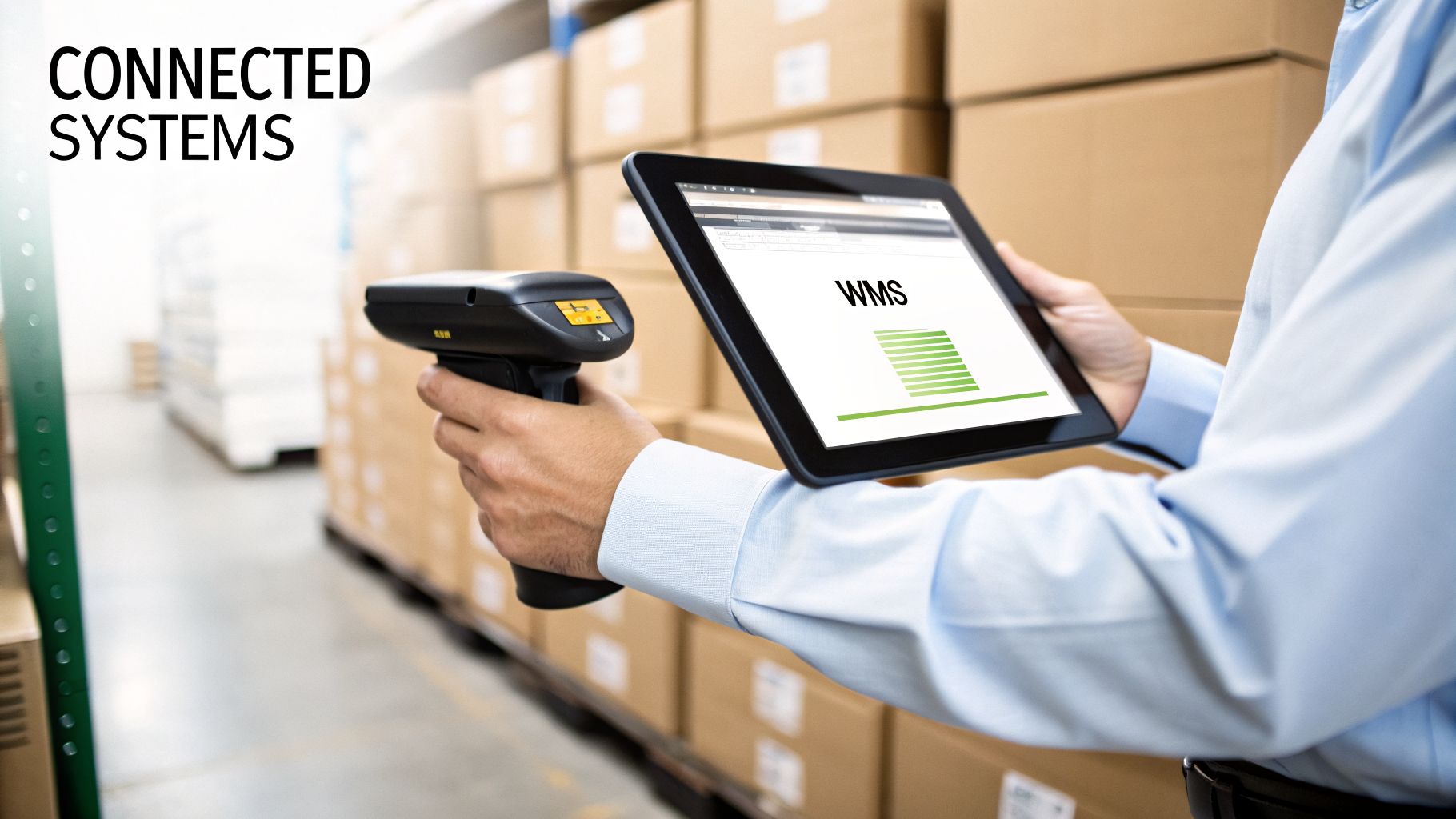
Let's be honest, the days of running a warehouse with a clipboard and a sharp pencil are long gone. Today, efficiency in logistics in warehouse operations isn't just about working harder; it's about working smarter with the right technology.
Think of it this way: a modern warehouse is like an orchestra. Every section has its part to play, but without a conductor, you just have noise. The right tech stack is your conductor, turning separate activities into a coordinated, high-performance operation where every part of your business is perfectly in sync.
The Brains of the Operation: Warehouse Management Systems (WMS)
At the heart of it all is the Warehouse Management System (WMS). This isn't just another piece of software; it's the central command centre for everything happening on your warehouse floor. From the second inventory arrives at your receiving dock to the moment it ships out to a customer, a WMS directs the flow of goods, tracks every item, and tells your team exactly where to go and what to do next.
But a WMS truly shines when it’s not an isolated island of data. Its real power is unlocked when it’s an integral part of your company’s Enterprise Resource Planning (ERP) system. When the WMS is a module within a system like Hinawi ERP, it connects directly to your sales, purchasing, and accounting departments. This is a game-changer for getting a complete, real-time picture of your operations, which we explore further in our guide to Hinawi Online ERP.
This integration closes the dangerous gap between what’s happening on the warehouse floor and what’s showing up in your financial reports. Every item scanned, moved, or shipped is instantly reflected in your books. No more manual data entry, no more guesswork—just a single source of truth for your business’s financial health.
Is your warehouse technology talking to your accounting team, or are they still operating in different worlds?
Chat on WhatsApp +971506228024 Quotation – Demo Request Chat with Hinawi AIKey Tools on the Warehouse Floor
Your WMS is the brain, but it needs hands and eyes on the floor to execute its commands. A suite of hardware and supporting software brings this data to life.
Barcode and RFID Scanners: These are your front-line tools for accuracy. A simple scan with a handheld device is what confirms a product's identity, counts quantities, and instantly updates the WMS. This one action is the bedrock of reliable data, from receiving all the way through to shipping.
Artificial Intelligence (AI): Once a futuristic idea, AI is now a practical tool for warehouse managers. AI algorithms can analyse past sales data to forecast future demand, helping you predict what will sell and when. This allows you to get ahead of the curve, adjusting stock levels and even rearranging your warehouse layout for upcoming busy periods.
Automation and Robotics: Full-scale automation isn't just for massive corporations anymore. Accessible options like Autonomous Mobile Robots (AMRs) are becoming more common. These smart carts can ferry goods across the warehouse, bringing items to your pickers and drastically cutting down on the time they spend walking.
The booming UAE logistics market is a perfect example of this shift in action. Fuelled by e-commerce and strategic initiatives like the UAE's 27 Comprehensive Economic Partnership Agreements (CEPAs), local businesses are rapidly investing in these technologies to keep up. In fact, studies show that companies using an integrated WMS have cut their order processing times by up to 30%. This proves the tangible ROI and underscores the need for an ERP system that connects warehouse data directly to your financial and asset management in real time.
Putting It All Together: Strategies for a High-Performing Warehouse
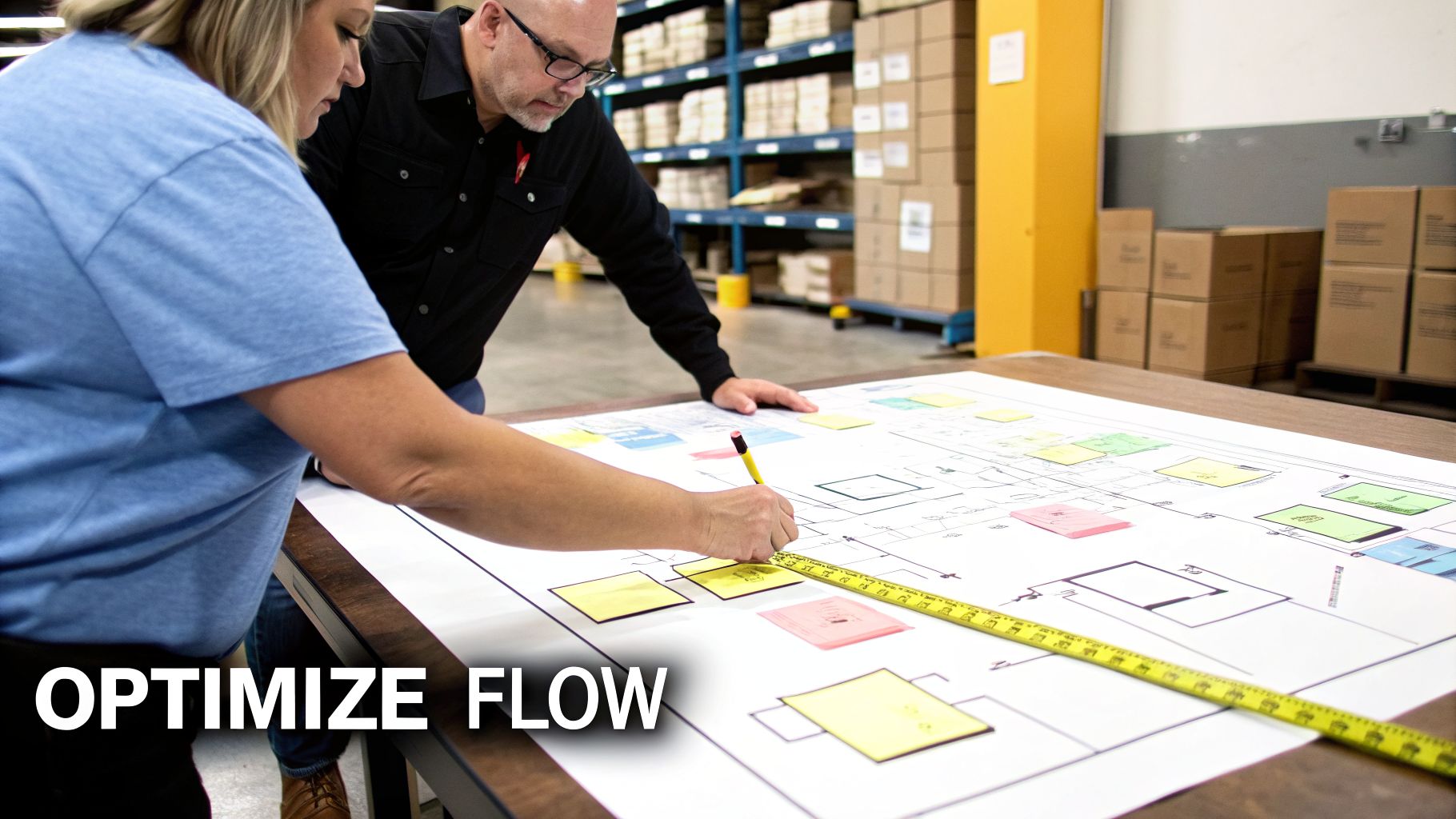
Understanding the theory of warehouse logistics is a great start, but the real gains come from putting that knowledge into practice. This is what truly sets the efficient, profitable businesses apart from the rest. Making your warehouse hum isn't about one massive, disruptive overhaul. It’s about a series of smart, focused improvements that tackle your specific bottlenecks.
For any business operating in the UAE, where warehouse space is expensive and customers demand fast delivery, these strategies aren't just nice-to-haves—they're crucial for staying competitive. It's time to move beyond just fighting daily fires and start proactively fine-tuning your operation with data as your guide.
Optimising Your Warehouse Layout
Everything flows from the physical layout of your warehouse. A bad floor plan is a constant drag on your team, forcing them to walk longer routes, creating traffic jams, and slowing down every single task. Most layouts fall into two main categories: the U-shaped flow and the I-shaped (or through-flow) design.
- U-Shaped Flow: In this setup, the receiving and shipping docks are on the same side of the building. This is great for smaller facilities because it concentrates your dock staff and equipment in one area, making them easier to manage.
- I-Shaped Flow: Here, goods come in one end of the building and go out the other. This creates a straight, predictable line for inventory movement, which is perfect for high-volume operations where you absolutely cannot afford to have inbound and outbound traffic crossing paths.
There's no single "best" layout. The right choice depends on your order volume, the shape of your building, and how you operate. The goal is always the same: make the journey from receiving to storage to picking and finally to shipping as short and simple as possible.
The Power of Smart Inventory Slotting
Once your physical layout is sorted, inventory slotting is your next big chance for a massive efficiency boost. Think of slotting as giving every single product (or SKU) a designated "home" on the shelf, based on how often it’s sold. The whole point is to put your best-selling, most popular items in the easiest-to-reach spots—usually on lower shelves near the packing stations.
Consultant's Takeaway: It’s a staggering fact, but in many warehouses, travel time for pickers accounts for over 50% of labour costs. Smart slotting directly targets that waste. Just by moving your top 20% of products to prime locations, you can slash the time your team spends walking and dramatically increase how many orders they can pick per hour.
Let’s take a practical example. A contracting company in Abu Dhabi could use this principle to store high-demand items like cement bags and standard pipes on ground-floor pallets right by the loading bay. Meanwhile, specialised fittings that are only needed once a month can be stored on higher racks or in a corner. This simple change ensures daily materials are dispatched quickly, preventing expensive delays at the construction site.
To do this right, you need solid data. Managing this is nearly impossible without a proper system, which is where integrated Supply Chain Management (SCM) software becomes invaluable. An ERP system like Hinawi ERP gives you the real-time sales data you need to identify your fast-moving products, turning slotting from a guessing game into a data-backed strategy.
Chat on WhatsApp +971506228024 Quotation – Demo Request Chat with Hinawi AIFuture-Proofing Your Logistics for Middle East Growth
In a market as ambitious and fast-moving as the Middle East, simply keeping up isn’t enough. True success comes from looking ahead. When we talk about optimising your logistics in warehouse operations, it’s not just about fixing today’s problems. It’s about building a robust, flexible system that can carry your company into the future.
The economic forecast for the region makes this forward-thinking approach essential. The UAE's logistics and warehousing market, valued at USD 54.5 billion in 2024, is expected to explode to USD 95.2 billion by 2033. This incredible growth, fuelled by e-commerce and major government projects, means more complexity for everyone. If you’re already juggling multiple warehouses, these numbers should be a wake-up call for getting your inventory and costs under one unified, real-time system. You can dig deeper into these trends in the full research on the UAE logistics market size.
Building a System for Tomorrow's Challenges
Future-proofing your logistics is about choosing a system that won’t just solve current headaches but is also ready for what’s around the corner. The right platform has to be agile enough to handle:
- Evolving Compliance: Mandatory e-invoicing is on the horizon. It's a question of when, not if. Your system needs to be ready to integrate these digital mandates without a hitch.
- Regional Expansion: When your business grows from Dubai to Abu Dhabi, or you decide to enter new GCC markets like Saudi Arabia, your system must scale with you. A complete and painful overhaul shouldn't be part of the plan.
- Supply Chain Complexity: As you bring on more products, work with new suppliers, and open up different sales channels, your logistics platform must have the muscle to manage it all without buckling.
This is where having a locally developed, fully integrated ERP really shows its worth. A system like Hinawi ERP, which was built from the ground up with a real understanding of how business gets done in this region, gives you a powerful head start.
Investing in a modern ERP is no longer just an operational expense. In the Middle East, it's a strategic tool for survival and the very foundation for sustainable growth.
When you choose a platform that’s already bilingual (Arabic/English) and compliant with local rules for VAT, WPS payroll, and corporate tax, you’re saving yourself from massive headaches down the road. It means that as your business changes, your core operational and financial systems change with it, giving you a stable backbone for growth. By unifying your data and automating key processes, you’re not just making things more efficient today—you’re building a resilient business that's ready for anything.
Take the Next Step with Hinawi ERP
For companies and business owners in the UAE and GCC, optimizing warehouse logistics is no longer optional—it's a critical driver of profitability and customer satisfaction. If you are struggling with manual work, inaccurate financials, or lack of control, it's time to modernize your operations.
Hinawi ERP is a fully integrated ERP software, developed in Abu Dhabi since 1998, designed specifically for the needs of the Middle East market. Our solution supports Accounting, HR & Payroll, Real Estate Management, Fixed Assets, Manufacturing, Garage & Maintenance, School Management, CRM, and complete business automation.
By implementing Hinawi ERP, you can achieve:
- Full Compliance: Seamlessly manage VAT and upcoming e-invoicing requirements, along with UAE WPS payroll support.
- Bilingual Operation: Operate effortlessly with a fully functional Arabic and English interface.
- Total Integration: Gain real-time accounting integration across all modules, from inventory to finance.
- Unmatched Flexibility: Configure the system to your unique company policies, whether you are a factory, contracting company, real estate business, school, garage, or trading company.
Modernize your operations, reduce manual work, improve financial accuracy, and gain superior control over your management. Let our consultants show you how Hinawi ERP can transform your business.
Visit us at www.hinawierp.com or request a personalized demo to see the system in action.
Chat on WhatsApp +971506228024 Quotation – Demo Request Chat with Hinawi AIFrequently Asked Questions
When it comes to warehouse operations in the UAE, business leaders often have the same core questions. Let's tackle some of the most common ones with direct, practical answers to help you see the path forward.
What Is the Biggest Advantage of Integrating Warehouse Management with an ERP?
Hands down, the biggest win is creating a single source of truth for your entire business. Think of it this way: without integration, your warehouse and your finance department are working from two different sets of books. It’s a recipe for confusion and costly errors.
When your warehouse system is plugged directly into your ERP, every scan at the receiving dock and every package shipped out instantly updates your financial records, sales orders, and purchasing data. This kills the need for manual data entry—and all the mistakes that come with it—giving you a live, moment-by-moment view of your inventory value and profitability. For any business here in the UAE, that real-time data is gold for accurate VAT reporting and smart financial decisions.
How Can a UAE Business Manage Inventory Across Multiple Warehouses?
This is a classic challenge as businesses grow. You might have your main hub in Dubai's JAFZA and another facility in Abu Dhabi's KEZAD to serve that market. Trying to manage both with spreadsheets or separate systems is a fast track to chaos. The only way to do it right is with a centralized system.
A modern ERP platform is built for exactly this scenario. With a system like Hinawi ERP, you get a bird's-eye view of real-time stock levels at every single location. This is a game-changer, allowing you to:
- Effortlessly manage stock transfers between your warehouses.
- Set different reorder points for each facility, tailored to local demand.
- Ship customer orders from the closest or most cost-effective warehouse.
It puts an end to the frustrating situation where you're overstocked in one branch and completely sold out in another, helping you get the most out of every dirham invested in inventory.
How Does Optimized Warehouse Logistics Help with UAE Compliance?
Having a well-run warehouse isn't just about efficiency; it's absolutely fundamental for meeting local compliance standards. For VAT, it means every movement of goods is tracked, and your inventory values are spot-on, ensuring your tax filings are correct. When it comes to corporate tax, it gives you a bulletproof calculation for your Cost of Goods Sold (COGS)—a figure that directly impacts your taxable profit.
By automating these core warehouse processes, you’re essentially creating a perfect, unblinking audit trail for every transaction. This detailed record is your best defense during any potential audits by the Federal Tax Authority (FTA), offering undeniable proof of your compliance and solid financial controls.