If you have ever found yourself staring at a mountain of supplier invoices, you know the feeling. For businesses in the UAE and GCC, the real cost isn't just the paper they’re printed on. It’s the hidden drain on your business: the hours lost to manual data entry, the endless chase for approvals, and the constant, nagging risk of human error that can impact your VAT reporting and cash flow.
At its core, vendor invoice management is all about how you receive, process, and pay those invoices correctly and on time. It’s a vital piece of your entire accounts payable puzzle. A modern approach, such as using an integrated solution like Hinawi ERP, transforms this process from a manual burden into a strategic asset.
Ready to move beyond manual invoice processing? See how an integrated ERP can automate your entire accounts payable workflow.
Chat on WhatsApp +971506228024
Quotation – Demo Request
Chat with Hinawi AI
Why Modern Vendor Invoice Management Is Critical for UAE Businesses
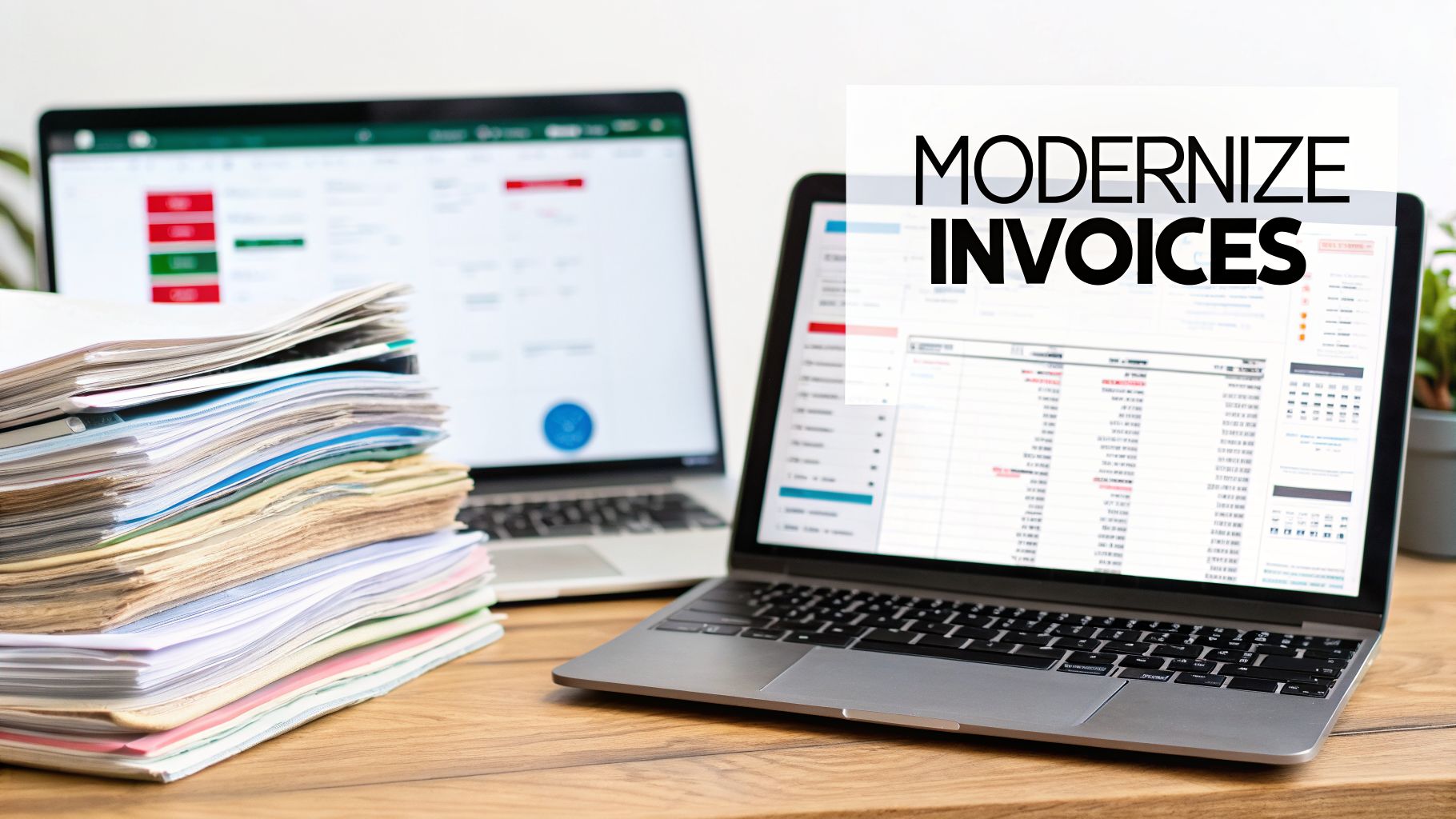
In the fast-paced markets of Dubai, Abu Dhabi, and across the GCC, clinging to old-school, manual invoice processing just doesn't work anymore. In fact, it’s a direct threat to your profitability and your ability to adapt. When your system is inefficient, the problems spread throughout the entire company, creating friction that actively holds back growth.
The Real Cost of Manual Processing
The damage goes far beyond the time your team spends typing in numbers. To really grasp why modernizing is so important, you have to look at the benefits of effective management of payables. Without a smart, automated approach, businesses run into a whole host of issues:
- Late Payment Penalties: These fees eat away at your bottom line, and worse, they can damage the good relationships you've built with your suppliers.
- Missed Early Payment Discounts: Many vendors offer discounts for paying early. Failing to take advantage of them is like leaving free money on the table.
- Increased Risk of Errors: Let's be honest, manual entry leads to mistakes. A real estate company in Dubai might mis-key a vendor invoice for a maintenance contract, leading to a duplicate payment that goes unnoticed for months. These errors directly impact cash flow.
- Lack of Financial Visibility: When invoices are buried in paper files or email chains, your finance leaders have no real-time view of liabilities. This makes accurate cash flow forecasting nearly impossible.
Compliance and Automation
On top of all that, the UAE's regulatory landscape is always evolving, with VAT laws and upcoming e-invoicing mandates adding another layer of complexity. Manual systems simply can’t provide the clear, auditable trail that the Federal Tax Authority (FTA) requires.
You can learn more about how integrated systems handle these rules in our article on VAT features in ERP software. This is exactly where an ERP system like Hinawi ERP provides a clear path forward, turning a clunky, frustrating task into a smooth, controlled, and automated process.
Have questions about implementing an automated system? Our consultants are ready to help guide you through the process.
Chat on WhatsApp +971506228024
Quotation – Demo Request
Chat with Hinawi AI
How an Automated Invoice Management System Actually Works
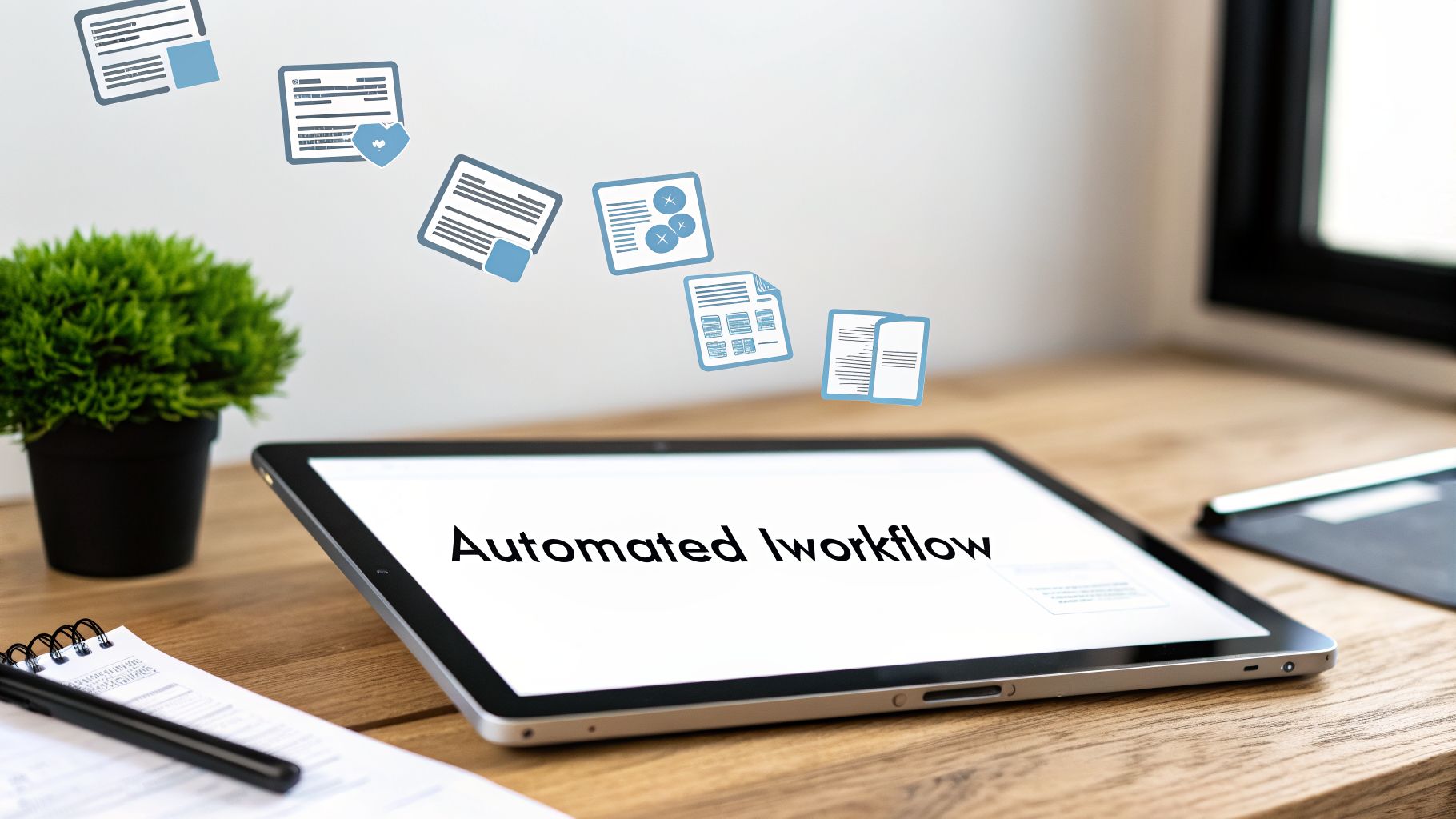
So, what does an automated system really do? Think of it less like a single piece of software and more like a well-oiled assembly line for your invoices. From the moment a supplier invoice lands in your inbox until it’s paid and recorded, each step is handled automatically, intelligently, and according to your rules.
This isn't about just scanning documents. It’s a complete, end-to-end workflow designed to bring speed, accuracy, and total control to your accounts payable function. Let's walk through the journey of a single invoice in a modern system.
The First Step: Smart Invoice Capture
It all begins the second an invoice arrives. Instead of an accounts clerk manually keying in details from a PDF, the system takes over. Using Optical Character Recognition (OCR) technology, it intelligently reads the document and extracts the critical information.
- Who it’s from: The vendor name is identified.
- What it’s for: The unique invoice number is captured.
- When it’s due: Both the invoice date and due date are noted.
- The specifics: Crucially, it pulls out line-item details like quantities, descriptions, unit prices, and totals.
Right away, you've eliminated the biggest source of human error—manual data entry—and given your team back valuable hours.
The Core Check: Automated Three-Way Matching
With the data captured, the system performs the most important check in accounts payable: the three-way match. This is where it automatically cross-references three essential documents to make sure everything lines up perfectly.
- The Purchase Order (PO): What you originally agreed to buy.
- The Goods Receipt Note (GRN): Proof of what you actually received.
- The Vendor Invoice: What your supplier is asking you to pay for.
If the items, quantities, and prices match across all three, the invoice is instantly validated. A properly configured ERP system will immediately flag any mismatch—like a price difference or a quantity discrepancy—and hold the invoice for a human to review. This simple, automated step prevents you from ever overpaying or paying for goods you never got.
The Gatekeepers: Smart Approval Workflows
Once an invoice is validated, it needs the right sign-off. Gone are the days of chasing managers for signatures or losing invoices in a sea of emails. The system automatically routes the invoice to the correct person based on rules you’ve already set.
For example, a contracting company in Abu Dhabi could have a rule where project-related invoices under AED 10,000 go directly to the site manager for approval. But any invoice over AED 50,000 must be approved first by the Project Director and then by the CFO.
You define these workflows once, and the system enforces them every single time, ensuring your internal financial controls are followed without fail.
The Final Record: Automatic Posting to the General Ledger
After the final approval is given, the job is still not quite finished. The system immediately and automatically posts the approved invoice details into the correct financial accounts. You can dive deeper into why this is so critical by reading our guide on the general ledger in accounting.
This real-time posting means your financial reports are always current, giving you an accurate, up-to-the-minute picture of company liabilities. From start to finish, this automated sequence creates a robust and reliable foundation for your company's financial operations.
Need to ensure your business is ready for the e-invoicing mandate? Let's discuss a compliance strategy that fits your operations.
Chat on WhatsApp +971506228024
Quotation – Demo Request
Chat with Hinawi AI
Getting Ready for the UAE's E-Invoicing Rules

If you're managing a business in the UAE, a major change is on the horizon for how you handle vendor invoices. The government is rolling out mandatory electronic invoicing, and it's much more than just swapping paper for PDFs. This isn't just a suggestion; it’s a new requirement that will fundamentally change financial workflows.
Think of it as a structured, government-overseen network for exchanging and reporting all invoice data. The goal is simple: create more transparency, make tax collection smoother, and cut down on fraud. For business owners and finance managers, getting ahead of this is now a top priority. Falling behind isn't really an option, as it will cause friction and could lead to penalties.
The Deadlines and What They Mean for You
The UAE is officially moving to mandatory e-invoicing, a significant shift detailed in Ministerial Decisions No. 243 and 244 of 2025. The rollout begins in July 2026 for all B2B and B2G transactions for VAT-registered businesses. By January 2027, it becomes compulsory for any company with a turnover above AED 50 million, giving larger businesses a clear 18-month window to get their systems in order.
Instead of having everyone upload invoices to a single government website, the UAE has chosen a decentralised continuous transaction controls (DCTCE) model. In practice, this means your own accounting software will need to send invoice data to an accredited service provider, which then securely passes it to the Federal Tax Authority (FTA). You can learn more about the specifics of the UAE's e-invoicing journey on hawksford.com.
The great thing about this model is that it doesn't drastically interrupt your day-to-day business. The catch? Your internal systems—your ERP or accounting software—must be ready for the job. They are the critical link in this new chain of compliance.
Preparing Your Systems for Compliance
For any business in the UAE, whether you're in trading in Dubai or manufacturing in Abu Dhabi, it's time to take a hard look at your current processes. The first step is to honestly evaluate your existing invoice management technology.
Start by asking these crucial questions:
- Can our current software produce invoices in the specific digital format required, like XML?
- Is our system capable of connecting to accredited service providers through APIs?
- How can we guarantee the security of our financial data from the moment it leaves our system to the moment it reaches the FTA?
This is where an integrated ERP system built for the region, like Hinawi ERP, makes a real difference. Having been developed in Abu Dhabi since 1998, it’s already designed to meet these exact local requirements. A system with the UAE's regulatory DNA built-in will make staying compliant feel like a natural part of your workflow.
As a business owner, your responsibility is to ensure the data sent to the FTA is accurate and on time. A compliant ERP doesn't add a new task; it automates that responsibility right within your existing vendor invoice process.
This new mandate is a clear sign that sticking with manual methods or outdated software is no longer a sustainable option. For more context on the wider tax environment, feel free to read our guide on new tax regulations in the UAE. Ultimately, e-invoicing is pushing businesses to adopt smarter, more secure financial habits that will strengthen their operations for years to come.
The Real-World ROI of Automated Invoice Processing

It’s one thing to talk about efficiency, but for any business leader in the UAE and GCC, the decision to invest always circles back to one question: what’s the actual return? When it comes to automating vendor invoice management, the answer isn't just about convenience—it's about hard numbers and measurable financial gains that can fundamentally change your company's performance.
The global data tells a compelling story. Businesses that switch to e-invoicing solutions routinely cut their invoice processing costs by 60-80%. This isn't a far-off trend; it's happening right here. The e-invoicing market in the Middle East and Africa was valued at USD 568.78 million in 2023 and is growing fast, signalling a major regional shift. Governments are seeing the benefits too, with some countries reporting a 10-15% reduction in their VAT gap after pushing for adoption. You can explore more of these compelling e-invoicing statistics in the UAE context.
A Realistic Scenario in Jebel Ali
Let's bring this to life with a typical example. Imagine a mid-sized trading company operating out of Jebel Ali Free Zone (JAFZA).
- Invoice Volume: They handle around 1,200 purchase invoices every month from a pool of 180 different suppliers.
- Manual Process: Their accounts payable team is stuck in a cycle of manual data entry, printing stacks of paper for physical sign-offs, and constantly chasing managers for approvals.
- The Hidden Cost: Between the labour, delays, and fixing inevitable errors, their total annual cost for processing accounts payable hits AED 320,000. On top of that, their average payment cycle is a sluggish 42 days.
Now, if this company brings in an automated vendor invoice management system, the picture changes completely. Features like automatic invoice capture, three-way matching, and digital approval workflows cause the cost per invoice to plummet. This move could easily slash their direct processing costs by over 60%, translating to annual savings of more than AED 200,000.
But the good news doesn't end with cost-cutting. By shrinking their payment cycle from a lengthy 42 days to under 15 days, the company can start taking advantage of early payment discounts offered by suppliers. This alone can add thousands more back to the bottom line while significantly freeing up cash flow. To really grasp the numbers and build a strong case for change, it’s worth digging into a full AP Automation ROI business case.
Beyond the Balance Sheet
The hard cost savings are impressive, but the strategic value that automation unlocks provides a lasting advantage. These aren't just "soft" benefits; they directly fortify your business for the long haul.
Automation transforms the accounts payable department from a cost centre focused on administrative tasks into a strategic partner that adds measurable value.
Here are the key strategic gains:
- Stronger Supplier Relationships: When you pay your vendors on time, every time, you build immense trust and goodwill. This reputation makes you a preferred customer, giving you real leverage when negotiating better pricing and payment terms in the future.
- Bulletproof Audit Trails: A proper automated system creates a perfect, unchangeable digital record for every single invoice. From the moment it arrives until it's paid, every action is logged and time-stamped. This is a game-changer for VAT audits by the FTA, making it effortless to pull documentation and prove compliance.
- Enhanced Financial Control: With real-time data on liabilities, senior management gets an accurate, up-to-the-minute view of the company's cash commitments. This level of visibility is crucial for sharp budgeting, reliable forecasting, and making sound strategic decisions.
In the end, the ROI of automating vendor invoices is a powerful mix of direct cost reduction, better working capital, and a more resilient, well-run operation.
Want to calculate the potential ROI for your specific business? Our consultants can help you model the savings.
Chat on WhatsApp +971506228024
Quotation – Demo Request
Chat with Hinawi AI
How to Implement a New Invoice Management System
Bringing a new invoice management system on board can feel like a huge project, but when you break it down into a clear roadmap, it’s not just manageable—it's one of the most rewarding changes you can make for your business. For any company in the UAE and the wider GCC, a successful rollout isn't just about plugging in new software; it's about fundamentally improving a critical financial process. A solid plan is your best guarantee for a smooth switch and a quick return on your investment.
So, where do you start? Not with software demos. The biggest misstep I see businesses make is rushing to pick a solution before they truly understand their own needs and what "success" even looks like.
Phase 1: Define Your Goals and Map Your Current State
Before you can fix your vendor invoice process, you need a painfully honest look at how it works right now. It's time to get out a whiteboard and map your entire accounts payable workflow, from the moment an invoice lands to the final payment.
Ask yourself and your team these questions:
- How do we receive invoices? Is it a chaotic mix of emails, paper copies, and WhatsApp messages?
- Who is stuck doing the manual data entry?
- What does our approval chain look like, and how many days does it really take?
- How do we handle a price mismatch or a missing PO number?
- Where do paid invoices go to die? (i.e., How are they archived?)
This simple exercise is incredibly revealing. It will immediately show you the bottlenecks, the duplicated effort, and the compliance risks. With this map as your guide, you can set real, measurable goals. Do you want to slash invoice processing costs by 50%? Maybe you need to cut your approval cycle from 15 days down to 3, or just finally put an end to late payment penalties. These goals will become the compass for every decision you make next.
Phase 2: Select the Right Software Partner
Once you have that clarity, you can start looking at software. It's tempting to grab a standalone invoicing tool, but that’s often a short-term fix. For lasting value, an integrated platform is the way to go. A system like Hinawi ERP, where vendor invoice management is woven directly into procurement, inventory, and your general ledger, gets rid of information silos and gives you one single, reliable source of truth.
When you're comparing your options, prioritise solutions that deliver:
- Intelligent Data Capture (OCR): To kill the soul-crushing task of manual data entry.
- Automated Three-Way Matching: To instantly check invoices against purchase orders and delivery notes. No more manual cross-referencing.
- Flexible Approval Workflows: The system should adapt to your company's rules, not the other way around.
- Real-Time General Ledger Integration: To ensure your financial reports are always accurate and current.
If you're thinking about how to handle your existing data, our guide on importing cash and credit invoices into an ERP is a great resource that can make that migration much simpler.
Phase 3: Manage Data Migration and Team Training
A successful launch comes down to two things: clean data and a confident team. Work closely with your software partner to create a plan for migrating your vendor lists, open purchase orders, and even historical invoices. Sometimes, a phased rollout is the smartest approach—maybe start with one department or a select group of suppliers to iron out any kinks in a controlled way.
At the same time, don't skimp on training. And I don't just mean showing people where to click. The real key is explaining why the process is changing and how this new system makes their jobs less about tedious admin and more about strategic financial management. This is all about change management. When your team sees the benefits for themselves, they'll be your biggest champions. You can even set up KPIs from day one, like "average invoice approval time" or "cost per invoice," to track your progress and prove the system's value from the get-go.
Take the Next Step with Hinawi ERP
If you're running a business in the UAE or anywhere in the GCC, you know that generic, off-the-shelf software often creates more problems than it solves. It simply wasn't built for the unique realities of our market. When you're ready to move beyond temporary fixes and truly upgrade your operations, you need a solution designed from the ground up for our region.
Hinawi ERP is a fully integrated ERP software developed since 1998 in Abu Dhabi. It’s a complete, unified system designed to manage the specific hurdles that businesses in our region face every single day. By unifying all core operations into one platform—including Accounting, HR & Payroll, Real Estate Management, Fixed Assets, Manufacturing, Garage & Maintenance, and School Management—Hinawi ERP provides a single source of truth for your entire business.
With Hinawi ERP, you can modernize your operations and gain significant advantages:
- VAT and e-Invoicing Compliance: The system is built to meet Federal Tax Authority (FTA) requirements, ensuring your vendor invoice process is ready for current and future regulations.
- UAE WPS Payroll Support: Run your payroll with complete confidence, knowing every transaction is fully compliant with the UAE's Wage Protection System.
- Bilingual Operation: Instantly switch the entire interface and all reports between Arabic and English, essential for managing a diverse workforce and communicating with all your suppliers.
- Flexible Company Policy Settings: Easily customize approval chains and business rules to perfectly mirror your company's internal controls.
- Real-Time Accounting Integration: A supplier invoice paid by the accounts team is instantly reflected in the general ledger, ensuring your financial data is always accurate and up-to-date across all modules.
Hinawi ERP is the ideal solution for factories, contracting companies, real estate businesses, schools, garages, trading companies, and manufacturers throughout the GCC. We invite you to speak with our Abu Dhabi-based consultants to see how you can reduce manual work, improve financial accuracy, and gain better control over your management.
Visit www.hinawierp.com or request a personalized demo to see the system in action.
Chat on WhatsApp +971506228024
Quotation – Demo Request
Chat with Hinawi AI