
Think about the daily grind in a construction or contracting business in the UAE. You're juggling project timelines, tracking costs that seem to multiply overnight, managing materials and equipment across multiple sites, and handling payroll for a large workforce. Trying to manage all of that with a patchwork of spreadsheets, separate accounting software, and endless email chains is not just inefficient—it's a massive financial risk.
An ERP construction software is built to solve this exact problem. Forget the jargon; think of it as the single, central brain for your entire operation. It connects every piece of your business—from the bidding process and project management on-site to finance, HR, and inventory—into one unified system. For companies in Abu Dhabi, Dubai, and across the GCC, a robust system like Hinawi ERP provides the operational control needed to protect margins and drive growth.
Want to see how an integrated ERP can streamline your contracting business? Let's talk.
Chat on WhatsApp +971506228024 Quotation – Demo Request Chat with Hinawi AIWhy Disconnected Operations Are Costing You Money
In the high-stakes construction world of the UAE and the broader GCC, profit margins are constantly under pressure. You’re dealing with tight deadlines, complex supply chains, and strict local regulations. When your teams operate in silos with scattered data, it’s like trying to build a high-rise on a foundation of sand. It's only a matter of time before things start to crumble.
Disconnected operations aren't just an inconvenience; they are a direct drain on your bottom line.
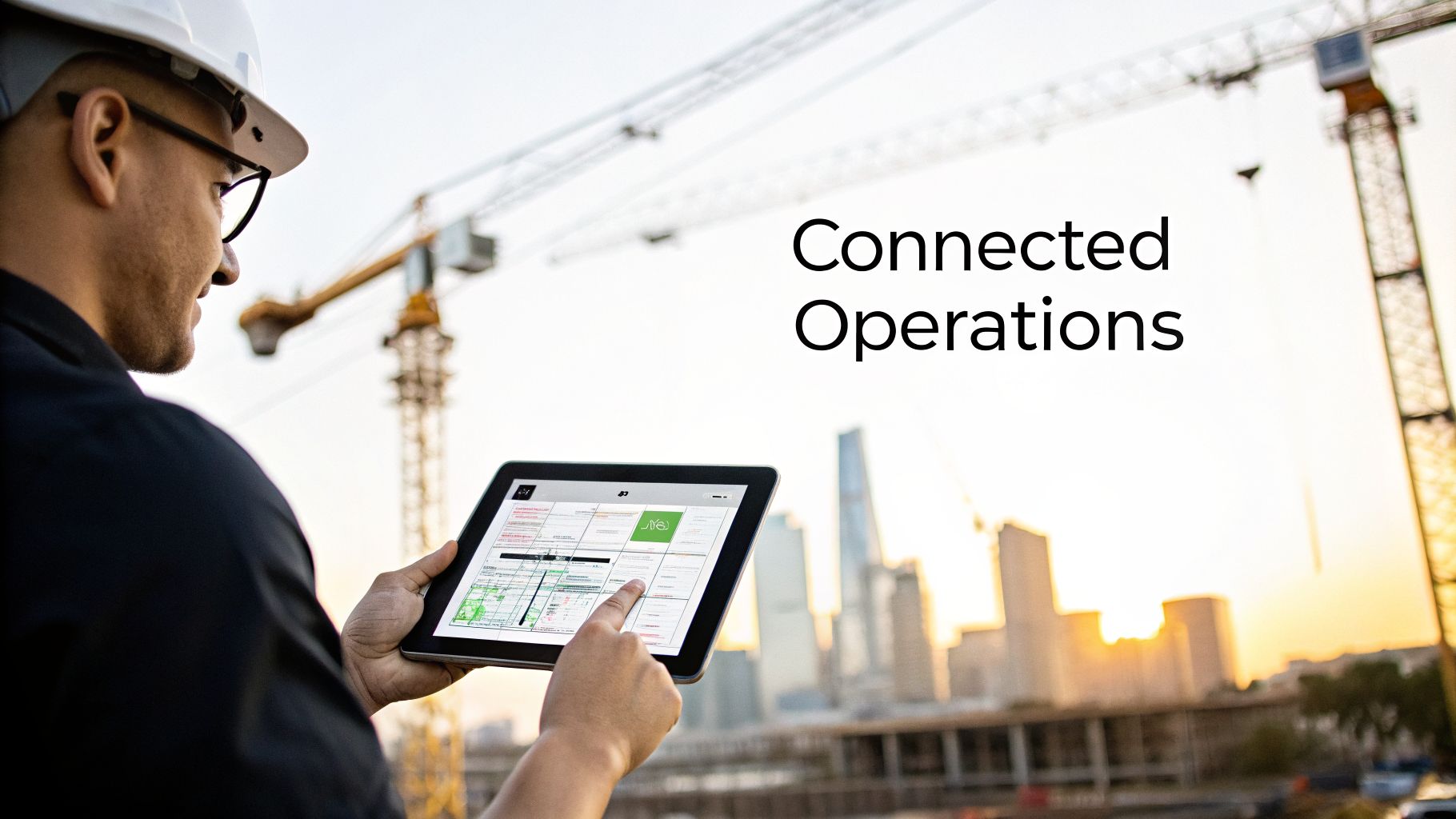
When your project manager on-site can't see real-time inventory levels from the warehouse, or your finance department is manually matching subcontractor invoices against progress reports that are already a week old, you've lost control. This lack of a single source of truth creates several critical challenges that chip away at your profitability:
- Inaccurate Bidding: Without solid historical data on actual project costs, your bids are based more on guesswork than on facts. This leads to under-priced jobs that barely break even or, worse, lose money.
- Poor Cost Control: Relying on manual tracking means you can't see how your budget is performing against actual expenses in real-time. By the time you spot a cost overrun, the damage is already done.
- Compliance Risks: Managing payroll according to the UAE's Wage Protection System (WPS) or ensuring full VAT compliance becomes a stressful, high-risk manual task. One mistake can lead to significant penalties.
- Inefficient Resource Allocation: Expensive equipment sits idle on one site while another team waits for it. Labour is misallocated because there’s no central view to coordinate needs across all your projects.
This is where a dedicated ERP construction software comes in, acting as the central nervous system for your entire business. It transforms your operations from a collection of fragmented, disjointed processes into a single, well-oiled machine. For a deeper dive into this concept, this homebuilder's guide to Construction Enterprise Resource Planning offers some great insights. Ultimately, adopting an ERP is more than just a technology upgrade; it’s a fundamental business strategy for controlling costs and driving real growth.
Ready to see how an integrated system can solve these daily frustrations? Let our experts show you how to connect your operations.
Chat on WhatsApp +971506228024 Quotation – Demo Request Chat with Hinawi AISolving Daily Headaches with an ERP
To really see the impact, let's contrast the common pain points for contractors in places like Abu Dhabi or Riyadh with the direct solutions a system like Hinawi ERP provides. The real power isn't just in the individual features, but in how they all talk to each other, which you can explore further by understanding the relation between ERP modules.
The table below clearly shows how an ERP turns operational chaos into streamlined control.
Common Construction Challenges vs ERP Solutions
| Operational Challenge | Traditional Method (High Risk) | ERP Construction Software Solution |
|---|---|---|
| Inaccurate Project Bidding | Relying on old spreadsheets and "gut feelings," often leading to bids that are too low to be profitable. | Uses historical data on labour, materials, and subcontractor costs to generate precise, data-driven estimates. |
| Cost Overruns | Manually tracking expenses on spreadsheets, discovering budget breaches only after it's too late to correct them. | Provides real-time budget vs. actuals tracking, sending automated alerts when costs approach their limits. |
| Material & Inventory Waste | Ordering excess materials "just in case" or suffering project delays due to stockouts across different sites. | Centralizes inventory management, showing real-time stock levels and enabling just-in-time procurement for specific jobs. |
| Payroll & Compliance Errors | Manually calculating wages, overtime, and deductions, risking errors and penalties under local laws like WPS. | Automates payroll processing, ensures compliance with local labour laws, and integrates directly with accounting. |
| Fragmented Communication | Project managers, finance, and procurement teams using separate systems, leading to miscommunication and delays. | Creates a single source of truth where all departments access the same real-time information and project data. |
By connecting these critical functions, an ERP system gives you the visibility and control needed to not just survive but thrive in the competitive construction market. It moves you from reacting to problems to proactively managing your projects for maximum profitability.
The Core Modules That Power Your Projects
A proper ERP construction software isn't just one piece of software. It’s a complete system where different, specialised tools work together seamlessly. As a business owner, you can think of these as the individual departments of your company—estimating, project management, accounting, HR—all finally speaking the same language. Getting them to sync up is where you unlock serious efficiency and profitability.
It’s a bit like the crew on a well-run job site. The site manager, the foreman, and the procurement officer all have different jobs, but they're constantly communicating to keep the project moving. When they're in sync, work gets done on time and on budget. An ERP system does the same thing for your business data.
This integrated approach is quickly becoming the standard. The ERP software market across the Middle East, including key construction hubs in the UAE and Saudi Arabia, was valued at USD 1,421.73 million in 2025 and is on track to hit USD 3,199.51 million by 2030. Companies that make the switch aren't just following a trend; they're seeing real results, reporting 30-50% faster operations and a 40% drop in manual errors.
Project Management and Costing
This is the command centre of any ERP construction software. It’s where you manage a project from the initial bid all the way to handover, keeping a close eye on every single detail. For any contracting firm, this means gaining total control over both the financial and operational sides of a job.
Here’s what you can finally get a handle on:
- Bill of Quantities (BOQ) Tracking: Forget juggling spreadsheets. You can manage your BOQ digitally, tracking progress against every line item while automatically linking it to your invoicing and procurement processes.
- Budget vs. Actuals Analysis: This is a game-changer. Get a live, real-time look at your project's financial health. You’ll know instantly if you're going over budget on labour, materials, or subcontractor costs, not weeks after the fact.
- Subcontractor Management: Keep all subcontractor agreements, payment schedules, and compliance documents in one organised place. This helps eliminate the back-and-forth and payment delays that can sour relationships.
Think about a project manager in Dubai overseeing a big commercial build. She gets an alert from the ERP dashboard that material costs for one phase are already trending 15% over budget. Before this would have been buried in a report she might see next month. Now, she can immediately find out why, talk to a different supplier, and fix the problem before it eats into the project’s profit margin. That’s the kind of control a real costing module gives you.
Integrated Accounting and Financials
While the project management module tracks the physical work, the integrated accounting module follows the money. It puts your financial workflows on autopilot, making sure every dirham and riyal is recorded accurately and in line with regional regulations.
For a business owner in Abu Dhabi or Riyadh, this is a huge relief. There's no more manually copying numbers from a project report into your accounting software. When an engineer on-site approves a subcontractor's progress payment in the project module, the system automatically creates the matching entry in accounts payable.
This direct link is what makes these powerful features possible:
- Automated Revenue Recognition: The system can automatically calculate and recognise your revenue based on project milestones or the percentage of completion. This gives you a true, up-to-date picture of your company's performance.
- VAT and E-Invoicing Compliance: A good regional ERP comes ready to handle UAE VAT and the latest e-invoicing rules in Saudi Arabia and Jordan. Every invoice is compliant from the start, which dramatically cuts down on audit headaches.
- Real-time Profitability Reporting: Want to know if a project is actually making money? You can generate a profit and loss statement for any specific job, at any time, without waiting for the month-end close.
If you’re tired of financial data that’s always out of date, our guide on software for contracting companies shows exactly how Hinawi ERP connects these critical functions.
Ready to see how these core modules can unify your project management and finances? Get a firsthand look with a personalised demo.
Chat on WhatsApp +971506228024 Quotation – Demo Request Chat with Hinawi AIHR, Payroll, and Inventory Management
Every construction business relies on two things: its people and its materials. An ERP system integrates these essential resources directly with your project and financial data, giving you a complete picture.
The HR & Payroll module handles everything from collecting timesheets on-site to processing salaries, and it comes with built-in compliance for local requirements like the UAE's Wage Protection System (WPS). When labour costs are captured on a tablet at the job site, that data flows straight into both the project's budget and the payroll run, killing double-entry for good.
At the same time, the Inventory & Procurement module gives you a central command post for all your materials. You can see stock levels across multiple sites, set up automatic purchase orders when you're running low, and assign material costs to specific jobs as they're used. This prevents those expensive delays caused by missing materials and stops you from wasting money on over-ordering. By pulling all these pieces together, an ERP like Hinawi ERP turns scattered information into clear, actionable intelligence for your entire operation.
Mastering Financial Control and GCC Compliance
If you're running a construction or contracting business in the UAE, Saudi Arabia, or anywhere in the GCC, you know that managing your finances is more than just good practice—it's about survival. The market is tough, and navigating the region's complex financial rules is a full-time job. This is precisely where a dedicated ERP construction software stops being a "nice-to-have" and becomes one of your most critical tools. It goes far beyond what standard accounting software can do, giving you real command over your financial operations.

Think about it: a generic, off-the-shelf system just isn't built for the way we do business here. A purpose-built ERP, on the other hand, already knows the local landscape. It handles things like VAT-compliant invoicing, multi-currency transactions for projects across borders, and even the automatic tracking of retention payments, which is a standard part of almost every contract in our industry.
Taming the UAE Wage Protection System (WPS)
For any contractor operating in the UAE, the Wage Protection System (WPS) is a major compliance headache. Trying to manage payroll with spreadsheets is not only a huge time sink but also a minefield of potential errors. One small mistake can lead to hefty government fines and a serious disruption to your operations.
This is a challenge an integrated ERP like Hinawi is designed to solve. The system automates the entire payroll workflow. It pulls data from timesheets, calculates wages and overtime, and then generates the SIF (Salary Information File) in the exact format the UAE Ministry of Human Resources and Emiratisation demands.
We saw this firsthand with a contracting firm in Abu Dhabi. They used to lose days every month manually preparing their payroll and SIF file, constantly stressed about making a mistake. After switching to an integrated ERP, the whole thing became a matter of a few clicks. The system instantly pulls approved hours, handles all deductions, and produces a perfect SIF file. WPS compliance went from being a monthly nightmare to a smooth, reliable process.
Staying Ahead of E-Invoicing and Tax Audits
Tax authorities are getting stricter across the entire region. With Saudi Arabia's ZATCA (Fatoorah) system and similar e-invoicing initiatives on the horizon elsewhere, having solid digital records is no longer optional. An ERP that was built with these rules in mind doesn't just help you catch up; it keeps you ahead of the curve.
For example, VAT-compliant invoicing is baked right into the system. Every single transaction is taxed and recorded correctly, which builds a crystal-clear audit trail. If you're curious about the details, you can read more about the new tax laws in the UAE and what they mean for your business.
A Dubai-based construction company we work with experienced the benefit of this directly. They were hit with a routine VAT audit. In the past, that would have meant weeks of digging through paper files and trying to make sense of old spreadsheets. With their ERP, the finance team simply generated a few detailed reports for the audit period. Every transaction, invoice, and VAT calculation was right there. The audit was over in a fraction of the time, without the panic.
Think about your own business for a second. Are you truly ready for a tax audit? Could you pull up compliant payroll records at a moment's notice?
Chat on WhatsApp +971506228024 Quotation – Demo Request Chat with Hinawi AIBy having these regional financial rules built into its very core, a good ERP effectively becomes your digital compliance officer. It works in the background to protect you from expensive mistakes and ensures your financial data is always accurate, easy to access, and ready for any audit. This is the solid financial footing you need to grow confidently in the GCC's demanding construction market.
Why Taking Your Construction ERP to the Cloud is a Game-Changer
Let's be honest, the term "the cloud" can sound a bit vague. But for a construction company, what it really means is incredibly practical: it’s about breaking down the walls between your main office, your project sites, and your teams on the ground. A cloud-based ERP construction software isn’t just a tech upgrade; it’s a fundamental shift in how you run your entire operation, giving you more control and a serious advantage in the competitive GCC market.

Think about it. No more being chained to a physical server in the back office. With a cloud ERP, your crucial business data lives in one secure, central hub online. This simple change is what finally connects all the moving parts of your business.
Real-Time Information, Right from the Job Site
This is where the magic really happens. The single biggest benefit of the cloud is instant access to live data.
Picture your project manager on a massive development in Riyadh. Instead of calling the office for an update, they can pull out a tablet and see the latest budget vs. actuals report, confirm a material delivery, or approve a subcontractor’s invoice—all while standing on site.
That critical information is no longer stuck on an accountant’s desktop back in the main office. This free flow of data allows for quicker, smarter decisions to be made right where the work is happening. The impact is huge. Across the Middle East & Africa, the cloud ERP market is exploding, projected to jump from US$ 2,102.57 million in 2022 to US$ 7,507.12 million by 2030. Companies that make the switch find their operations become 30–50% faster, with errors dropping by as much as 40%.
Scale Smartly and Secure Your Data
Old-school, on-premise ERPs meant a huge upfront cost for servers and hardware. As you won more projects, you had to keep buying more expensive equipment. A cloud-based ERP construction software completely changes the financial picture.
With a cloud ERP, you typically pay a subscription. This lets you scale up during busy periods and down during quieter times. You only pay for what you actually need, which turns a massive capital investment into a predictable, manageable operating expense. For any growing contractor, that kind of financial flexibility is invaluable.
And for anyone worried about security, today's top cloud providers offer protection that is far more robust than what most individual companies could manage on their own. They use advanced encryption and multi-factor authentication and run their services from highly secure data centres. This means your sensitive financial and project data is well-defended against modern threats. You can learn more about how Hinawi Online ERP provides secure access to your business anywhere.
When you can connect all your teams, grow your business without massive hardware costs, and know your data is secure, a cloud-based ERP stops being a "nice-to-have" and becomes a core part of a modern, successful construction firm.
Choosing the Right ERP Partner for Your Business
Think of choosing your ERP construction software as less of a one-off purchase and more like bringing on a new, long-term business partner. This isn't just about buying a tool; it's about investing in a relationship that will anchor your company's growth and day-to-day stability for years to come. Getting this choice right is absolutely fundamental to seeing the results you want.
The numbers tell a story of their own. The UAE's ERP software market was valued at USD 2.14 billion in 2023 and is on track to hit USD 3.45 billion by 2028. This boom is largely driven by small and medium-sized businesses looking for solutions that actually fit the local landscape. With so much at stake, picking the right partner is more critical than ever. You can see the full picture by exploring the complete research on the UAE ERP market.
The Local Expertise Advantage
Here’s where a lot of companies stumble: they get drawn in by a big global name, only to find the software doesn't speak their language—and I don't just mean Arabic. A generic, one-size-fits-all system often completely misses the subtle but crucial realities of doing business in the GCC.
A partner with deep roots in the region already understands the complexities you deal with every day. They know the ins and outs of subcontractor payments, retention handling, the UAE's Wage Protection System (WPS), and ZATCA e-invoicing in Saudi Arabia. This knowledge isn't a feature they add on; it’s baked into the very core of their software.
This is why a vendor born and raised in the UAE, like Hinawi ERP which has been serving the region since 1998, gives you a serious head start. Their system was built from the ground up with local rules and business culture in mind. That means a much smoother setup and far fewer headaches with expensive custom fixes down the line.
Are you ready to ask the tough questions that will show you whether a potential partner truly gets your local business needs?
Chat on WhatsApp +971506228024 Quotation – Demo Request Chat with Hinawi AIKey Questions for Your Potential ERP Partner
To make sure you're not just buying a product but gaining a real partner, you need to dig deeper than the sales pitch. Bring this checklist to your evaluation meetings to cut through the noise and get the answers you actually need.
H3: Implementation and Data Migration
- What’s your typical implementation process and timeline for a construction firm our size?
- How, exactly, will you get our historical data out of spreadsheets and our old systems into the new one?
- Can you connect us with a few other construction companies here in the UAE or GCC that we can talk to about their experience with you?
H3: Training and User Adoption
- Show us what your user training programme involves. Is it done on-site with our team?
- We have a diverse team. Are your training materials available in both Arabic and English?
- Let's be realistic—people resist change. How do you help us manage that and make sure our team actually uses the new system?
H3: Post-Launch Support and Customisation
- After we go live, what does support look like? Do we get a dedicated contact, or are we just calling a helpdesk? What are your support hours?
- How flexible is the system? Can we easily adjust our internal policies for things like employee leave, payroll runs, and project workflows?
- What's the plan for future updates, especially when new compliance rules are introduced in the region?
Ultimately, this process is about finding a vendor who acts more like a consultant. Look for someone who takes the time to genuinely understand your operational pains and can clearly demonstrate how their solution will solve them. A true partner is invested in your success long after the launch party is over.
Answering Your Top Questions About Construction ERPs
Making the move to an ERP is a big decision for any construction firm. If you're a leader in the industry, you probably have a few practical questions on your mind. Here are some straightforward answers to the most common concerns we hear from companies in the UAE and wider GCC region.
How Long Does an ERP Implementation Really Take?
There’s no single answer, as it depends on your company’s size and how complex your operations are. For a typical mid-sized contracting firm in the UAE, you can expect a phased implementation to take anywhere from 3 to 9 months.
We don't try to boil the ocean all at once. The smart approach is to start with the essentials—like finance and project costing—to build a strong foundation. From there, we roll out other modules. Your timeline can be cut down significantly if you work with a vendor who already knows the local landscape. For instance, a system like Hinawi ERP comes with pre-built settings for regional requirements like WPS payroll and VAT, which gets you up and running much faster.
Is This Kind of Software Affordable for a Small or Medium-Sized Contractor?
Absolutely. The old days of massive upfront costs for servers and licenses are fading fast. Modern ERP construction software has changed the game, with most systems now offered as a cloud-based subscription (SaaS).
This means you’re looking at a predictable monthly operating expense instead of a huge capital investment. The real question for any business owner is about the return. You'll see it quickly in a few key areas:
- Fewer costly mistakes in your accounting and payroll.
- Tighter budget control that prevents project cost overruns.
- Better cash flow from getting accurate invoices out the door faster.
- Avoiding hefty fines for non-compliance with local laws.
A scalable system lets you start with just the modules you need today and add more as you grow. It’s a financially sound move for SMEs, not just the big players.
My Team Lives on Spreadsheets. How Hard Is the Switch?
This is probably the most common—and valid—concern we hear. Shifting your team away from the spreadsheets they know inside and out can feel daunting, but success hinges on two things: choosing an intuitive system and committing to proper training.
Think of it this way: you can't run a multi-million dirham project from a dozen disconnected Excel files without something falling through the cracks. A modern ERP gives everyone a single source of truth with dashboards tailored to their specific role.
A good partner doesn’t just hand you the keys to the software; they show your team how it makes their individual jobs easier, not more complicated. It's also crucial to meet your team where they are. With a fully bilingual interface like Hinawi ERP offers, training and day-to-day work can happen in English or Arabic. This ensures everyone, from the site foreman to the head office accountant, feels confident and adopts the new system quickly.
Take the Next Step with Hinawi ERP
For business owners and decision-makers in the UAE and GCC, choosing an ERP is a critical step toward operational excellence. If you run a contracting company, real estate business, factory, or school, you need more than generic software; you need a solution built for our market.
Hinawi ERP is a fully integrated ERP software developed in Abu Dhabi since 1998. It is designed specifically for the operational challenges and regulatory environment of the Middle East. Our platform unifies your core business functions, including Accounting, HR & Payroll, Real Estate Management, Manufacturing, and complete business automation into a single, reliable system.
By choosing Hinawi ERP, you can modernize your operations and gain significant advantages:
- Guaranteed Compliance: Stay ahead with built-in support for local VAT laws, e-Invoicing requirements, and the UAE WPS payroll system.
- Bilingual Operations: Empower your entire team with a seamless, user-friendly interface in both Arabic and English.
- Unmatched Flexibility: Configure company policies for payroll, leave, and more to match your unique business processes.
- Real-Time Financial Control: Benefit from real-time accounting integration across all modules, giving you an accurate, up-to-the-minute view of your financial health.
- Industry-Specific Solutions: Whether you manage a factory, contracting firm, real estate portfolio, or trading company, Hinawi ERP has modules tailored to your needs.
It's time to reduce manual work, improve financial accuracy, and gain the control needed to grow your business confidently. We invite you to speak with our consultants to understand how Hinawi ERP can be the foundation for your success. Visit www.hinawierp.com to learn more.
Ready to see how a dedicated ERP can transform your business? Request a personalized demo today.
Chat on WhatsApp +971506228024 Quotation – Demo Request Chat with Hinawi AI