
When an employee's time with your company comes to an end, handling their final payment correctly is crucial for compliance and maintaining your reputation as a fair employer. In the UAE, the end-of-service gratuity is not just a courtesy; it's a legal requirement mandated by UAE Labour Law. Getting this calculation right demonstrates respect for your team and ensures your business remains compliant, avoiding unnecessary financial penalties.
The calculation itself hinges on two key factors: the employee's last drawn basic salary and their total years of continuous service. The core formula is 21 days' basic pay for each of the first five years of service and 30 days' basic pay for each year thereafter. A common error for many businesses is the inclusion of allowances like housing or transport—the calculation must be based strictly on the basic salary. Accurately managing this process is a foundational task for any HR or finance department. An ERP system like Hinawi ERP, developed in Abu Dhabi since 1998, is designed to automate these specific regional payroll requirements, eliminating manual errors from the outset.
Automating these complex, region-specific calculations is no longer a luxury but a strategic necessity for businesses in the UAE and GCC. A system that integrates HR & Payroll with accounting ensures that your gratuity liabilities are always accurate, compliant, and reflected correctly in your financial statements.
Chat on WhatsApp +971506228024 Quotation – Demo Request Chat with Hinawi AIUnderstanding Your UAE End of Service Gratuity

For any decision-maker in the United Arab Emirates—whether you are a business owner, an HR manager, or an accountant—mastering the gratuity calculation is a fundamental responsibility. This is not merely an administrative task for compliance; it's about upholding employee trust and ensuring your financial planning is sound. Think of it as a cornerstone of employee rights, governed by precise legal standards.
The Legal Framework and Core Principles
The entire process is grounded in the UAE Labour Law, specifically Federal Decree-Law No. 33 of 2021. This law is unequivocal: any private sector employee who has completed at least one full year of continuous service is entitled to a gratuity payment upon the termination of their contract.
The calculation formula is precise. An employee is entitled to:
- 21 days of their current basic salary for each of their first five years of service.
- 30 days of their current basic salary for each year of service after the fifth year.
It is also critical to remember that the total gratuity payment cannot exceed the employee's two-year total salary.
To provide a clearer picture, here’s a quick summary of how the entitlement accrues over time.
UAE Gratuity Calculation at a Glance
| Length of Continuous Service | Gratuity Entitlement Per Year of Service | Key Eligibility Requirement |
|---|---|---|
| 1 to 5 years | 21 days' basic salary | Must complete at least one full year of service. |
| More than 5 years | 30 days' basic salary | The higher rate applies to years after the fifth one. |
This table outlines the basic structure, but real-world scenarios often involve partial years, which must be calculated on a pro-rata basis.
Consultant's Insight: A common mistake we see in Abu Dhabi and Dubai-based companies is the accidental inclusion of allowances in the gratuity calculation. This not only inflates the payment but also creates inconsistent precedents that can be difficult to manage. A well-configured payroll system prevents this by design.
Why Accuracy Matters for Your Business
Gratuity is more than a final paycheck; it represents a significant financial liability that must be accurately accrued in your company's books. Whether you are running a contracting company in the GCC or a large manufacturing plant, errors can have serious consequences.
Inaccurate calculations can lead to:
- Financial Penalties: Non-compliance with labour laws can attract fines and lead to costly legal disputes.
- Damaged Employee Morale: Nothing erodes trust faster than inaccurate or delayed final payments, tarnishing your company's reputation as an employer.
- Inaccurate Financial Reporting: If gratuity accruals are incorrect, your financial statements will not reflect the true health of your business, which can affect everything from investor confidence to loan applications.
Managing these calculations with manual spreadsheets is a high-risk practice, especially as your team grows. The process is prone to human error, particularly with pro-rata calculations for partial years or managing different tenures.
This is why modern, integrated payroll software is no longer a luxury but a necessity. A system like Hinawi ERP, which has been serving the UAE market since 1998, is specifically designed to handle these regional rules. It automates the entire calculation, from isolating the basic salary to applying the correct 21/30-day rule and enforcing the two-year cap. If you want to learn more about how this fits into the bigger picture, our guide on what is payroll is a great place to start. This level of automation removes the manual guesswork that exposes businesses to financial and legal risk.
The Building Blocks of Your Gratuity Calculation

If you're asking how to calculate end of service in UAE, you must understand that the entire calculation rests on two key figures: the employee's basic salary and their total length of continuous service. Defining these two components accurately isn't just good practice—it's essential for legal compliance.
A common pitfall, especially for businesses still relying on manual spreadsheets, is misinterpreting what 'basic salary' means in this context. The law is explicit: gratuity is only based on the last basic salary stated in the employment contract.
This means you must exclude all other elements of their compensation package.
- Housing Allowance: Not included.
- Transport Allowance: Not included.
- Utilities Allowance: Not included.
- Commissions & Bonuses: Not included.
For businesses where pay structures can be complex, such as in contracting or real estate, this distinction is critical. We have seen companies in the GCC mistakenly include allowances, which not only inflates the payment but also sets a costly, incorrect precedent for future separations.
Modernizing your HR and payroll processes is essential for accuracy. An integrated ERP system helps you avoid common pitfalls and ensures compliance with UAE labor laws, safeguarding your business from financial risks.
Chat on WhatsApp +971506228024 Quotation – Demo Request Chat with Hinawi AIDetermining the Length of Service
Once you have isolated the basic salary, the next piece of the puzzle is the employee's continuous service period. This runs from their official start date up to their last day of work. However, employment isn't always a clean, straight line, and you must account for certain interruptions.
The main factor here is unpaid leave. Any days an employee has taken as unpaid leave must be subtracted from their total service period. For example, if an individual worked for five years but took 30 days of unpaid leave during that time, their service period for gratuity purposes is five years minus those 30 days. This is an essential adjustment for an accurate calculation. You can see how this ties into broader HR functions in our guide on leave calculations in HRMS.
When an employee leaves mid-year, you will need to calculate their final year on a pro-rata basis. If they served for 4 years and 6 months, you calculate the gratuity for those final 6 months proportionally. This is another area where manual calculations can easily go wrong.
Consultant's Insight: I worked with a manufacturing firm in Abu Dhabi that had a high-turnover workforce. Trying to manually track unpaid leave and pro-rata service was an operational nightmare for them. Implementing an integrated system like Hinawi ERP, which links leave management directly to payroll, automated the entire process and eliminated those data integrity issues.
The Legal Payment Timeline and Deductions
It’s not just about calculating the right amount; when you pay it matters, too. The UAE Labour Law is strict on this, requiring the final gratuity payment to be settled within 14 days of the employee's contract termination.
Employers also have the right to deduct any outstanding financial debts owed by the employee directly from their final gratuity. This is especially relevant for businesses managing a Bill of Quantities (BOQ) or those with multi-warehouse operations where staff might have financial accountabilities.
By mastering these core components—basic salary and length of service—and respecting the legal timelines, HR and finance managers can handle every end-of-service settlement with confidence, ensuring it's compliant, accurate, and fair to all parties.
Calculating Gratuity with Real-World Scenarios

Let's put the rules into practice. Understanding the law is one thing, but accurately converting it into dirhams and fils is where challenges can arise for HR and finance teams. To give you a clear picture of how to calculate end of service in UAE, we will walk through a few common examples that businesses encounter.
For consistency, all our scenarios will use a basic salary of AED 10,000 per month. Remember, we only use the basic salary for this—allowances do not count. The first step is to determine the daily wage: AED 10,000 / 30 days = AED 333.33 per day.
Scenario 1: Service Period of 4 Years
Let's start with a straightforward case. An employee has been with the company for exactly four years. Since this is less than five years, the entire calculation uses the first tier of the gratuity formula.
- The Rule: 21 days of basic pay for each year of service.
- The Math: 4 years x 21 days = 84 days of total entitlement.
- Total Gratuity Payable: 84 days x AED 333.33/day = AED 28,000.
Under the current labour law, the gratuity amount is the same whether the employee resigned or was terminated, which simplifies the process considerably.
Scenario 2: Service Period of 7.5 Years
This scenario is more complex as the employee’s tenure crosses both gratuity tiers and includes a fraction of a year—a common source of manual errors.
First, let's handle the initial five years of service.
- First 5 Years: The calculation is standard.
- Calculation: 5 years x 21 days/year = 105 days.
- Gratuity (Part 1): 105 days x AED 333.33/day = AED 35,000.
Next, we calculate the gratuity for the remaining time, where the higher rate applies.
- Remaining 2.5 Years:
- Calculation: 2.5 years x 30 days/year = 75 days.
- Gratuity (Part 2): 75 days x AED 333.33/day = AED 25,000.
Finally, add the two parts together.
- Total Gratuity Payable: AED 35,000 + AED 25,000 = AED 60,000.
It's precisely these split-rate and pro-rata calculations that make spreadsheets a risky choice. A tiny mistake in a formula can easily lead to a compliance issue or a dispute with a departing employee.
Accurate, automated calculations are crucial for compliance and financial stability. An ERP system removes the risk of manual errors, ensuring every gratuity payment is correct and legally sound.
Chat on WhatsApp +971506228024 Quotation – Demo Request Chat with Hinawi AIScenario 3: Service Period of 12 Years (and the Gratuity Cap)
Our last example involves a long-serving employee, which brings the maximum gratuity cap into play. This is a critical final check that is often overlooked. The law states that the final gratuity payment cannot exceed two years of an employee's total salary.
Let's run the numbers first.
First 5 Years:
- Calculation: 5 years x 21 days/year = 105 days.
- Gratuity (Part 1): 105 days x AED 333.33/day = AED 35,000.
Remaining 7 Years:
- Calculation: 7 years x 30 days/year = 210 days.
- Gratuity (Part 2): 210 days x AED 333.33/day = AED 70,000.
Calculated Total Gratuity: AED 35,000 + AED 70,000 = AED 105,000.
Now for the crucial step: checking against the cap. Let's assume this employee's total monthly salary (basic + allowances) is AED 15,000.
- Maximum Gratuity Cap: Two years' total salary = AED 15,000 x 24 months = AED 360,000.
- Final Check: Our calculated gratuity of AED 105,000 is well under the AED 360,000 limit. Therefore, the employee receives the full calculated amount.
Consultant's Note: I have consulted for many companies in sectors like manufacturing and real estate with a mix of long-term veterans and newer staff. Managing these calculations manually is not just slow—it’s a major financial risk. One mistake in applying the cap or a pro-rata rule can lead to significant overpayments or underpayments.
For a business with dozens, or even hundreds, of employees, automating these calculations is the only logical way to ensure accuracy and compliance. A dedicated system like Hinawi ERP is designed to handle these specific UAE labour law rules automatically, managing tiered rates, fractions of years, and the final cap check based on each employee's data. If you'd like to dive deeper, we offer more detailed guidance and EOS calculation assistance.
Automating Gratuity Calculations for Financial Peace of Mind
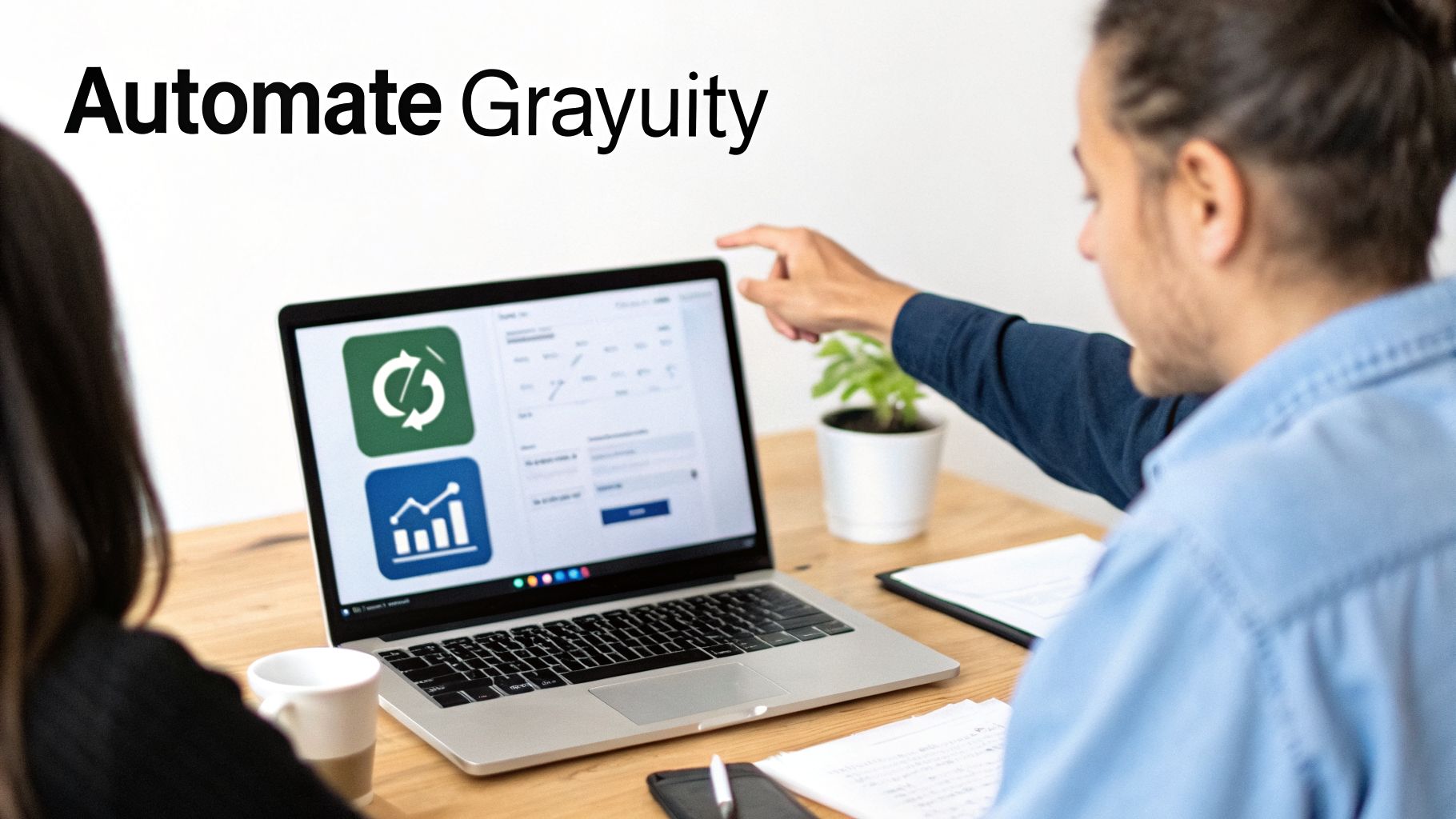
If you are still relying on spreadsheets to calculate end-of-service gratuity, you are not just creating extra work—you are exposing your business to unnecessary financial risk. For any business leader in the UAE, the complex rules mean that a small formula error can snowball into a significant liability.
Moving to an automated system is a strategic shift towards financial integrity. It guarantees that your calculations are always aligned with UAE Labour Law, reduces the administrative burden on your HR team, and provides a solid audit trail for financial reporting. With automation, accuracy is no longer the goal; it becomes the standard.
The Power of a Truly Integrated System
The real value is realized when your HR and Payroll system communicates directly with your accounting general ledger. This creates a single source of truth for all employee-related liabilities. It’s precisely this seamless integration where a system like Hinawi ERP, developed in Abu Dhabi since 1998, proves its worth.
An integrated platform delivers tangible benefits:
- Built-in Compliance: The system is pre-configured with the nuances of UAE Labour Law, including the 21/30-day tiered system and the two-year salary cap. Every calculation is correct by default.
- Lighter HR Workload: Automation frees your HR team to focus on strategic initiatives instead of being bogged down by manual data entry and calculation checks.
- Accurate Financials, Always: Real-time data synchronization ensures your financial statements consistently reflect the precise liability for end-of-service benefits.
This level of accuracy is especially critical for businesses with large asset bases, such as manufacturing plants and real estate firms across the GCC, where correctly accruing liabilities is fundamental to financial stability.
From the Field: We consulted for a Dubai real estate firm that struggled with their quarterly reports because their gratuity liability was a rough estimate. After implementing an integrated HR and accounting system, they could automatically accrue the exact liability for over 200 employees every month. Their balance sheet became a source of confidence, not anxiety.
From Simple Calculation to Total Financial Control
Automating how you calculate end of service in UAE elevates the process from a tedious payroll task to a function of robust financial management. With a connected ERP system, it becomes a proactive, automated workflow. When an employee’s record is updated in the HR module—a salary increase or a period of unpaid leave—the gratuity liability in the accounting ledger adjusts instantly.
This seamless flow of information is critical. In Hinawi ERP, for example, the HRMS and Accounting modules are not just linked; they are designed as a single, cohesive unit. This approach eliminates the data silos that cause so many errors when using separate software. Modern tools for AI-powered financial analysis can further validate data and flag anomalies, providing even greater confidence.
If your current process creates unnecessary risk and manual work, it may be the perfect time to modernise your approach and gain genuine control over your financial data.
Ready to see how automation can transform your financial operations? An integrated ERP solution provides the control and accuracy needed to manage complex payroll requirements like end-of-service calculations with confidence.
Chat on WhatsApp +971506228024 Quotation – Demo Request Chat with Hinawi AITake the Next Step with Hinawi ERP
Mastering how to calculate end of service in the UAE is a complex but non-negotiable task. The process is loaded with legal nuances where simple mistakes can lead to significant financial penalties and damage employee relations. For any business in the UAE and GCC, relying on spreadsheets for such a critical function is a high-risk strategy. This is where dedicated, regionally-focused software becomes an essential asset.
Hinawi ERP is the solution. Developed in Abu Dhabi since 1998, our fully integrated ERP software is built from the ground up for the GCC market. We have unified Accounting, HR & Payroll, Real Estate Management, Fixed Assets, Manufacturing, and more into a single, cohesive platform designed to eliminate manual work, enforce compliance, and provide complete business automation.
A Solution Built for the UAE and GCC Markets
We designed Hinawi ERP to solve the real-world operational challenges that companies in our region face daily.
- VAT and E-Invoicing Compliance: Our system is fully compliant with regional tax regulations, ensuring your business meets all VAT and e-invoicing requirements without manual effort.
- UAE WPS Payroll Support: Hinawi ERP includes built-in support for the UAE's Wage Protection System (WPS), streamlining payroll processing and guaranteeing compliance.
- Bilingual Operation: The entire platform operates seamlessly in both Arabic and English, catering to the diverse workforce in the GCC.
- Flexible Policy Settings: Configure company policies, from leave rules to gratuity parameters, to match your specific operational needs.
- Real-Time Accounting Integration: The Hinawi HR and Payroll module posts data directly to the accounting ledger in real-time. This eliminates data silos and ensures liabilities like end-of-service gratuity are always accurately accrued and visible on your financial statements.
- Industry-Specific Solutions: Hinawi ERP is suitable for a wide range of industries, including factories, contracting companies, real estate businesses, schools, garages, trading companies, and manufacturers.
By modernizing your operations with Hinawi ERP, you can reduce manual work, improve financial accuracy, and gain better control over your entire management process.
Our Expert Take: Stop gambling with outdated methods. Modernising your back-office operations isn't just about efficiency; it's about gaining a genuine competitive edge through financial control and compliance.
It's time to move beyond manual calculations and gain full visibility over your business. See how Hinawi ERP can make a real difference in your operations.
Visit www.hinawierp.com to learn more or request a personalized demo to speak with our Abu Dhabi-based consultants.