
Trying to manage your team in a growing UAE company with just spreadsheets? That’s more than just inefficient; it’s a serious business risk. For any company in Dubai, Abu Dhabi, or across the GCC with ambitions to scale, a modern HR software UAE solution isn’t just an administrative extra. It's the digital backbone for your most important asset: your people. As an ERP solution developed in Abu Dhabi since 1998, Hinawi ERP provides a practical framework for achieving this operational excellence.
Chat on WhatsApp +971506228024 Quotation – Demo Request Chat with Hinawi AIWhy Integrated HR Software is a Necessity in the UAE
The UAE's fast-paced business environment comes with its own set of operational hurdles. You’re not just managing a diverse workforce; you're doing it while navigating strict labour laws, especially the Wage Protection System (WPS), which demands absolute accuracy. Manual methods and patched-together systems just can't keep pace, opening the door to expensive mistakes and compliance headaches.
Picture a contracting company in Abu Dhabi juggling multiple projects. Their HR team is buried for days, manually calculating payroll for hundreds of workers, trying to track their leave, and then painstakingly preparing SIF files for WPS. One slip-up in data entry could mean salary delays, unhappy employees, and steep government fines. This isn't just a worst-case scenario; it's the day-to-day reality for too many businesses still clinging to outdated spreadsheets.
A proper HR system shifts your business from constantly putting out fires to proactively managing your team. It automates compliance, clears administrative bottlenecks, and gives you the clear line of sight you need to make smart, strategic decisions.
The Hidden Costs of Manual HR Management
The real price of managing HR manually goes way beyond what you pay your admin staff. It’s measured in lost productivity, compliance penalties, and flawed workforce planning. An integrated HR software UAE solution directly tackles these critical pain points:
- WPS Compliance Failures: Instead of wrestling with manual file creation, the system automatically generates WPS-compliant salary files. This all but eliminates human error, guaranteeing your team is paid accurately and on time, meeting all Ministry of Human Resources and Emiratisation (MOHRE) rules.
- Administrative Overload: Think of all the hours spent on tasks like tracking leave balances, sending alerts for expiring passports or visas, and managing employee documents. Automation hands those hours back to your HR team, freeing them to work on what truly matters—like talent development and keeping your staff engaged.
- Data Silos and Inaccuracy: When your HR and accounting data live in separate worlds, financial reporting becomes a nightmare of manual data checking. An integrated system, like the HR & Payroll module inside Hinawi ERP, posts all payroll expenses directly to the general ledger in real-time. This creates a single, reliable source of financial truth for your entire business.
Ready to see how an ERP developed right here in the UAE can solve these exact challenges? Learn more about our approach by checking out this detailed comparison of Hinawi ERP vs. other ERPs.
Bringing your HR function into the modern era with a dedicated system is a direct investment in your company's stability and growth. It gives you the tools to manage your workforce effectively, reduce risk, and build a solid foundation for long-term success in the competitive UAE market.
Chat on WhatsApp +971506228024 Quotation – Demo Request Chat with Hinawi AIWhat to Look For: The Core Features of a Great UAE HR System
When you’re looking at HR software in the UAE, it’s easy to get lost in a long list of features. But the real goal isn’t about ticking boxes—it’s about finding a system that solves genuine business headaches and strengthens your operations. A good platform should be the reliable hub for everything related to your people.
Let’s break down the features that truly matter for any business operating here, focusing on what they actually do for you.
Automated Payroll with Built-in WPS Compliance
Let’s be honest: manual payroll is probably the single riskiest administrative task your business handles. One mistake can cause a ripple effect of incorrect salaries, unhappy employees, and potentially hefty fines from the Ministry of Human Resources and Emiratisation (MOHRE).
This is why the number one, non-negotiable feature has to be automated payroll that includes flawless Wage Protection System (WPS) integration. A solid system does more than just basic salary calculations. It must handle the tricky stuff—overtime, specific allowances, and various deductions—all based on your company policies and UAE Labour Law.
Think about a construction company in Dubai with over 300 workers on different pay grades. Manually creating the SIF file for WPS every month is a stressful, multi-day job where a single error can halt the entire process. A properly integrated system, like Hinawi ERP, does this automatically, creating a 100% accurate, compliant file in minutes. This means salaries are paid on time, every time, and the risk of penalties is virtually eliminated.
Seamless Attendance and Leave Management
Tracking who’s in, who’s out, and who’s on leave can easily become a full-time job for your HR team. Without a central system, managers are often flying blind, and trying to calculate leave balances by hand is a recipe for errors.
A robust attendance and leave management module is absolutely essential. It should give you:
- Flexible Policies: The power to set up your specific rules for every leave type—annual, sick, unpaid, you name it—and automate how leave is earned based on an employee's service.
- Real-Time Tracking: The ability to connect with biometric scanners or mobile apps to get accurate attendance data as it happens.
- Simple Approvals: A straightforward process for employees to request time off and for managers to approve it, with leave balances updating instantly.
This kind of automation turns leave management from a major headache into a clear, efficient process that everyone understands. You can see how these pieces fit into a bigger picture by exploring the different software modules in Hinawi software.
Employee Self-Service (ESS) Portals
An Employee Self-Service (ESS) portal is one of the smartest ways to boost efficiency and give your team more ownership. It’s a secure, central place where staff can find their own information and handle basic HR tasks, which dramatically cuts down the admin work for your HR department.
Instead of your HR manager answering the same questions all day, an ESS portal lets your employees:
- View and download their payslips whenever they need them.
- Submit leave requests and see their remaining balance.
- Update their own personal details, like a new phone number or bank account.
- Find important company documents, like policies or handbooks.
This doesn't just give your HR team their time back; it also makes your data more accurate because employees are responsible for keeping their own information current.
Chat on WhatsApp +971506228024 Quotation – Demo Request Chat with Hinawi AIThe table below summarises how these core modules directly impact a business in the UAE, helping you see the clear return on your investment.
Core HR Software Modules and Their Business Impact
| Module | Primary Function | Key Business Benefit in the UAE |
|---|---|---|
| Payroll & WPS | Automates salary calculations and generates WPS-compliant files. | Guarantees compliance with MOHRE, avoids hefty fines, and ensures timely salary payments. |
| Attendance & Leave | Tracks employee hours and manages all leave requests and accruals. | Provides accurate data for payroll, improves workforce planning, and reduces administrative overhead. |
| Employee Self-Service | Allows staff to access payslips, request leave, and update personal data. | Empowers employees, reduces HR queries, and improves the accuracy of employee records. |
| Reporting & Analytics | Gathers HR data and presents it in easy-to-understand reports. | Offers strategic insights for budgeting, identifying turnover trends, and making informed decisions. |
Ultimately, a system with these features doesn't just manage HR; it gives you the control and clarity needed to run your business more effectively.
Insightful Reporting and Analytics
Finally, a modern HR software UAE solution has to do more than just process transactions—it needs to give you insight. Good reporting and analytics tools turn all that raw HR data into clear information you can actually use to make smart business decisions.
A great system will often incorporate features found in a modern talent management system software to help you get the most out of your team. As a decision-maker, you need to be able to pull reports on crucial metrics like employee turnover rates, payroll cost breakdowns, departmental headcount, and absence patterns. This is the information you need for strategic workforce planning, creating realistic budgets, and spotting trends before they become problems.
Mastering Compliance with WPS and UAE Labour Law
Running a business in the UAE means compliance isn't just a box to tick—it's woven into the very fabric of your daily operations. And when it comes to the Wage Protection System (WPS), simply being aware of it isn’t enough. The real goal is to make compliance an automatic, error-free outcome of your HR process, not a monthly scramble. The right HR software UAE solution gets you there.
A truly effective system does more than just give a nod to WPS. It automates the entire process from the ground up. This means the software generates the required Salary Information File (SIF) in the exact format the Central Bank of the UAE demands, every single time, without anyone needing to touch it manually.
Even better, it validates your payroll in real time. Before any file is created, the system cross-references every calculation against the employee’s contract, leave balance, and attendance records. It’s a completely self-contained loop that catches mistakes before they ever become a compliance issue.
Creating a Rock-Solid Audit Trail
One of the biggest advantages of a modern HR system is the bulletproof audit trail it creates. Every salary calculation, every deduction, and every payment is automatically logged and time-stamped. This gives you undeniable proof that you're meeting your obligations.
Think about how crucial that is during an audit or an employee dispute. Instead of digging through folders or trying to make sense of clashing spreadsheets, you can instantly pull up a clear, detailed history for any employee.
Let's look at a common scenario.
A trading company in Dubai is facing a routine VAT audit. The auditor starts asking questions about the payroll expenses being claimed. Because they use separate systems for HR and accounting, the finance team is thrown into chaos. They’re stuck trying to manually match payroll reports to bank transfers and general ledger entries—a nightmare process just waiting for errors.
Now, imagine that same company was using an integrated ERP like Hinawi. The HR manager simply generates a report. Since the HR & Payroll module automatically posts every expense to the general ledger, the data is perfectly synchronised. The records are clean and irrefutable, showing a direct link between what was paid and what was recorded. That's the kind of confidence you get from integrated compliance. If you're curious about the nuts and bolts of how this works, our guide on what payroll truly entails breaks it down further.
Having that seamless connection is fundamental to protecting your financial integrity and staying prepared for any regulator's questions.
Chat on WhatsApp +971506228024 Quotation – Demo Request Chat with Hinawi AIThe Critical Link Between HR and Finance
Compliance doesn't stop with WPS; it's also about financial accuracy, especially with VAT in the picture. In the UAE, every single business expense needs to be recorded perfectly. Since payroll is usually your biggest expense, a disconnect between your HR and finance teams is a major risk.
This is why any worthwhile HR software UAE solution must have a built-in, real-time bridge to your accounting module. When they talk to each other, you get:
- Accurate Cost Posting: All payroll costs—from basic salaries and allowances to end-of-service provisions—are automatically logged in the correct general ledger accounts. No manual data entry needed.
- Airtight VAT Filings: When your costs are recorded correctly, your financial statements are accurate. This accuracy is the foundation for filing your VAT returns correctly and with confidence.
- No More Data Silos: When HR and finance are on the same page (and the same platform), you eliminate the dangerous gaps and conflicting information that cause reporting headaches.
This kind of integration doesn't just make the HR team's life easier. It turns HR into a function that actively protects the company's financial health and regulatory standing.
On-Premise vs. Cloud: Where Should Your HR Software Live?
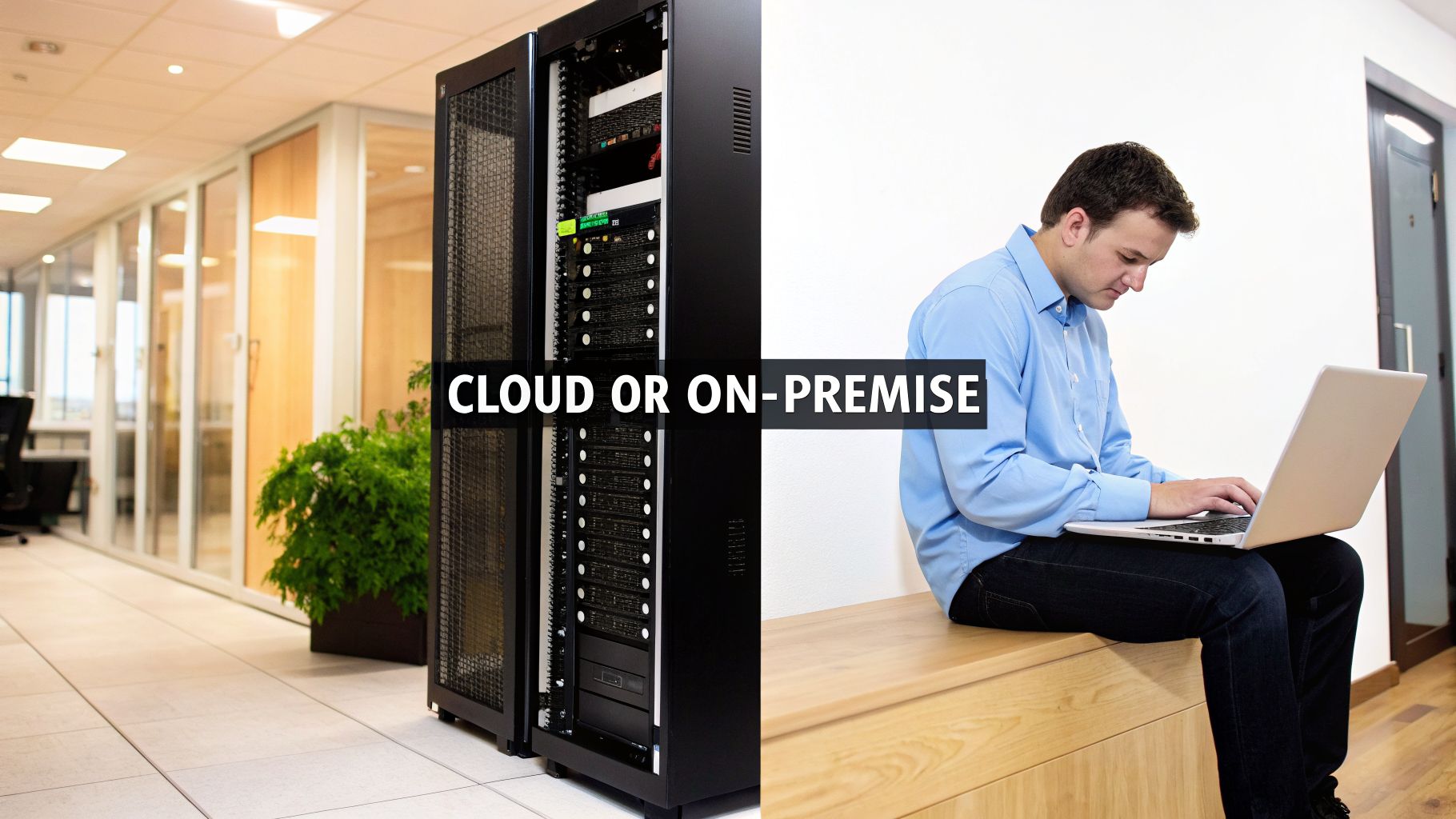
When choosing an HR software in the UAE, one of the first big questions you'll face is where it will be hosted. This isn't just a technical detail—it's a strategic decision that affects your budget, security, and day-to-day operations. Here in the UAE and across the GCC, where keeping sensitive data in-house is often a top priority, this choice is especially important.
The Case for On-Premise Solutions
For many well-established businesses, particularly in sectors like contracting, manufacturing, or government services, the on-premise model has long been the gold standard. It’s straightforward: the software runs on your own servers, located at your physical premises. This gives you absolute control over your confidential employee data.
Think of it as owning your own house versus renting an apartment. You have complete ownership and can modify it however you see fit.
This is where on-premise truly shines: its capacity for deep customisation. A factory in Abu Dhabi, for example, might have very specific rules for overtime and complex shift patterns. An on-premise system like Hinawi ERP can be tailored to match these unique workflows perfectly—a level of flexibility that many one-size-fits-all cloud systems just can't offer.
Financially, this model usually involves a one-time capital expenditure (CAPEX) for the software license, followed by annual maintenance fees. Many organisations prefer this predictable cost structure, as they own the asset outright instead of paying a recurring subscription.
The Flexibility of Cloud-Based Solutions
On the other hand, cloud-based software, often called Software-as-a-Service (SaaS), has become incredibly popular, especially with startups and companies with teams spread across different locations. The appeal is all about accessibility and scalability. A consulting firm with staff in Dubai, Riyadh, and working from home can all log into the same HR platform with nothing more than an internet connection.
This approach flips the cost model from a large upfront payment to a predictable operational expenditure (OPEX), typically a monthly or annual subscription. The vendor takes care of all the behind-the-scenes work—infrastructure, security updates, and maintenance—which frees up your IT team to focus on other priorities. You can see how this works in practice, as Hinawi Online ERP lets you access your business anywhere.
On-Premise vs. Cloud HR Software: A UAE Business Perspective
So, which one is right for you? There's no single correct answer. The best model depends entirely on your industry, security requirements, budget, and future growth plans. To help you decide, we've broken down the key differences from the perspective of a business operating in the UAE.
| Factor | On-Premise HR Software (e.g., Hinawi ERP) | Cloud-Based HR Software (SaaS) |
|---|---|---|
| Data Control & Security | You have full control over data stored on-site. This is often preferred by businesses with strict data sovereignty policies. | Your data is stored on the provider's servers. You are relying on their security measures and protocols. |
| Customisation | Offers a high degree of customisation to match your specific company policies and unique operational workflows. | Customisation is generally limited to the configuration options available within the platform itself. |
| Cost Structure | Primarily a one-time capital expenditure (CAPEX) for licenses, with ongoing fees for maintenance and support. | An operational expenditure (OPEX) model with recurring monthly or annual subscription fees. |
| Accessibility | Access is typically within the company network, though secure remote access can be set up via a VPN. | Accessible from anywhere with an internet connection, making it ideal for remote and hybrid teams. |
| Implementation & IT | Requires your own IT infrastructure and internal resources to manage servers, updates, and maintenance. | Minimal IT overhead. The vendor handles all infrastructure, updates, and technical maintenance. |
Ultimately, a good software provider should be able to offer a solution that fits your preference, whether it's on-premise or in the cloud. By understanding these fundamental differences, you can confidently choose the deployment model that truly aligns with your company's reality and long-term vision.
How to Select the Right HR Software Partner in the UAE
Picking a new HR software solution for your UAE business isn’t just about ticking off features on a list. Think of it as entering a long-term partnership. The right provider becomes an extension of your team—a consultant and a support system, not just a software seller. Your search should focus less on generic sales pitches and more on finding a partner who genuinely understands the unique landscape of the GCC market.
While a general guide to Top HRIS Platforms can give you a starting point, choosing a partner for your UAE operations requires a much more specific set of criteria. Here’s what really matters.
Assess Local Presence and Support
Let's be honest: when you have a critical payroll issue on a Wednesday afternoon, the last thing you want is an international call centre in a different time zone. This is where a local presence becomes invaluable.
Look for a vendor with an actual office and a consulting team on the ground in cities like Abu Dhabi or Dubai. This means you get access to experts who work on your schedule, understand the local business culture, and can even provide on-site help when things get complicated. A local team offers practical, timely support that a remote-only provider simply can't match.
Prioritise Deep Industry Expertise
A one-size-fits-all HR system might cover the basics, but businesses here have specific, complex needs. Your software partner should have a proven track record working with companies in your industry.
Take a growing real estate firm in Abu Dhabi, for instance. Their payroll isn't just about processing monthly salaries. It involves complicated commission structures tied to property sales that have to be calculated perfectly, every single time. For them, an effective HR software UAE solution must also integrate smoothly with their property management and accounting systems.
A specialist vendor like Hinawi ERP already understands these intricate workflows because they’ve built their software around them. That deep industry knowledge is baked right in, creating a single, reliable source of information that a generic system could never hope to offer.
Chat on WhatsApp +971506228024 Quotation – Demo Request Chat with Hinawi AIVerify True Scalability and Integration
Your business is going to grow, and your HR software has to keep up. Real scalability isn't just a buzzword; it means the system can handle more employees, more complex policies, and a higher volume of transactions without slowing down.
Just as crucial is how well the system plays with others. An HR platform that operates in a silo creates more work, not less. Ask the tough questions about integration:
- Accounting: Does payroll data flow automatically into the general ledger, or will my team be stuck doing manual entries?
- CRM: Can sales commissions be pulled from our CRM and calculated directly in payroll?
- Manufacturing: Is it possible to track labour costs and assign them to specific production jobs?
A partner offering a fully integrated suite isn't just selling you software; they're investing in your entire business's efficiency. This holistic approach ensures data moves freely across departments, which eliminates tedious manual work and gives you a clear, unified picture of your operations.
In the end, choosing the right HR software partner is about finding a provider who gets your local context, speaks your industry's language, and delivers a platform built to support your ambitions for years to come.
Take the Next Step with Hinawi ERP
We’ve walked through the unique complexities of managing HR in the UAE, from the non-negotiable demands of the WPS to the nuances of regional leave policies. It’s clear that sticking with outdated methods isn’t just inefficient—it’s a business risk. This is where having a partner who genuinely understands the local landscape makes all the difference.
Hinawi ERP isn't just another software. We've been building our solution right here in Abu Dhabi since 1998, crafting a fully integrated system designed from the ground up for the realities of business in the UAE and the wider GCC. It’s a single, central hub for everything you do, covering Accounting, HR & Payroll, Real Estate Management, Fixed Assets, Manufacturing, Garage & Maintenance, School Management, CRM, and complete business automation.
Choosing Hinawi means you can modernize your operations, reduce manual work, improve financial accuracy, and gain better control over your management. Our system provides:
- VAT and e-Invoicing compliance to keep you aligned with regional regulations.
- UAE WPS payroll support for guaranteed accuracy and timeliness.
- Arabic and English bilingual operation for a seamless user experience.
- Flexible company policy settings to match your unique operational rules.
- Real-time accounting integration across all modules for a single source of financial truth.
- Suitability for diverse sectors, including factories, contracting companies, real estate businesses, schools, garages, trading companies, and manufacturers.
Whether you're running a factory in Dubai, a contracting firm in Saudi Arabia, a real estate agency in Abu Dhabi, or a school anywhere in the GCC, it’s time to stop the manual grind and get a firm grip on your operations. Let us show you how you can make smarter, data-driven decisions with complete confidence.
Our Abu Dhabi-based consultants are ready to discuss your specific challenges and demonstrate how Hinawi ERP can help you achieve your business goals. Visit www.hinawierp.com or request a personalized demo today.
Chat on WhatsApp +971506228024 Quotation – Demo Request Chat with Hinawi AIFrequently Asked Questions About HR Software UAE
When you're thinking about moving to a new HR system in the UAE, a lot of practical questions naturally come up. It’s a big move, after all. Business owners and HR managers want to know exactly what they’re getting into. Here are some of the most common questions we hear—and our straight-to-the-point answers.
How Long Does HR Software Implementation Take in the UAE?
This is probably the most-asked question, and the honest answer is: it depends. The timeline really hinges on the complexity of your business. For a small or medium-sized company with pretty standard needs, we can often get the system up and running in just a few weeks. That usually covers getting your basic employee files moved over, setting up payroll, and configuring your leave policies.
On the other hand, if you're a large enterprise with thousands of employees, you’re looking at a more involved process. A big contracting firm or a manufacturer, for instance, might need deep customisation and have years of historical data to migrate. A full-scale project like that could take a few months to make sure every single workflow is mapped correctly and all the data is clean.
The real secret isn't the software itself—it's the team putting it in place. A good, local implementation partner who really gets your business will manage the entire project. They'll handle everything, making the switch as smooth as possible with little to no disruption to your daily work.
Can the Software Handle Complex UAE Gratuity and Leave Calculations?
Yes, absolutely. In fact, this is one of the main reasons you'd choose a system designed specifically for the UAE market. A generic international platform often stumbles over the unique rules in the UAE Labour Law, but a proper, localised HR software UAE solution is built from the ground up to handle them perfectly.
Take a system like Hinawi ERP. It’s designed to let you set very specific rules for things like:
- End-of-Service Benefits: It automatically works out the correct gratuity based on an employee's contract type, length of service, and final salary. No more manual spreadsheets or worrying about compliance.
- Leave Accruals: You can customise how annual leave is earned and carried over, matching your exact company policy while staying within the law.
- Air Ticket Allowances: The system can track eligibility and manage provisions for employee air tickets automatically.
Having this level of detail built-in takes the guesswork out of the equation. You can be confident that every calculation is right on the money and fully compliant, every single time.
How Secure Is Our Employee Data with a Local HR Software Provider?
Protecting your team's sensitive information is non-negotiable. When you partner with a local provider, you actually get some key security advantages.
For example, on-premise solutions give you the ultimate level of control. All your data lives on your own physical servers, right in your office. You’re in charge of the security environment from top to bottom. For many organisations in the GCC, especially those with strict data sovereignty rules, this is the preferred way to go.
Even with cloud options, reputable local providers know how critical data protection is. They build their platforms on secure foundations and understand the local compliance landscape inside and out. Having a local partner means you know exactly who is responsible for your data's security—a level of transparency and accountability that can be much harder to find with a faceless overseas vendor.